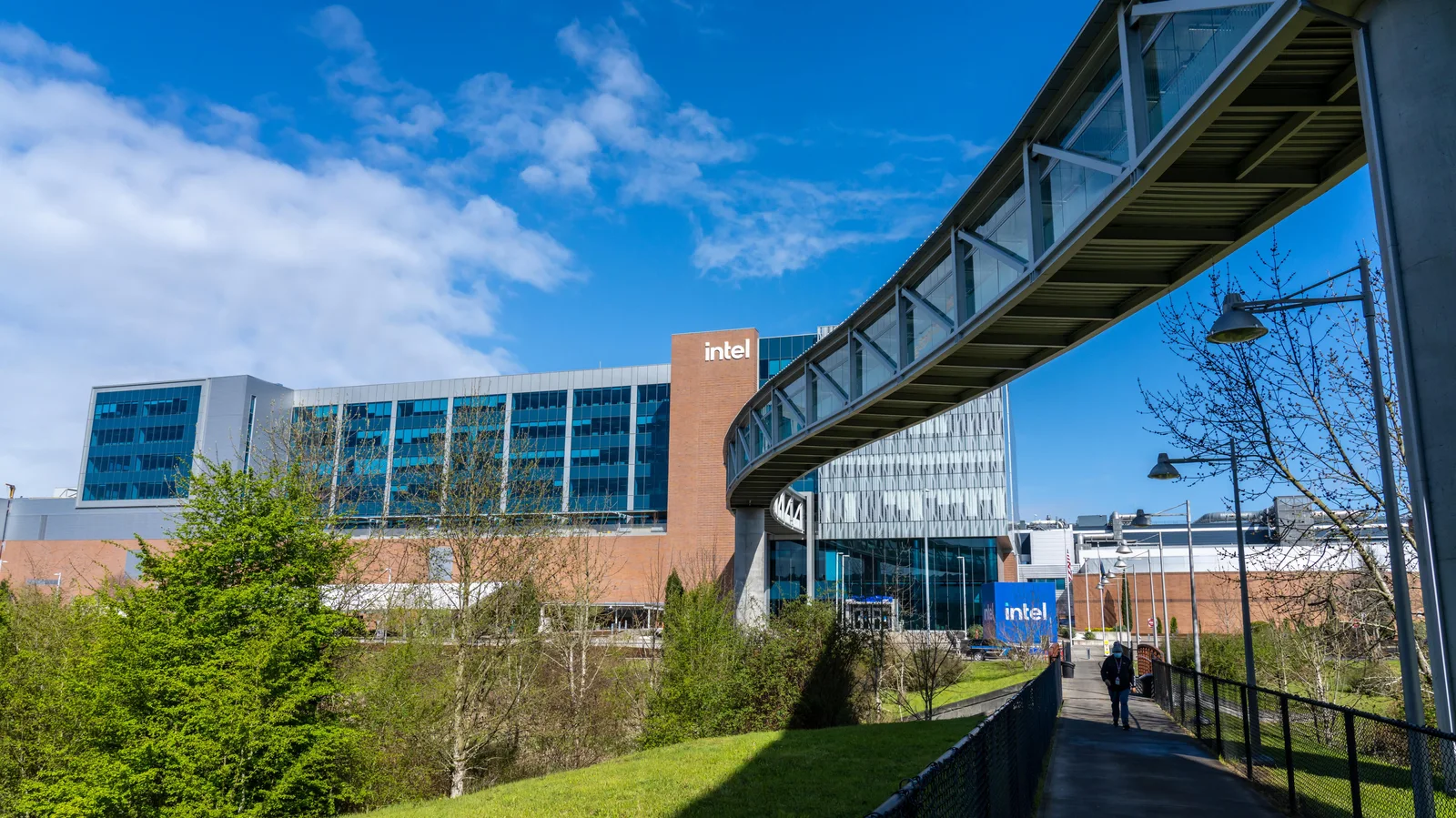
On October 30, 2026, Intel lost nearly 29% of its market value despite reporting strong revenue growth the previous day. Behind this historic sell-off lies a deeper contradiction: one of the pioneers of the semiconductor industry is benefiting from the global expansion of artificial intelligence, yet continues to struggle to translate that demand into lasting industrial and financial strength. Its future now depends as much on its manufacturing capabilities as on its ability to reclaim a position in an industry whose rules it once helped establish.
Growth Is No Longer Enough
There was a time when a 21% increase in revenue would have been sufficient to reassure investors in a major semiconductor manufacturer. For Intel, on October 30, 2026, it failed to prevent one of the most punishing trading sessions in the company's history.
The American group had nevertheless reported quarterly revenue of $16.5 billion, accompanied by a remarkable 78% increase in its data center and artificial intelligence business. Revenue from that segment reached $7.3 billion, confirming that Intel retained an important position in the computing infrastructure supporting the expansion of AI.
But financial markets looked beyond those figures. Their attention focused primarily on the considerably weaker outlook for the fourth quarter. Intel expects revenue of between $15 billion and $16 billion and adjusted earnings per share of $0.25, compared with $0.52 in the third quarter. These projections come alongside persistent manufacturing capacity constraints, a weakening personal computer market, and substantial investment requirements.
Intel shares ended the Friday, October 30 session down 28.58%, at approximately $65.76. The market's reaction therefore reflected not an absence of growth, but growing doubts about its quality, sustainability and, above all, its ability to generate sufficient cash.
This distinction is fundamental. A company can report substantial revenue growth while its strategic position deteriorates if the investments required to sustain that growth increase faster than the resources it can generate.
Intel finds itself at the center of precisely this contradiction.
From Industry Leader to a Company in Recovery
Understanding Intel's current position requires returning to the foundations of its former strength.
Founded in 1968 by Robert Noyce and Gordon Moore, who were soon joined by Andy Grove, Intel helped shape the modern microprocessor industry. With the introduction of the 4004 in 1971, followed by the development of x86 architectures, the company contributed to establishing the technological foundations of personal computing.
The partnership between Intel processors and Microsoft's operating systems subsequently created one of the most powerful industrial ecosystems in technological history. For several decades, Intel occupied an exceptional position: it designed its own processors, controlled their manufacturing and exercised considerable influence over industry standards.
This integration represented a major competitive advantage. Simultaneous control over architecture, design and production allowed Intel to optimize performance, manage costs and maintain a pace of innovation that competitors struggled to match.
But the model depended on one demanding condition: preserving a sufficient technological lead in semiconductor manufacturing.
Over time, that advantage eroded.
Difficulties in transitioning to new manufacturing processes slowed product development. Meanwhile, the industry increasingly moved toward specialization between companies that designed chips and those that manufactured them.
This transformation facilitated the rise of Taiwan Semiconductor Manufacturing Company, which became the world's leading manufacturer of advanced semiconductors for external customers, while AMD regained technological and commercial competitiveness against Intel.
The emergence of smartphones, followed by the acceleration of artificial intelligence, further shifted the industry's centers of gravity. Intel, once indispensable to personal computing, never achieved an equivalent position in mobile processors or AI accelerators.
The company that had helped define computing in the twentieth century consequently found itself confronting a twenty-first-century industry organized around different architectures, applications and dominant players.
Artificial Intelligence: An Incomplete Opportunity
The expansion of artificial intelligence might have appeared to offer Intel an ideal opportunity for recovery. It has indeed become an important source of growth, but it has also exposed the limitations of the company's competitive position.
Modern data centers do not depend on a single category of processor. They combine central processing units, specialized accelerators, high-performance memory, networking equipment and storage systems. Their operation relies on complex architectures in which each component performs a distinct function.
Intel retains a substantial presence in the server CPU market, particularly through its Xeon product line. These processors remain essential to numerous computing workloads, including those performed within infrastructure supporting artificial intelligence systems.
However, the market for specialized accelerators used to train and run large AI models is dominated by other companies, most notably Nvidia. The latter has established an advantage extending beyond the performance of its chips, supported by its software ecosystem, interconnect technologies and the integration of its solutions into the infrastructure of major technology operators.
AMD, meanwhile, continues expanding its presence in server processors and accelerators, while major cloud providers invest in their own chip architectures.
Intel's 78% growth in data center revenue therefore does not mean that the company has regained a dominant position across the entire artificial intelligence economy. It primarily reflects strong demand for its server processors in a market where general-purpose computing remains essential.
This distinction explains part of the current paradox. Intel benefits from a worldwide technological transformation without necessarily controlling the segments capturing the highest margins.
And when demand increases faster than available manufacturing capacity, growth itself becomes a source of pressure.
Producing More, but at What Cost?
Intel's difficulties are not limited to competition. They also arise from the structure of its industrial operations.
Manufacturing advanced semiconductors requires extraordinarily expensive facilities, highly precise equipment, specialized expertise and continuous investment in production processes. Profitability depends not only on manufacturing volumes, but also on production yields, factory utilization and the speed at which new technologies become commercially viable.
Unlike Nvidia or AMD, which outsource most of their manufacturing to specialized partners, Intel continues to bear a substantial share of these industrial constraints directly.
This approach offers strategic advantages. It allows the company to retain technological control, secure certain production capabilities and eventually provide manufacturing services to other chip designers. But it also imposes exceptionally high capital requirements.
Intel's third-quarter 2026 results illustrate this ambiguity.
Intel Foundry, the group's manufacturing division, reported segment revenue of $6.7 billion, an increase of 58% year over year. Yet this figure does not represent an equivalent volume of sales to independent customers. A substantial portion of the division's revenue comes from internal transactions that are eliminated when the group's financial statements are consolidated.
The reported growth therefore cannot be interpreted as evidence that Intel has already become a major commercial competitor to TSMC in the open foundry market.
The company must still demonstrate its ability to attract external customers over the long term, manufacture their components at competitive yields and secure sufficient production volumes to make its facilities profitable.
The situation is further complicated by supply constraints extending beyond semiconductor factories themselves. Substrates used in advanced packaging, memory components and other critical materials also represent sources of pressure.
Intel has acknowledged that it cannot fully meet demand for certain server processors. At the same time, rising memory costs are contributing to weakness in the personal computer market.
The company is consequently experiencing two opposing effects from the expansion of AI: exceptional demand for some of its chips and indirect pressure on traditional markets that continue to support its business.
The PC Market: A Weakened Foundation
Personal computing remains an essential market for Intel. Yet this segment is experiencing a difficult period.
In the third quarter of 2026, revenue from the Client Computing and Physical AI business declined 5% year over year to $8.1 billion. This contraction occurred even as global computing requirements continued to expand.
The paradox is only apparent. Growth in digital investment is increasingly concentrated in infrastructure, data centers and specialized systems, while equipment purchased by consumers and businesses faces different economic constraints.
Higher memory prices increase the cost of computers. Manufacturers adjust their orders, companies sometimes extend the useful lives of existing equipment, and consumers become more sensitive to prices.
These developments are unfolding in a competitive environment that has also changed. AMD now offers a competitive processor portfolio, while Arm-based architectures have progressively demonstrated their ability to meet a growing range of computing requirements.
Intel can therefore no longer regard the PC market as a sufficiently stable revenue foundation to absorb the investments required for its transformation without difficulty.
The group must finance its industrial recovery at the very moment when one of its principal historical markets is showing signs of weakness.
This combination is arguably one of the most challenging features of its current position.
The Return of the State to the Semiconductor Industry
Intel's difficulties extend beyond the company itself. They form part of a major geopolitical transformation.
For several decades, the semiconductor industry developed according to a logic of international specialization. The United States retained dominant positions in chip design, software and certain critical technologies, while a substantial share of advanced manufacturing became concentrated in Asia, particularly Taiwan and South Korea.
This model generated significant efficiency gains, but it also created strategic dependencies.
Technological rivalry between Washington and Beijing, tensions surrounding Taiwan and the growing importance of semiconductors for military systems and artificial intelligence have fundamentally changed how these dependencies are perceived.
The ability to manufacture advanced chips on American soil has become an economic and national security objective.
Intel occupies a distinctive position within this strategy. The company represents one of the few opportunities for the United States to preserve a domestic capability for manufacturing leading-edge logic chips under the control of an American enterprise.
Public support measures for the industry, particularly those introduced under the CHIPS Act, together with the US federal government's acquisition of an equity stake in Intel in 2025, demonstrate this strategic dimension.
But public intervention does not eliminate economic constraints.
Financial support can help preserve investment, reduce certain risks or accelerate infrastructure development. It does not guarantee manufacturing yields, customer acquisition or the long-term competitiveness of technological processes.
Intel consequently stands at the intersection of two objectives that are sometimes difficult to reconcile. For American policymakers, the company represents a strategic industrial capability that must be preserved. For investors, it remains a publicly traded corporation whose expenditures must eventually generate sufficient financial returns.
These objectives are not inherently incompatible. Their timelines, however, can diverge considerably.
Industrial sovereignty is built over decades. Financial markets reassess expectations with every earnings release.
Capital Is No Substitute for Competitiveness
Intel's transformation requires substantial financial resources.
The group has notably announced a $23 billion public equity offering intended to support its growth prospects while preserving balance sheet strength and its credit rating.
The transaction illustrates the scale of the financial requirements associated with its strategy. It also demonstrates that an industrial company may need to raise capital even when some of its businesses are experiencing strong growth.
The challenge is not simply to secure the funds needed to construct additional capacity. It is to ensure that this capacity can subsequently generate sufficient revenue and margins to justify its cost.
In the semiconductor industry, expenditure is committed long before the corresponding revenue is guaranteed. Facilities can require several years of development, while technologies evolve rapidly and decisions by major customers can fundamentally alter commercial prospects.
A scheduling error, technological delay or manufacturing yield below expectations can therefore weigh on profitability for years.
Intel must also continue investing in an environment where competitors are not slowing down. TSMC continues developing advanced manufacturing capacity, Samsung is seeking to strengthen its industrial position, and chip designers are multiplying specialized architectures.
Access to capital is therefore a necessary condition for Intel's recovery, but it cannot guarantee success.
The company must convert its investments into measurable industrial advantages, and then transform those advantages into contracts, margins and cash flow.
That is precisely the conversion investors are now waiting to see.
An Industry Confronting Its Own Contradictions
Intel's collapse occurred amid broader investor skepticism toward spending on artificial intelligence.
On October 30, the Nasdaq declined 2.86%, while several major semiconductor manufacturers also recorded substantial losses. AMD fell nearly 11%, Nvidia approximately 4.2%, and the US semiconductor sector index dropped more than 7%.
These movements do not mean that the technological prospects of artificial intelligence suddenly deteriorated. Rather, they reflect growing questions about the pace of investment and its future profitability.
Major technology companies are committing enormous sums to building data centers, acquiring processors, developing networks and expanding energy infrastructure. These expenditures directly support the revenues of hardware suppliers.
But they must eventually be financed by applications and services capable of generating sufficient economic returns.
The value chain is therefore experiencing a new tension: one company's capital expenditure becomes another company's revenue, without automatically guaranteeing the ultimate profitability of the entire system.
Intel occupies a particularly revealing position within this configuration.
The group benefits from infrastructure demand but must simultaneously invest heavily to remain competitive. It enjoys exceptional sectoral growth while suffering from the consequences of industrial resources being concentrated around AI.
The technological transformation offering Intel an opportunity for recovery is therefore also intensifying some of its difficulties.
This contradiction extends far beyond a single company. It exposes the limitations of interpreting the digital economy solely through revenue growth or increasing demand for computing power.
As artificial intelligence becomes an infrastructure-intensive industry, questions of financing, capacity, production yields and resource availability are regaining decisive importance.
Recovery Remains Possible, but Its Price Is Rising
It would be premature to interpret Intel's difficulties as evidence of irreversible decline.
The company retains considerable industrial expertise, established commercial relationships, a substantial presence in server computing and research and development capabilities that would be difficult to replicate. Its role in the American semiconductor strategy also gives it an importance extending beyond its stock market valuation.
Progress in manufacturing processes, the development of new processor generations and the potential expansion of its foundry business could gradually reshape its competitive position.
But recovery now requires several transformations to succeed simultaneously: preserving the competitiveness of its traditional processors, meeting data center demand, developing a manufacturing business open to external customers and restoring cash generation consistent with future investment requirements.
Each of these ambitions would be demanding for a company pursuing it independently. Their combination makes execution particularly complex.
The risk is therefore not simply that Intel might miss another technological revolution. It is that the cost of participating in that revolution could absorb, for too long, the resources required for its recovery.
The stock market collapse of October 30, 2026, ultimately recalls a reality that enthusiasm surrounding artificial intelligence sometimes obscures: demand alone does not create profitability, just as owning factories does not guarantee industrial leadership.
For decades, Intel embodied a form of technological power built on the integration of design and manufacturing. Today, that same integration represents both its greatest opportunity for differentiation and one of its heaviest financial burdens.
The company has not lost its place in the semiconductor industry. It has lost the certainty that this place belongs to it permanently.
And perhaps that is the deeper significance of this historic trading session: Intel must no longer merely demonstrate that it can design and manufacture the technologies of tomorrow. It must prove that it can still finance their future.
Atlas Limits Research Desk
Atlas Limits’ editorial and analytical desk.