Gadi Eisenkot has formally received the mandate to form Israel's next government. Backed by 67 lawmakers during presidential consultations, he now holds the institutional initiative against Benjamin Netanyahu. But this majority of recommendations does not yet constitute a coalition. Between the demands of religious parties, the parliamentary weight of Arab factions and divisions inherited from regional wars, the succession remains dependent on particularly difficult compromises.
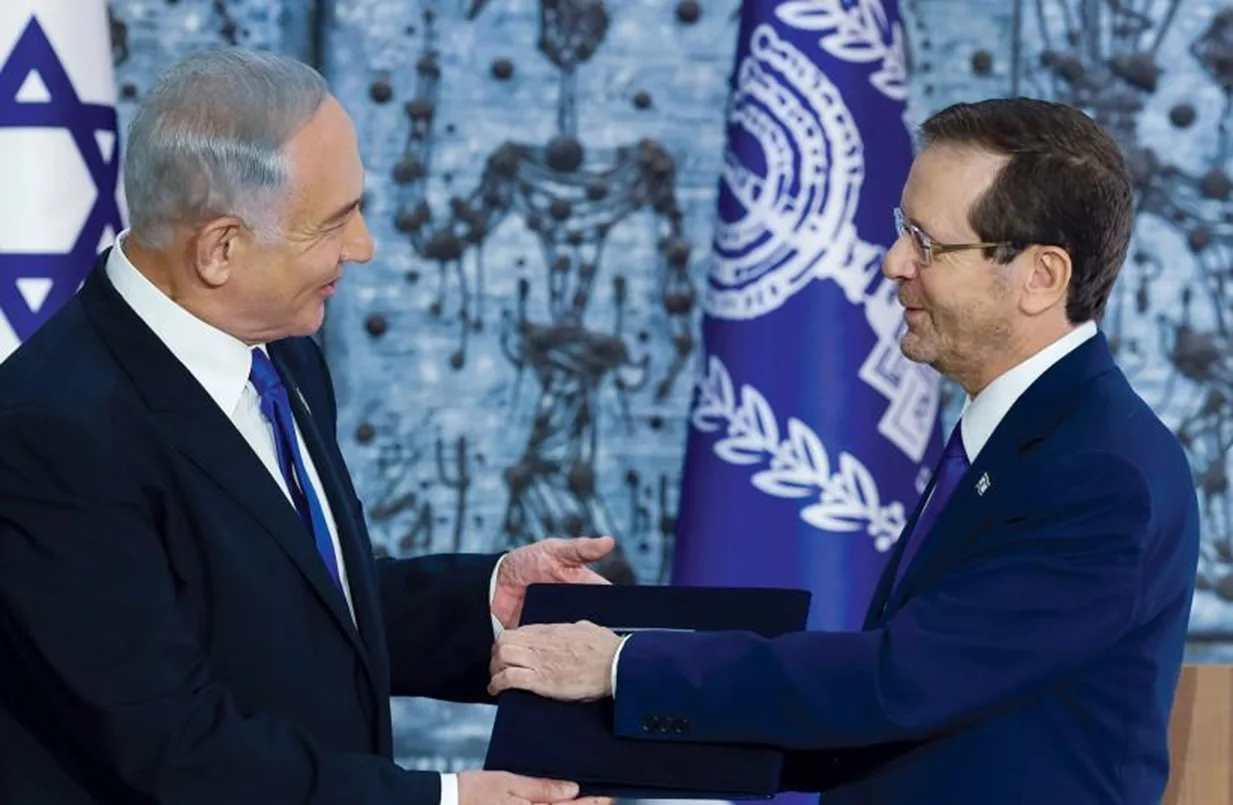
Israel's political center of gravity has shifted, but power has not yet changed hands. On November 8, 2026, President Isaac Herzog formally tasked Gadi Eisenkot with forming the next government. For Benjamin Netanyahu, who still heads the executive, the decision marks an important institutional turning point: for the first time since the October 27 election, the initiative belongs to his principal opponent.
The ceremony at the presidential residence in Jerusalem gave concrete expression to the new parliamentary balance. During consultations with the parties represented in the Knesset, 67 lawmakers recommended Eisenkot, compared with 46 for Netanyahu. The seven representatives of United Torah Judaism chose not to endorse either candidate.
The difference appears decisive. Yet it does not settle the question of government formation. The 67 recommendations secured by Eisenkot do not amount to 67 coalition commitments, and the parties seeking Netanyahu's departure share neither the same priorities nor the same conditions for entering government.
This is the distinctive feature of Israel's current political situation: the election has produced a parliamentary majority willing to support an alternative, but that majority has not yet been transformed into a common governing project.
The Presidential Mandate Changes the Negotiations
Under Israel's parliamentary system, citizens elect the 120 members of the Knesset through nationwide proportional representation. The prime minister is not directly elected by voters. The appointment depends on a political leader's ability to form a government that commands the confidence of parliament.
The president plays a central role in this initial stage. After consulting the parties, the president assigns a member of parliament the task of forming a coalition. The decision takes into account parliamentary recommendations, but also the practical prospects of establishing a government.
By selecting Eisenkot, Isaac Herzog acknowledged the significance of the support expressed by a majority of lawmakers. He also emphasized the need to overcome the divisions preventing the formation of a stable executive.
Eisenkot initially has 28 days to conduct negotiations. An extension of 14 days may be granted, potentially extending this first attempt until December 20.
This timetable places the parties before an immediate responsibility. They can no longer simply express opposition to the outgoing government; they must now specify the compromises they are prepared to accept.
The presidential mandate therefore changes the balance of power. Netanyahu continues to serve as prime minister during the transition, but Eisenkot becomes the institutional figure around whom negotiations over the next government must be organized.
This distinction is essential. The succession process has begun; the transfer of power has not taken place.
A Majority That Exists on Paper
The October 27 election left the Knesset deeply fragmented. Netanyahu's Likud remains the largest party with 27 seats, while Yashar, led by Eisenkot, holds 21.
Netanyahu's traditional bloc controls 53 seats. The four opposition parties aligned around Eisenkot hold 48. The two principal Arab parties, the Joint List and Ra'am, together account for 19 seats.
These figures explain both Eisenkot's appointment and the difficulty of his mission.
The 48 lawmakers belonging to his bloc, combined with the 19 Arab representatives, constitute an arithmetic majority of 67 seats. But this calculation brings together parties whose positions differ profoundly on the identity of the state, the Palestinian question, security policy and the conditions for participating in government.
The Joint List agreed to recommend Eisenkot in order to enable an alternative to Netanyahu. That decision does not mean it intends to join a coalition. It has notably raised the possibility of providing external parliamentary support.
Ra'am, for its part, has experience of government participation through the Bennett-Lapid coalition of 2021. But that experience does not eliminate present disagreements.
Even within the opposition bloc, Avigdor Lieberman rejects a government dependent on Arab parties. The Democrats, led by Yair Golan, support a more inclusive approach to their participation.
Eisenkot must therefore resolve a fundamental contradiction: the lawmakers who enabled him to receive the presidential mandate are not necessarily those with whom he can form a government.
A majority exists to appoint a negotiator. It has yet to be built for the exercise of power.
Ultra-Orthodox Parties at the Center of Negotiations
This difficulty explains the growing attention directed toward the ultra-Orthodox parties.
United Torah Judaism, which holds seven seats, declined to recommend Netanyahu despite its historical association with his political camp. This abstention is politically significant, although it does not amount to an endorsement of Eisenkot.
Shas, another ultra-Orthodox party, retains six seats and supported Netanyahu during the presidential consultations.
Adding the opposition bloc's 48 seats to United Torah Judaism's seven and Shas's six produces exactly 61 seats, the absolute majority required in the Knesset.
This combination remains purely arithmetic. It assumes agreements that do not exist and confronts a particularly sensitive disagreement: the conscription of ultra-Orthodox men.
Military service has for years been one of the principal sources of conflict between religious parties and other sections of Israeli society. Ultra-Orthodox parties seek to preserve specific arrangements for students at religious institutions, while several opposition parties demand a broader application of military or civilian service obligations.
The war has increased the significance of this controversy. Prolonged reserve mobilization, the military's personnel requirements and the economic consequences of military operations have intensified debates over the distribution of national obligations.
Eisenkot has defended the principle of more broadly shared service. Lieberman, long opposed to concessions on this issue, has nevertheless opened the door to discussions with ultra-Orthodox parties.
This does not constitute an agreement, but it represents a shift in the conditions of negotiation.
For religious parties, a compromise would need to provide sufficiently precise guarantees concerning the status of students in religious seminaries. For Eisenkot and his partners, it would be necessary to avoid concessions that directly contradict commitments made to their voters.
The question therefore extends beyond military recruitment. It concerns equality in collective obligations, the place of religion within the state and the social foundations of a possible coalition.
Eisenkot Seeks to Move Beyond Political Blocs
When formally receiving his mandate, Eisenkot called for the formation of a national emergency government. He acknowledged that such an initiative would require unconventional political steps and compromises between traditionally opposed parties.
His appeal was not limited to those who had recommended his appointment. He also invited lawmakers from Likud and Religious Zionism to consider participating in a government under his leadership.
This opening introduces another dimension into the negotiations.
Until now, the electoral debate had largely opposed two groups: parties supporting Netanyahu and those seeking his replacement. Eisenkot is now attempting to transform that confrontation into a search for partners beyond established partisan boundaries.
Such a strategy could take several forms. It might lead to negotiations between party leaderships, parliamentary support agreements or individual initiatives by lawmakers. None of these possibilities, however, represents a confirmed commitment at this stage.
The obstacles remain considerable.
Likud remains committed to Netanyahu, while several of its partners defend positions that are difficult to reconcile with those of parts of the opposition. The disagreements concern judicial institutions, conscription, the Palestinian territories and political responsibility for the events of October 7, 2023.
The proposal for a national emergency government therefore has a strategic as well as an institutional dimension. It allows Eisenkot to present his mandate as an effort at national unity while requiring other parties to explain publicly their refusals or conditions.
But widening the dialogue does not guarantee a broader coalition.
Netanyahu Retains Political Resources
Eisenkot's appointment does not mean Benjamin Netanyahu has disappeared from the political landscape.
Likud remains the largest parliamentary party, with 27 seats. The outgoing bloc retains substantial influence, and several partners remain committed to Netanyahu's continuation as head of government.
Above all, the prime minister continues to exercise his functions during the transition. The outgoing executive remains in office until a new government is sworn in.
This continuity allows him to maintain an institutional and political presence throughout the negotiations.
Netanyahu has also advocated a national unity government, but disagreements over its leadership and the participation of his allies constitute major obstacles.
The situation therefore has a distinctive feature: both principal leaders invoke the need for national unity while defending conditions that do not yet permit an agreement between them.
If Eisenkot fails to form a government, the institutional framework provides for further attempts. The president may assign the task to another lawmaker. If the entire process fails, another dissolution could lead to an early election.
Netanyahu therefore retains political options, even though he did not receive the first mandate.
The political contest did not end with the presidential decision. It has shifted into coalition negotiations.
The Weight of War in Political Realignment
The government formation crisis cannot be separated from the security environment in which it is unfolding.
Since the attacks of October 7, 2023, Israel has experienced a succession of military and diplomatic confrontations that have profoundly altered its national priorities.
The war in Gaza, fighting with Hezbollah in Lebanon and tensions with Iran have increased the prominence of defense issues in public debate. They have also intensified questions concerning leadership accountability, the conduct of military operations and relations between political authorities and security institutions.
Eisenkot, a former chief of staff of the Israel Defense Forces, possesses military experience that occupies an important place in his political positioning.
But this experience does not establish that a government led by him would pursue a fundamentally different regional policy from Netanyahu's.
Israel's principal political parties differ over methods, priorities and responsibility while sharing certain broad national security objectives.
The Palestinian question remains particularly revealing of these limitations.
The humanitarian and political situation in Gaza, the territory's future administration, settlements in the West Bank and the prospects for a political settlement remain central issues. Yet Eisenkot's potential partners do not necessarily converge on a common approach.
A change of government could alter the diplomatic handling of these questions without automatically resolving the underlying disagreements.
The consequences extend beyond Israel. Palestinians, neighboring states and international partners will be directly affected by the policies of the future executive.
Washington Faces an Uncertain Transition
The United States represents another essential dimension of this political realignment.
The Israeli-American relationship rests on long-standing military, technological, financial and diplomatic cooperation. It does not depend exclusively on personal relationships between leaders.
Nevertheless, the composition of the next government could influence the management of bilateral disagreements, regional military operations and diplomatic initiatives concerning Gaza and Arab states.
For Washington, the immediate issue includes continuity in its Israeli counterparts and the ability of the next executive to make durable commitments.
Gulf countries, Egypt and Jordan will also follow the negotiations closely. Israeli government decisions can affect security arrangements, diplomatic relations and prospects for regional normalization.
Iran, meanwhile, remains a structural factor in Israeli security doctrine. Military tensions and regional networks aligned with Tehran will continue to influence the next government's decisions, whatever its composition.
Israel's political transition is therefore taking place in an environment where domestic room for maneuver is closely connected to regional and international constraints.
A change of prime minister would not remove these constraints. It could, however, alter the way they are managed.
Institutional Stability Becomes an Economic Issue
The formation of a durable government also has an economic dimension.
Years of conflict have imposed substantial costs on Israel: military expenditure, reserve mobilization, disruptions to economic activity, financing requirements and pressure on public finances.
The country retains competitive economic sectors, particularly in advanced technology, software, cybersecurity and certain strategic industries. But these strengths do not make the economy independent of political stability.
The next government's budgetary decisions will have to account for defense spending, social commitments, investment requirements and financing constraints.
The composition of the coalition will influence these choices.
Religious parties may defend specific priorities concerning education funding and public transfers. Other parties seek to reform military service obligations or modify certain spending commitments. Institutional disagreements may also affect perceptions of regulatory stability.
A government formed around a minimal compromise could command a parliamentary majority without necessarily possessing an agreement broad enough to implement structural reforms.
The economic challenge therefore concerns more than the rapid formation of a cabinet. It involves the government's capacity to make coherent decisions across several budget cycles.
The Coming Weeks: Between Compromise and Deadlock
The timetable opened on November 8 now establishes a decisive period of negotiations.
Eisenkot has until December 6 to form a government within the initial 28-day period. An extension could allow discussions to continue until December 20.
Several institutional configurations remain possible.
A government led by Eisenkot could emerge from the opposition parties and agreements with additional formations. Another arrangement could rely on external parliamentary support, particularly from Arab parties. Discussions with ultra-Orthodox factions could also change the possible combinations.
A broader coalition incorporating figures from Netanyahu's camp would require compromises over government leadership and political direction.
Finally, unsuccessful negotiations could lead to another candidate being tasked with forming a government, and potentially to another election if no majority can be established.
These configurations are not politically equivalent. Each depends on different concessions and presents distinct difficulties.
The decisive criterion will be the ability to convert statements of support into effective parliamentary commitments.
A presidential recommendation can be given to allow negotiations to begin. Parliamentary confidence, by contrast, determines the government's survival and its ability to act.
It is this second majority that Eisenkot must now build.
Conclusion — Alternation Meets the Reality of Power
Gadi Eisenkot's appointment represents an important stage in Israel's political realignment. It confirms that Benjamin Netanyahu no longer commands the parliamentary majority that allowed him to govern with his traditional allies, and that parties supporting an alternative have succeeded in securing a different candidate during presidential consultations.
But the transition from a presidential mandate to executive power remains unresolved.
Eisenkot must bring together parties whose objectives converge on replacing Netanyahu but diverge on several questions shaping Israeli political life: conscription, religion, judicial institutions, Arab representation and Palestinian policy.
The negotiations will determine whether these differences can be accommodated within a common governing program or whether they prevent the establishment of a durable coalition.
Beyond the question of personal succession, the central issue concerns the parliamentary system's ability to produce a stable executive after years of fragmentation and conflict.
A coalition will not necessarily be stable simply because it has assembled 61 lawmakers. Its durability will depend on the nature of the compromises reached, the coherence of its program and its capacity to confront the country's economic and security constraints.
The October 27 election shifted the political balance. The November 8 decision gave Eisenkot the initiative. What remains to be established is whether that initiative can become a governing majority.
For now, Israel finds itself in a situation where political alternation has an institutional mandate but not yet the instruments required to exercise power.
Eisenkot has obtained the right to form a government. He must now demonstrate that a majority capable of governing can emerge from a majority assembled to replace a leader.
Main Sources
- Presidency of the State of Israel — President Herzog Concludes Consultations and Announces He Will Task Gadi Eisenkot With Forming a Government, November 7, 2026.
- Presidency of the State of Israel — President Herzog Concludes Round of Consultations With Knesset Factions, November 5, 2026.
- Associated Press — Israel's president gives Eisenkot the first chance to form the next government, November 8, 2026.
- The Times of Israel — Eisenkot gets nod to form government, vows unconventional acts in time of emergency, November 8, 2026.
- The Jerusalem Post — Unconventional steps required: Eisenkot vows to form emergency government as Herzog bestows mandate, November 8, 2026.
- Anadolu Agency — Arab Joint List formally recommends Eisenkot to form Israeli government, November 5, 2026.
- Council on Foreign Relations — Israel's Election: Understanding Who's Who and What's at Stake, October 2026.
Atlas Limits Research Desk
Atlas Limits’ editorial and analytical desk.