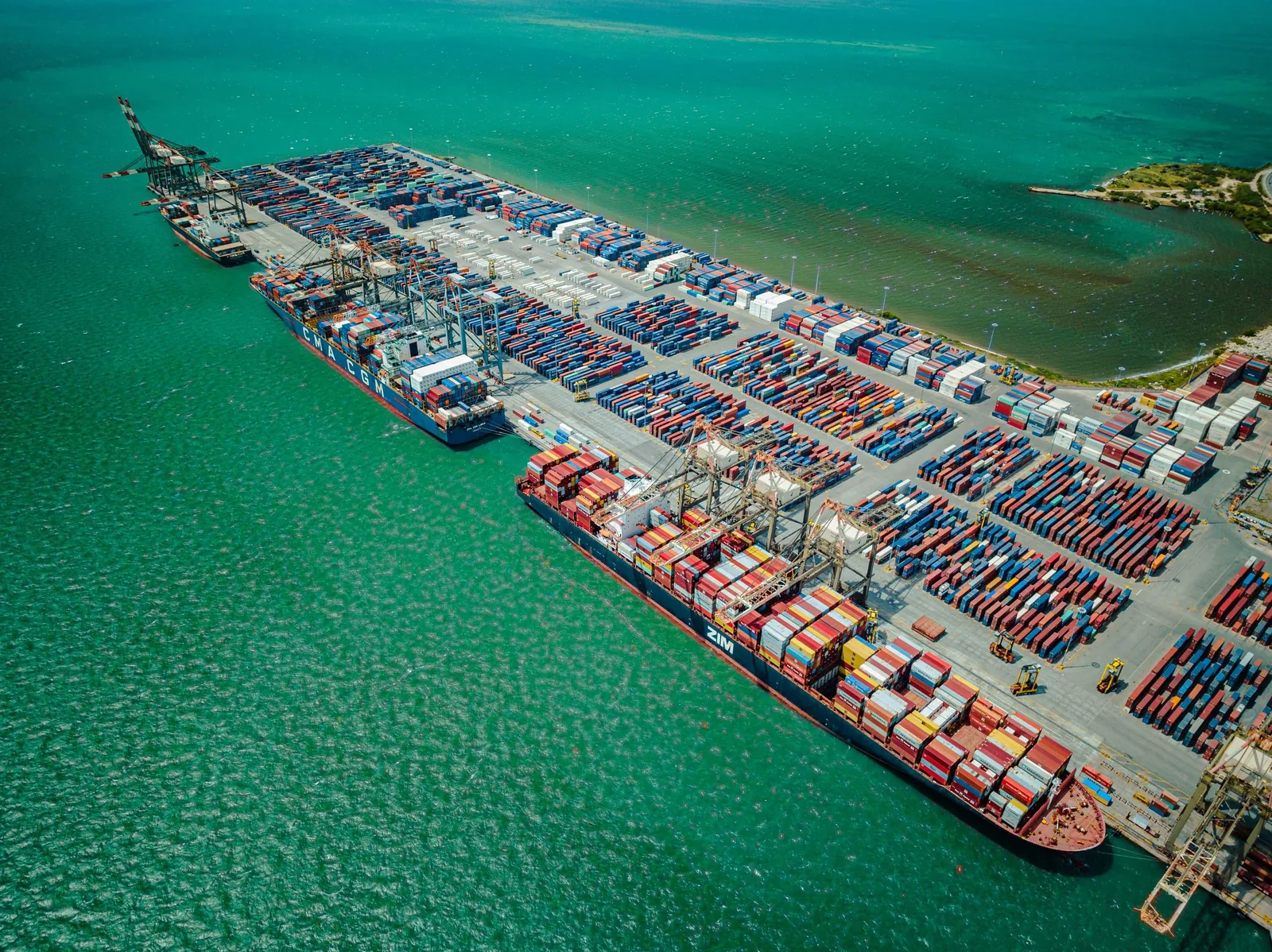
In Kingston, shipping containers tell a story that extends far beyond Jamaica's borders. Along the port's quays, goods arriving from Asia, Europe and the Americas are unloaded, transferred, stored and shipped onward to other destinations. Many of these cargoes will never truly enter the Jamaican economy. They will cross its territory without reaching its factories, markets or consumers. Yet their passage represents one of the country's most important strategic economic assets.
Located near the maritime routes connecting the Panama Canal to the eastern United States, the Gulf of Mexico and Caribbean markets, Kingston occupies a privileged position within the region's shipping network. Geography has long provided the city with a natural advantage. Today, however, that advantage has become the focus of an industrial and financial competition in which infrastructure, foreign investment, shipping companies and trade policies determine how much economic value a territory can actually capture.
For Jamaica, a country of fewer than three million inhabitants, the challenge therefore extends beyond modernizing a port. It involves transforming a transit function into a genuine logistics economy capable of generating skilled employment, fiscal revenues, industrial activity and regional commercial influence.
An Island at the Intersection of Major Trade Routes
Kingston's maritime importance begins with geography. Jamaica lies in the heart of the Caribbean Sea, south of Cuba and close to the routes connecting the Atlantic and Pacific oceans through the Panama Canal. Vessels operating along these corridors serve some of the world's largest commercial markets, including the United States, Mexico, Central America and the Caribbean islands.
This location enables Kingston to operate as a transshipment hub. Under this model, goods arrive aboard large container ships, are transferred to other vessels and continue toward secondary ports. The hub functions as an intermediary between major ocean-going shipping services and regional distribution networks.
The economic rationale rests on the concentration of cargo flows. Large shipping companies seek to minimize port calls, optimize vessel capacity and reduce operating costs. Rather than serving every destination directly, they favor ports capable of redistributing containers efficiently across multiple markets.
Kingston belongs to this geography of maritime concentration, alongside logistics platforms in Panama, Colombia, the Dominican Republic and the Bahamas. But its position does not constitute a monopoly. Shipping companies can modify their routes, relocate cargo volumes and favor competing terminals when commercial conditions become more attractive.
Geography therefore creates an opportunity. It guarantees neither future traffic nor the wealth that may result from it.
Three Million TEUs and an Economy Built Around Transit
Port statistics illustrate Jamaica's importance within the regional maritime system. According to CariCRIS figures reported by the Jamaican press in April 2026, total container traffic across Jamaica's ports reached approximately 3.03 million twenty-foot equivalent units, or TEUs, in 2025, compared with roughly 3.17 million in 2024.
The decline of approximately 4.4% demonstrates that infrastructure investment alone cannot guarantee continuous traffic growth. Cargo volumes also depend on shipping companies' commercial decisions, international demand, transportation costs and competition between terminals.
The composition of this activity is even more revealing: approximately 88% of Jamaica's container traffic consists of transshipment operations. In other words, the overwhelming majority of containers handled are not directly associated with imports destined for domestic consumption or exports produced by Jamaican businesses.
This specialization is simultaneously a strength and a vulnerability.
It enables Jamaica to handle cargo volumes far beyond what its domestic economy could generate independently. Yet it also makes port revenues particularly sensitive to decisions taken by international operators whose commercial priorities extend well beyond the country's national interests.
A port can therefore handle several million containers annually without generating a proportionate expansion of domestic industrial production.
The decisive question is not simply how many containers pass through Jamaica. It is how much value the country retains from each cargo flow.
Port Modernization as an Instrument of Competitiveness
For several years, Kingston has attracted investments designed to expand its operational capabilities and improve productivity. Kingston Freeport Terminal, operated under a long-term concession, stands at the center of this transformation.
The terminal's operation by Kingston Freeport Terminal Limited, a company associated with the French shipping group CMA CGM, illustrates the growing influence of major international operators over strategic maritime infrastructure.
Modernization programs undertaken since 2016 have involved more than $500 million in announced investments. These have focused on upgrading cargo-handling equipment, improving berthing infrastructure and strengthening the operational capabilities required to accommodate large container vessels.
In 2025, a further expansion project known as Westlands was announced, representing an investment of approximately $80 million. The development includes around 15 additional hectares and is intended to increase the terminal's container storage capacity by more than 25%.
These investments respond to a fundamental transformation in global shipping: the concentration of international cargo aboard increasingly large vessels.
As container ships grow, ports require sufficient water depth, suitable berths, high-performance cranes and sophisticated information systems capable of coordinating complex operations within increasingly narrow timeframes.
Competitiveness is now measured as much by operational speed and reliability as by physical capacity.
For Kingston, remaining integrated into major ocean shipping networks requires continuous modernization. A terminal that stops investing risks gradually losing the largest vessel calls and, eventually, the regional feeder services dependent on those connections.
Shipping Companies Also Hold the Real Power
The contemporary port economy rests on an asymmetric relationship between territories and major international carriers.
Governments can build quays, establish free zones, improve roads and provide tax incentives. But cargo volumes are largely directed by shipping companies' commercial strategies, maritime alliances and the service networks they organize.
This reality is particularly important for ports specializing in transshipment.
A shipping company may decide to concentrate operations in Kingston before subsequently reorganizing its services around another Caribbean or Central American port. The consequences for local activity can be substantial even when existing infrastructure remains fully operational.
Kingston's integration into the network of a major shipping group nevertheless offers advantages. It can support more stable commercial connections, facilitate investment and place the terminal within a long-term international strategy.
But it also raises an important question of economic governance: how can the commercial objectives of a global operator be reconciled with the development ambitions of a small island state?
Interests may converge when rising cargo volumes generate additional activity, employment and revenue. They may also diverge when an operator's priority is to optimize an international network rather than develop local production chains.
This distinction is essential to understanding the limitations of Jamaica's maritime model.
Panama, Colombia and the Dominican Republic: Competition Between Maritime Gateways
Kingston is not expanding in an empty maritime landscape. The Caribbean Sea and its surrounding coastlines contain several logistics platforms competing to attract the same international cargo flows.
Panama enjoys a major structural advantage: its canal is one of the world's principal passages between the Atlantic and Pacific oceans. Around this infrastructure, the country has developed an ecosystem combining ports, warehouses, free trade zones, financial services and logistics operations.
Colombia, meanwhile, operates major terminals along its Caribbean coastline, particularly in Cartagena. These facilities combine transshipment activity with connections to a domestic economy considerably larger than Jamaica's.
The Dominican Republic is also strengthening its regional logistics role, drawing on port infrastructure, export-oriented industrial zones and commercial relationships with the United States.
The Bahamas, through Freeport, provides another example of specialization in international transshipment operations.
Competition between these hubs no longer depends exclusively on geographical location. It increasingly involves handling costs, operational reliability, channel depth, customs efficiency, the availability of industrial land and the ability to provide integrated logistics services.
Kingston must therefore defend its position within a regional system where several territories possess comparable advantages.
Proximity to major shipping routes remains valuable. But genuine differentiation depends on the quality of the economic ecosystem developed around the port.
From Cargo Handling to Production: The Challenge of Added Value
The transshipment business model has a fundamental limitation: moving a container does not necessarily mean participating in the production or commercialization of the goods it contains.
Direct revenues primarily come from port services, cargo handling, storage and related logistics activities. These services can be profitable and generate employment, but their ability to transform the wider economy depends on their connections with domestic businesses.
Jamaica could capture greater value by developing complementary activities, including packaging, light assembly, equipment maintenance, refrigerated logistics, regional distribution, digital services and selected forms of industrial processing.
Special economic zones represent one potential instrument for this strategy. They allow industrial and commercial activities to cluster near port infrastructure, supported by procedures designed to facilitate international trade.
Their effectiveness, however, cannot be measured solely by the number of registered businesses or hectares developed. It depends on actual capital investment, employment creation, skills transfers and the ability of domestic suppliers to participate in production networks.
International experience suggests that logistics hubs can become engines of industrialization when supported by training policies, reliable energy infrastructure and a favorable business environment.
Conversely, a port can remain a highly efficient enclave, deeply connected to global trade but only weakly integrated into its national economy.
For Kingston, the challenge is precisely to avoid that second trajectory.
Strategic Infrastructure in a Vulnerable Island Economy
The port's importance extends beyond its commercial revenues. It is also central to Jamaica's economic security.
Like many Caribbean island states, Jamaica depends heavily on maritime trade for essential supplies, including fuel, machinery, food products and manufactured goods.
This dependence exposes the economy to fluctuations in shipping costs, supply-chain disruptions and geopolitical shocks affecting major ocean routes.
The difficulties experienced by the Panama Canal during periods of drought have demonstrated that maritime infrastructure is also subject to environmental constraints. Disruptions to navigation in the Red Sea have similarly illustrated how security crises can reshape international shipping routes.
These events do not necessarily affect every port in the same way. Some may temporarily benefit from the reorganization of shipping services, while others experience fewer vessel calls or higher operating costs.
Jamaica must also contend with its own exposure to climate-related risks. Hurricanes, intense rainfall and infrastructure damage can simultaneously disrupt port operations, electricity networks and inland transportation connections.
Resilience has therefore become a central dimension of maritime competitiveness.
An efficient port must not only process cargo rapidly under normal conditions. It must also maintain or restore operations after major disruptions.
Maritime Trade as an Instrument of Regional Influence
Beyond its domestic economy, Kingston could strengthen Jamaica's role in organizing commercial exchanges across the Caribbean.
The region is characterized by an unusually fragmented geography. Markets are scattered across numerous islands, commercial volumes vary significantly and direct maritime connections between neighboring economies remain limited in some cases.
This fragmentation increases logistics costs and complicates trade between countries that are geographically close.
A platform capable of consolidating cargo, organizing redistribution and providing reliable logistics services could help address some of these constraints.
Kingston therefore has the potential to play a larger role in regional distribution networks, particularly for consumer goods, food products, industrial equipment and merchandise destined for smaller island markets.
But this ambition requires coordination extending beyond port infrastructure. It depends on regular shipping services, efficient customs procedures, interoperable digital systems and commercial conditions that allow regional businesses to make practical use of these connections.
Developing a maritime hub does not automatically guarantee deeper Caribbean economic integration.
It can contribute to that objective when public policies and commercial strategies encourage regional trade rather than merely facilitating cargo movements between larger economic powers.
Economic Sovereignty in the Age of Global Logistics
Kingston's experience reveals a broader transformation in the meaning of economic power.
In contemporary maritime trade, possessing a strategic location is no longer sufficient. Economic value is distributed among infrastructure owners, terminal operators, shipping companies, logistics providers, insurers and the businesses controlling the goods themselves.
A territory can occupy an essential position within this architecture without controlling the decisions that determine its cargo flows.
For Jamaica, economic sovereignty does not necessarily mean directly operating every terminal or placing all maritime activities under national ownership. It means retaining the capacity to negotiate favorable investments, protect long-term interests and translate international commercial activity into domestic development.
That requires balanced port concessions, appropriate public infrastructure, education and training policies, and a coherent industrial strategy.
It also means measuring performance through indicators extending beyond container throughput.
The most meaningful measures would include domestic value added generated by logistics activities, the number of skilled jobs created, public revenues, productive investment stimulated by the port and growth in Jamaican exports using its infrastructure.
An additional million containers does not have the same economic significance if it generates only handling operations as it would if it also supports local manufacturing, distribution and commercial activity.
Kingston: The Difference Between Being a Transit Point and Becoming an Economic Power
Kingston possesses advantages that many territories seek to develop: a favorable maritime location, a long history of international trade, specialized infrastructure and integration into the networks of major global operators.
Ongoing investments strengthen its ability to remain competitive in a region where logistics platforms continue to expand. Yet the modest decline in traffic recorded in 2025 highlights the vulnerability of a model heavily dependent on transshipment and the decisions of international shipping companies.
The port's economic future will therefore not be determined solely by the extension of its quays or the acquisition of new equipment. It will depend on Jamaica's ability to develop a sufficiently dense network of productive, commercial and technological activities around its maritime infrastructure to retain a growing share of the wealth crossing its territory.
This distinction extends far beyond Jamaica. It concerns numerous economies situated along the world's major trade routes, from Asian straits to African ports and interoceanic corridors.
All can benefit from geography. But only some succeed in transforming their function as transit points into lasting economic power.
In Kingston, millions of containers will continue to cross the quays before departing for distant destinations. The true measure of Jamaica's success will not simply be how many pass through, but how much they leave behind.
Main Sources
- Port Authority of Jamaica — Institutional reports, port statistics and Kingston infrastructure development.
- CariCRIS — Jamaican port traffic data for 2024 and 2025, reported by Jamaica Observer in April 2026.
- Kingston Freeport Terminal Limited / CMA CGM — Terminal modernization, investment programs and the Westlands expansion project.
- United Nations Economic Commission for Latin America and the Caribbean (ECLAC) — Regional port activity and logistics competition.
- United Nations Conference on Trade and Development (UNCTAD) — Review of Maritime Transport, maritime connectivity, global shipping and the development of island economies.
Atlas Limits Research Desk
Atlas Limits’ editorial and analytical desk.