Missile tests are multiplying on both sides of the Korean border. Behind the competition for hypersonic speeds lies a deeper transformation of the regional military balance: the ability to strike rapidly, penetrate enemy defenses and compress reaction times is becoming as important as the size and destructive power of military arsenals. For Seoul and Pyongyang alike, the pursuit of more credible deterrence could ultimately make crises harder to control.
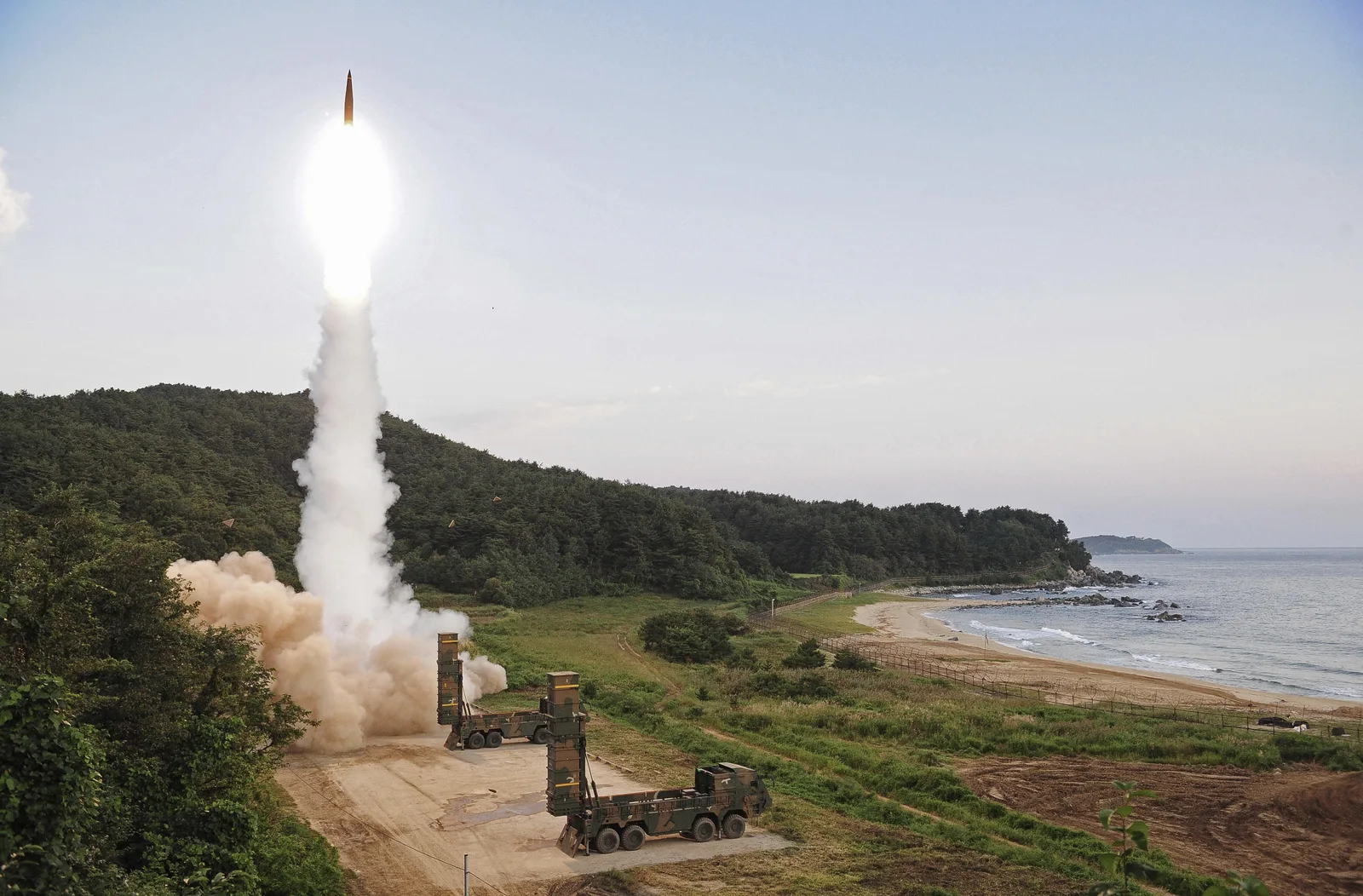
On October 12, 2026, two North Korean ballistic missiles crossed the skies of the Korean Peninsula toward the Sea of Japan. According to preliminary assessments released by Japanese authorities, the first projectile, launched at approximately 9:19 a.m., traveled around 220 kilometers. The second, fired seventeen minutes later, covered more than 910 kilometers and reached an estimated maximum altitude of 70 kilometers. Japanese defense officials were examining the possibility that the second missile followed an irregular trajectory, a characteristic that could complicate missile defense operations.
The launches came during a particularly concentrated period of military activity. On October 3, North Korea had announced another test of a hypersonic weapon. Five days later, South Korean President Lee Jae-myung attended a test demonstration involving a domestically developed hypersonic glide vehicle. Within less than two weeks, both countries had publicly demonstrated their ambitions in a technological field long dominated by the world's leading military powers.
The sequence of events does not, by itself, establish a direct causal relationship between the tests. It nevertheless illustrates a structural shift: the military confrontation on the Korean Peninsula is entering a phase in which speed, maneuverability and the ability to penetrate opposing defenses are becoming increasingly central to national military doctrines.
Since the 1953 armistice, the peninsula has remained in a state of permanent military confrontation, without a definitive peace treaty. For decades, the balance rested primarily on the conventional strength of South Korean and American forces, the proximity of North Korean artillery to the Seoul metropolitan area and, progressively, Pyongyang's development of nuclear weapons.
That strategic architecture has not disappeared. But it is evolving under the pressure of a technological competition that could fundamentally alter how each side assesses its own vulnerability.
Speed Is No Longer Enough: The Battle Over Trajectories
The term hypersonic generally refers to speeds exceeding Mach 5, or five times the speed of sound. Depending on atmospheric conditions and altitude, this corresponds to several thousand kilometers per hour.
Yet hypersonic speed is not an entirely new military capability. Intercontinental ballistic missiles have long reached velocities well above Mach 5 during certain phases of flight.
The innovation now being pursued concerns the combination of extreme speed and the ability to change trajectory.
A conventional ballistic missile follows a path largely governed by the laws of mechanics after its powered flight phase. Modern surveillance systems can detect its launch, estimate its trajectory and calculate a probable impact area. This relative predictability forms one of the foundations of missile defense architectures.
New maneuvering hypersonic weapons are designed to complicate those calculations.
Two broad technological categories dominate military development efforts. Hypersonic glide vehicles, or HGVs, are generally accelerated by a rocket before continuing their flight through the upper atmosphere, with varying degrees of maneuverability. Hypersonic cruise missiles, meanwhile, rely on propulsion systems capable of sustaining extremely high speeds during a substantial portion of their flight.
In both cases, the objective is to reduce the predictability of the approach and make interception more demanding.
For a defensive system, the difficulty does not arise from speed alone. It also depends on altitude, radar signature, the ability to change direction, the quality of available sensors and the time required to transmit information to interception units.
A fast weapon following a predictable trajectory may, under certain conditions, be easier to engage than a slower projectile capable of significantly altering its course.
This uncertainty is precisely what North Korean and South Korean programs are seeking to exploit, each according to its own strategic priorities.
A distinction must nevertheless be maintained between declared capabilities and demonstrated performance. A successful test does not necessarily prove that a system possesses the reliability, accuracy and resistance to countermeasures required for sustained operational use. Publicly available information on Korean hypersonic programs remains incomplete, particularly regarding North Korean capabilities.
Pyongyang: Preserving the Ability to Strike Despite Enemy Defenses
For North Korea, hypersonic missiles form part of a much older strategy: ensuring that an attack against the regime cannot eliminate its ability to retaliate.
The conventional military imbalance between the two Koreas remains substantial. Seoul benefits from a technologically advanced economy, a powerful defense industry, modern air forces and American military support. Pyongyang retains a large army and significant artillery capabilities but faces persistent economic and industrial constraints.
The development of ballistic missiles and nuclear weapons has gradually allowed the North Korean regime to compensate for part of this asymmetry.
Since its first nuclear test in 2006, North Korea has expanded its missile programs to diversify its means of attack. Its arsenal now includes several categories of short-, medium- and long-range missiles, alongside systems presented as capable of carrying tactical nuclear warheads.
Hypersonic programs extend this logic.
Pyongyang seeks to make its missiles more difficult to intercept by South Korean, American and Japanese defensive systems. It also aims to complicate the calculations involved in any potential preventive operation against its military installations.
American Patriot and THAAD systems, South Korean interceptors and Aegis-equipped naval assets contribute to a multilayered missile defense architecture. But this architecture does not provide absolute protection. It must contend with different threats, potentially large volumes of incoming missiles and trajectories that do not always match the profiles for which certain interceptors were originally designed.
North Korea's interest in maneuvering vehicles therefore lies less in achieving absolute invulnerability than in degrading the overall effectiveness of opposing defenses.
Even a relatively high probability of interception can prove insufficient when several projectiles are launched simultaneously against different targets.
This quantitative dimension remains essential. Sophisticated missiles do not replace saturation strategies; they may reinforce them.
North Korea is consequently attempting to build a combination of capabilities: mobile missiles, diverse ranges, variable trajectories, conventional or nuclear payloads and multiple launch platforms.
The political objective remains relatively constant: to convince Washington and Seoul that no military operation could neutralize North Korea's retaliatory capabilities with certainty.
But this strategy faces a fundamental limitation. Information released by Pyongyang does not always establish whether the systems presented are fully operational weapons or experimental programs still under development.
Mastering maneuvering hypersonic flight requires particularly advanced expertise in aerodynamics, materials capable of withstanding extreme temperatures, navigation and guidance. Repeated tests may demonstrate genuine progress without proving that all these technical challenges have been overcome.
Seoul: From Territorial Protection to Neutralization Capabilities
South Korea is pursuing a different strategy, although one that produces a comparable acceleration in military technology.
For decades, South Korean military doctrine was built around two imperatives: resisting a conventional North Korean offensive and maintaining close operational coordination with American forces stationed in the country.
This orientation remains central. Approximately 28,500 American military personnel have traditionally been stationed in South Korea under an alliance that constitutes one of the pillars of the United States' strategic presence in East Asia.
But Seoul has increasingly sought to develop national capabilities that reduce certain operational dependencies.
This ambition rests partly on the three components generally associated with its defense architecture: Kill Chain, intended to detect and potentially neutralize imminent threats; Korea Air and Missile Defense, dedicated to missile interception; and Korea Massive Punishment and Retaliation, which envisages a large-scale conventional response against strategic North Korean targets.
These three dimensions are complementary, but they depend on demanding assumptions.
Neutralizing a threat before launch requires reliable intelligence about its location and the imminence of an attack. Intercepting a missile requires detecting its trajectory sufficiently early and engaging an appropriate defensive system. Guaranteeing retaliation requires preserving strike capabilities capable of reaching designated targets.
The development of hypersonic vehicles could reinforce some of these capabilities, particularly by reducing the time required to reach a target and complicating enemy defenses.
South Korea already possesses a substantial industrial base in missile technology. Its Hyunmoo missile family includes several generations of ballistic and cruise systems, with different capabilities and operational missions.
The removal in 2021 of bilateral restrictions that had historically limited the range and payload of certain South Korean missiles expanded the country's technological and strategic options.
Since then, Seoul has enjoyed greater freedom to design systems aligned with its own defense priorities.
Hypersonic technologies form part of this broader effort to achieve greater autonomy.
They also provide an opportunity for South Korea to consolidate a defense industry that has become a major international player.
Companies such as Hanwha Aerospace, LIG Nex1 and Hyundai Rotem participate at different levels in the development of South Korea's military-industrial ecosystem. Research capabilities in propulsion, guidance, detection and systems integration acquired through advanced weapons programs can also benefit other military technologies.
It would nevertheless be premature to equate a hypersonic glide vehicle test with the deployment of a fully mature operational capability.
Between technological demonstration and operational deployment, qualification, production, integration and training can require several years.
The Military Balance Extends Beyond the Peninsula
The Korean hypersonic competition cannot be understood independently of the strategic transformations taking place across East Asia.
China has spent years developing advanced conventional and nuclear strike capabilities, including the DF-17 system associated with a hypersonic glide vehicle. Russia is pursuing its own programs, while the United States is investing in several categories of hypersonic weapons and the technologies required to detect them.
These developments are changing the environment in which both Koreas operate.
For Seoul, threats do not originate exclusively from Pyongyang. China's military modernization, tensions surrounding Taiwan and the evolution of the American military posture in the Pacific indirectly influence South Korean industrial and doctrinal choices.
The country must maintain defenses adapted to the North Korean threat while preserving its ability to coordinate with the United States in an increasingly complex regional environment.
For Pyongyang, strategic relations with Moscow and Beijing are also changing the security landscape.
Military cooperation between Russia and North Korea has intensified since the beginning of the war in Ukraine. This relationship raises questions about potential transfers of technology, expertise and military equipment.
It would, however, be excessive to automatically attribute North Korean progress in hypersonic technology to specific foreign assistance without verifiable technical evidence.
Domestic capabilities, successive experiments and external cooperation may all contribute to the evolution of these programs.
Japan represents another decisive actor.
Tokyo is investing in stronger missile defenses, long-range strike capabilities and space-based surveillance systems. Repeated North Korean missile tests contribute to the strategic rationale for this modernization.
The United States, Japan and South Korea have also strengthened mechanisms for sharing information on North Korean missile launches.
The objective is to improve detection continuity, shorten transmission times and establish a shared assessment of emerging threats.
This coordination illustrates an important change: missile defense can no longer be understood simply as a succession of interceptor batteries deployed on national territory.
It is becoming a regional system combining satellites, ground-based radars, naval assets, communication networks and command centers.
The quality of information may now matter as much as the performance of interceptors.
The Real Strategic Issue: Less Time to Decide
The most profound transformation introduced by hypersonic systems may concern not the destruction of targets but the time available to political and military decision-makers.
During a conventional crisis, the detection of military preparations, the assessment of enemy intentions and the mobilization of forces may unfold over several hours or days.
High-speed missiles sharply reduce some of these margins.
On a peninsula where geographical distances are exceptionally short, ballistic missile flight times are already limited. Maneuvering hypersonic systems do not necessarily shorten those times in every configuration, but they can increase uncertainty about intended targets and the prospects for interception.
This uncertainty has considerable political consequences.
When a projectile is detected, authorities must rapidly determine whether it represents a test, a limited conventional strike, an attack against military infrastructure or the beginning of a broader offensive.
The presence of weapons potentially capable of carrying different types of warheads further complicates that assessment.
North Korea has formally incorporated nuclear weapons into its national security doctrine. Its 2022 legislation identifies several circumstances under which their use could be contemplated.
This doctrine increases the risks associated with a crisis in which Pyongyang believes that the survival of the regime or its command structure is threatened.
South Korea's doctrine of preventive neutralization, meanwhile, may be interpreted by the North as a direct threat to its strategic capabilities.
The problem lies in the interaction between these two approaches.
Seoul seeks to develop the means to neutralize an imminent attack. Pyongyang seeks to make the neutralization of its retaliatory capabilities impossible.
Every technological improvement on one side can therefore be perceived as a deterioration in the security of the other.
Under certain circumstances, this dynamic could encourage preemptive behavior: acting before losing the ability to act.
This risk does not mean that war has become likely in the near term. It indicates that crisis management may become more demanding as military arsenals grow increasingly sophisticated.
An Industrial Race as Much as a Military One
Developing hypersonic weapons requires a range of capabilities extending far beyond missile manufacturing.
Vehicles traveling at extremely high speeds through the atmosphere experience considerable thermal and mechanical stresses. Their surfaces can reach exceptionally high temperatures, requiring specialized materials and suitable protection systems.
Guidance presents another major challenge.
At certain speeds and altitudes, aerodynamic phenomena and plasma formation around the vehicle can interfere with communications and the operation of some sensors. Accuracy consequently depends on navigation systems, onboard computing capabilities and trajectory-correction methods.
Testing must also validate vehicle stability, structural resistance and the reproducibility of performance.
These constraints explain why hypersonic programs simultaneously mobilize research laboratories, aerospace companies, materials specialists, electronics manufacturers and testing facilities.
South Korea possesses considerable industrial advantages in several of these fields.
Its electronics industry, advanced manufacturing capabilities, aerospace sector and experience in defense systems provide access to a highly developed technological ecosystem.
North Korea has far more limited resources, but it concentrates a significant share of its scientific and industrial capabilities on strategic weapons programs.
This difference produces two distinct development models.
Seoul can pursue sophisticated systems integrated into a digitized military architecture and capable of operating alongside American and Japanese equipment.
Pyongyang prioritizes capabilities capable of generating substantial deterrent effects despite a restricted economic base.
Cost therefore becomes an essential variable.
An extremely sophisticated missile that is difficult to manufacture in significant numbers may have a different military value from a less advanced system available in larger quantities and capable of overwhelming defenses.
The hypersonic competition will not be won simply by the country that demonstrates the highest speed.
It will depend on the ability to manufacture reliable systems, deploy them, maintain operational readiness and integrate them into a coherent military doctrine.
The Limits of Technological Superiority
Hypersonic weapons are frequently presented as capable of rendering missile defenses obsolete.
That assertion requires qualification.
Existing defensive systems were not all designed to intercept the same categories of threats. Some are optimized for ballistic missiles, others for aircraft and cruise missiles, while emerging architectures seek to address maneuvering targets traveling at extremely high speeds.
The difficulties of interception are real, but they do not mean that defense is impossible.
Space-based detection technologies, advanced radars, next-generation interceptors and distributed command networks may progressively reduce some offensive advantages.
The United States is developing capabilities intended to track hypersonic threats from space and improve interception during different phases of flight.
The result could be a permanent competition between strike systems and defensive technologies.
Every improvement in missile maneuverability encourages the development of new sensors. Every advance in detection creates incentives to pursue more complex trajectories, reduced signatures or saturation tactics.
This dynamic resembles previous technological competitions between offensive and defensive systems, but it is unfolding in an environment where computing power, communications and autonomous systems are advancing rapidly.
Artificial intelligence could help improve radar-data processing, fuse information from multiple sensors and identify suspicious trajectories.
Its use in early-warning systems nevertheless raises an additional question: how far should analysis and response be automated when available decision times become extremely short?
Excessive automation could accelerate reactions without necessarily improving the political understanding of a situation.
Conversely, exclusive dependence on human decision-making may become problematic when information arrives too late to permit interception.
Strategic stability will therefore also depend on command structures, verification procedures and the ability to distinguish a genuine threat from an error of interpretation.
Deterrence Is Becoming More Sophisticated, but Not Necessarily More Stable
The Korean confrontation rests on a longstanding paradox.
Each side develops military capabilities to reduce the probability of an enemy attack. Yet the accumulation of those capabilities can simultaneously increase the other side's concerns and encourage it to accelerate its own programs.
Hypersonic weapons introduce a new dimension into this logic.
For Pyongyang, they may help preserve retaliatory capabilities against technologically superior adversaries. For Seoul, they may strengthen the means to neutralize threats and establish more credible conventional deterrence.
Both strategies are coherent from the perspective of their respective objectives.
Their interaction, however, may produce a less predictable balance.
The central question is not whether a North Korean missile can reach Mach 5, Mach 10 or beyond. It is whether military and political leaders still possess the time, information and communication mechanisms necessary to prevent a limited incident from escalating.
The Korean Peninsula combines several sources of vulnerability: the geographical proximity of opposing forces, high urban density, nuclear weapons, competing military alliances and the absence of a definitive political settlement.
Military modernization is therefore taking place in an environment already subject to severe strategic constraints.
Over the medium term, three developments appear plausible.
The first is the continuation of North Korean testing, accompanied by greater diversification of trajectories, launch platforms and flight profiles. Pyongyang is likely to continue prioritizing technologies capable of complicating the surveillance and neutralization of its strategic forces.
The second is an acceleration of South Korean investment in advanced strike systems, space-based assets, sensors and interception capabilities. This evolution could strengthen Seoul's technological autonomy while deepening operational integration with Washington and Tokyo.
The third concerns the transformation of regional military competition into an increasingly interconnected system. Korean programs will become harder to separate from Chinese, Russian, Japanese and American developments, particularly in space-based detection and maneuvering missile technologies.
None of these developments makes confrontation inevitable.
But they indicate that military stability can no longer be assessed solely through the number of nuclear warheads, troop levels or the maximum range of missiles.
It will also depend on how quickly a threat can be identified, how accurately enemy intentions can be interpreted and how much time remains available to make a decision.
For decades, deterrence on the Korean Peninsula rested on the certainty that war would produce devastating destruction.
In the hypersonic age, that certainty remains. What is changing is the time available to political leaders to prevent that destruction from beginning.
The competition between the two Koreas is therefore no longer simply about the ability to strike. It is increasingly about the ability to decide before it is too late.
Main Sources and Documentary References
- Japan Ministry of Defense (MOD) — Official communications concerning North Korean missile launches and trajectory assessments. Figures relating to the October 12, 2026 launches are based on preliminary information and require final documentary confirmation.
- Republic of Korea Joint Chiefs of Staff (JCS) — Communications on North Korean launches, military surveillance and South Korean response mechanisms.
- Defense Acquisition Program Administration (DAPA) — Documentation concerning domestic missile development and advanced defense technologies.
- Republic of Korea Ministry of National Defense — Defense White Paper, missile defense doctrines and South Korea's deterrence architecture.
- Congressional Research Service (CRS) — Hypersonic Weapons: Background and Issues for Congress, covering hypersonic technologies, industrial constraints and strategic implications.
- Missile Defense Agency (MDA) — Documentation on missile defense architectures and programs designed to intercept advanced threats.
- Stockholm International Peace Research Institute (SIPRI) — SIPRI Yearbook 2026, data and analysis concerning nuclear forces and international military balances.
- International Institute for Strategic Studies (IISS) — The Military Balance 2026, comparative military capabilities and developments in East Asian armed forces.
Verification note: Technical characteristics of the October 2026 launches and announcements concerning hypersonic tests by both Koreas are presented on the basis of the initial information supplied. They do not constitute independent confirmation of the performance claims. Doctrinal and technological assessments should be distinguished from operational capabilities that have been conclusively demonstrated.
Atlas Limits Research Desk
Atlas Limits’ editorial and analytical desk.