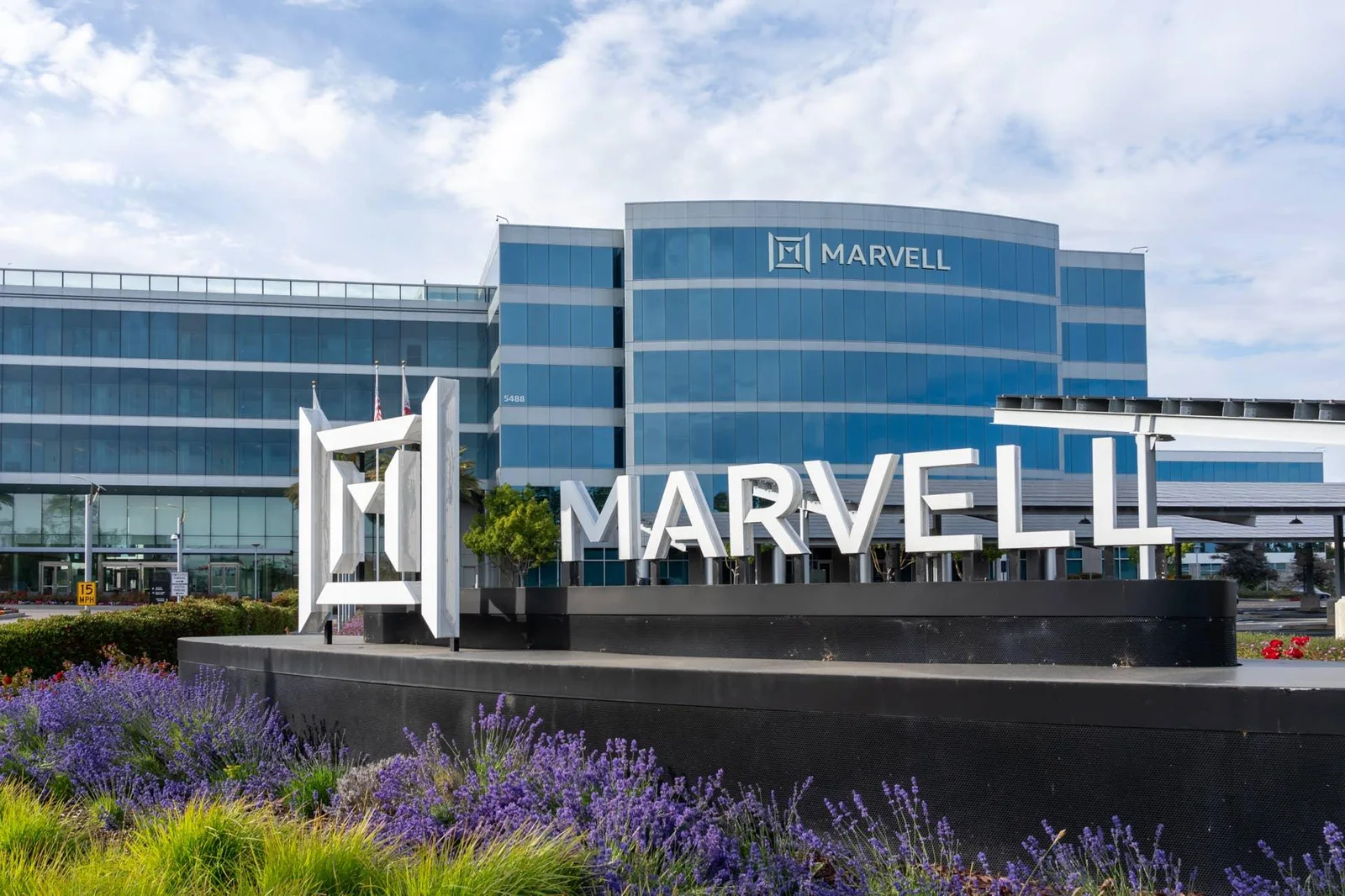
Artificial intelligence was initially presented as a competition to develop the world's most powerful processors. It is increasingly becoming a battle over the infrastructure connecting those processors. By announcing the acquisition of Lumentum on November 2, 2026, in a transaction valuing the company at approximately $115 billion in enterprise value, Marvell Technology is seeking to establish itself at one of the industry's emerging centers of gravity: optical connectivity.
The all-stock transaction provides for Lumentum shareholders to receive 4.5 Marvell shares for each share they own. They would hold approximately 33% of the combined company, with existing Marvell shareholders retaining the remaining 67%. Closing is expected in the first half of 2028, subject to regulatory approvals and shareholder consent.
Behind the transaction lies a more fundamental transformation. The computing power of an artificial intelligence system no longer depends solely on the number of processors available. It also depends on how quickly those processors exchange information, how much energy those exchanges consume, and whether the networks connecting them can operate reliably at an industrial scale.
The question is therefore no longer simply who will manufacture the most advanced chips. It is also who will control the connections that allow those chips to function collectively.
Computing Meets Its Physical Limits
The expansion of artificial intelligence infrastructure depends on the deployment of increasing numbers of computing accelerators, generally concentrated in ever-larger data centers. These machines must exchange enormous volumes of information to train models, synchronize operations, and respond to user requests.
Yet the performance of individual processors does not necessarily determine the performance of the entire system. When data transfers become too slow, computing capacity may remain partially unused. Bandwidth, latency, and the energy consumption of interconnections consequently become decisive parameters.
Traditional electrical connections, particularly those based on copper, face growing physical constraints as transmission speeds increase. Signal losses, distance limitations, and power requirements complicate their use in the most demanding architectures.
Optical technologies transmit information through light signals. Already widely deployed in telecommunications networks and between data centers, they are now advancing toward the internal connections of computing infrastructure.
This evolution does not imply the immediate disappearance of copper. Electrical connections retain technical and economic advantages over certain distances. However, the boundary between electrical and optical technologies may gradually move closer to the processors themselves.
This is precisely the transition Marvell is seeking to anticipate.
Two Companies, One Technological Value Chain
Marvell has developed substantial expertise in semiconductors used in data infrastructure, networking, and custom computing architectures. Its portfolio includes signal-processing components, switching technologies, and interconnection solutions.
Lumentum operates further along the photonics value chain. Its activities include high-performance lasers, optical transceivers, optical switching devices, and specialized manufacturing processes involving compound semiconductors.
Combining the two businesses would bring together complementary elements of the same industrial system: the electronic technologies that process and organize information, and the optical devices that transmit it.
The strategic objective extends beyond combining product portfolios. Future computing systems may require the simultaneous design of electronic components, lasers, optical interfaces, and advanced packaging technologies.
This approach, commonly described as co-design, could improve performance while reducing interoperability challenges between different suppliers.
It could also reshape commercial relationships with major data center operators, which increasingly seek integrated solutions compatible with their architectures and capable of being deployed at scale.
An Acquisition on a Different Scale
The announced enterprise value of Lumentum amounts to approximately $115 billion, while its equity value is estimated at around $102.5 billion. The distinction matters: enterprise value incorporates elements such as net debt, whereas equity value represents the consideration attributed to shareholders.
The offer represents a premium of approximately 23.9% over unaffected share prices on October 28, 2026.
The transaction would mark a considerable change in scale for Marvell. The company had already strengthened its position in interconnection technologies through the acquisition of Inphi in 2021, before extending its photonics capabilities with Celestial AI.
The proposed acquisition of Lumentum takes this strategy much further. Rather than simply acquiring a complementary technology, Marvell is attempting to build an industrial group capable of operating across several layers of artificial intelligence infrastructure.
Marvell estimates that the combined company's total addressable market could reach $550 billion. This figure represents a theoretical commercial opportunity, not guaranteed revenue.
The companies also anticipate more than $1 billion in annual recurring synergies and improvements in selected profitability measures.
These expectations depend on demanding assumptions: sustained growth in artificial intelligence infrastructure investment, accelerated adoption of optical interconnections, and the successful integration of complex industrial operations.
The acquisition price therefore reflects not only the value of existing businesses but also expectations about the future direction of technological development.
The Competition with Broadcom
One of the most significant strategic implications of the transaction concerns competition with Broadcom, a major supplier of networking semiconductors, custom integrated circuits, and data center infrastructure technologies.
Large technology companies are no longer looking exclusively for suppliers of individual components. They are developing increasingly specialized architectures combining processors, accelerators, networking systems, memory, and communication technologies.
This evolution favors companies capable of participating early in infrastructure design and supplying several complementary technologies.
By integrating Lumentum, Marvell could strengthen its ability to address a larger share of its customers' connectivity requirements.
The transformation also concerns Nvidia, whose computing ecosystem relies heavily on interconnected architectures. Major cloud providers, including Google, Amazon, and Microsoft, likewise have a strategic interest in improving the performance of the networks connecting their accelerators.
Competition, however, extends beyond Broadcom. Coherent, several Asian optical component manufacturers, and specialized semiconductor companies are also participating in this industrial transition.
The market could therefore evolve toward competition between increasingly integrated industrial ecosystems, while still preserving opportunities for specialized suppliers controlling critical technologies.
The Return of Industry to the Digital Economy
The transaction highlights an often-overlooked characteristic of artificial intelligence: behind software applications and computational models lies an extensive physical infrastructure.
Performance depends on electronic components, lasers, optical fibers, specialized materials, industrial processes, and manufacturing facilities capable of operating with exceptional precision.
Lumentum brings expertise in technologies involving indium phosphide, a material used in several important photonics applications.
Such capabilities cannot be reproduced immediately through increased research spending alone. They depend on accumulated knowledge, specialized equipment, supply chains, and industrial qualification processes developed over many years.
Control over these assets can provide a durable competitive advantage.
It also raises geopolitical questions. The production of optical and electronic components depends on international value chains, particularly those connecting the United States and Asia. Trade restrictions, industrial policies, and export controls can alter the conditions under which companies compete.
As connectivity becomes increasingly strategic, the manufacturing of optical components may attract attention comparable to that already directed toward advanced semiconductors.
Investors Question the Price of Transformation
Financial markets reacted negatively to the announcement. On November 2, shares in both Marvell and Lumentum recorded substantial declines.
The reaction reflected concerns about valuation and the combined company's ability to deliver the announced synergies.
An all-stock acquisition reduces the immediate need to finance the purchase through additional cash resources, but it does not eliminate the transaction's economic cost. It dilutes existing shareholders and transfers part of the valuation risk to investors in the combined company.
The fixed exchange ratio also means that the effective value of the consideration will fluctuate with Marvell's share price until closing.
Industrial integration represents another challenge. Bringing together semiconductor design, photonics technologies, and specialized manufacturing capabilities requires close coordination across research, production, and commercial operations.
The announced timetable also leaves a prolonged period of regulatory uncertainty. The transaction will require examination in several jurisdictions at a time when technological supplier concentration and supply-chain security are becoming increasingly important public policy considerations.
A compelling industrial rationale therefore guarantees neither the financial success of the acquisition nor its completion under the proposed terms.
A New Frontier for Artificial Intelligence
The proposed Marvell–Lumentum combination comes at a moment when the economics of artificial intelligence are gradually changing.
The first phase of expansion was dominated by access to computing accelerators. The next may depend increasingly on the ability to organize complex systems, move data efficiently, and control energy costs.
From this perspective, interconnections are no longer merely peripheral components. They are becoming a fundamental condition of overall system performance.
This transformation could encourage further industrial consolidation as companies seek to control several complementary stages of the technological value chain. It could also strengthen the bargaining power of major customers, whose investment decisions remain essential to the profitability of new infrastructure capacity.
The principal risk would be to assume that the current expansion of artificial intelligence infrastructure will continue automatically. Investment could slow, computing architectures could evolve, and technological innovations could reduce the economic value of solutions currently considered indispensable.
Marvell is therefore making an exceptionally large bet on the long-term convergence of semiconductors and photonics.
If that convergence accelerates, the acquisition of Lumentum could emerge as a major milestone in the industrial restructuring of artificial intelligence. If progress proves slower than expected, the transaction's valuation could become difficult to justify.
Ultimately, the implications extend beyond the two companies. For years, technological competition focused on making individual machines calculate ever faster. It is now shifting toward enabling those machines to operate together.
The next frontier of artificial intelligence may not lie within the processors themselves, but in the space between them.
Main Sources
- Marvell Technology and Lumentum, joint announcement of the definitive acquisition agreement, November 2, 2026.
- Marvell Technology, Form 8-K and investor presentation, filed November 2, 2026.
- Reuters, Marvell doubles down on AI boom with costly $115 billion Lumentum deal, November 2, 2026.
- Transaction documentation filed with the U.S. Securities and Exchange Commission (SEC), November 2026.
Analysis as of November 3, 2026. The transaction remains subject to regulatory approvals and closing conditions. The companies' commercial and financial projections should not be interpreted as guaranteed outcomes.
Atlas Limits Research Desk
Atlas Limits’ editorial and analytical desk.