For a long time, North Korea’s nuclear programme could be reduced to a handful of names. Yongbyon was the most important of them, almost a symbol in itself: a complex north of Pyongyang where reactors, fuel-processing facilities and uranium-enrichment capabilities were concentrated. That representation never captured the entire programme, parts of which remain concealed. But it gave the international community an identifiable centre of gravity. The latest observations by the International Atomic Energy Agency suggest that it is becoming increasingly difficult to think in those terms.
In a report dated 28 August 2026, the IAEA describes another stage in the expansion of North Korea’s nuclear infrastructure. At Yongbyon, the Agency has identified a second building associated with uranium enrichment. At Kangson, near Pyongyang, it has observed indications consistent with the operation of the annex built in 2024. At the same time, Yongbyon’s 5 MW reactor appears likely to have continued operating, while the light-water reactor has also shown signs of operation since late April.
None of these observations, taken individually, amounts to a sudden rupture. The buildings did not appear during the summer of 2026, and North Korea has been developing its capacity to produce fissile material for years. What has changed is the precision with which the organisation of that capacity is beginning to emerge. The picture is no longer simply that of a nuclear programme becoming larger. It is increasingly that of a production apparatus distributed across several facilities, expanding its capacity and multiplying its potential supply routes.
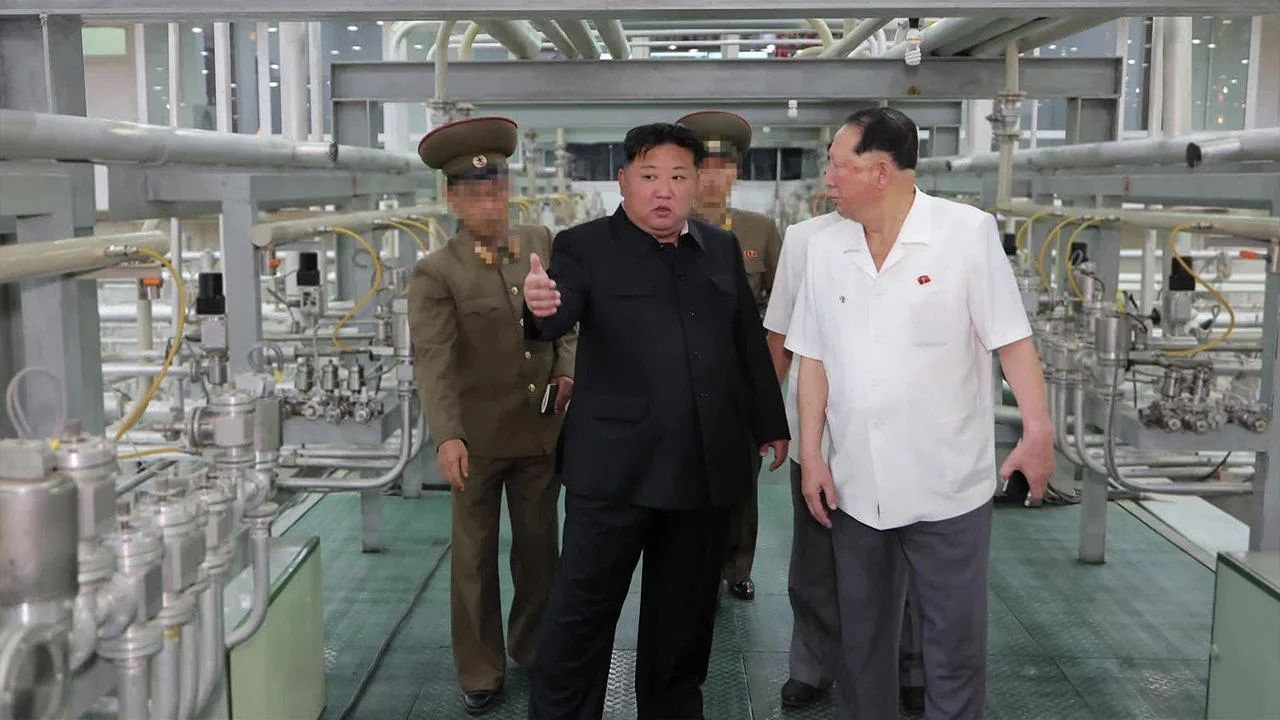
At Yongbyon, this evolution is particularly visible. At the end of 2025, the IAEA was still observing interior work in a new building without being able to determine with certainty either its configuration or its operational status. The evidence now available allows the Agency to go further. Photographs released by North Korean state media and compared with satellite imagery show centrifuge cascades installed on both floors of the building. According to the Agency, the facility could accommodate as many as 28 cascades of the type visible in those images.
The figure matters, but its meaning must remain precise. Twenty-eight cascades represent potential installed capacity, not a measurement of enriched-uranium output. The IAEA does not know the exact number of centrifuges actually operating, their performance, the enrichment level being achieved or the quantities being produced. Since its inspectors left North Korea in 2009, the Agency has been unable to conduct the physical verification that would turn external observation into a nuclear inventory.
That is precisely why Kangson matters so much.
Located near Pyongyang, the complex has for several years been monitored as a facility consistent with uranium enrichment. An annex constructed in 2024 substantially increased the available floor space. Photographs released that same year during a visit by Kim Jong Un had already enabled the IAEA to identify centrifuge cascades in the main building and in the new extension. The development in 2026 is different: the Agency now assesses that there are indications that operations began in the annex in January.
Yongbyon and Kangson therefore have to be considered together. IAEA Director General Rafael Grossi has described their simultaneous operation, alongside North Korea’s declared effort to increase the production of weapons-grade nuclear material, as a cause for serious concern. Behind the diplomatic language lies a much broader question: whether a nuclear programme once understood through a limited number of known facilities is gradually becoming a larger, more redundant and more difficult-to-measure production infrastructure.
That transformation corresponds to the evolution of North Korea’s own nuclear doctrine. Pyongyang no longer presents its arsenal simply as a minimum capability intended to guarantee regime survival while awaiting a possible agreement. For several years, the authorities have explicitly called for a quantitative increase in nuclear weapons, the development of tactical nuclear capabilities and greater production of fissile material. The physical expansion now being observed gives industrial substance to that political ambition.
Uranium enrichment occupies a particular place in this evolution. A nuclear reactor is a large installation, produces observable signatures and is relatively easy to monitor from space. A centrifuge enrichment plant is considerably more discreet. Once uranium feedstock and the necessary equipment are available, cascades can be installed inside buildings whose external appearance reveals relatively little about what takes place within them. The multiplication of enrichment sites therefore increases not only potential production capacity but also uncertainty surrounding that capacity.
That uncertainty has strategic value.
An adversary that knows the approximate size of an arsenal, its production infrastructure and its fissile-material stocks can construct scenarios around relatively stable parameters. When those parameters become uncertain, planners must work with ranges. How much fissile material can North Korea produce each year? How much comes from highly enriched uranium and how much from plutonium? Are there additional facilities that remain unidentified? How quickly could a destroyed production capability be rebuilt? As the answers become less certain, both military planning and diplomatic negotiation become more complicated.
The likely continued operation of Yongbyon’s 5 MW reactor adds another dimension to the problem. Historically associated with plutonium production, the reactor provides a different route to the material required for nuclear weapons. The light-water reactor at the same complex, which the IAEA now assesses has shown indications of operation since late April 2026, introduces another variable, even though its precise function and any possible role in the military fuel cycle cannot be established from outside the country.
North Korea is therefore gradually constructing something more consequential than a stockpile of weapons: a productive base capable of maintaining and expanding it. The distinction is fundamental. Possessing a given number of warheads constitutes a military capability. Possessing several enrichment facilities, reactors, conversion capabilities and an industrial infrastructure capable of replenishing stocks turns that capability into a system.
For Seoul, Washington and Tokyo, this evolution complicates the deterrence equation. A geographically dispersed nuclear infrastructure reduces the likelihood that a limited operation could permanently eliminate North Korea’s production capability. It increases the number of facilities that would have to be monitored, characterised and, in an extreme scenario, neutralised. It also increases the importance of satellite, electronic and human intelligence required to track a programme whose growing components can operate inside relatively inconspicuous buildings.
It also feeds an already existing debate in South Korea over the credibility of US extended deterrence. The larger, more diverse and more survivable North Korea’s arsenal becomes, the more the question facing Washington moves beyond whether it has the capability to protect its ally. It increasingly becomes a question of whether that guarantee remains credible when Pyongyang can simultaneously threaten the Korean Peninsula, Japan and potentially the American homeland. Missile defence, conventional strike capabilities and nuclear coordination among allies consequently assume greater importance.
Yet the most durable consequence may emerge somewhere else: at the negotiating table.
Nuclear agreements are comparatively straightforward when they concern a known installation. They become far more difficult when they must establish the existence, location, capacity and operational history of several sites, some of which have never been inspected. Any future process intended to cap, reduce or dismantle North Korea’s nuclear programme would therefore begin with an elementary but formidable question: what, exactly, has to be counted?
That question was already difficult when Yongbyon dominated negotiations. It becomes harder when Kangson enters the equation and the existence of additional facilities cannot be excluded. Every additional cascade, every extension and every further year of potential production increases not only the stocks that may exist but also the volume of information that would eventually have to be verified. Time therefore works in a particular way: even without another spectacular nuclear test, it can gradually make the programme more difficult to dismantle.
There is nevertheless an opposite temptation that must also be resisted: turning satellite observations into industrial certainties. The IAEA has had no inspectors inside North Korea since April 2009. Its assessments rely on commercial satellite imagery, signatures observable from outside the country and, paradoxically, photographs that the North Korean authorities themselves choose to release. These sources allow analysts to reconstruct parts of the puzzle, but not to count all of its pieces.
The Agency therefore cannot confirm fissile-material inventories, directly measure centrifuge output or establish with certainty the function of every facility it observes. The theoretical capacity of the new Yongbyon building must not be confused with verified production. Likewise, indications of operation do not amount to a material balance. Uncertainty is no longer a footnote to this story; it has become one of its central elements.
This may be where the deepest change lies. During the first decades of North Korea’s nuclear programme, the outside world largely watched Yongbyon and waited for tests that would reveal Pyongyang’s progress. The contemporary programme increasingly evolves in the intervals between those events: another building, an equipped annex, additional centrifuge cascades, one reactor operating, then another site gradually entering the equation.
An underground explosion is no longer required to announce every new stage. North Korea appears to be pursuing a more patient strategy: accumulating facilities, material and options until their combined weight changes the strategic reality.
North Korea’s nuclear programme may therefore not be changing in nature. It is changing in scale. And in a programme whose complete inventory cannot be established by anyone outside the country, scale eventually becomes a form of power in its own right.
Main Sources
International Atomic Energy Agency (IAEA) — reports by the Director General on the application of safeguards in the Democratic People’s Republic of Korea, including assessments covering 2024, 2025 and the report dated 28 August 2026.
International Atomic Energy Agency (IAEA) — statement by Director General Rafael Mariano Grossi to the Board of Governors, September 2026.
International Atomic Energy Agency (IAEA) — Safeguards Statement for 2024, including material relating to Yongbyon, Kangson and the limitations of verification in the absence of access to North Korean territory.
Reuters — “North Korea builds new Yongbyon uranium enrichment facility, IAEA says”, 9 September 2026.
United Nations Security Council — resolutions concerning the nuclear and ballistic missile programmes of the Democratic People’s Republic of Korea.
Atlas Limits Research Desk
Atlas Limits’ editorial and analytical desk.