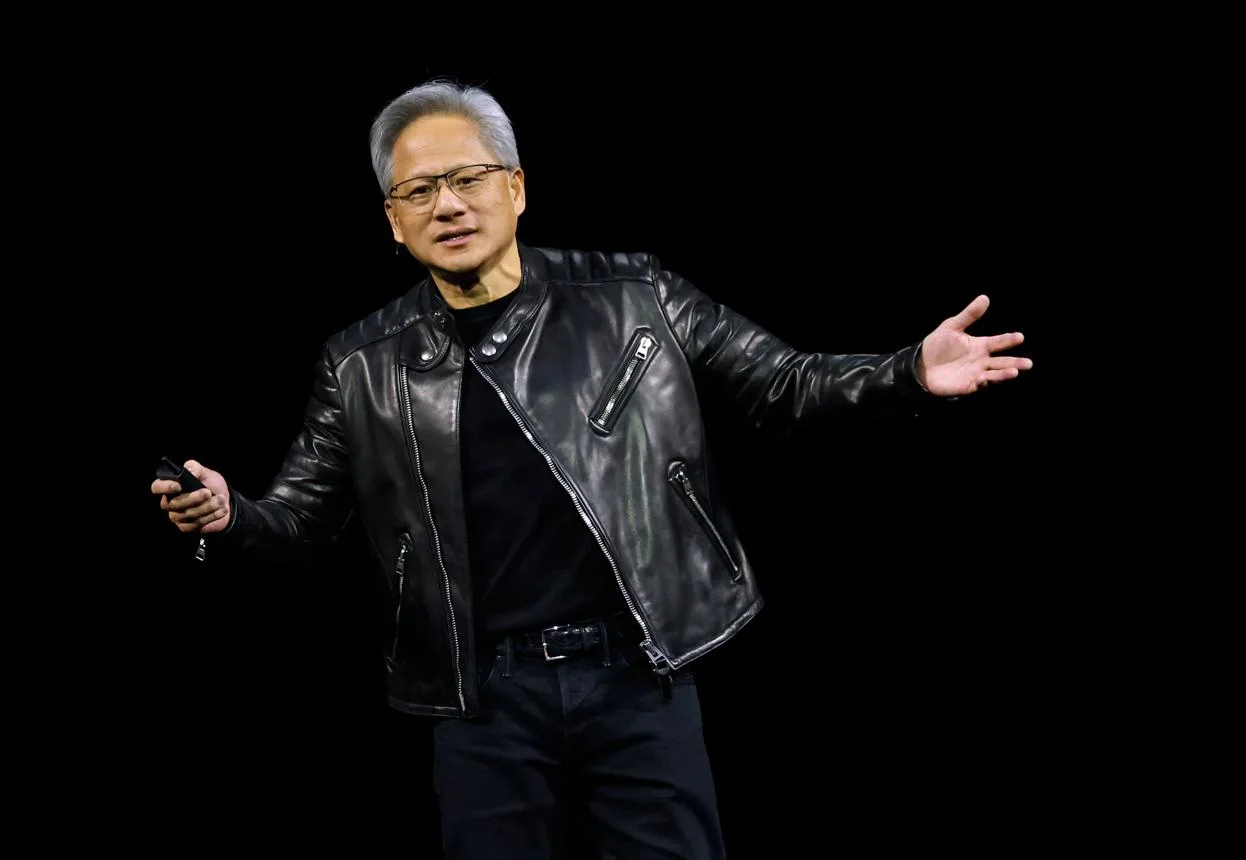
NVIDIA's leadership transition concerns a company whose investment and production decisions affect many AI customers. Its industrial importance nevertheless requires a distinction between governance facts, statements and hypotheses about consequences. The starting point is the regulatory filing: the Form 8-K says the board accepted Jensen Huang's resignation as president, chief executive and director on 11 November 2026, effective immediately. The public announcement followed on 12 November. [1][2]
Chief Financial Officer Colette Kress became interim chief executive and Harvey C. Jones became board chair. The company announced a search for a permanent successor. [1] Interim leadership provides decision-making continuity without establishing the next chief executive's profile or future strategy. The announcement date should not be treated as the date of every action it reports.
Events developed further after this article's original publication. On 17 November, Jones said the board did not intend to reinstate Huang as chief executive, Reuters and Associated Press reported. [3] This is the board's stated position at that time. It does not determine every future decision or constitute a judicial finding about information surrounding the departure.
Personal leadership and industrial continuity
A founder's departure can affect relationships with customers, staff and investors without immediately removing contracts, expertise or products. An enterprise of this scale operates through organisations, suppliers and schedules extending beyond its chief executive. The issue is whether governance can preserve coordination while reviewing choices that need to change.
Customers' priorities concern delivery and support for platforms around which they have invested. A transition becomes an operational risk if it disrupts decisions, qualifications or partner relationships. It would be excessive to infer interrupted production without concrete evidence. Products and orders need to be monitored separately from the share-price response.
Dependence on a computing supplier also extends beyond hardware. Software, developer skills and application adaptations make migration costly. Customers can seek diversification without being able to move all workloads immediately. Competition must therefore be assessed by use and timetable rather than through an assumption of instant replacement.
Internal governance matters because it organises research priorities, equipment allocation, capacity commitments and financing risks. Strong demand can encourage faster decisions while increasing the cost of delay or error. The board's task is to make responsibilities and procedures robust enough that these choices do not depend on one personality.
The ecosystem's economic value should also be distinguished from the value assigned to the shares. Investors can change the multiple they will pay without an immediate change in revenue. Industrial outcomes will be visible in deliveries, margins, customer retention and funding for future programmes. Price movements do not directly measure each of these factors.
The transition consequently opens a period of assessment rather than proving that the AI industry has already undergone a break. Established facts concern the departure, interim arrangements and board statements. Their lasting significance depends on preserving execution and renewing strategic choices under leadership whose authority will no longer rest on founder status. That institutional continuity matters to organisations that have built their own infrastructure around NVIDIA.
Sources and update
[1] SEC, NVIDIA Form 8-K, filed 12 November 2026, reporting board actions of 11 November.
[2] NVIDIA, NVIDIA Announces CEO Transition, 12 November 2026.
[3] Reuters, board position on Huang's return, 17 November 2026. Updated to 18 November; industrial implications are Atlas Limits analysis.
Atlas Limits Research Desk
Atlas Limits’ editorial and analytical desk.