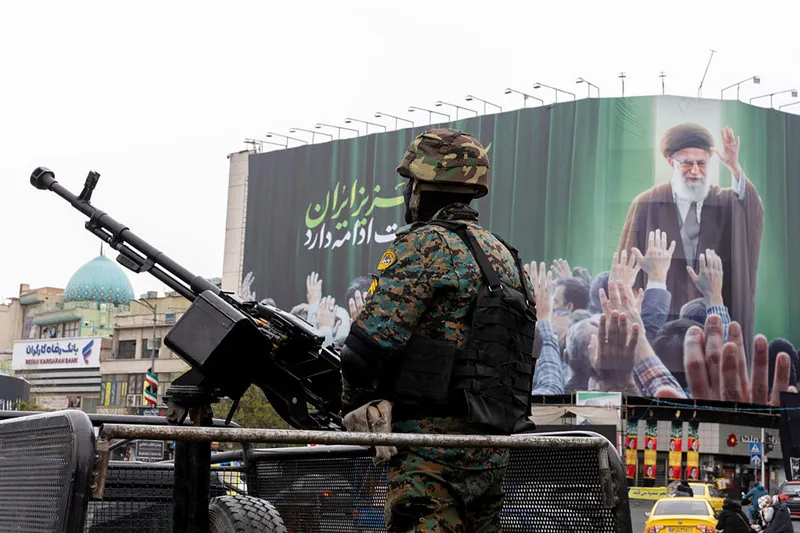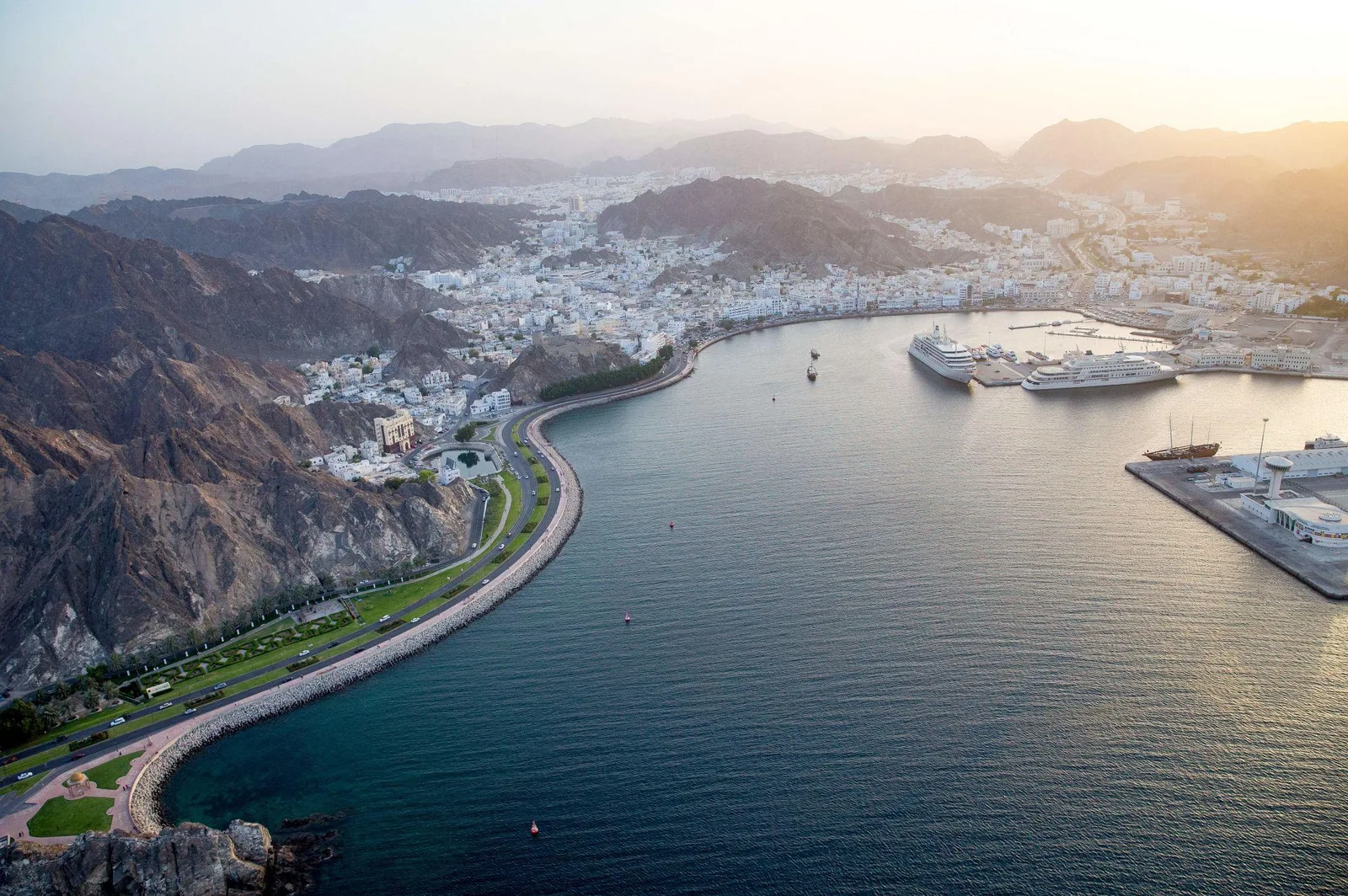
At the edge of the Arabian Peninsula, a strip of mountains descends into one of the most strategic maritime passages in the world. Here, the Strait of Hormuz is only a few dozen kilometers wide between its two shores. Iran lies to the north. Oman’s Musandam Peninsula lies to the south. Behind it begins the Persian Gulf; ahead stretches the Indian Ocean.
Almost the entire story of Oman can be read through this geography.
The Sultanate belongs to the Gulf without being trapped within it. It is Arab, yet for centuries it has looked toward India and East Africa. It maintains close relations with the monarchies of the Arabian Peninsula while preserving an unusual dialogue with Tehran. It produces oil and gas, but possesses neither Saudi Arabia’s immense reserves nor the financial power of the United Arab Emirates or Qatar. It is close enough to the region’s great rivalries to suffer their consequences, but too small to dominate them.
Oman has therefore built its power differently.
First through geography. Then through diplomacy. And increasingly through an economic strategy designed to transform its access to the ocean into an industrial, energy and logistical advantage.
In 2026, as the Strait of Hormuz has once again become one of the central pressure points of the global economy, this strategy has acquired a new dimension. A considerable share of global energy flows still depends on this passage. But Oman’s major ports of Salalah and Duqm lie directly on the Arabian Sea and the Indian Ocean.
For Oman, the strait is a position.
The open sea is a strategy.
A country facing the sea
Long before oil, Oman was maritime.
Omani sailors and merchants traveled between the Arabian Peninsula, India, Persia and East Africa. After the Portuguese were expelled from Muscat in 1650, Omani power gradually expanded along the shores of the Indian Ocean. In the nineteenth century, Zanzibar even became, for a time, the political center of an Omani realm whose commercial networks connected Arabia to East Africa.
This historical depth distinguishes Oman from several other Gulf monarchies.
Its strategic horizon has never been exclusively continental or peninsular. It is oceanic.
Today, the country possesses roughly 3,165 kilometers of coastline, stretching from Musandam in the north to Dhofar in the south. This coast provides access to the Gulf of Oman, the Arabian Sea and directly to the Indian Ocean. It places Omani territory alongside the major routes connecting East Asia, India, the Middle East, Africa and Europe.
For several decades, hydrocarbons partially obscured this older geography. Oil financed the modern state. Roads, schools, hospitals and infrastructure accompanied the extraordinary transformation launched under Sultan Qaboos from 1970 onward.
But oil never gave Oman the same room for maneuver enjoyed by its wealthiest neighbors.
The country produces around one million barrels of crude oil and condensates per day. That is considerable for a population of just over five million, but modest by Gulf standards. Oman must therefore solve a particular equation: using hydrocarbons to finance the transformation of an economic model that remains heavily dependent on hydrocarbons.
That contradiction now shapes much of its economic policy.
Power without mass
Oman cannot compete with Saudi Arabia in scale, with the United Arab Emirates in capital concentration, or with Qatar in gas abundance.
It must therefore make its small size useful.
Omani diplomacy is perhaps the most accomplished expression of this principle.
Muscat has long maintained important security ties with the United States and the United Kingdom while preserving functional relations with Iran. Oman belongs to the Gulf Cooperation Council, but it has repeatedly resisted forms of automatic alignment that would have reduced its diplomatic room for maneuver.
This position has allowed it to assume a rare role: that of an intermediary acceptable to adversaries that can no longer speak directly to one another.
Negotiations over Iran’s nuclear program have provided several examples. In 2025 and again in early 2026, Muscat hosted or facilitated discussions between American and Iranian representatives. When official channels close, Oman sometimes becomes the place where messages continue to circulate.
This role is not merely a prestigious addition to its foreign policy. It is a geographical necessity.
A prolonged confrontation between Iran and the United States directly threatens Oman. War in the Gulf disrupts its trade, investment, tourism and exports. A closure of Hormuz affects its immediate environment. Absolute polarization between Riyadh, Abu Dhabi and Tehran would reduce its autonomy.
Oman therefore has an interest in preventing any regional power from completely imposing its order.
Its moderation is not the absence of strategy.
It is the strategy.
Hormuz, or geography as destiny
Musandam is separated from the rest of Omani territory by the United Arab Emirates. This mountainous enclave appears peripheral on a political map. On a map of global flows, it becomes central.
It overlooks the southern shore of the Strait of Hormuz.
The vulnerability of the passage is well known: under normal conditions, close to one-fifth of global oil and liquefied natural gas flows pass through it. The regional crisis of 2026 has provided a brutal reminder that this dependence belongs very much to the present.
By early October, despite a partial recovery in regional exports, attacks on vessels and tensions surrounding maritime traffic were continuing to disrupt the strait. Middle Eastern crude exports had nevertheless returned in September to levels close to, and temporarily above, those observed before the war.
The paradox is revealing.
The global economy can redirect flows, mobilize inventories and reorganize routes.
It cannot easily abolish geography.
For Oman, this creates both a threat and an opportunity.
The threat is obvious: no economy located only kilometers from a major maritime conflict can fully insulate itself from the consequences.
The opportunity is less obvious.
Much of the port infrastructure Oman has spent years developing lies precisely on the other side of the bottleneck.
Duqm, a city built around a map
Several hundred kilometers south of Muscat, Duqm encapsulates Oman’s ambition.
For much of its history, the area was little more than a small settlement on an immense desert coastline facing the Arabian Sea. Today, it hosts a deep-water port, a special economic zone, a refinery, industrial infrastructure, energy facilities and projects designed to attract international capital.
Duqm’s importance does not lie only in its infrastructure.
It lies in its location.
A vessel using Duqm can reach the Indian Ocean without passing through the Strait of Hormuz. The same logic applies to Salalah, much farther south, whose port sits close to the major East-West shipping lanes connecting Asia and Europe.
The crisis of 2026 has made this characteristic particularly visible. In June, the IMF noted that Oman’s economy had so far shown relative resilience to the consequences of the regional war, specifically highlighting the location of its major ports outside the Hormuz chokepoint.
That is a considerable advantage.
Oman cannot move Musandam.
But it can gradually move the center of gravity of parts of its economy toward the Arabian Sea.
Duqm therefore becomes more than a regional development project. It is a form of geopolitical insurance built from concrete, quays, pipelines and industrial zones.
Leaving oil with the money from oil
The other battle is economic.
Progress is real. Non-hydrocarbon activities now account for close to 70% of GDP according to IMF estimates. But that statistic provides an incomplete picture of the country’s dependence.
Hydrocarbons still generate around 80% of government revenue.
In other words, Oman has diversified what it produces more successfully than it has diversified the way its state is financed.
The distinction matters.
A hotel, logistics company or factory may increase non-oil GDP, but if public spending, investment and part of domestic demand remain indirectly supported by petroleum revenues, the hydrocarbon cycle continues to irrigate the broader economy.
The IMF estimates that a shock temporarily pushing oil prices toward $40 a barrel could rapidly move Oman’s fiscal and external balances into substantial deficits.
This is precisely what Oman Vision 2040 is intended to address.
The program seeks to expand manufacturing, logistics, tourism, financial services, technology, renewable energy and non-oil exports. It also aims to increase the role of the private sector while gradually reducing the state’s dependence on hydrocarbon revenue.
The transformation has already produced results. Central government debt, which had risen sharply after the previous decade’s oil shock, had fallen to around 34.7% of GDP by the end of 2025. For 2026, despite regional disruptions, the IMF estimated in June that real growth could reach roughly 3.7%, supported in part by higher oil production.
But the real test will come when oil stops helping.
Hydrogen after oil
Here, Oman possesses another geographical advantage.
Abundant sunshine. Vast, sparsely populated spaces. Favorable wind regimes in some regions. A long coastline. Industrial ports. And a location relatively close to both Asian and European markets.
This combination explains the country’s ambitions in green hydrogen.
The idea is to use large solar and wind installations to generate renewable electricity, electrolyze water and produce hydrogen or more easily transportable derivatives, particularly ammonia.
Duqm could become one of the principal centers of this new economy.
The wager remains uncertain. The global green hydrogen industry still faces high costs, enormous infrastructure requirements and demand that is developing more slowly than some early projections suggested. Oman will not escape these constraints.
But the choice itself is revealing.
For half a century, the country’s energy advantage lay beneath the ground.
Tomorrow, it may lie across its territory.
Oil was extracted.
Renewable energy must be built.
That difference fundamentally changes the role of the state. It is no longer enough to exploit an existing resource. An entire industrial ecosystem must be constructed around a potential one.
Between Dubai and Riyadh, another path
Oman’s diversification is sometimes compared with that of the United Arab Emirates or Saudi Arabia. The comparison has limits.
Oman is not trying to reproduce Dubai.
It lacks the same urban concentration and financial power, and it does not necessarily seek the same social model. Nor can it simply reproduce the Saudi transformation, which is backed by an economy and sovereign wealth apparatus of an entirely different scale.
Its advantage may lie elsewhere.
Sohar can serve trade with the Gulf and neighboring industrial markets. Duqm can become an industrial platform directly connected to the Indian Ocean. Salalah is already positioned along one of the world’s great maritime corridors, and its container capacity has recently been expanded from roughly 4.5 million to 6.5 million TEUs annually.
Around these ports can develop refineries, petrochemicals, metals, hydrogen, warehousing, ship maintenance, industrial processing and logistics corridors.
The strategy, therefore, is not simply to build three large ports.
It is to turn the Omani coastline into an economic system.
And that system looks less toward the interior of the Gulf than toward the Indian Ocean.
The demographic constraint
This transformation faces another limitation: employment.
Oman has a population of roughly 5.4 million, including a large share of foreign workers. As elsewhere in the Gulf, the state must simultaneously attract the skills required to operate the economy and create enough attractive jobs for its own citizens.
This is one of the central contradictions of Gulf economic models.
The most competitive sectors often rely on a flexible international workforce. Yet the stability of the social contract requires diversification to benefit the national population directly as well.
The policy of “Omanization” responds to this tension. It seeks to increase the presence of Omani citizens in the private sector, but it must do so without undermining business competitiveness or simply shifting national employment into protected activities.
The real success of Vision 2040 will therefore not be measured solely in kilometers of quays, renewable megawatts or billions invested.
It will also be measured by Oman’s ability to create sufficiently productive employment to make its new model sustainable.
The value of balance
Oman remains a small country surrounded by much larger powers.
Iran has more than fifteen times its population. Saudi Arabia possesses incomparable territorial, financial and energy depth. The Emirates have financial and logistics centers already embedded in global networks. India, across the Arabian Sea, has become one of the major economic powers of the century.
Oman will dominate none of them.
But it can become useful to all of them.
Useful as a diplomatic intermediary between Washington and Tehran.
Useful as a port platform between the Gulf and the Indian Ocean.
Useful as an access point to the markets of the Arabian Peninsula.
Useful as a future producer of renewable energy and low-carbon molecules.
And useful, finally, as a relatively stable territory in a region where stability itself is becoming infrastructure.
That may be where Oman’s true singularity lies.
For several decades, globalization favored large hubs capable of concentrating flows. Dubai, Singapore, Rotterdam and Hong Kong became spectacular expressions of that model.
The world now emerging is different. Companies seek greater redundancy. Governments want to secure trade routes. Straits are becoming risks. Supply chains increasingly incorporate geopolitics. Ports are no longer judged solely by efficiency, but also by their exposure to disruption.
In such a world, the ability to bypass a chokepoint may become almost as valuable as the ability to concentrate flows.
Oman possesses precisely that possibility.
Its history began with the sea. Oil later drew it closer to the destiny of the Gulf monarchies. Geopolitics may now be pushing it back toward its older horizon.
To the north, Musandam still watches over Hormuz.
But Oman’s future may lie farther south, on the quays of Duqm and Salalah, where the strait ends and the open sea begins.
Main sources
International Monetary Fund — IMF Staff Concludes Staff Visit to the Sultanate of Oman, June 2026.
International Monetary Fund — Oman: 2025 Article IV Consultation, January 2026.
International Monetary Fund — Beyond Oil: Accelerating Export Diversification for Sustainable Growth — Oman, 2026.
Sultanate of Oman, Oman Vision 2040 — indicators, diversification objectives and implementation reports.
Ministry of Foreign Affairs of the Sultanate of Oman — historical documentation and material concerning Omani foreign policy and U.S.–Iran mediation.
Reuters — reporting and data concerning oil flows, the Strait of Hormuz and maritime tensions, October 2026.
Atlas Limits Research Desk
Atlas Limits’ editorial and analytical desk.