From Cubism to Guernica, how a revolution in visual perception intersected with the ideologies, conflicts, and political transformations of the twentieth century.
Paris, 1907. In his studio at the Bateau-Lavoir, on the slopes of Montmartre, Pablo Picasso is working on a painting that will permanently transform the history of art. Five female figures occupy a space that is difficult to recognize. Their bodies appear fractured, their faces distorted, their perspectives contradictory. Two figures display features reminiscent of African masks. Almost nothing corresponds to the conventions of representation inherited from the Renaissance. With Les Demoiselles d’Avignon, Picasso is no longer simply attempting to depict the world differently. He is beginning to question the rules that determine what a representation should be.
The rupture is initially artistic. Yet it emerges in a Europe undergoing profound political, economic, and intellectual transformations. Colonial empires are expanding their domination, industrial societies are reshaping social relations, nationalism is gaining strength, and scientific discoveries are challenging established understandings of space, time, and matter. Painting does not mechanically reflect these upheavals, but it participates in a broader movement questioning the certainties inherited from the nineteenth century.
Cubism, which Picasso would develop alongside Georges Braque beginning in 1908, represents one of the most radical expressions of this transformation. By abandoning a single perspective in favor of fragmented representation, the two artists open a question that gradually extends beyond aesthetics: can reality be understood from only one point of view?
Although fundamentally artistic in origin, this question carries considerable political resonance. Governing, interpreting history, and organizing society also involve producing representations of reality. Institutions, ideologies, and political authorities do more than administer populations and territories. They construct narratives, establish hierarchies, and seek to impose particular ways of understanding the world.
Cubism is not a political doctrine. Its history nevertheless offers a way to examine how a revolution in artistic form can intersect with the major ideological confrontations of its time.
The End of the Single Perspective
For centuries, geometric perspective occupied a central position in Western painting. Developed during the Renaissance, it made it possible to organize objects within a coherent space constructed around a particular observation point. This technique was never the only means of representing the world, but it acquired considerable authority within the European academic tradition.
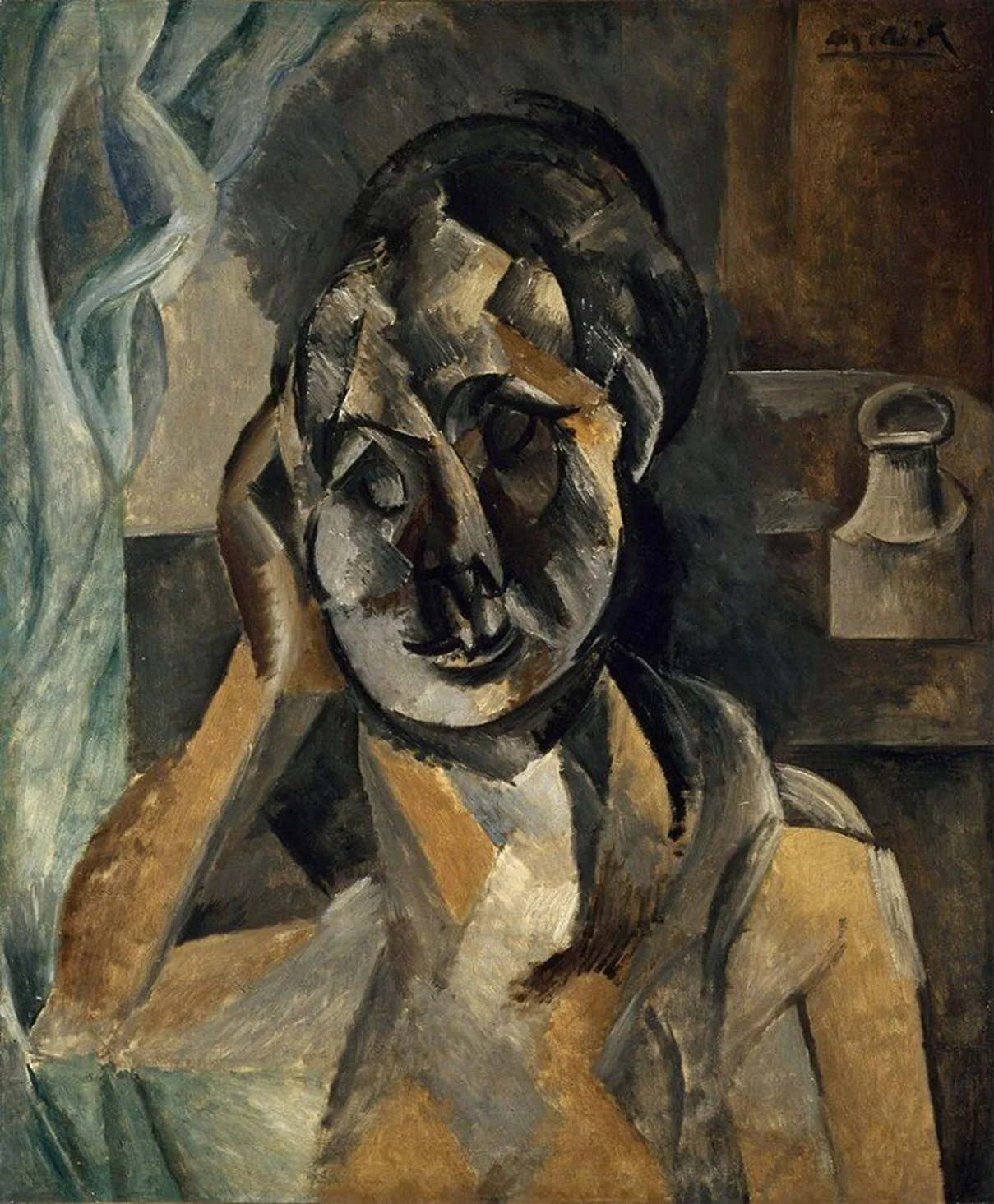
Picasso and Braque broke with this convention. A musical instrument could now be represented from several angles simultaneously. A face could combine frontal and profile views. Volumes no longer had to correspond to immediate optical perception. The painting became an intellectual construction as much as a visual representation.
In Analytical Cubism, particularly between 1909 and 1912, objects were decomposed into geometric planes that seemed to penetrate the surrounding space. The distinction between figure and background weakened. Traditional depth contracted. Rather than discovering a scene arranged before them, viewers encountered a network of relationships they had to reconstruct.
This transformation fundamentally altered the spectator's position. The eye was no longer guided toward a clearly identifiable center. It moved between fragments, searched for connections, and accepted that the represented object could not immediately be grasped in its entirety.
It would be historically misleading to interpret this development as an explicit attempt to democratize representation. Picasso and Braque were primarily pursuing artistic investigations. Their concerns did not correspond to an organized political program. Nevertheless, the intellectual implications of their approach extended beyond their original intentions.
Cubism demonstrated that representation is never an entirely neutral reproduction of reality. It depends on conventions, choices, and processes of construction. By making these mechanisms visible, it opened a broader reflection on how societies produce their own images of the world.
This question became particularly important during the twentieth century, when mass ideologies, political propaganda, photography, and cinema transformed the production and circulation of collective representations. 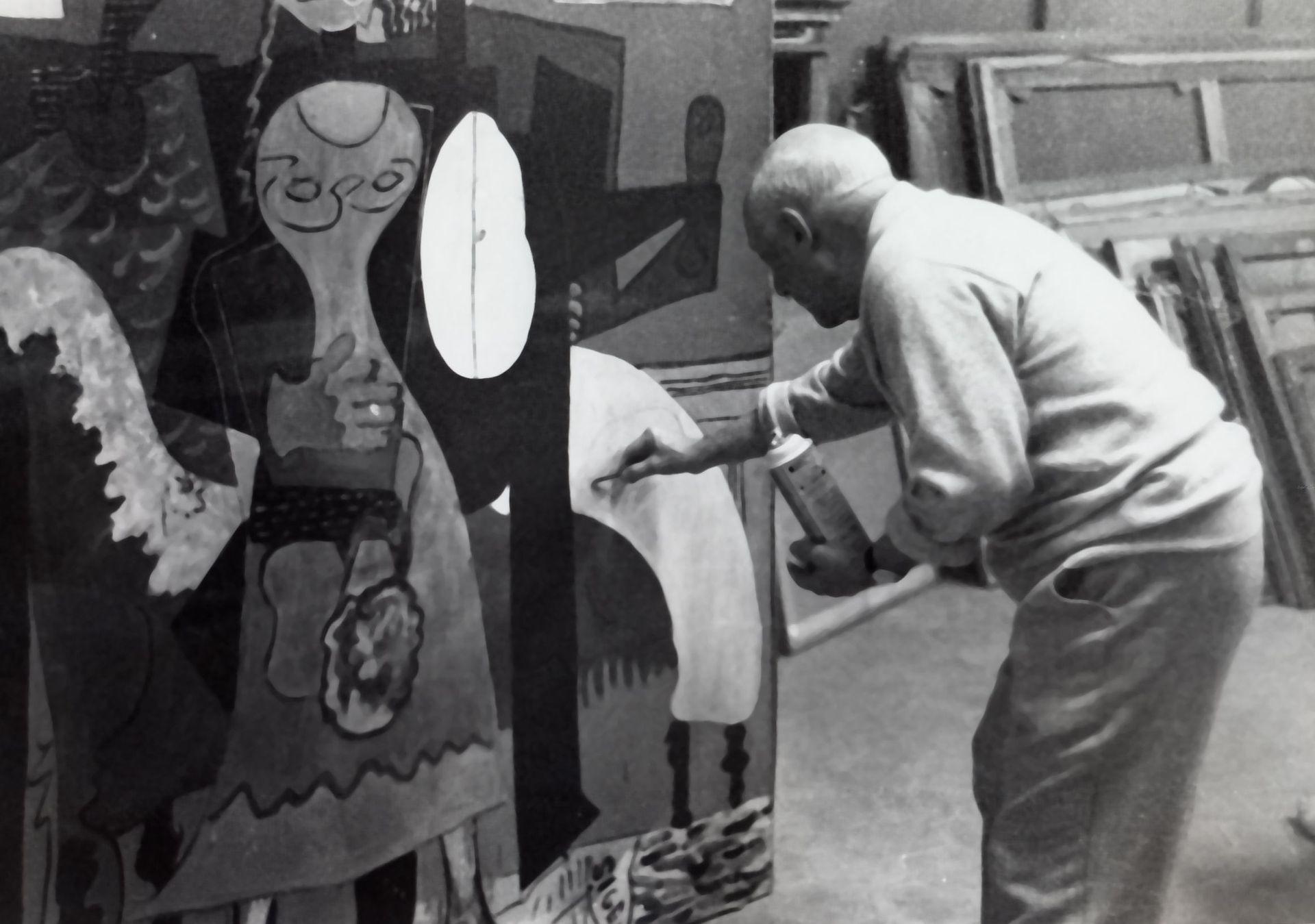
A Modernity Born in an Imperial World
The Cubist revolution cannot, however, be understood independently of the power relations that structured Europe at the beginning of the twentieth century.
Paris was an international artistic center, but it was also the capital of a colonial empire. African and Oceanian objects circulated through ethnographic museums, private collections, and European commercial networks. Their presence influenced the investigations of several modern artists, often without the cultures from which they originated receiving comparable recognition.
Picasso's encounter with certain forms of African sculpture, particularly in the context of his visits to the Musée d'Ethnographie du Trocadéro, contributed to the evolution of his visual language. The faces in Les Demoiselles d’Avignon reflect this encounter, although the influence of Iberian art and other traditions must also be considered.
This artistic circulation reveals a fundamental contradiction within European modernity. Avant-garde artists sought to free themselves from Western conventions by drawing inspiration from artistic traditions belonging to societies politically dominated by colonial powers.
Objects were admired for their formal qualities while frequently being separated from their religious, social, and historical meanings. Their transformation into aesthetic references occurred within profoundly unequal relationships.
This does not mean that Cubism can be reduced to a consequence of colonialism. Its emergence resulted from complex artistic investigations involving Cézanne, geometry, perception, and pictorial construction. Yet ignoring the imperial context would amount to presenting European artistic modernity as an entirely autonomous phenomenon.
The history of Cubism therefore reveals that aesthetic revolutions can develop within political structures they do not necessarily seek to challenge.
This distinction is essential. An artwork can radically transform artistic conventions while remaining embedded in the social and historical contradictions of its time.
The Avant-Gardes and the Revolutionary Temptation
As the twentieth century progressed, the relationship between artistic experimentation and political transformation became increasingly explicit.
In Italy, Futurism, launched by Filippo Tommaso Marinetti in 1909, celebrated speed, machines, industrial energy, and the destruction of tradition. Its provocative language accompanied a glorification of violence and war. Several of its representatives, beginning with Marinetti himself, subsequently developed close relationships with Italian Fascism.
In Russia, the avant-gardes followed a different trajectory. Constructivism, associated particularly with Vladimir Tatlin and Alexander Rodchenko, sought to bring art closer to industrial production, architecture, and social organization. Following the 1917 Revolution, several artists participated in the cultural projects of the new Soviet state.
Geometric forms, abstract compositions, and typographic experimentation became potential instruments for transforming the collective environment. Art was no longer expected merely to produce objects for contemplation. It aspired to participate in the construction of a new society.
These experiences nevertheless demonstrate that breaking with artistic tradition does not necessarily lead toward any particular political orientation.
Italian Futurism and Russian Constructivism shared certain interests in machinery, speed, and the transformation of form. Their relationships with political authority, however, followed very different paths.
Artistic modernity is therefore neither inherently emancipatory nor naturally authoritarian. It constitutes a field of experimentation whose political meanings depend on historical contexts, institutions, and individual commitments.
The fate of the Soviet avant-gardes illustrates this tension particularly clearly. While the early revolutionary years created opportunities for experimentation, the consolidation of Stalin's power brought increasing restrictions on cultural production. From the 1930s onward, Socialist Realism became the official artistic doctrine, favoring figurative representations consistent with the regime's ideological objectives.
A political revolution that had initially accommodated certain forms of experimentation eventually imposed severe limitations on their autonomy.
This development reveals a recurring contradiction between artists' ambitions to transform society and political institutions' determination to control collective representations.
Guernica: Violence Enters the Painting
On April 26, 1937, during the Spanish Civil War, the Basque town of Guernica was bombed by German and Italian air forces supporting the Nationalists led by General Francisco Franco. The attack caused extensive destruction and numerous civilian casualties. It quickly became an international symbol of the violence inflicted upon civilian populations during modern warfare.
Picasso, then living in Paris, was working on a commission for the Spanish Republic's pavilion at the 1937 International Exposition. The bombing profoundly transformed the direction of his project.
He produced an enormous composition in black, white, and gray, measuring approximately 3.5 meters in height and 7.8 meters in width. At its center, a wounded horse appears to scream. A mother holds her dead child. A bull dominates part of the scene. Dislocated bodies, open hands, and distorted faces occupy a space in which ordinary points of reference have disappeared.
No traditional battlefield is depicted. No identifiable military confrontation organizes the composition. Aircraft and bombs are not directly represented.
Violence appears through its human consequences.
The political significance of Guernica lies precisely in this transformation of representation. Picasso does not construct a heroic scene celebrating a military faction. He gives monumental form to suffering, destruction, and the disorientation produced by war.
The visual language developed since his earliest Cubist experiments acquires a new function. The fragmentation of bodies and the dislocation of space contribute to the representation of a world shattered by violence.
It would nevertheless be inaccurate to regard Guernica as a straightforward application of Analytical Cubism. The painting combines several dimensions of Picasso's artistic development, including expressive distortions, symbolic references, and compositional techniques developed long after Cubism's formative period.
Its power emerges from this synthesis.
The painting retains a precise historical significance connected to the Spanish Civil War while developing a representation that extends beyond the immediate circumstances of the bombing.
Over the following decades, Guernica became a major reference in the condemnation of wartime violence. Its reception evolved alongside armed conflicts, peace movements, and debates over historical memory.
The work demonstrates that painting can acquire lasting political significance without reproducing the conventional language of propaganda.
Picasso and Communism: The Artist Confronts the Party
Picasso's political commitment became explicit in October 1944, when he joined the French Communist Party during the Liberation of France.
His decision followed years marked by the Spanish Civil War, the German occupation of France, and the Second World War. The prestige acquired by Communists through their participation in the Resistance contributed to the party's growing influence in French intellectual and cultural life.
Picasso made no attempt to conceal his commitment. He participated in initiatives associated with the Communist movement and international peace campaigns. His lithograph depicting a dove, produced in 1949 and used for the World Congress of Partisans for Peace in Paris, became one of the most widely circulated images associated with that mobilization.
Yet his political affiliation raised a fundamental contradiction.
Soviet Communism promoted a conception of art strongly regulated by ideological requirements. Socialist Realism emphasized accessibility, positive representations of workers, and the celebration of transformations attributed to the socialist system.
Picasso's work remained profoundly different from these prescriptions.
His distorted figures, fragmented compositions, and formal experimentation did not correspond to the dominant models of official Soviet art. This distance generated tensions within certain Communist circles, where avant-garde art was sometimes criticized for formalism or for its perceived detachment from popular concerns.
The controversy surrounding Picasso's portrait of Stalin, published in Les Lettres françaises in 1953 shortly after the Soviet leader's death, illustrates this contradiction. The drawing provoked criticism among Communist officials and militants who considered it inconsistent with the expected representation of Stalin.
The incident revealed that political control over art concerned more than the subjects being depicted. It also extended to the forms considered acceptable for representing political authority.
Picasso remained a member of the French Communist Party until his death in 1973 without abandoning his artistic autonomy. His political loyalty, however, did not eliminate the contradictions of his commitment or the questions raised by his relationship with the Soviet Union.
His trajectory demonstrates that an artist can maintain a lasting affiliation with a political organization while pursuing an aesthetic practice difficult to reconcile with some of its cultural doctrines.
It also reminds us that formal artistic freedom does not, by itself, guarantee a critical position toward every form of political power.
Art as an Instrument of Legitimacy
Picasso's history raises a broader question: why do political authorities attach such importance to artists and visual representations?
States have long mobilized images to construct their legitimacy. Royal portraits, imperial monuments, battle paintings, and official architecture already participated in the staging of political authority.
The twentieth century, however, transformed the scale of this relationship.
The development of photography, cinema, posters, and mass media enabled political regimes to disseminate their representations among much larger populations.
Images became central instruments of mobilization, collective identification, and ideological competition.
Under authoritarian regimes, artistic production could be subjected to explicit prescriptions. In democracies, relationships between artistic creation and political power generally took more varied forms, involving public commissions, cultural institutions, funding mechanisms, diplomacy, and debates over freedom of expression.
The Cold War gave this competition an international dimension.
The United States and the Soviet Union sought to promote competing conceptions of modernity, culture, and freedom. American abstraction, particularly Abstract Expressionism, acquired diplomatic significance through certain exhibition programs supported by American cultural institutions. Historical research has also documented the CIA's role in indirectly financing some cultural initiatives during this period.
This instrumentalization does not mean that the artists concerned necessarily acted in the service of government programs, nor that their works can be reduced to their diplomatic uses.
Rather, it demonstrates that an aesthetic innovation can be reinterpreted as a political symbol independently of its creators' intentions.
Art thus becomes a field of confrontation between several ambitions: producing new forms, asserting collective identity, legitimizing political authority, or demonstrating the supposed superiority of a particular social model.
Picasso's career intersects with nearly all these dimensions.
His work contributed to the transformation of modern pictorial language, became associated with the condemnation of war, accompanied certain political movements, and gradually entered the international cultural heritage.
The Paradox of Recognition
Another transformation emerged during the twentieth century: works initially considered provocative or incomprehensible eventually entered the most prestigious institutions.
Cubism, which had disrupted academic conventions, gradually became a central chapter in the official history of modern art. Picasso's paintings entered major public and private collections. Museums devoted exhibitions to a visual language once perceived as a radical rupture.
This process of recognition raises questions about the ability of institutions to absorb aesthetic challenges.
Can an artwork retain its critical power once it becomes an object of cultural heritage, diplomatic prestige, or financial speculation?
There is no simple answer.
The incorporation of an artwork into a museum can neutralize certain aspects of its original provocation. It can also ensure its preservation, broaden public access, and allow new generations to assign it different meanings.
Guernica illustrates this ambiguity.
After being exhibited in several countries, the painting remained for many years at the Museum of Modern Art in New York. Picasso had expressed the wish that it should not be transferred to Spain until the political conditions necessary for the restoration of public freedoms had been established.
The painting finally arrived in Spain in 1981, six years after Franco's death and during the country's democratic transition. It is now housed at the Museo Reina Sofía in Madrid.
Its return carried a significance extending far beyond art history. It accompanied the reconstruction of Spanish political memory and became a symbolic event in the country's institutional transformation.
A painting originally created to condemn historical violence thus acquired a new function in the representation of a different political order.
The artwork remained materially unchanged, but its public meanings evolved alongside the societies observing it.
Who Organizes Our Vision?
More than a century after Les Demoiselles d’Avignon, representation occupies a central place in contemporary societies.
Images are no longer produced and distributed primarily by artists, cultural institutions, or traditional media. They now circulate through digital platforms, recommendation systems, and technologies capable of automatically generating visual content.
This transformation profoundly changes the conditions under which individuals construct their understanding of the world.
Photography, video, data visualization, and artificial intelligence-generated images can document events, but they can also select, simplify, or distort certain aspects of reality.
Distribution systems themselves play a decisive role. By prioritizing some images over others, they help organize collective attention.
The political question therefore concerns not only the content of representations but also the infrastructures determining their visibility, circulation, and credibility.
This does not establish a direct historical continuity between Cubism and digital technologies. Their contexts, intentions, and mechanisms are profoundly different.
Yet a common question remains: how do forms of representation influence our understanding of reality?
Picasso helped demonstrate that an object could be represented from more than one perspective. Contemporary technologies multiply the perspectives available while creating new possibilities for selection and control.
The proliferation of images does not necessarily guarantee a diversity of viewpoints.
A society may possess an almost unlimited quantity of representations while concentrating their distribution in the hands of a relatively small number of technological and economic actors.
The question of visual authority, which art history allows us to explore in a particular form, thus intersects with contemporary debates about information, technology, and power.
The Freedom to See Differently
Picasso's political history cannot be reduced either to his Communist commitment or to the antiwar significance of Guernica. It begins much earlier, with the formal transformations that led to the emergence of Cubism.
This chronology matters.
Picasso did not wait until he took explicit positions in the ideological conflicts of his time to participate in a fundamental reconsideration of representational conventions. His work first transformed the construction of images before becoming more directly involved with the political events of the century.
It would nevertheless be misleading to conclude that every aesthetic innovation constitutes an act of emancipation. Avant-garde movements maintained diverse, sometimes contradictory relationships with political ideologies and regimes. Some accompanied revolutionary projects, others nationalist or authoritarian ambitions. Many simply pursued artistic investigations whose historical consequences extended beyond their original intentions.
This complexity is precisely what makes Picasso's trajectory so revealing.
Cubism demonstrates that visual conventions can be transformed. Guernica shows that formal freedom can become a language for condemning violence. Picasso's Communist commitment finally reminds us that artistic autonomy and political loyalties can coexist within a permanently conflicted relationship.
Art therefore exists neither entirely outside politics nor in a position of simple dependence upon it. It constitutes a space in which representations of the world can be reproduced, challenged, or reinvented.
In 1907, Picasso fragmented bodies and disrupted perspective. He was not proposing a new political system. He was demonstrating that an image could cease to obey the rules that had previously appeared to determine its coherence.
The significance of that rupture remains.
For power does not consist solely in deciding what people are allowed to do. It also resides, in part, in the capacity to determine what they can see, what they recognize as real, and the perspectives through which they understand their time.
And one of the freedoms that art can preserve is precisely the freedom to reveal that the world could have been represented differently.
Main Sources
Museo Nacional Centro de Arte Reina Sofía — Guernica, Pablo Picasso, 1937. Historical and artistic documentation concerning the painting, its creation, and its return to Spain in 1981.
Museum of Modern Art (MoMA) — Documentation on Pablo Picasso, Les Demoiselles d’Avignon (1907), and the development of Cubism alongside Georges Braque.
Musée national Picasso-Paris — Collections, archives, and biographical resources covering Picasso's political commitments and his relationships with twentieth-century artistic movements.
Centre Pompidou — Historical and educational resources on Cubism, European avant-garde movements, and the transformation of modern art.
Tate — Documentation on Cubism, Futurism, Constructivism, and the relationship between abstraction and artistic modernity.
Gertje R. Utley — Picasso: The Communist Years, Yale University Press, 2000. A historical study of Picasso's political commitments and his relationship with the French Communist Party.
Frances Stonor Saunders — Who Paid the Piper? The CIA and the Cultural Cold War, Granta Books, 1999. A historical investigation into cultural policies and influence operations during the Cold War.
Serge Guilbaut — How New York Stole the Idea of Modern Art: Abstract Expressionism, Freedom, and the Cold War, University of Chicago Press, 1983. An analysis of the relationship between modern art, cultural institutions, and the geopolitical transformations of the postwar period.
Atlas Limits Research Desk
Atlas Limits’ editorial and analytical desk.