By placing additional European industrial assets under Russian administration, Moscow is accelerating a profound transformation of its economic relationship with the West. Behind the officially temporary nature of these measures lies a more enduring question: what remains of corporate ownership when control over an investment depends on the balance of power between states?
16 October 2026 — Geopolitics | Eurasia
A factory can continue operating even after its owner has lost the ability to manage it. Employees remain at work, production lines keep running, goods circulate, and customers continue receiving deliveries. Yet the essential decisions have passed into different hands. Investments accumulated over decades still exist physically, but the companies that financed them no longer necessarily possess the means to operate them. It is within this widening gap between legal ownership and economic control that another dimension of the confrontation between Russia and Europe is unfolding.
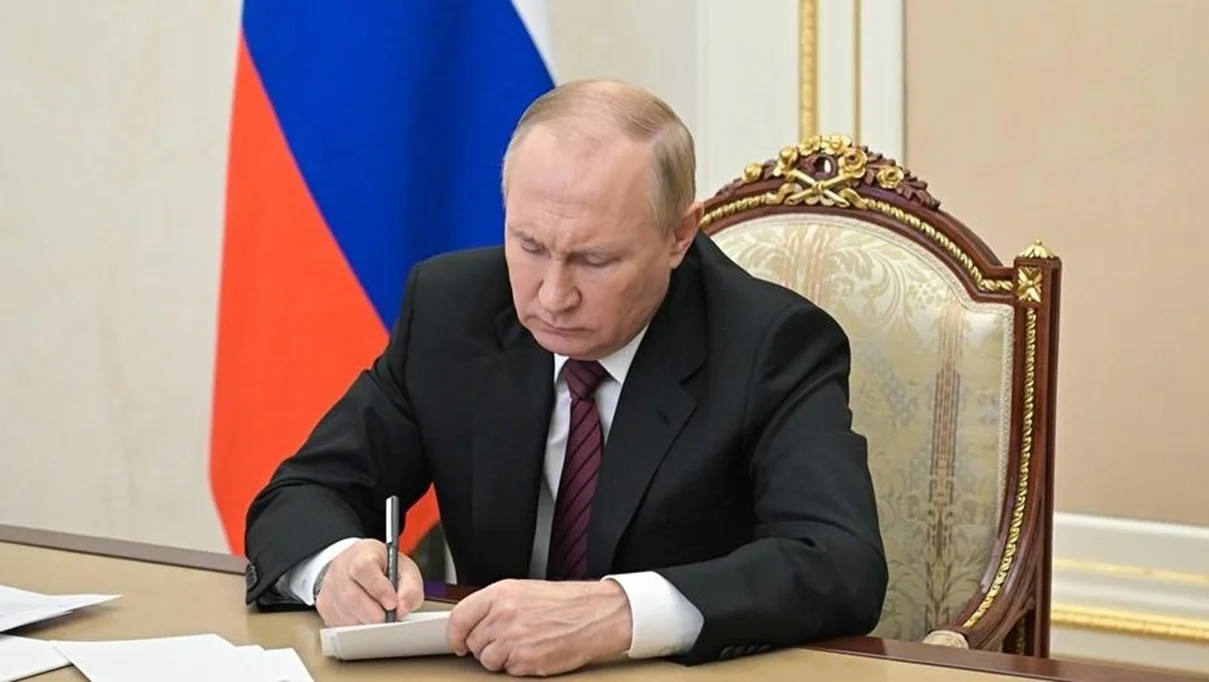
On 15 October 2026, a new decree signed by Vladimir Putin placed Russian assets belonging to several foreign industrial groups under temporary administration. The companies reportedly affected include French flooring manufacturer Tarkett, German packaging specialist Menshen, Belgian hygiene products group Ontex, and operations associated with Sweden's Sverige International Holdings. The measures also extend to Eviosys, a metal packaging company acquired by the American group Sonoco in 2024. The targeted holdings have been transferred to the administration of a Russian management company, Centre Capital.
Together, the affected operations represent a substantial industrial portfolio, with combined annual revenues reportedly exceeding 50 billion roubles, equivalent to approximately €530 million according to estimates published around the decree. The measure is not formally presented as a permanent transfer of ownership. Foreign shareholders retain their legal titles, while management authority is assigned to administrators appointed under the Russian framework. Yet this distinction, although legally essential, does not fully capture the economic consequences of the decision.
An industrial company is more than a collection of buildings, machinery, and financial holdings. It is a network of commercial relationships, technical knowledge, investment decisions, and contractual commitments. Removing an owner's ability to determine how that network operates fundamentally changes the economic value of the investment, even when the shareholder's name remains on the register.
Economic integration becomes strategic vulnerability
During the three decades following the collapse of the Soviet Union, economic relations between Russia and Europe developed around increasingly institutionalised interdependence. European companies sought access to a large domestic market, abundant natural resources, and significant industrial capacity. Russia, in turn, benefited from foreign capital, technology, distribution networks, and production methods that supported the modernisation of parts of its economy.
This integration extended far beyond hydrocarbons. It encompassed retail, food processing, chemicals, construction materials, industrial equipment, financial services, and consumer goods. In several sectors, European groups established local subsidiaries, acquired existing companies, or developed manufacturing facilities intended to supply Russian customers.
These investments rested on a fundamental assumption: political disagreements might complicate commercial relations without necessarily undermining the continuity of economic rights. Contracts, shareholdings, and industrial assets were expected to retain a degree of stability even when diplomatic relations deteriorated.
That assumption began weakening after 2014 and deteriorated much more rapidly following Russia's full-scale invasion of Ukraine in February 2022. Western sanctions, financial restrictions, foreign corporate withdrawals, and Russian countermeasures fragmented an economic space that had previously become relatively integrated.
For European investors, the difficulty was no longer limited to the profitability of their operations. It increasingly concerned their ability to transfer dividends, sell equity holdings, maintain technological supplies, or simply retain control over their subsidiaries.
Russia, meanwhile, developed mechanisms allowing the authorities to assume control over foreign-owned businesses associated with countries Moscow designated as unfriendly. The temporary administration framework introduced in April 2023 marked an important stage in this process. Initially applied to assets associated with Germany's Uniper and Finland's Fortum, the mechanism was subsequently extended to other companies.
The decisions taken in September and October 2026 follow this trajectory. After measures targeting businesses including Nestlé, Auchan, and Metro, the latest decree reaches specialised manufacturing activities. The approach is therefore no longer confined to major energy groups or companies with particularly high political visibility. It increasingly affects ordinary industrial sectors embedded in domestic production and consumption chains.
The issue consequently extends beyond the fate of individual investors. It concerns the foundations of the guarantees upon which economic relations between Russia and Europe were constructed.
Three legal mechanisms, one geopolitical confrontation
The proliferation of economic measures on both sides should not obscure their legal differences. European sanctions against Russia, the immobilisation of Russian sovereign reserves, and Moscow's temporary administration of foreign-owned companies operate through distinct legal mechanisms.
Western sanctions include trade restrictions, financing prohibitions, measures targeting designated individuals and entities, and limitations on technology exports. Their purpose is to constrain the economic resources and capabilities available to Russia in the context of the war in Ukraine. Their scope varies across sectors, jurisdictions, and legal instruments.
The immobilisation of Russian sovereign assets follows a different logic. Approximately €210 billion in Russian central bank assets remain immobilised within the European Union. These holdings, a substantial portion of which are maintained through European financial infrastructure, cannot be freely accessed or mobilised by their owner. Their immobilisation does not, however, automatically mean that ownership of the underlying principal has been transferred to European governments.
This distinction matters. Restricting access to an asset, allocating certain revenues generated by it, and permanently confiscating its principal are different operations, each raising specific questions of law, sovereignty, and financial responsibility.
Russian decisions targeting foreign companies introduce a third configuration. Owners may formally retain their equity holdings while management rights are transferred to appointed administrators. Such measures directly affect the ability to make the industrial and commercial decisions that determine an investment's value.
Moscow presents these interventions as responses to Western restrictions and what it describes as infringements of Russian interests abroad. European authorities, meanwhile, justify their sanctions by reference to Russia's aggression against Ukraine and the need to exert economic pressure on Moscow.
These positions do not make the mechanisms legally equivalent. They nevertheless demonstrate that cross-border investments, financial reserves, and economic rights have become embedded in a political confrontation extending far beyond their original functions.
This creates an additional difficulty: assets are increasingly assessed not only according to their productive or financial value, but also according to their potential usefulness in negotiations between governments.
The paradox of temporary administration
The Kremlin emphasises the reversible nature of measures imposed on foreign companies. In early October, Vladimir Putin had already raised the possibility of returning certain Western assets if relations improved. This formulation formally preserves the prospect of normalisation.
But legal reversibility does not guarantee economic reversibility.
A company placed under external administration for several years can undergo profound changes without any formal alteration to its ownership. Its executives may be replaced, suppliers redirected, contracts renegotiated, and investment priorities redefined. Customer relationships evolve, financial arrangements change, and management systems can gradually diverge from those of the original parent company.
In manufacturing, these developments are particularly consequential. The value of a factory depends on equipment maintenance, access to spare parts, workforce expertise, and the continuity of technical processes. A facility that remains operational may nevertheless lose competitiveness if it no longer benefits from the investment, technology, or standards that previously supported its development.
Similar questions arise concerning brands, patents, and distribution networks. A company might eventually recover its ownership rights without regaining the commercial organisation it originally built.
Cash flow introduces another complication. Profits generated during the administration period, their allocation, new contractual commitments, and additional liabilities can substantially alter a company's financial position. Returning an asset does not automatically resolve questions about the value created, transferred, or destroyed while control was exercised by others.
Time therefore becomes a decisive variable. The longer a temporary administration continues, the more difficult it becomes to reverse the decisions taken under it.
Formal restitution may remain possible even when a return to the previous economic situation no longer is.
A quiet redistribution of industrial power
Placing foreign assets under temporary administration does not affect only their owners. It also changes the distribution of economic power within Russia.
When a domestic management company receives operational control over a foreign-owned business, it acquires decision-making authority over facilities, employees, supply arrangements, and commercial flows that may have taken decades to establish. This authority can contribute to the emergence of new industrial actors or strengthen companies already operating in the Russian market.
That does not necessarily mean every affected company will be sold or permanently transferred. But it creates conditions under which corporate governance and economic relationships can be reorganised around actors now enjoying privileged access to management.
This industrial dimension is essential to understanding the significance of the decrees. Foreign-owned assets are not simply frozen while awaiting a diplomatic settlement. They can continue producing, selling, and generating revenue under different management.
For Moscow, maintaining operations offers an evident economic advantage. The abrupt closure of industrial facilities could produce job losses, supply disruptions, and difficulties for Russian businesses dependent on their products. Continued production can limit these disturbances while reducing the control exercised by foreign shareholders.
Yet this strategy also faces constraints. The companies concerned may depend on imported technologies, licences, specialised components, or international commercial relationships that are difficult to replace. Domestic administration may preserve immediate operations without necessarily possessing the resources required to maintain the same performance over the longer term.
The industrial question is therefore not simply who controls a factory. It is whether that control preserves, transforms, or gradually erodes the productive capabilities accumulated within it.
As these situations multiply, the Russian economy may become less dependent on certain decisions taken at European corporate headquarters, while simultaneously exposing itself to reduced foreign investment and fewer future technology transfers.
Property as a diplomatic instrument
The timing of the latest decree adds to its geopolitical significance. The decision comes as European leaders gather in Brussels to examine continued support for Ukraine and the mechanisms through which that support might be financed.
The future use of immobilised Russian sovereign assets remains central to these discussions. Their potential mobilisation to support Kyiv raises significant legal and political difficulties, particularly for the states and financial institutions responsible for holding them.
Within this context, Russian decisions concerning European companies can be interpreted as an additional means of exerting pressure on Western governments. This interpretation must nevertheless be distinguished from Moscow's official explanation, which presents the measures as responses to European actions.
Private investments are consequently exposed to decisions that extend far beyond the activities of their owners.
A French company manufacturing flooring materials or a German producer of packaging components does not determine its government's foreign policy. Yet it may directly bear the economic consequences of relations between its home country and Russia.
This separation between political responsibility and economic exposure is one of the most consequential features of the current confrontation. Companies become targets of state-level measures regardless of whether they have played any direct role in the disputes concerned.
The phenomenon also transforms diplomatic calculations. When a government considers additional sanctions, it must account for the economic interests of companies that remain exposed within Russia. Conversely, Moscow can incorporate the existence of these assets into its assessment of the economic leverage available to it.
Private property, without formally disappearing, acquires a strategic dimension that it did not necessarily possess when the original investment was made.
A rupture extending beyond Russia
The implications of these developments may reach beyond Russian-European relations.
For several decades, the globalisation of productive investment has rested on the assumption that companies can commit capital to foreign jurisdictions over long periods while relying on reasonably predictable rules. Investment protection treaties, arbitration mechanisms, and contractual guarantees have supported this expansion.
These instruments have never eliminated political risk. Nationalisations, capital controls, and expropriations existed long before the present confrontation. Recent events nevertheless illustrate how a major geopolitical rupture can weaken the practical effectiveness of legal protections, particularly when enforcement depends on states engaged in a prolonged conflict.
For multinational companies, the result is a transformation in risk assessment. Investment stability no longer depends solely on market profitability, taxation, or infrastructure quality. It also depends on the geopolitical position of the host country, its relationship with the investor's home state, and the possibility that industrial assets could become instruments of retaliation.
These developments may encourage more regional production networks, greater geographical diversification, and the reduction of dependencies considered excessive. They may also increase the cost of capital in jurisdictions perceived as politically exposed.
It would nevertheless be excessive to conclude that international investment is approaching its end. Companies will continue seeking markets, resources, and industrial capabilities abroad. But they may attach greater importance to whether their ownership rights can actually be enforced under adverse political circumstances.
The distinction between owning an asset and being able to exercise control over it becomes central to cross-border investment decisions.
What guarantees remain after confrontation?
The possibility of a future improvement in relations between Moscow and European capitals does not, by itself, resolve the difficulties already accumulated.
A potential lifting of sanctions could restore certain financial and commercial transactions. A political agreement might also establish mechanisms for restitution, compensation, or dispute settlement. But such decisions would not necessarily reconstruct the industrial structures, contractual relationships, and market conditions that existed before the war.
Companies would have to assess not only whether their assets could be recovered, but also whether resuming operations remained economically worthwhile. They would need to examine the condition of facilities, commitments undertaken during their absence, commercial prospects, and the credibility of future legal protections.
Returning to a normal economic relationship would therefore require more than a diplomatic agreement. It would demand the reconstruction of institutional confidence eroded over several years.
That difficulty could weigh on European investment in Russia long after any political détente. Companies that experienced a loss of control without a formal transfer of ownership may conclude that legal guarantees offer insufficient protection when they cannot be effectively exercised.
The decree of 15 October thus illustrates a transformation extending beyond the companies directly affected. The confrontation between Russia and Europe is no longer confined to trade flows, financial sanctions, or energy resources. It increasingly reaches the ownership and governance structures that once made their economic integration possible.
Russia maintains that its measures remain temporary. That designation retains legal and diplomatic significance. But it does not fully answer questions about their duration or the industrial transformations they may produce.
Irreversibility does not necessarily begin when a government announces a definitive nationalisation. It can emerge gradually, as management decisions, unrealised investments, lost commercial relationships, and new dependencies make it impossible to restore the previous organisation.
This may be the most profound rupture of all: a system in which property rights continue to exist formally, but their exercise increasingly depends on political conditions whose timing and outcome lie beyond the control of the companies concerned.
Main Sources
- Russian Presidential Decree No. 738, 15 October 2026, concerning the temporary administration of foreign-owned corporate holdings.
- Reuters, 16 October 2026, Russia takes control of more European corporate assets ahead of Zelenskiy's appearance at EU summit.
- Reuters, 29 September 2026, reporting on the expansion of temporary administration measures affecting European companies.
- Reuters, 1 October 2026, reporting on Vladimir Putin's statements concerning the possible return of Western-owned assets.
- Council of the European Union, institutional documentation on sanctions against Russia and the immobilisation of Russian sovereign assets.
- Euronews, 16 October 2026, reporting on the companies affected and the provisions of the new decree.
Atlas Limits Research Desk
Atlas Limits’ editorial and analytical desk.