Russia can lose markets, see its arms exports decline and still retain considerable power to shape world affairs. It can face opposition within a society while becoming indispensable to its leaders. It can inspire a government’s distrust while continuing to maintain its military equipment, supply its energy or participate in negotiations on which its security depends. This coexistence of vulnerability and influence is one of the defining characteristics of Russian power.
It would be a mistake to seek a single explanation for this presence. Neither propaganda, hydrocarbons nor military interventions alone can explain how Moscow operates. Its influence rests on their combination, adapted to circumstances and interlocutors. It does not always require support for the Russian model. It may arise from commercial calculation, technical dependence, a need for protection or the desire for an additional partner when dealing with Western powers.
The decisive question is therefore less where Russia is present than what that presence enables it to obtain. Selling a power plant, training an army, spreading a narrative and influencing a sovereign decision are different outcomes. Confusing them can lead both to exaggerating Moscow’s reach and to underestimating the mechanisms through which it becomes established.
Russia’s first advantage lies in an inherited position that economic difficulties alone cannot erase. Its permanent seat on the UN Security Council, nuclear arsenal and geography secure it a role in issues whose importance extends beyond its commercial weight. These attributes provide bargaining power and, in certain circumstances, the ability to obstruct. They do not automatically generate allies, but they make treating Russia as a secondary actor costly.
Alongside this position, Moscow pursues bilateral relationships centred on the immediate needs of those in power. In a state facing an insurgency or a threat to its government, readily available military assistance can matter more than a promise of long-term investment. A partner’s usefulness is then measured by its ability to supply equipment, advisers and protection. Research published by Carnegie in February 2026 describes how Russia has responded to this demand in the Central African Republic and the Sahel, building political positions around security services.
Yet this relationship contains a fundamental ambiguity: the security of a government and that of its population are not necessarily the same. A leadership can remain in power without durably restoring control over its territory. An operation can deliver a military success without rebuilding administration, justice or economic activity. Assessing Russian influence therefore requires distinguishing its ability to protect a partner from its ability to resolve the problems that made such protection necessary.
Arms provide another means of embedding a relationship over time. Purchasing a military system generally entails years of training, maintenance, spare parts and upgrades. A contract can thus outlast changes of government and diplomatic disagreements. But this instrument is undergoing measurable erosion. According to SIPRI, Russian exports of major arms fell by 64% between 2016–2020 and 2021–2025. Russia’s share of global exports dropped to 6.8%. These figures measure the volume of transfers under SIPRI’s methodology, rather than their financial value.
This decline does not mean that Russian equipment already delivered ceases to create dependencies. It does, however, suggest that renewing this influence is becoming harder. A power can service an installed base while losing ground in future orders. The distinction matters: the accumulated stock of inherited relationships can conceal a weakening of the means required to reproduce them.
Energy reveals a comparable pattern. For years, gas relations with Europe combined commercial revenues, fixed infrastructure and political interdependence. That arrangement has been profoundly disrupted since the full-scale invasion of Ukraine. According to the Council of the European Union, Russia’s share of European gas imports fell from 45% in 2021 to 13% in 2025. Its share of oil imports declined from 27% to below 3%.
These figures illuminate a limit to economic coercion. Dependence provides an advantage as long as a partner considers maintaining it less costly than reducing it. Once that dependence becomes a strategic threat, the partner accepts the expense of escaping it. Politicising a commercial relationship can therefore accelerate its destruction. Moscow retains major energy resources and export markets, but redirecting flows does not necessarily recreate the leverage it previously held over their recipients.
Nuclear energy operates on a different timescale. At Akkuyu in Turkey, the Rosatom-led project comprises four 1,200-megawatt reactors, for a planned capacity of 4,800 megawatts. Its model combines construction, ownership and operation through the Russian project company. The relationship therefore extends beyond equipment delivery: it involves operating essential infrastructure over a long period.
It would nevertheless be excessive to infer control over Turkish policy. Sectoral dependence does not eliminate the client state’s bargaining capacity. It introduces costs, constraints and shared interests into its calculations. This is precisely where influence should be examined: in the difficulty of replacing a supplier, the consequences of a rupture and the place the relationship occupies among other national priorities.
The information contest works differently. It seeks to alter perceptions of events, the credibility of institutions or the political cost of certain decisions. The existence of Russian manipulation operations is documented. In June 2023, Viginum identified 355 domain names impersonating media outlets as part of the RRN campaign, also known as Doppelgänger. Imitations of French newspapers were among the platforms designed to deceive readers.
But documenting an operation does not establish its effectiveness. How many people encountered it? How many believed the content? How many changed their opinions or behaviour? These questions are harder to answer than counting fake websites and posts. Yet they must remain central to the analysis. In its June 2025 report on African Initiative, Viginum describes a propaganda apparatus and covert digital activities while emphasising that the limited audiences of its channels warrant caution about its actual impact.
Such caution prevents another error: attributing to Moscow every expression of dissent that serves its interests. Distrust of former colonial powers, criticism of Western interventions and perceptions of unequal international treatment have causes of their own. Russian actors can amplify them, redirect them or provide platforms for their expression. They did not necessarily create them. Reducing these opinions to foreign manipulation erases the experiences and choices of the societies concerned.
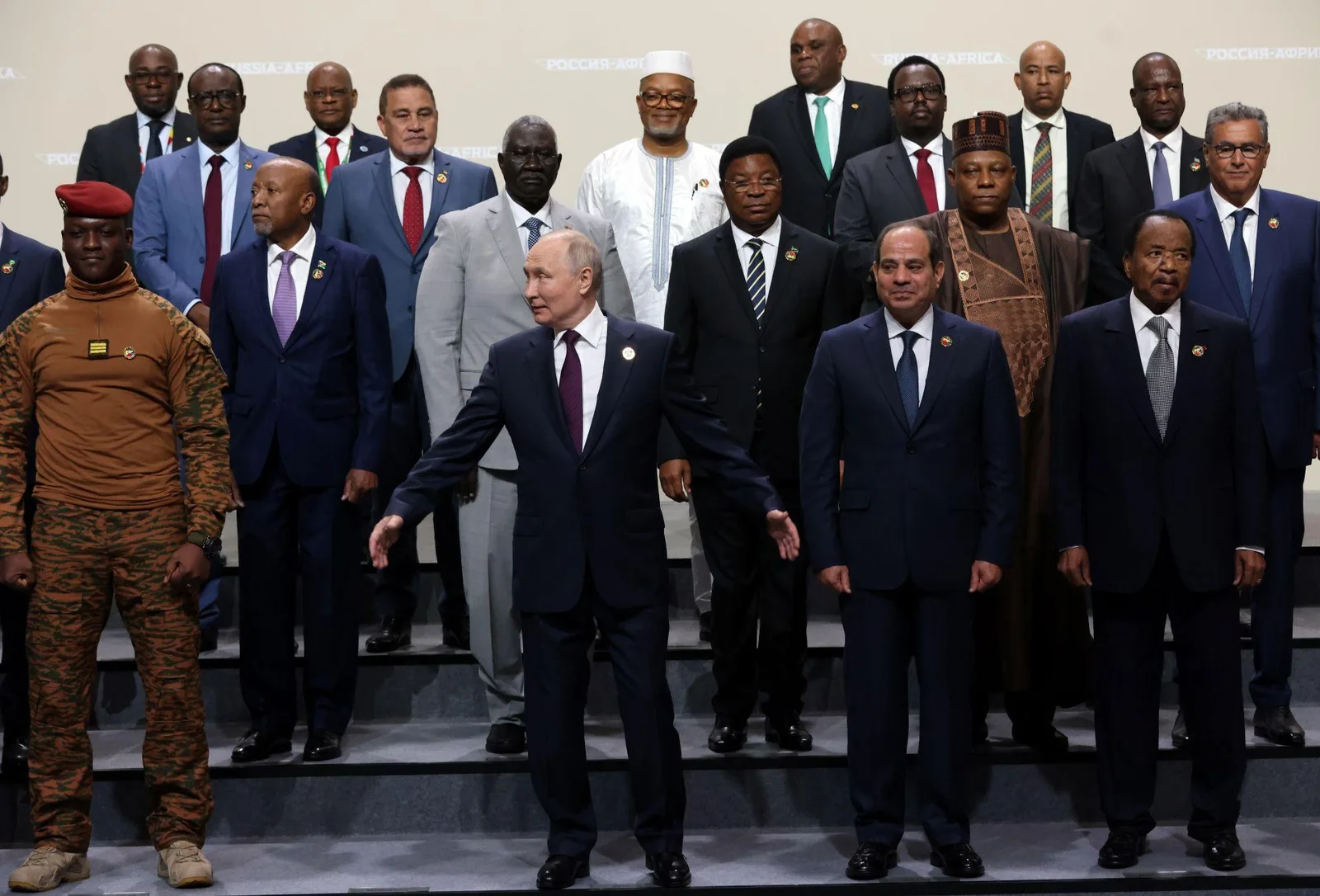
Opinion surveys offer a way to move beyond impressions generated by social media. In surveys conducted in 2024–2025 across 38 African countries, Afrobarometer found that an average of 36% of respondents viewed Russia’s economic and political influence positively, compared with 23% who viewed it negatively; 42% offered no assessment, with rounding explaining the total. Positive assessments reached 62% for China, 52% for the United States and 50% for the European Union. Mali stood out sharply, with 88% expressing favourable views of Russia’s influence.
These findings rule out any notion of uniform African support. They reveal widely differing national situations and considerable uncertainty. The same survey found that, among respondents who had heard about the Russia–Ukraine war, 72% wanted their country to remain neutral. This preference cannot be equated with support for Moscow. It also expresses a desire not to be drawn into other powers’ confrontations.
For Russia, such neutrality can nonetheless be useful. Its objective is not necessarily to turn every partner into an ally. It may be to preserve commercial access, avoid complete diplomatic isolation or prevent a united front from forming. This kind of influence requires less allegiance than a structured alliance. It remains reversible, however: a partner can cooperate on one issue and refuse to follow on the next.
This is also why the Russian presence must be examined from the perspective of those who welcome it. A government may seek to diversify its suppliers, improve its bargaining position or reduce an existing dependence. It then uses its relationship with Moscow as much as it is influenced by it. The risk emerges when diversification turns into a new concentration of dependence, particularly in a sector where replacing the actors involved becomes difficult.
Russia itself is not immune to this mechanism. Closer economic relations with China provide markets and supplies, but also raise the question of asymmetry between the two partners. According to Chinese customs data reported by Reuters, bilateral trade reached $228.1 billion in 2025, down 6.9% from the previous year. The scale of the relationship therefore guarantees neither uninterrupted growth nor equal bargaining power.
The implication is uncomfortable for Russia’s narrative of autonomy: escaping dependence on the West can increase the importance of another partner without eliminating dependence itself. Moscow’s external influence must therefore be assessed alongside the constraints on its own choices.
Russia possesses a real capacity to intervene in fragile balances, sustain lasting technical relationships and make certain decisions more costly for its adversaries. Yet these instruments do not form a uniform whole. A position gained with a government can disappear when that government falls. An industrial relationship can endure without producing diplomatic alignment. An information campaign can circulate widely without persuading. A threat can impose caution while strengthening the determination to resist it.
Measuring this influence therefore requires tracking its outcomes: decisions actually changed, dependencies actually created, commitments secured and their durability over time. Russia’s visibility does not, by itself, demonstrate its hold. Nor does its retreat in one area mean its disappearance from others.
Moscow has shown that it is possible to exert influence without being widely admired, and to become useful without being wholeheartedly chosen. Its difficulty lies in the next step: turning usefulness born of circumstance into lasting trust. A partner retained for lack of alternatives remains vulnerable to the day an alternative appears.
Principal sources
SIPRI, Trends in International Arms Transfers, 2025, March 2026; Council of the European Union, Ending Russian Energy Imports; Afrobarometer, Dispatch AD1139, Popular Perceptions of Russia Lag, Even as Its Influence Grows Across Africa, February 2026, drawing on 2024–2025 surveys; Carnegie Endowment for International Peace, Russia in Africa: Examining Moscow’s Influence and Its Limits, February 2026; World Nuclear Association, Nuclear Power in Turkey; SGDSN/Viginum, reports on RRN, June 2023, and African Initiative, June 2025; Reuters, report on China–Russia trade in 2025, January 14, 2026.
Atlas Limits Research Desk
Atlas Limits’ editorial and analytical desk.