On October 12, 2026, the European Union adopted one of the largest rounds of individual sanctions in its history against Russia. In a single decision, 1,569 individuals and companies were added to European sanctions lists. Yet behind the scale of the announcement lies a more fundamental transformation in Western economic strategy: Brussels is no longer seeking merely to sanction Russia's major arms manufacturers. It is increasingly targeting the industrial activities that make their production possible.
The decision covers 826 Russian companies and 743 executives. Together, the targeted businesses generate at least €20 billion in annual revenue and employ more than 250,000 people. More than half of the new listings are connected to the production chain of ballistic missiles, including systems used by Moscow against Ukraine.
This approach marks a significant evolution in European sanctions policy. For years, economic restrictions primarily sought to reduce the Russian state's financial resources, limit its access to Western technologies, and isolate major industrial institutions. Brussels is now moving deeper into the production system, reaching manufacturers of electronic components, materials specialists, equipment suppliers, and intermediate contractors.
The objective is no longer simply to make war more expensive for Moscow. It is to make the physical production of weapons more difficult.
An Offensive Against Russia's Industrial Core
The October 12 decision follows several years of restructuring within the Russian economy to meet military requirements.
Since the full-scale invasion of Ukraine in February 2022, Moscow has progressively mobilized a growing share of its industrial, financial, and human resources in support of its defense sector. Arms manufacturers have increased production rates, some facilities have expanded operating hours, and the government has multiplied public procurement orders.
This mobilization has enabled Russia to maintain substantial military output despite Western restrictions on equipment, technology, and financial transactions.
It has also exposed a fundamental difficulty for sanctioning countries: an economy with an extensive industrial base, abundant energy resources, and external trading partners can absorb part of the pressure imposed upon it.
The European Union is now attempting to act directly on that capacity for adaptation.
The 826 newly sanctioned companies are not limited to final manufacturers of missiles, aircraft, or drones. They include intermediate suppliers producing equipment required across the military-industrial complex.
According to the Council of the European Union, the activities concerned include semiconductors, microcircuits, computers, radar systems, antennas, communications equipment, navigation systems, optical devices, explosives, and ammunition.
The distinction matters.
A company capable of assembling a missile does not necessarily possess the industrial expertise required to manufacture every component. It depends on a network of specialized subcontractors, some of which also supply civilian industries.
By targeting these suppliers, Brussels is attempting to turn industrial interdependence into strategic vulnerability.
The €20 billion in annual revenue provides an initial indication of the economic scale of the network concerned. It does not, however, represent the value of military production directly affected or an estimate of the economic losses the sanctions will generate. The targeted companies may conduct several activities, some unrelated to weapons manufacturing.
The measure is therefore primarily an exercise in legal and industrial targeting whose actual consequences will depend on implementation.
The Ballistic Missile as an Industrial System
The emphasis on ballistic missiles is not accidental.
Since the beginning of the war, Russian forces have used ballistic and cruise missiles, alongside attack drones, to strike Ukrainian military, energy, logistical, and urban infrastructure.
Ballistic missiles pose particular challenges for air defense systems. Their speed, trajectory, and, in some models, maneuvering capabilities reduce the time available to detect, track, and intercept incoming weapons.
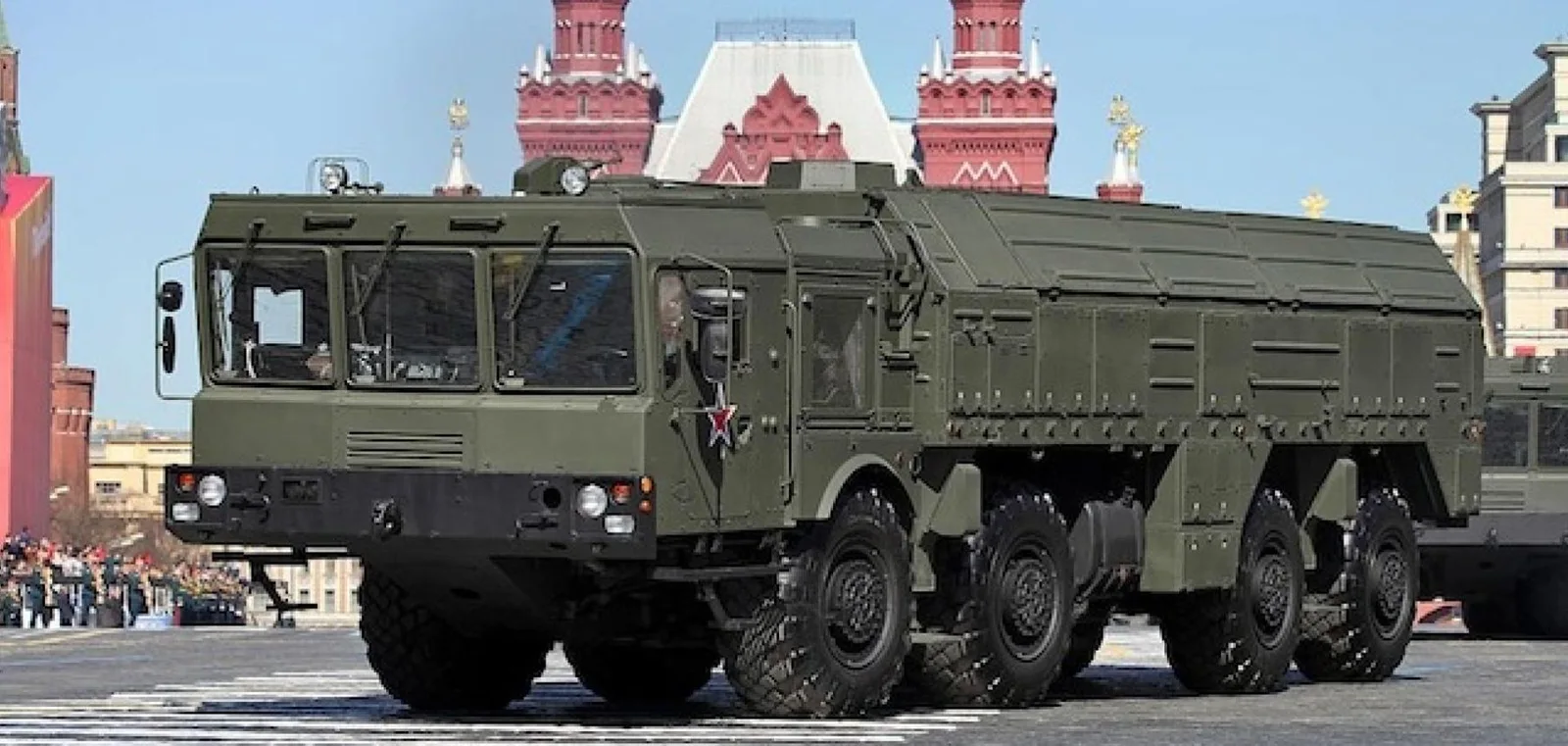
The Iskander-M system, whose 9M723 missile is one of its principal weapons, occupies an important position within Russia's arsenal.
With a generally estimated range of approximately 500 kilometers, it can strike targets far behind the front lines. Its accuracy and flight characteristics make it particularly dangerous against fixed infrastructure and concentrations of military assets.
Yet a ballistic missile is not simply a weapon. It is the final product of a complex industrial supply chain.
Its manufacture requires materials capable of withstanding significant mechanical and thermal stress, propulsion equipment, electronic devices, navigation and control systems, and specialized assembly and quality-control processes.
Rocket motors and solid propellants represent one category of industrial dependencies. Composite materials, specialized fibers, and technical textiles are used in various structural and protective components. Electronics and navigation equipment provide essential functions for controlling the system.
These components are complemented by industrial machinery, measurement instruments, and manufacturing equipment required for consistent production.
This organization creates an important asymmetry.
A major arms manufacturer may possess substantial financial reserves, privileged access to government contracts, and direct political support. A specialized supplier, by contrast, may depend on a limited number of machines, manufacturing processes, imported components, or skills that cannot easily be replaced.
This is precisely the difference Brussels is seeking to exploit.
Information obtained by Reuters during European negotiations referred to companies involved in missile research, rocket motor manufacturing, solid propellants, and synthetic or carbon fiber production.
The strategy involves extending restrictions to actors less visible than major arms manufacturers but potentially indispensable to their operations.
The effectiveness of such an approach cannot be measured by the number of companies sanctioned. It depends on how difficult their products and services are to replace.
Why Targeting Suppliers Can Be More Effective Than Targeting Manufacturers
Industrial production depends on a succession of interconnected operations.
In some sectors, a final product involves hundreds of direct and indirect suppliers. Major industrial groups control only part of this chain, even when they possess extensive vertically integrated capabilities.
This structure distributes costs, encourages specialization, and increases productivity. It also creates points of dependency.
When a supplier becomes inaccessible, its customer must find an alternative, modify production processes, or bring manufacturing in-house.
Each solution can generate additional expenses, qualification delays, and technical difficulties.
These constraints are particularly significant in defense industries. Equipment must operate under demanding conditions and comply with precise specifications. Replacing a component may therefore require changes to testing procedures, quality controls, or the characteristics of the final product.
European sanctions seek to exploit these constraints.
Asset freezes prevent listed individuals and companies from accessing economic resources within European jurisdiction. Operators subject to EU rules are also prohibited from making funds or economic resources available to them, directly or indirectly.
The targeted executives are additionally subject to travel restrictions involving the European Union.
These measures can complicate access to commercial partners, financial services, international contracts, and certain types of equipment.
They do not, however, constitute a universal embargo on every transaction conducted by the listed companies.
A Russian business with no assets in Europe and operations entirely outside the jurisdictional reach of European sanctions may continue certain activities. Indirect consequences then depend on its partners' exposure to European markets and their willingness to limit legal risks.
Individual listings must also be distinguished from broader restrictions on exports of sensitive technologies.
The two instruments can reinforce each other, but they do not create identical legal obligations.
An export prohibition targets a category of goods or technologies. A sanctions listing targets a specific individual or legal entity.
European strategy increasingly relies on combining both instruments.
Russia Has Learned to Circumvent Restrictions
The principal difficulty facing this policy is the Russian economy's capacity to adapt.
Since 2022, Russian companies have progressively modified their procurement networks. Some purchases previously made directly from Western suppliers now pass through intermediaries or businesses established in third countries.
The products concerned are not necessarily identifiable military equipment.
A microprocessor, communications device, electronic component, or industrial machine may have both civilian and military applications. This dual-use character considerably complicates export controls.
A product legally sold for civilian purposes may be diverted to military applications after passing through several transactions.
Supply networks can also be fragmented across multiple companies, countries, and commercial intermediaries.
Such fragmentation makes it more difficult to identify the ultimate end user.
The European Union has already attempted to address this problem.
In its twenty-first sanctions package, adopted in July 2026, it added 51 entities to the list of organizations subject to enhanced restrictions on exports of dual-use goods and technologies.
Some were established in China, including Hong Kong, India, Kazakhstan, Kyrgyzstan, Turkey, and the United Arab Emirates.
These measures particularly concerned supply networks enabling Russia to obtain microelectronic components, computer numerical control machine tools, and semiconductor-processing equipment.
The presence of companies in these countries does not necessarily mean their governments participate in the activities concerned. Rather, it illustrates the transnational nature of industrial supply chains and the difficulties involved in controlling end users.
The problem therefore extends well beyond trade relations between Russia and Europe.
It concerns global industrial networks.
For Brussels, sanctioning a Russian company may prove insufficient if that business can obtain the same components through an intermediary elsewhere.
Conversely, indefinitely extending restrictions to foreign actors carries diplomatic, economic, and legal costs.
The effectiveness of the system will depend on Europe's ability to identify genuinely sensitive transactions without turning sanctions into generalized trade restrictions against third-country partners.
Industrial Substitution: The Real Strategic Challenge
Russia possesses an important advantage: it retains an industrial base inherited from decades of investment in aerospace, metallurgy, chemistry, propulsion systems, and military technologies.
This foundation does not guarantee complete technological autonomy.
It nevertheless allows Russia to manufacture certain equipment domestically, redirect production capacity, and develop substitutes when foreign suppliers become unavailable.
Substitution can take several forms.
A company may replace an imported component with a less advanced domestic product. It may redesign equipment to accommodate more readily available parts. It may also accept higher costs or longer production times.
In a wartime economy, profitability criteria differ from those prevailing in civilian markets.
The state may be willing to pay substantially more for military equipment considered strategically important. It can financially support loss-making companies, allocate resources to priority sectors, or redirect industrial capacity.
This reduces the effectiveness of sanctions that rely exclusively on increasing costs.
Military production can remain economically inefficient while still being strategically sustainable for the government financing it.
The real objective of industrial sanctions is therefore to create constraints that financial resources alone cannot overcome.
A shortage of specialized skills, the unavailability of critical equipment, or the inability to reproduce certain manufacturing processes may be more difficult to resolve than rising raw-material prices.
But this requires accurately identifying the relevant dependencies.
The size of a sanctioned company is not necessarily an indicator of its strategic importance. A supplier generating modest revenue may occupy an industrial position that is harder to replace than that of a large corporation with numerous competitors.
This is why the quality of economic and industrial intelligence is becoming decisive.
Sanctions policy now depends as much on understanding production chains as on the political ability to adopt diplomatic decisions.
A War Economy That Endures — But at What Cost?
Russia's experience since 2022 demonstrates the importance of distinguishing three phenomena that are frequently confused: the ability to maintain military production, the economic efficiency of that production, and its long-term sustainability.
Continued weapons deliveries do not necessarily mean sanctions are ineffective.
A company may maintain output while experiencing rising costs, declining quality, additional delays, or greater dependence on particular suppliers.
Conversely, economic difficulties do not automatically imply a reduction in Russian military capabilities.
The authorities may choose to preserve priority sectors at the expense of other activities.
The Russian economy has consequently faced increasingly significant trade-offs between military requirements, civilian investment, labor availability, and macroeconomic stability.
Industrial mobilization can support certain manufacturing sectors while intensifying pressure on wages, skills, and available capacity.
Growing public procurement can also sustain economic activity without necessarily improving overall productivity.
This distinction is essential to understanding the limits of sanctions.
The European objective is not simply to produce a statistical contraction in the Russian economy. It is to reduce the industrial resources effectively available for warfare.
Such a reduction may take time and remain difficult to observe.
A sanctioned company may continue production for months using existing inventories. Another may change suppliers without any apparent interruption. A third may experience quality or maintenance problems that become visible only later.
Industrial effects are rarely immediate.
They may also be cumulative.
Limited constraints affecting several components, processes, and suppliers can eventually generate difficulties greater than those produced by each restriction individually.
This logic helps explain why Brussels is expanding the range of targeted companies rather than concentrating exclusively on major arms manufacturers.
Economic Warfare Moves Into the Factory
The change in European methodology reflects a broader evolution in international power relations.
For decades, economic sanctions were primarily associated with financial restrictions, trade embargoes, and control over energy resources.
These instruments remain central.
But industrial globalization has created new possibilities for intervention.
Modern companies depend on supplier networks distributed across multiple territories. The most complex technologies require skills and equipment that are not available everywhere.
This structure gives states capable of controlling particular markets, technologies, or infrastructure considerable influence over foreign industrial activities.
American restrictions on advanced semiconductors and certain manufacturing equipment destined for China have already illustrated this development.
The European Union is now applying a comparable logic, in a different strategic context, to Russia's military-industrial complex.
Sanctions are becoming an instrument of external industrial policy.
They no longer seek merely to prevent an adversary from financing particular activities. They aim to alter the material conditions under which those activities can be conducted.
This transformation requires new capabilities.
Authorities must understand value chains, identify genuinely critical suppliers, distinguish civilian from military applications, and monitor changes in commercial networks.
Sanctions administrations must therefore work alongside customs authorities, financial regulators, export-control specialists, and intelligence organizations.
The boundary between economic policy and national security is becoming increasingly blurred.
This development extends far beyond the war in Ukraine.
It points toward a period in which control over components, industrial equipment, and logistical networks may become as important as control over financial flows.
Washington and Brussels: Priorities Beginning to Diverge
The European decision comes at a particularly revealing moment.
Only days earlier, on October 9, American authorities had issued an authorization covering certain transactions involving Russian-origin diesel, against a backdrop of significant tensions in international energy markets.
That decision does not constitute a general lifting of American sanctions against Moscow. It introduces a limited exemption from certain existing restrictions.
Nevertheless, the contrast with the European decision of October 12 deserves attention.
The United States and the European Union must balance several objectives that are not always perfectly compatible.
Restricting Russian military capabilities is a strategic priority. Stabilizing energy markets, containing inflation, and securing supplies are also important objectives.
When energy prices rise sharply, governments may be tempted to relax certain restrictions to limit economic disruption.
Conversely, European states directly exposed to the security consequences of the war in Ukraine may prioritize sustained pressure on Russia's military capabilities.
It would be premature to conclude that these decisions represent a transatlantic rupture.
They concern different instruments and sectors. A limited authorization involving an energy product does not necessarily indicate the abandonment of restrictions on military technologies.
But they illustrate the growing complexity of Western coordination.
Sanctions policy is no longer a homogeneous set of restrictions pursuing a single objective.
It is becoming a system of trade-offs involving security, energy, commerce, inflation, diplomacy, and industrial competitiveness.
This evolution could widen differences between American and European strategies if their economic and security priorities diverge further.
For Moscow, any lasting divergence could create opportunities for adaptation.
For Brussels, it would reinforce the importance of enforcement mechanisms capable of producing results even when certain partners pursue different policies.
How Can the Effectiveness of Sanctions Be Measured?
The number of new listings indicates the intensity of European action, but it does not measure effectiveness.
The October 12 decision brings the total number of listings under the European sanctions regime concerning Ukraine's territorial integrity to nearly 4,600.
This figure illustrates the progressive expansion of the framework since 2014, particularly after 2022.
It does not, however, establish how many missiles Russia will be able to manufacture in the coming months.
Assessing the results would require more detailed information about the targeted companies, their industrial roles, technological dependencies, and substitution options.
Changes in production volumes for Iskander systems and other relevant weapons would provide an initial indicator, provided sufficiently reliable data were available.
Delivery schedules, manufacturing costs, component substitutions, and potential design modifications would also offer important evidence.
Analysis of missile and drone debris could help identify changes in the components being used, although it cannot independently establish production volumes.
Trade statistics from intermediary countries could reveal changes in the movement of sensitive technologies.
Such information would nevertheless require careful interpretation.
An increase in electronic equipment imports by a third country does not, by itself, prove re-exportation to Russia's military industry.
Similarly, declining direct Russian imports may reflect domestic substitution, changes in trading routes, or an actual contraction in demand.
Evaluating sanctions therefore requires combining multiple sources rather than inferring effectiveness from a single indicator.
It also requires distinguishing the effects of sanctions from those of Ukrainian strikes on industrial facilities, labor shortages, budgetary decisions, and technological changes.
These factors may simultaneously influence Russian production capabilities.
Without this distinction, outcomes risk being incorrectly attributed to one policy alone.
Can Europe Disrupt an Industry It Does Not Control?
The central question remains how much influence the European Union can exercise over an industry located outside its territory.
Brussels possesses an enormous market, important financial institutions, and a regulatory framework capable of influencing the behavior of foreign companies.
But Russia is not entirely dependent on European suppliers.
It retains domestic manufacturing capabilities, maintains commercial relations with numerous countries, and can mobilize public resources to support priority military activities.
The success of the European strategy therefore depends on several conditions.
The first is identifying genuinely critical industrial dependencies. Sanctioning an easily replaceable supplier may produce limited results. Targeting a company possessing rare expertise may cause far more substantial disruption.
The second concerns enforcement. A legal decision produces consequences only when the relevant actors comply with its prohibitions and attempts at circumvention can be detected.
The third is time. Industrial sanctions may require several production cycles before significantly changing available capabilities.
The fourth concerns international coordination. The more restrictions are applied by countries controlling complementary technologies and equipment, the more difficult substitution becomes.
Finally, European strategy must account for the adversary's capacity for innovation and adaptation.
A restriction may prevent access to a particular technology without preventing the development of an alternative solution. That alternative may be less efficient, more expensive, or slower to manufacture, yet remain sufficient for certain military requirements.
Economic confrontation thus becomes a continuous competition between restriction and adaptation.
A New Stage in the Transformation of Sanctions
The European decision of October 12, 2026, does not guarantee an immediate slowdown in Russian military production.
Nor does it demonstrate that previous sanctions have failed.
Instead, it reveals the gradual evolution of the instruments used to constrain the capabilities of an economy engaged in prolonged warfare.
The first major measures adopted after February 2022 sought, among other objectives, to isolate Russia financially, restrict its trade, and reduce access to Western technologies.
Subsequent measures progressively extended restrictions to foreign companies involved in certain procurement networks and actors participating in the circumvention of existing sanctions.
The latest wave of listings deepens this approach by targeting intermediate suppliers within Russia's military industry on an unprecedented scale.
Its importance lies less in the striking number of sanctioned individuals and companies than in the level of detail at which the European Union is now attempting to intervene.
Brussels no longer views Russia's military-industrial complex simply as a collection of major corporations and state-owned facilities.
It increasingly approaches it as a network of technical, financial, and industrial dependencies, some of which may be exploited to slow production.
This approach could become a lasting characteristic of contemporary economic confrontation.
In a world where advanced military equipment depends on complex manufacturing networks, the ability to identify and control particular components can become a powerful instrument of statecraft.
But it also exposes a fundamental limitation: sanctions can alter an adversary's production conditions without necessarily depriving it of the ability to manufacture weapons.
Europe's challenge is therefore not to expand its sanctions lists indefinitely.
It is to determine whether these restrictions can generate shortages, delays, and costs substantial enough to produce a lasting change in Russian military capabilities.
Economic warfare is no longer fought exclusively through banks, ports, or energy markets. It is moving into factories, laboratories, and assembly lines. And its outcome will depend less on how many companies are sanctioned than on whether the industrial connections sustaining their production can actually be disrupted.
Main Sources
Council of the European Union — October 12, 2026. Russia's war of aggression against Ukraine: EU agrees largest-ever package of listings targeting almost 1,600 individuals and entities in Russia's military-industrial complex. Official confirmation of the 1,569 listings, including 826 companies and 743 executives, and the economic characteristics of the targeted network.
Official Journal of the European Union — October 12, 2026. Council Decision (CFSP) 2026/2279 and Council Implementing Regulation (EU) 2026/2281. Legal instruments concerning the new sanctions listings.
Reuters — October 12, 2026. EU adopts nearly 1,600 new sanctions listings targeting Russia. Reporting on the adoption of the measures and their concentration on ballistic missile production chains.
Reuters — October 7, 2026. EU envoys approve new Russia sanctions listings, diplomats say. Reporting on rocket motor manufacturers, solid propellants, specialized fibers, and suppliers associated with Iskander missile systems.
Council of the European Union — July 23, 2026. 21st package of sanctions: EU hits Russian energy, financial services and crypto hard. Measures concerning dual-use technologies, sanctions circumvention, and companies established in third countries.
Council of the European Union — August 7, 2026. Russia's war of aggression against Ukraine: EU lists five additional individuals supporting Russia's military-industrial complex. Information on executives involved in precision components and Russian ballistic missile systems.
Council of the European Union. EU sanctions against Russia. Overview of European sanctions regimes, trade restrictions, and measures designed to prevent circumvention.
Atlas Limits Research Desk
Atlas Limits’ editorial and analytical desk.