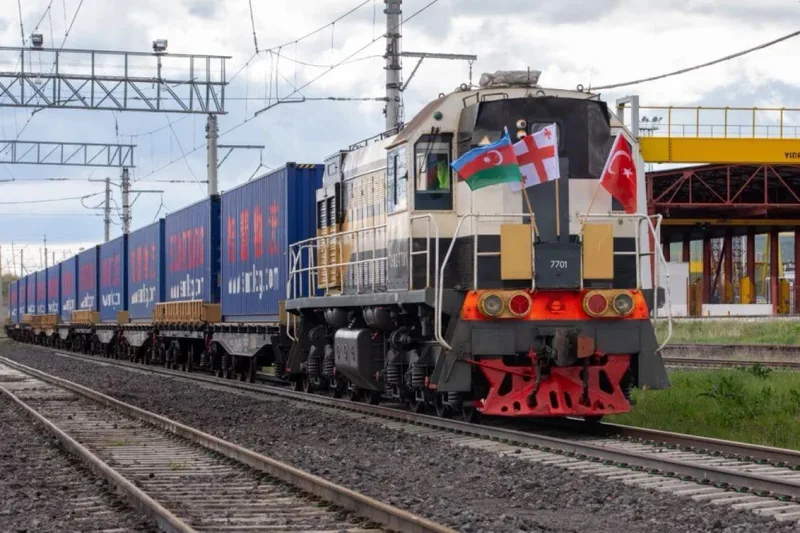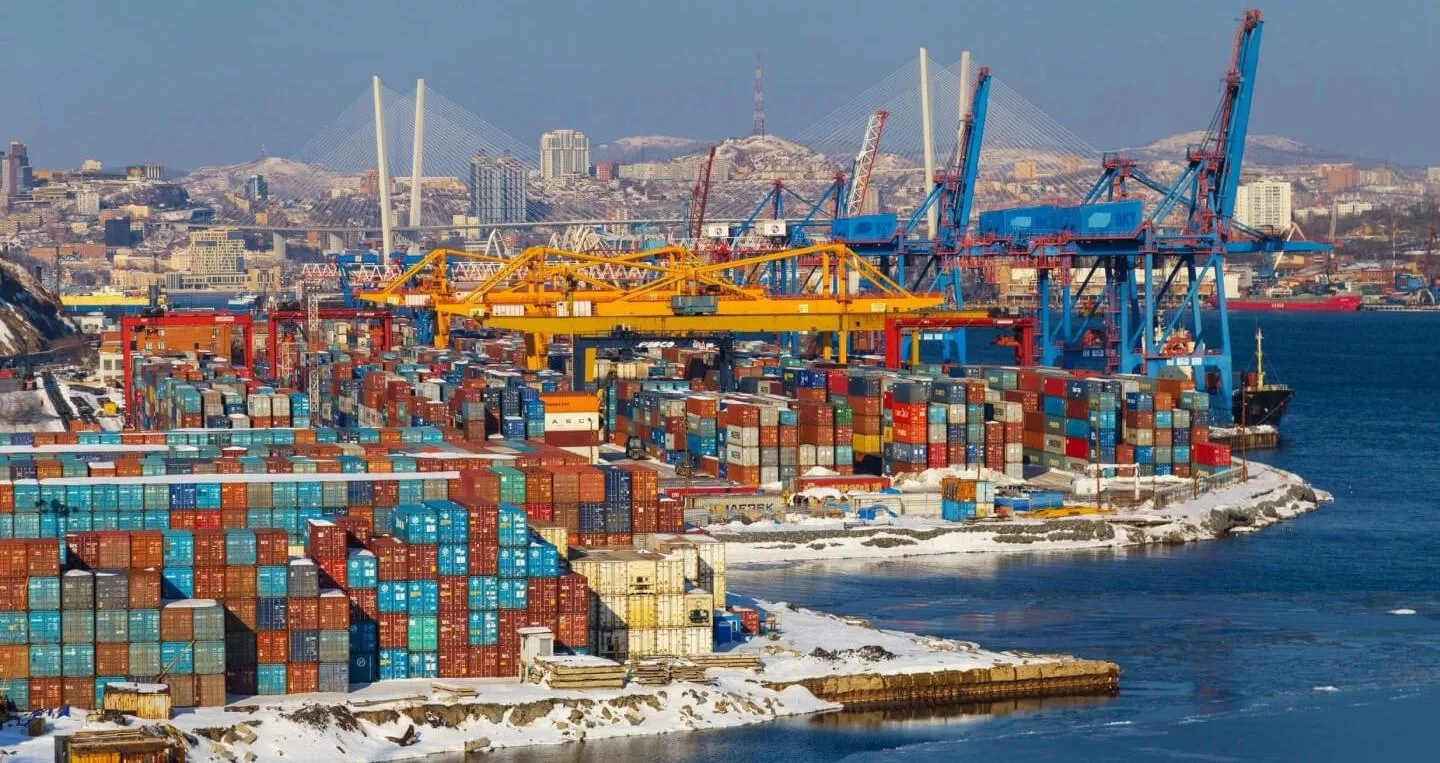
East of Lake Baikal, trains now tell part of Russia’s economic story. Coal, minerals, hydrocarbons and containers converge on the same tracks — the Trans-Siberian Railway and the Baikal-Amur Mainline — before continuing toward Pacific ports or the Chinese border. The problem is no longer finding cargo. It is finding enough railway capacity to carry it.
Russia had begun modernizing this vast corridor long before February 2022. But the war in Ukraine and the collapse of much of its commercial relationship with Europe gave the project another purpose. What had been a policy for developing Siberia and the Russian Far East became infrastructure for a national reorientation.
Within a few years, Russian foreign trade changed direction. In 2025, 73.4% of Russia’s merchandise trade was conducted with Asia, compared with 18.6% with Europe. Exports to Asia reached $326 billion; those to Europe, $57.4 billion. In 2024, the respective shares had still been 72.6% and 19.7%. The shift therefore continued well beyond the initial shock.
These figures do not show that Russia has escaped the consequences of Western sanctions. They show something different: an economy built for three decades around a privileged relationship with Europe is learning to function according to another geography.
And when an economy’s center of gravity moves, changing customers is not enough. Energy flows, supply chains, payment systems, infrastructure and, ultimately, dependencies must move with it.
The Geography That Was Lost
During the three decades following the collapse of the Soviet Union, the Russian economy developed a peculiar contradiction. Politically, Moscow sought to preserve its strategic autonomy. Economically, a considerable share of its wealth looked west.
The great fields of Western Siberia supplied Europe. Pipelines ran toward Germany and Central Europe. Russian oil flowed into European refineries. Baltic ports served as critical outlets. Russian companies bought German machinery, Italian industrial equipment and European cars. London, Frankfurt, Amsterdam and Cyprus belonged, in different ways, to the financial ecosystem surrounding major Russian companies and fortunes.
This architecture rested on an almost geographical complementarity: Russia possessed immense energy and mineral resources; nearby Europe offered a wealthy, industrialized and energy-hungry market.
Oil captures the scale of the rupture. In 2020, Europe still absorbed 51% of Russian crude oil and condensate exports. By 2024, that share had fallen to 12%. In the first half of 2025, it stood at just 11%, with more than half of that European volume destined for Turkey.
Russian oil, however, did not disappear from world trade.
It changed destination.
China Fills the Vacuum
No country has benefited more from this transformation than China.
In 2021, merchandise trade between China and Russia amounted to roughly $147 billion. Three years later, it had reached $244.8 billion — an increase of almost 67% from the level immediately preceding the war.
By 2025, Beijing still accounted for roughly 27% of Russian exports and 36% of its imports.
But the important transformation lies not only in the volume.
It lies in what is moving.
Russia primarily sends hydrocarbons, metals and other raw materials to China. Since February 2022, mineral fuels have represented, on average, roughly 70% of the value of Chinese imports from Russia. Moving in the opposite direction are Chinese cars, tractors, electronics, industrial equipment and consumer goods.
The automobile industry offers one of the most visible illustrations. Chinese manufacturers held approximately 9% of the Russian car market in 2021. Two years later, their share had reached 61%.
European, Japanese and South Korean manufacturers withdrew or reduced their presence. Chinese companies occupied the space.
The same process, with varying degrees of intensity, has affected machinery, electronics and numerous manufactured goods.
Here lies the paradox of Russia’s pivot. China is helping Russia reduce its dependence on the West while simultaneously increasing Russia’s dependence on China.
Trade figures can create the impression of a relatively balanced relationship in value terms. Its structure is far less balanced. Moscow largely sells what its territory contains; Beijing increasingly sells what its factories manufacture.
Over time, that distinction becomes decisive.
India, the Providential Outlet
If China has become Russia’s principal structural partner, India has played another role: that of an enormous energy outlet.
Russia-India trade reached $68.7 billion during the 2024–2025 financial year. Behind that record, however, lies an extraordinary imbalance. India exported only $4.9 billion worth of goods to Russia while importing $63.8 billion. Oil and petroleum products form the core of those purchases, alongside fertilizers, coking coal, metals and sunflower oil.
India has therefore not become for Russia what Europe once was.
It has become something more specific: a colossal buyer of Russian commodities.
The distinction matters. A commercial relationship based primarily on energy sales does not generate the same interdependence as one combining energy, investment, finance, industry, technology and integrated value chains.
It also leaves Moscow exposed to the terms demanded by a smaller number of buyers.
Since 2022, Indian refiners have been able to purchase large quantities of discounted Russian crude. But by 2026, competition among Asian buyers was demonstrating how fluid the new geography remained: in September, Indian imports of Russian oil were expected at around 1.75 million barrels per day, down from 2.1 million in August, while Chinese demand increased amid an energy market disrupted by tensions in the Middle East. Russia nevertheless remained India’s largest crude supplier.
Russia has found markets.
It has not necessarily rebuilt the ecosystem it lost.
The Countries That Become Interfaces
Between a closing Europe and an opening Asia, intermediary spaces have also emerged.
Turkey is the most obvious.
It remains connected to Western economies while maintaining deep commercial and energy ties with Moscow. It imports Russian hydrocarbons, participates in regional logistics networks and constitutes one of the few major markets positioned directly at the intersection of European, Russian, Mediterranean and Middle Eastern economic spaces.
The Gulf economies perform a different function. Dubai, in particular, has become an important node for companies, capital, trade and services connecting Russia to a global economy whose Western infrastructure has become considerably less accessible to it.
These countries replace neither the European Union nor China.
They become interfaces.
And that function reveals an essential characteristic of Russia’s new economy: it is not isolated from the world. It simply has to use more intermediaries to reach it.
Every intermediary carries a cost. Every detour lengthens a logistics chain. Every additional bank introduces another payment risk. Every transshipment absorbs part of the advantage generated by selling a commodity.
Economic geography never abolishes distance.
It charges for it.
The Price of Kilometers
This reality becomes particularly visible when one leaves trade statistics behind and looks at a map.
Russia’s major industrial and energy basins did not move in 2022. Neither did the infrastructure connecting them to the outside world.
For decades, a considerable portion of Russia’s network had been designed to transport resources westward. Ports, pipelines and railways reflected that orientation.
Sending more goods toward Asia therefore requires pushing increasing volumes across Siberia.
The Trans-Siberian Railway stretches for roughly 9,300 kilometers. The Baikal-Amur Mainline extends for more than 4,000. Together they form the core of what Moscow calls the Eastern Polygon.
And that system has become a bottleneck.
Its freight capacity stood at roughly 144 million tonnes in 2021. The modernization program targeted 180 million tonnes annually at the completion of its second phase. A third phase now aims to raise capacity to approximately 210 million tonnes by 2030 and 270 million by 2032, notably through new tunnels, bridges and railway sections.
These projects existed before the rupture with Europe.
Their meaning has changed.
A network designed to develop the Russian Far East is gradually becoming one of the main arteries of Russian foreign trade.
The same logic runs through energy infrastructure.
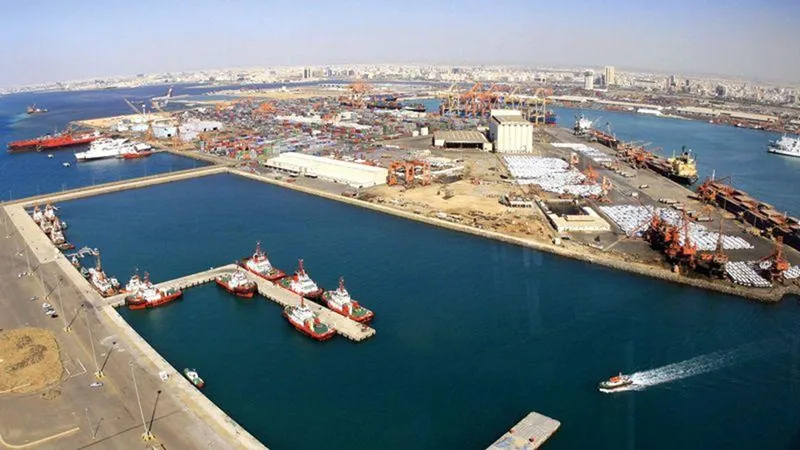
Eastward pipelines, Pacific ports, liquefied natural gas terminals and Arctic projects have acquired an importance that now goes far beyond diversification. They are participating in the geographical reconstruction of Russia’s export model.
This is where the shift becomes difficult to reverse.
A tanker can change destination within weeks. A commercial contract can be renegotiated. A pipeline or railway commits an economy for decades.
A More Asian Russia, but Not Necessarily a Freer One
The eastward shift is sometimes presented as proof that Western sanctions have failed. The opposite interpretation portrays it as evidence that Russia has been expelled from its most advantageous markets.
Both readings simplify what is actually happening.
Sanctions have not prevented Russia from trading. They have profoundly altered the conditions under which it trades.
Russian oil exports proved relatively resilient in volume: between 2020 and 2024, crude and condensate exports averaged around 5 million barrels per day before declining to 4.3 million in the first half of 2025. Russia therefore succeeded in redirecting much of its flows rather than losing them altogether.
But redirecting is not replacing.
Distances to some markets are greater. Oil discounts can reduce revenues. Payment mechanisms have become more complex. Some Western technologies are harder to obtain. Eastern railway capacity must be expanded. Above all, Russia is increasingly negotiating with partners that know it has fewer alternatives.
China is the central example.
The relationship is useful to Russia and, in some areas, indispensable. It allows Moscow to import manufactured products while selling a substantial share of its resources. But the difference in economic scale between the two countries is gradually changing the terms of the relationship.
Russia wanted to reduce its vulnerability to the West.
It is discovering that dependence can be relocated more easily than eliminated.
When Emergency Becomes Structure
China-Russia trade itself demonstrates that the transition is not linear.
After reaching a record of nearly $245 billion in 2024, bilateral trade contracted by 6.9% in 2025. It then rebounded strongly in 2026, with July recording a monthly high, driven in part by energy prices and Chinese vehicle exports.
Those fluctuations matter less than the structure that remains beneath them.
In 2025, despite an overall decline in Russian foreign trade to $697.3 billion, Asia’s share continued to increase.
That is probably where the most durable transformation since 2022 can be found.
Russia has not become an Asian economy. Its industrial history, its demography, its largest cities and much of its infrastructure continue to occupy a space deeply connected to Europe.
But its trade now looks in another direction.
As goods change destination, infrastructure follows. As infrastructure changes, investment follows in turn. Then come companies, financial networks, commercial habits and vested interests organized around the new geography.
At that point, the phenomenon extends beyond the sanctions that accelerated it.
One day, the sanctions regime may change. A war can end. Governments can change. Diplomatic relations can be restored.
But a railway crossing Siberia, a terminal built on the Pacific, a pipeline pointed toward China, an Indian refinery configured for Russian crude or a supply chain organized around Chinese manufacturers does not disappear with a diplomatic communiqué.
Since 2022, Russia has learned that it can redirect a considerable share of its trade.
It is now learning something deeper: when an economy moves its center of gravity for long enough, it eventually moves part of itself.
Main Sources
- Federal Customs Service of Russia / Interfax — Russian foreign trade in 2025 and the geographical distribution of trade.
- U.S. Energy Information Administration — evolution of Russian oil exports and the redirection of flows toward Asia.
- General Administration of Customs of China / Reuters — China-Russia trade in 2024.
- MERICS — structure and evolution of China-Russia trade through 2026.
- Government of India — evolution of Russia-India trade and composition of bilateral flows.
- Russian Ministry of Transport — modernization of the Trans-Siberian Railway and Baikal-Amur Mainline and capacity expansion of the Eastern Polygon.
Atlas Limits Research Desk
Atlas Limits’ editorial and analytical desk.