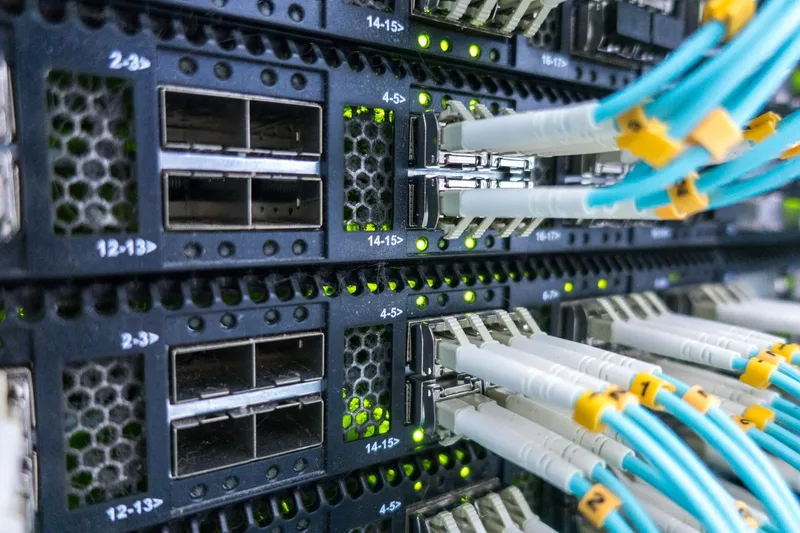
India's artificial intelligence ambitions are not taking shape inside data centers alone. They also depend on thousands of kilometers of fiber-optic networks capable of connecting computing facilities, transporting enormous volumes of data, and turning isolated infrastructure into an integrated digital economy.
On October 26, 2026, Tata Communications announced plans to invest between $400 million and $450 million in approximately 10,000 kilometers of new connectivity infrastructure across India.
The project, called the AI Super Highway, is designed to connect major data centers, cloud platforms, and artificial intelligence hubs throughout the country.
The announcement comes as global investment in artificial intelligence remains heavily concentrated on semiconductors, computing capacity, and the construction of increasingly powerful data centers. Yet another component of the digital economy is becoming strategically important: the networks capable of moving information between these facilities.
For Tata Communications, this transformation presents an industrial and financial opportunity. For India, it highlights another dimension of its technological ambitions: developing not only computing capacity but also the infrastructure required to connect and operate it.
The underlying question extends beyond telecommunications. As artificial intelligence becomes embedded in economic activity, who will control the physical systems that make its deployment possible?
A $450 Million Investment in AI's Invisible Infrastructure
Tata Communications' investment program involves deploying approximately 10,000 kilometers of new terrestrial fiber-optic infrastructure.
The company expects to commit between $400 million and $450 million over an estimated three-to-five-year period, with implementation organized into three phases.
Unlike investments directly targeting graphics processing units or the buildings housing advanced computing equipment, this expenditure focuses on the transmission infrastructure connecting those assets.
The objective is to establish high-capacity, low-latency, and resilient connections capable of meeting the demanding requirements of artificial intelligence applications.
These characteristics become particularly important when computing operations are distributed across multiple data centers.
Training certain AI models, transferring large datasets, replicating information, and operating distributed digital services all require reliable and continuous data exchanges.
Even highly advanced computing infrastructure can lose part of its operational efficiency if the networks connecting it to other facilities cannot deliver sufficient capacity or predictable performance.
Artificial intelligence performance therefore increasingly depends on the architecture of the entire physical system rather than computing power alone.
This distinction is becoming economically significant.
The value of a data center is influenced not only by the processors it contains but also by its access to electricity, cooling systems, network capacity, and other computing facilities.
Tata Communications is positioning itself within this broader infrastructure ecosystem.
Mumbai, Pune, Hyderabad, and Chennai: Building a Strategic Corridor
The first phase of the AI Super Highway is expected to connect Mumbai, Pune, Hyderabad, and Chennai.
These cities occupy important positions within India's technological and industrial economy.
Mumbai is the country's leading financial center and a strategic location for international telecommunications infrastructure.
Pune hosts a substantial industrial and technological ecosystem, particularly in engineering, information technology, and enterprise services.
Hyderabad has emerged as a major destination for international technology companies, cloud infrastructure, and digital services.
Chennai combines a diversified industrial base with established information technology activities and access to international connectivity routes.
Connecting these locations would create a network linking several concentrations of digital infrastructure and enterprise demand.
Subsequent phases are expected to extend connectivity toward Visakhapatnam and Bhubaneswar along India's eastern corridor, as well as Jamnagar and GIFT City in the west.
This geographical configuration reflects an economic strategy.
Rather than treating connectivity as a uniform national service, Tata Communications is targeting locations where existing or planned digital investments could generate substantial demand for data transmission.
The project is also intended to strengthen connections between domestic data centers and international submarine cable landing stations.
India's terrestrial infrastructure would therefore become part of a wider international connectivity system.
The strategic importance of these corridors lies not simply in their geographical reach but in their ability to connect computing resources, enterprises, and international markets.
Artificial Intelligence Is Reshaping Telecommunications Economics
For decades, telecommunications development was primarily associated with telephone networks, internet access, and communication services for households and businesses.
Artificial intelligence is progressively changing the structure of demand.
Network operators must increasingly accommodate the requirements of data center companies, cloud providers, AI developers, and enterprises operating computing-intensive applications.
These customers require more than additional bandwidth.
They also need predictable performance, secure connections, redundant transmission routes, and contractual guarantees concerning service availability.
For telecommunications companies, this transformation creates opportunities to develop specialized infrastructure services supported by relatively long-term commercial agreements.
Tata Communications intends to expand its position in precisely this segment.
The company is not attempting to become a semiconductor manufacturer or directly compete with the world's leading developers of artificial intelligence models.
Instead, it aims to provide part of the infrastructure on which those businesses depend.
This distinction matters.
As computing capacity expands, companies capable of connecting and supporting that capacity may occupy strategically important positions without controlling the underlying computing technologies.
The development of artificial intelligence could therefore create additional sources of value across the telecommunications industry.
However, capturing that value will depend on competitive positioning, pricing power, network utilization, and the ability to secure recurring commercial demand.
An Indian Market That Could Exceed $1 Billion
Tata Communications estimates that India's data center interconnection market could exceed $1 billion over the medium term.
This projection reflects expectations of expanding cloud infrastructure, artificial intelligence deployment, and demand for high-capacity connections between computing facilities.
It remains a company estimate rather than independently established future market revenue.
Management has also indicated an ambition to capture approximately 30% to 40% of the Indian data center interconnection market.
Such a target illustrates the commercial scale of the project, but achieving it will depend on several conditions.
Demand must expand at the anticipated pace.
New data centers must move from announced investment plans to operational facilities.
Customers must also choose Tata Communications' infrastructure rather than competing networks or privately developed alternatives.
The timing of deployment will be particularly important.
Infrastructure constructed significantly ahead of demand can tie up capital for years before generating sufficient revenue.
Conversely, a network that becomes operational as new computing facilities enter service may benefit from favorable commercial positioning.
The synchronization of physical investment and digital demand will therefore be one of the central determinants of the project's financial performance.
The opportunity is substantial, but the relationship between projected market size and realized revenue remains uncertain.
A Financial Strategy Built Around Long-Lived Assets
Tata Communications expects to finance the investment primarily through operating cash flows.
This approach could reduce the immediate need for additional external financing, although future funding decisions will depend on the company's broader financial position and investment requirements.
The project follows an infrastructure investment model built around assets with relatively long economic lives.
Fiber-optic networks can remain operational for decades, even though the electronic equipment required to transmit information through them must be upgraded more frequently.
Management has referred to potential asset lives extending to approximately 25 years, alongside commercial contracts that could run for five to ten years.
The difference between infrastructure life and contractual duration is central to the economic model.
Once a network has been constructed, its operator can seek to commercialize capacity across multiple customers and successive contract periods.
Financial returns depend on utilization rates, negotiated prices, maintenance expenditure, operating costs, and the capital required to accommodate technological change.
According to management comments reported by Indian financial media, return expectations or benchmarks for such infrastructure investments could fall within a range of approximately 15% to 20%.
These figures should be understood as prospective financial references, not returns already achieved by the new network.
The company's leadership expects the program's financial contribution to develop progressively as infrastructure enters operation, with more meaningful effects anticipated around fiscal years 2028 and 2029.
The central financial question therefore extends beyond the initial investment of up to $450 million.
It concerns Tata Communications' ability to convert that capital expenditure into durable, recurring revenue over a sufficiently long period.
The value of the project will ultimately depend less on the number of kilometers constructed than on the economic activity those kilometers support.
Connecting India's Digital Infrastructure to Global Networks
The AI Super Highway is not being developed in isolation.
Tata Communications already operates an extensive international telecommunications infrastructure.
According to company disclosures, its global network includes more than 500,000 kilometers of submarine fiber-optic infrastructure and over 200,000 kilometers of terrestrial fiber networks.
The new Indian investment is intended to complement this existing architecture.
That integration could provide an important competitive advantage.
Large technology companies rarely operate within a single national market.
Their computing infrastructure, enterprise customers, and data-processing activities may be distributed across several countries, creating continuous requirements for international connectivity.
An operator capable of providing both domestic and cross-border connections may therefore offer a more integrated service than a company operating only within individual local markets.
Tata Communications has also been developing connectivity between India and Singapore, one of Asia's major digital infrastructure hubs.
Such connections can support data exchanges between Indian computing facilities and broader Southeast Asian technology markets.
The combination of terrestrial and submarine infrastructure could allow Tata Communications to offer connectivity across several stages of the digital value chain.
The strategic asset is therefore not simply the physical ownership of fiber-optic cables.
It is the ability to organize those assets into a reliable, commercially accessible, and internationally connected network.
India's Digital Transformation Enters a More Capital-Intensive Phase
India has spent several decades developing a globally competitive information technology services industry.
Software engineering, outsourcing, enterprise technology, and digital services have supported the international expansion of Indian companies and helped establish a substantial technological workforce.
Artificial intelligence introduces additional requirements.
Software services can be organized primarily around skills, intellectual property, and service delivery.
Large-scale AI infrastructure also requires substantial physical investment.
Data centers, computing equipment, electricity generation and distribution, cooling systems, telecommunications networks, and security installations are becoming interconnected components of the same productive system.
Digital competitiveness consequently depends on several complementary capabilities.
A country may possess highly qualified engineers without sufficient domestic computing capacity.
It may construct data centers without securing reliable electricity supplies.
It may acquire advanced processors without developing the networks necessary to connect computing facilities efficiently.
Tata Communications' investment addresses this last requirement.
The project could strengthen India's ability to support an expanding domestic artificial intelligence ecosystem.
However, it does not independently guarantee technological sovereignty.
Dependencies involving advanced semiconductors, networking equipment, specialized software, and cloud platforms remain important structural features of the global technology industry.
Digital sovereignty cannot be reduced to ownership of any single infrastructure category.
It depends on the capacity to control or reliably access enough components of the technological system to preserve operational flexibility and strategic autonomy.
For India, building stronger domestic networks represents one element of that broader challenge.
Global Competition Is Expanding Beyond Chips and Data Centers
Tata Communications' announcement reflects a wider transformation in international technological competition.
The first major wave of investment in artificial intelligence directed attention toward semiconductor manufacturers and companies developing increasingly sophisticated models.
The expansion of computing capacity is now exposing the importance of supporting industries.
Electricity suppliers must accommodate additional demand.
Cooling equipment manufacturers must respond to the requirements of increasingly energy-intensive computing facilities.
Construction and engineering companies must develop specialized installations.
Telecommunications operators must provide the networks connecting these assets.
This evolution is expanding the industrial value chain associated with artificial intelligence.
It creates opportunities for businesses that neither manufacture advanced processors nor develop foundational AI models but operate infrastructure essential to their commercial deployment.
Competition is consequently extending beyond the performance of digital technologies themselves.
It increasingly concerns the availability, cost, reliability, and control of the physical resources required to operate them.
For governments, this transformation is changing industrial priorities.
For businesses, it is creating new markets.
For investors, it is directing greater attention toward infrastructure assets whose returns depend on long-term commercial relationships, capacity utilization, and disciplined capital allocation.
The development of artificial intelligence may therefore redistribute economic opportunities across a much broader group of industries than initially anticipated.
The Execution Risks Behind a Strategic Investment
The significance of the project should not obscure the uncertainties surrounding its implementation.
Constructing approximately 10,000 kilometers of fiber-optic infrastructure requires rights of way, civil engineering work, specialized equipment, and coordination across multiple jurisdictions.
Regulatory requirements, construction delays, weather conditions, and access to existing infrastructure can influence costs and schedules.
Competition presents another challenge.
Established telecommunications operators, specialized connectivity providers, and major technology companies may also expand their own networks.
Some large cloud operators could choose to develop dedicated infrastructure for particular routes or computing facilities.
Tata Communications' ability to differentiate its services will therefore depend on network quality, commercial terms, operational reliability, and the performance actually delivered to customers.
Demand growth remains another uncertainty.
The expected expansion of data center interconnection depends partly on whether announced computing investments are completed and brought into operation.
Slower-than-anticipated development could delay revenue generation.
Conversely, faster AI infrastructure deployment could increase connectivity requirements beyond current expectations.
The investment is therefore strategically significant, but its eventual financial success remains conditional.
The essential challenge will be converting anticipated demand into contracted services and sustainable cash flows.
Digital Power Also Depends on What Connects the Machines
Tata Communications' investment illustrates a fundamental evolution in the economics of artificial intelligence.
Technological power can no longer be assessed exclusively through the number of processors available, the sophistication of AI models, or the capital committed to data centers.
It also depends on the infrastructure capable of connecting those resources, maintaining their operational continuity, and making computing capacity accessible to businesses.
For India, the development of high-capacity connectivity networks represents another stage in the construction of its digital economy.
For Tata Communications, it offers an opportunity to transform a traditional telecommunications activity into a strategic position within an emerging infrastructure market.
The program's success will depend on actual demand, financial discipline, execution capabilities, and the construction of networks capable of remaining economically relevant over time.
But the implications extend beyond a single company.
As artificial intelligence becomes a general-purpose economic infrastructure, the foundations of technological power are expanding across the physical systems required to operate it.
Owning computing capacity is not enough to guarantee its economic value. That capacity must also be connected, powered, and integrated into productive activity.
In the artificial intelligence economy, the companies controlling the connections may become as indispensable as those building the machines.
Main Sources
- Tata Communications, October 26, 2026 — Tata Communications to Build India's AI Super Highway. Official announcement outlining the investment program, infrastructure development, and deployment phases.
- Reuters, October 26, 2026 — India's Tata Communications to Spend $450 Million on AI Connectivity Infrastructure. Independent confirmation of the investment announcement.
- The Economic Times, October 26, 2026 — Coverage of Tata Communications' planned investment in a 10,000-kilometer AI fiber network, including financing and deployment details.
- Moneycontrol, October 26, 2026 — Reporting on the AI Super Highway, management's market-share ambitions, and prospective investment returns.
- Business Standard, October 26, 2026 — Coverage of the investment's financial structure, network expansion, and anticipated contribution to future operating performance.
Atlas Limits Research Desk
Atlas Limits’ editorial and analytical desk.