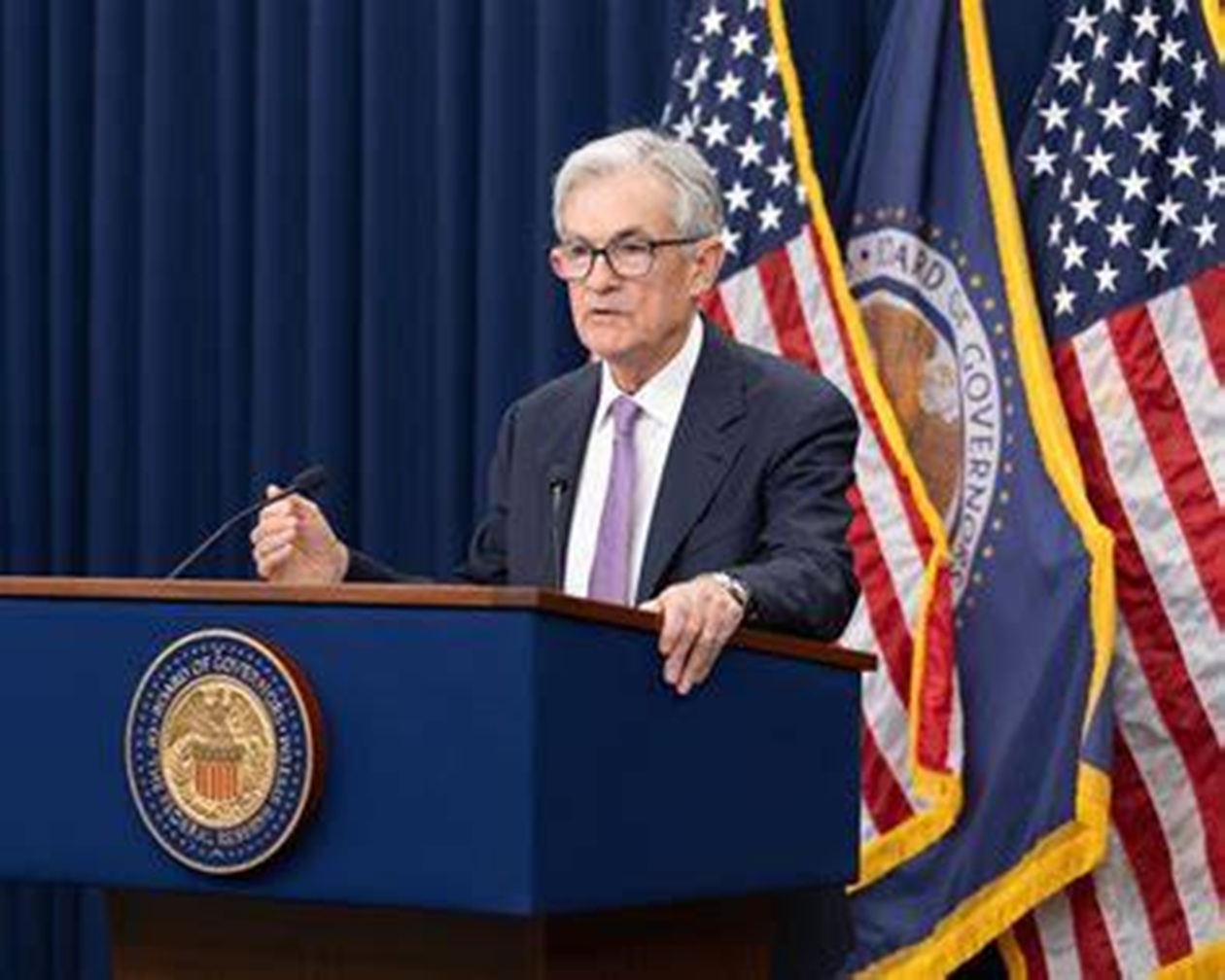
The Federal Reserve has raised interest rates for the first time since 2023. Behind a move of just 25 basis points lies a much larger question: how long will the rest of the world have to contend with a persistently expensive dollar?
For three years, the next major direction of US monetary policy appeared relatively clear. The question was less whether the Federal Reserve would raise rates again than how quickly it might eventually be able to lower them.
On September 16, 2026, that trajectory was interrupted.
The Federal Open Market Committee unanimously decided to raise the target range for the federal funds rate by 25 basis points, bringing it to 3.75–4%. The decision, effective September 17, marks the first US rate increase since 2023.
On the surface, the move is modest. A quarter-point increase does not, by itself, transform global financial conditions. Its significance lies elsewhere: the Federal Reserve is no longer simply waiting for inflation to converge gradually toward its target. It now considers further monetary restraint necessary.
And its own projections suggest the move may not be over.
An Economy That Refuses to Slow Enough
The Fed's rationale reflects a combination that has become uncomfortable for central banks: inflation remains too high while the economy is still strong enough to absorb tighter monetary conditions.
In its September 16 statement, the FOMC described economic activity as expanding at a solid pace, with resilient domestic demand, strong productivity growth and robust capital investment. The labor market, meanwhile, shows no major deterioration: job creation is broadly keeping pace with growth in the labor force, while unemployment has changed little.
In other words, the Fed is not confronting the classic dilemma of elevated inflation alongside an economy already suffering a severe downturn. Instead, it sees an economy performing well enough to allow monetary policy to continue prioritizing price stability.
Its latest projections make that tension particularly visible.
The median projection among Fed officials now puts real GDP growth at 2.3% in 2026 and unemployment at 4.1%. At the same time, PCE inflation is expected to remain at 3.7% by year-end, with core PCE inflation at 3.4% — both well above the Fed's 2% objective.
Disinflation has not disappeared. But it is evidently no longer proceeding quickly enough for the central bank simply to stand still.
One Increase Today, Perhaps Another Tomorrow
The change in direction becomes even clearer in the interest-rate projections.
In June, the median FOMC participant projected the federal funds rate at 3.8% at the end of 2026. In September, that median rose to 4.1%.
Following the September 16 increase, that trajectory is consistent with another 25-basis-point rise before the end of the year.
It is not a promise.
The familiar “dot plot” is neither a timetable nor a collective commitment. Each point represents an individual policymaker's assessment in an economic environment that can change rapidly.
The dispersion of projections also remains significant.
But the shift in their center of gravity is difficult to ignore. Only months ago, the central question remained the timing of future monetary easing. It is now the potential extent of additional tightening.
The Fed has changed direction.
Rates Are Rising, but the Balance Sheet Is Not Shrinking
That shift must nevertheless be properly qualified.
The central bank is not reactivating the entire tightening apparatus used after the inflation surge earlier in the decade.
The implementation note released alongside the decision maintains an ample-reserves regime. The Fed will continue rolling over Treasury principal payments at auction and reinvesting principal payments from agency securities into Treasury bills.
It may also purchase Treasury bills and, if necessary, other government securities with short remaining maturities to maintain an adequate supply of reserves.
Two developments therefore need to be distinguished.
The price of money is rising, but system liquidity is not simultaneously being compressed through a renewed contraction of the Federal Reserve's balance sheet.
The Fed is tightening through interest rates, not through a combined rates-and-balance-sheet strategy.
That distinction matters for understanding how the decision will ultimately transmit through financial markets.
The Real Issue Lies Outside the United States
For the global economy, however, the essential question is not whether the US policy rate stands at 3.75%, 4% or 4.25%.
It is how long the principal reference price of the international financial system remains elevated.
A substantial share of global credit, sovereign borrowing, corporate financing, commodity trade and international capital flows remains directly or indirectly linked to the dollar.
When US financing costs remain high, the constraint extends far beyond American borders.
For companies that have borrowed in dollars, it increases potential refinancing costs. For emerging economies carrying dollar-denominated debt, it can raise debt-servicing burdens. For some central banks, it can also reduce the freedom to lower domestic interest rates when widening yield differentials threaten to place pressure on their currencies or capital flows.
This transmission is neither automatic nor uniform.
Long-term bond yields, inflation expectations, risk premiums, debt maturity structures and the dollar's exchange rate will determine the actual intensity of the effect.
But the direction of the American signal has changed.
During much of the previous cycle, governments, companies and investors could gradually incorporate the assumption that the next major move in the price of money would be downward.
That assumption has just become considerably less secure.
The Trap of an Inflation Problem That Has Become International Again
The broader environment further complicates the equation.
Geopolitical and energy disruptions can sustain price pressures independently of US domestic demand. Tariffs can alter the cost of imported goods. These forces coexist with more persistent components of domestic inflation.
For a central bank, these different sources are not equivalent.
An oil-price increase caused by geopolitical disruption cannot be treated in exactly the same way as an overheating labor market. A temporary increase in import prices does not necessarily generate the same dynamics as generalized inflation in services and wages.
But when several sources of pressure overlap in an economy that continues to grow, analytical distinctions do not eliminate the monetary problem.
The Fed must prevent a succession of supposedly temporary shocks from eventually changing pricing behavior and long-term inflation expectations.
This is precisely where the September 16 decision acquires an international dimension.
US inflation partly generated by global disruptions can lead Washington to maintain tighter financial conditions. Those conditions can then be transmitted back toward economies experiencing neither the same growth nor the same inflationary pressures.
The shock returns to the global system in another form: the cost of capital.
The Return of a Constraint Many Thought Was Temporary
It would be premature to describe this as the beginning of another prolonged rate-hiking cycle.
One decision does not constitute a trajectory. The Federal Reserve's own projections are surrounded by considerable uncertainty and could change quickly in response to economic data, energy prices or deterioration in the labor market.
September 16 nevertheless marks a break.
For the first time since 2023, the Federal Reserve is no longer merely asking how long it should keep rates where they are. It has raised them.
And its policymakers collectively envisage a slightly higher level before the end of the year.
The difference between those two situations extends far beyond 25 basis points.
For several years, much of the global financial system has been waiting for the gradual return of cheaper money. Companies, governments and investors have sometimes postponed refinancing or investment decisions in the expectation that time would eventually lower their cost of capital.
The Federal Reserve has just reminded them that time does not necessarily move in that direction.
The problem of the expensive dollar may not be behind us.
It may simply have changed form.
Main sources
Federal Reserve — Federal Reserve issues FOMC statement, September 16, 2026.
Federal Reserve — Implementation Note issued September 16, 2026, September 16, 2026.
Federal Reserve — Summary of Economic Projections, FOMC meeting of September 15–16, 2026.
Associated Press — coverage of the US monetary policy decision and the Federal Reserve Chair's press conference, September 16, 2026.
Atlas Limits Research Desk
Atlas Limits’ editorial and analytical desk.