For decades, mass retailers treated real estate primarily as a means to an end. They needed hectares of land for hypermarkets, parking lots large enough to absorb Saturday traffic, shopping galleries to extend the customer journey, and warehouses to supply the entire system. Land served retail.
That hierarchy is becoming much less obvious.
The groups that accompanied the expansion of European and American suburbs did not merely build networks of stores. They also accumulated, sometimes almost incidentally, considerable property portfolios. Some of the land acquired when cities were smaller and peripheral real estate relatively inexpensive now sits inside metropolitan areas that have gradually expanded around it.
The store remains visible. The land beneath it is much less so.
Yet that may be where part of the value is now shifting.
Retail Created Property Wealth
The historical hypermarket model consumed extraordinary amounts of space. A large store required more than its sales floor. It needed storage areas, access roads, logistics zones and, above all, parking lots designed to accommodate peak customer traffic.
When these sites were developed, such extensive land use was not necessarily problematic. Large retail complexes were often built on the edges of cities, close to new road infrastructure. The availability of inexpensive land was precisely one of the conditions that made the model possible.
Several decades later, the geography has changed.
Cities have expanded. Residential districts have grown around former outskirts. Transport networks have developed. Sites once considered peripheral have become pieces of the city itself.
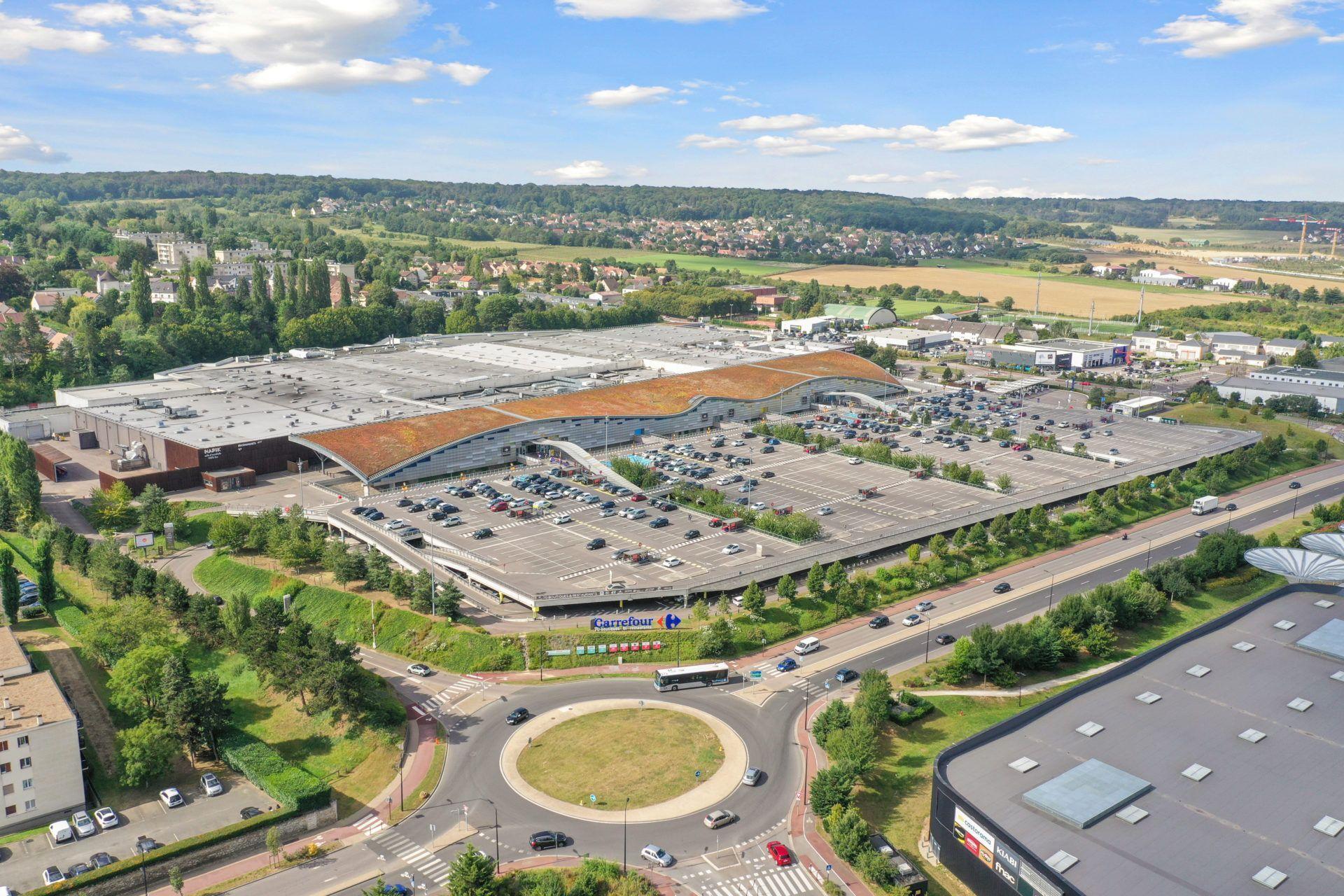
The result is a striking urban anomaly: in some metropolitan areas, tens of hectares of well-connected land continue to be occupied according to a model designed for the car-dependent retail economy of the 1970s and 1980s.
For retailers that own all or part of these sites, the question is therefore no longer simply how much the store earns.
It is also what the site itself is worth.
Walmart Shows the Scale
The American market provides an indication of how large this accumulation can become.
As of January 31, 2026, Walmart owned 3,728 of its 4,611 Walmart retail units in the United States. Sam’s Club directly owned 464 of its 601 locations. The company also states that the land underlying its stores may itself be owned or leased.
On its balance sheet, Walmart reported $20.8 billion of land and $128.5 billion of buildings and improvements at historical accounting cost.
These figures are not estimates of the market value of Walmart's property portfolio. They nevertheless demonstrate the amount of physical capital required to build a modern retail network.
And Walmart is only one example.
Wherever retailers historically favored ownership of their stores or land, decades of commercial expansion have mechanically produced a second category of assets. These companies have simultaneously accumulated operating networks and real estate portfolios whose economics are not necessarily identical.
That distinction becomes increasingly important when the expansion of retail space slows.
The Hypermarket Shrinks. The Land Remains.
The transformation is particularly visible in Europe.
Changing consumer habits, e-commerce, the expansion of convenience formats and demand for different retail experiences have reduced the need for some of the enormous spaces inherited from the golden age of the hypermarket.
But when a 15,000-square-meter hypermarket shrinks to 10,000 square meters, the remaining 5,000 square meters do not disappear.
They become an asset available for another use.
Auchan and its property ecosystem provide an almost experimental illustration of this transition. Ceetrus, the real estate company associated with the Mulliez ecosystem, acquired approximately 60,000 square meters of retail space released through the downsizing of several Auchan hypermarkets in France. Nhood is responsible for transforming these spaces into new activities and restructuring the sites concerned.
The logic is revealing: reducing the size of a retail operation does not necessarily destroy property value. It can instead release space or land capable of accommodating other uses.
The property ceases to be merely the shell around the store.
It becomes an economic activity in its own right.
From Parking Lot to Piece of City
The potential extends beyond the square meters contained inside buildings.
Parking lots may represent one of the most interesting land reserves controlled by mass retailers.
Their dimensions reflected an era in which almost every shopping trip involved a car and the success of a shopping center depended partly on its ability to absorb enormous flows of vehicles. In areas that have since become urbanized, maintaining several hectares exclusively as surface parking can become increasingly difficult to justify economically.
A parking lot can be densified. Part of it can accommodate housing. Another section can become offices, a hotel, student accommodation, healthcare facilities, public infrastructure or additional retail. Parking itself can be consolidated into a multistory structure, releasing land for development.
The supermarket can remain.
Everything around it can change.
In Bordeaux, the transformation of an Auchan, Ceetrus and Nhood site illustrates the principle. The Allée Counord regeneration project is expected to include 87 housing units, six neighborhood retail spaces and a landscaped pedestrian avenue.
What was once a retail asset gradually becomes a piece of city.
Carrefour and the Separation of Businesses
The Carrefour ecosystem illustrates another way of organizing the boundary between retail and property.
At the end of 2025, Carmila owned a portfolio of 250 shopping centers and retail parks adjoining Carrefour hypermarkets in France, Spain and Italy, representing approximately 1.7 million square meters and an appraised portfolio value of €6.7 billion.
But the distribution of assets is revealing: the Carrefour hypermarket and supermarket buildings, together with the parking areas adjoining centers owned by Carmila, remain held by Carrefour group entities.
A single retail complex can therefore contain several layers of ownership and several different economic functions: operation of the store, management of the shopping gallery, parking, land ownership and potentially future development rights.
Carrefour has also continued to adjust its exposure to Carmila, including through the sale in 2025 of approximately 7% of the property company's capital for around €170 million.
Real estate therefore becomes a financial instrument as well. It can be retained, developed, transferred into a property company, partially sold or used to release capital.
Selling the Walls to Finance Retail
Another strategy is to do precisely the opposite: monetize the property.
Sale-and-leaseback transactions allow a retailer to sell a property to an investor and continue operating from it as a tenant. The company converts a fixed asset into cash without closing the store.
Such transactions can be attractive when a group needs to finance its digital transformation, reduce debt, invest in logistics or simply increase short-term liquidity.
But they fundamentally change the long-term economics.
The retailer exchanges an asset for immediate capital and a future rental obligation. It gains financial flexibility but also gives up some of the potential appreciation of the underlying property.
In an area where real estate values rise sharply, that difference can become substantial.
The property question therefore becomes directly connected to capital allocation: should hundreds of millions remain tied up in buildings when retail returns are modest, or should those assets be retained precisely because the land may appreciate independently of the store operating on it?
There is no universal answer.
But it is becoming increasingly difficult to treat real estate as a secondary variable.
Hidden Value Is Not Automatically Realizable
It would nevertheless be misleading to add together the hectares controlled by retailers and immediately describe them as a gigantic reserve of profits.
Commercial land does not become residential land simply because apartments could theoretically be built on it.
Transformation depends on planning regulations, infrastructure, transportation, possible environmental remediation, construction costs, local demand, municipal authorities and the ability to maintain commercial activity while redevelopment takes place.
Projects can take years.
The value of a site also depends enormously on location. A hypermarket that has been absorbed into a growing metropolitan area is fundamentally different from one situated in a region experiencing demographic decline.
Mass retailers therefore possess less a homogeneous treasure chest than an enormous portfolio of real estate options.
Some are worth little.
Others could be worth a great deal.
A New Discipline of Capital Allocation
This is probably where the deepest transformation lies.
For decades, the property decision followed the retail strategy: find land, build a store, capture a catchment area.
The reasoning can now operate in reverse.
A group can examine its existing property portfolio and ask what the economically optimal use of each parcel should be, including when that use is no longer exclusively retail.
Ceetrus explicitly illustrates this evolution. The company has stated that it intends to concentrate investment on strategic assets, develop new value-creating projects and dispose of selected non-strategic properties. In March 2026, eight shopping centers jointly owned with Auchan in Poland were sold to the Adventum investment fund.
The logic increasingly resembles that of a portfolio manager: arbitrate, sell, densify, transform and reinvest.
Retailers are no longer confronted only with the question of revenue per square meter.
They must increasingly ask whether that square meter should still be used to sell something.
The Second Balance Sheet
Mass retail emerged from a very particular combination: mass consumption, mass automobile ownership and abundant peripheral land.
It is now discovering that one of the most durable legacies of that era may not be the store, but the land acquired to build it.
That does not mean Carrefour, Walmart, Auchan or their competitors are about to become disguised property developers. Retail remains their core business, and the quality of their locations remains essential to it.
But the boundary is becoming more porous.
When retail space can become housing, when parking lots become developable land, when shopping galleries are managed as asset portfolios and when selling store properties becomes a financing instrument, real estate ceases to be passive infrastructure.
It becomes a second allocation of capital.
For half a century, mass retailers searched for the best places to sell.
They must now decide what to do with the places they already own.
Main sources: Walmart Inc., Annual Report 2026; Carmila, 2025 financial reports; Carrefour, Universal Registration Document 2025; Ceetrus/Nhood, real estate publications and transactions, 2025–2026.
Atlas Limits Research Desk
Atlas Limits’ editorial and analytical desk.