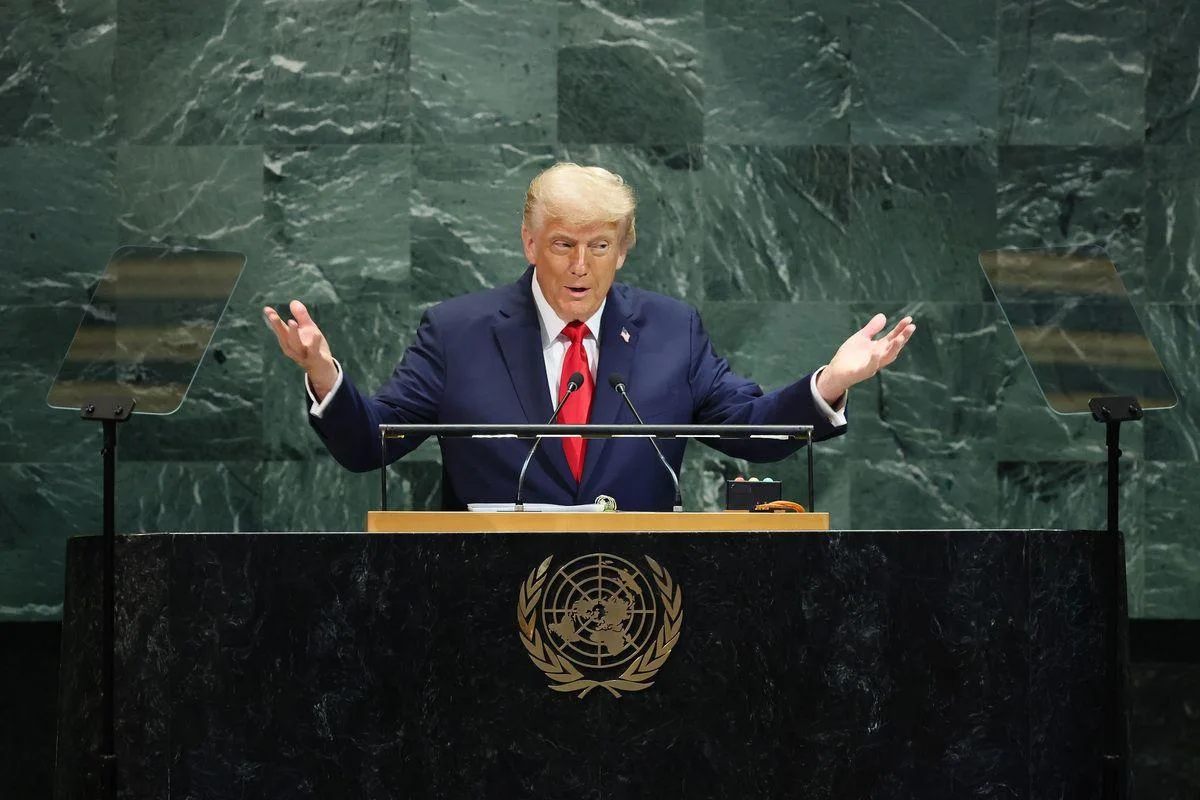
At the United Nations, the setting was entirely familiar. The green marble, the rows of delegations, the translation headsets, then the president of the United States standing beneath the emblem of an institution created precisely to prevent the power of states from being sufficient to define their rights.
A few hours later, however, another scene was unfolding in the same New York. Washington and Tehran were talking.
The contrast may capture what happened on September 22, 2026 better than the speech itself. Before the General Assembly, Donald Trump had threatened Iran with “annihilation” if no agreement were reached to end the conflict. Behind the diplomatic scenes, contacts continued. By the end of the day, the American president was confirming that the two countries had spoken and saying he believed a settlement would eventually be reached.
There was not necessarily a contradiction between the threat delivered from the podium and the negotiations taking place around it. There was a method.
Iran offers the most spectacular illustration: demonstrate that force can be used, maintain military and economic pressure, then negotiate from the balance of power that pressure has created. But the New York speech went much further. Venezuela, drug cartels, Cuba, the International Criminal Court, Greenland, artificial intelligence: behind seemingly disconnected issues, the contours of a common conception of American power were emerging.
Washington is not abandoning institutions, alliances or diplomacy. It increasingly appears to believe that they do not need to precede its freedom of action.
Negotiation After Force
Iran is the best place to begin because the events that followed the speech gave this logic an unexpected material form.
Before the General Assembly, Trump defended the campaign against the Islamic Republic and argued that the United States had prevented Tehran from obtaining a nuclear weapon. He called on other countries to deepen Iran’s economic isolation and suggested that failure to reach an agreement could lead to further escalation.
A few hours later, he confirmed that the two governments were still talking.
Tehran had arrived in New York with more than a speech. According to a senior Iranian official, the delegation attending the General Assembly had been given a mandate to negotiate. A proposal had already been transmitted to the United States through intermediaries on September 16. Iran was now saying it was prepared to reopen the Strait of Hormuz within roughly a week if Washington reduced military pressure and lifted the blockade affecting Iranian ports.
Hormuz changes the negotiation.
The strait is not merely an instrument of Iranian pressure. It has become one of the places where military security, maritime circulation, energy prices and the stability of the global economy directly intersect. Commercial traffic has been severely disrupted by the conflict. Preliminary data for September 21 recorded only two passages by large cargo vessels, compared with an average of roughly 125 a day before the escalation that began in February.
The Iranian proposal therefore places something on the negotiating table that much of the world wants back: the normalization of a critical artery of global energy trade.
Washington possesses military superiority. Tehran retains a capacity for geographic disruption. The negotiation begins precisely where those two forms of power meet.
That is also what makes the sequence more revealing than a simple diplomatic opening.
Force is no longer merely what diplomacy seeks to prevent. It can become what prepares diplomacy.
The Return of Geography
That logic does not stop in the Gulf.
Since 1945, American power has rested on an extraordinarily productive ambiguity. The United States has simultaneously been the dominant power within the international system and one of the principal architects of the institutions designed to constrain the arbitrary use of power. The United Nations, the financial system that emerged from Bretton Woods, military alliances, trade institutions and the norms gradually constructed around them allowed Washington to transform material superiority into political order.
That architecture never eliminated power politics. It constrained them.
The United States has repeatedly bypassed, interpreted or challenged international institutions when it considered its fundamental interests to be at stake. The history of the postwar period therefore leaves little room for an artificially idealized vision of a Washington once entirely subordinate to multilateralism.
What is changing is more subtle.
Unilateralism no longer necessarily appears as an exception that must be wrapped in universal language. It can instead be presented as the normal consequence of a particular American responsibility for its own security.
The discourse on the Americas showed this with particular clarity.
Trump portrayed drug cartels as threats comparable to terrorist organizations and defended the use of American capabilities against them. He described Mexico as an epicenter of cartel violence and called on the country to regain control of its territory. He also invoked US operations in Venezuela as evidence of Washington’s determination within its regional environment.
The shift in vocabulary matters.
A criminal organization traditionally calls for a police, judicial and financial response. An organization classified as terrorist opens a different register, one in which intelligence, external operations and military instruments become easier to contemplate.
Changing the classification of a threat therefore changes the boundary of what can be presented as a legitimate response.
Behind the cartels, Cuba and Venezuela, a much older idea begins to reappear: the Western Hemisphere constitutes a space in which the United States claims particular security interests and, with them, particular prerogatives.
Geography is becoming doctrine again.
Asymmetric Sovereignty
This is where the doctrine encounters its fundamental contradiction.
Washington vigorously defends its own sovereignty against international institutions capable of constraining American action. At the United Nations, Trump directly attacked the International Criminal Court, portraying it as an uncontrolled institution and calling on its member states to leave it.
Yet this demanding conception of sovereignty becomes more flexible when a threat beyond American borders is considered capable of directly affecting US security.
Sovereignty then ceases to operate as an absolute boundary. It becomes a variable within the balance of power.
The phenomenon is obviously not exclusively American. Russia has developed its own conception of regional security space. China extends the notion of strategic interest well beyond its land borders. Turkey intervenes outside its territory when it considers its security directly engaged. Other regional powers, to very different degrees, are developing comparable doctrines.
The international system is therefore entering a period in which major powers do not necessarily contest the existence of rules. Instead, they increasingly claim exceptions corresponding to their own strategic space.
The difficulty is mechanical: every exception creates a precedent available to others.
If a power can act beyond its borders because it considers a criminal organization, a technology, a trade route or a political regime to threaten its security, the central question eventually shifts. It is no longer only whether the justification is legitimate. It is who possesses the means to make that interpretation prevail.
International law does not disappear.
It risks becoming proportional to each state’s ability to impose its interpretation.
The UN Confronts What It Was Built to Contain
The New York setting makes this evolution almost paradoxical.
Nearly 130 heads of state and government have gathered this week inside an organization that is itself confronting questions about its capacity to act. The General Assembly is meeting as conflicts multiply, technological rivalries intensify and major powers increasingly deploy their economic, military and industrial instruments directly.
Yet the United Nations continues to rest on an intuition born from the catastrophes of the twentieth century: some questions become too dangerous when they are left to the balance of power alone.
It is precisely that intuition that is now encountering its limits.
Multilateral institutions reason from the premise that global problems require collective mechanisms. Washington increasingly reasons from the premise that national capabilities can address those problems when collective mechanisms appear too slow, insufficient or incompatible with American interests.
Two conceptions of international effectiveness are now meeting in the same room.
The first holds that interdependence makes common rules more necessary.
The second holds that interdependence makes power more useful.
Coercion as a Diplomatic Language
The US-Iranian conversation on September 22 makes it impossible to regard this opposition as purely theoretical.
Only a few hours separated the public threat from confirmation of the talks.
That proximity matters. Threatening an adversary while negotiating with it is obviously not an invention of the Trump administration. Coercion has accompanied diplomacy for as long as states have negotiated. But the current sequence gives coercion a particularly visible function: first alter the conditions under which negotiations will take place.
The objective is no longer simply to obtain a compromise. It is to transform beforehand the balance of power that will determine that compromise.
Trump himself said on Tuesday that the two countries had spoken during the day and that he believed a settlement would eventually be reached.
Iran, for its part, is not proposing capitulation. It is attempting to convert what it still controls — particularly its ability to affect Hormuz — into bargaining power. Its conditional offer to reopen the strait shows Tehran attempting to transform a capacity for disruption into diplomatic leverage.
Two profoundly unequal powers are therefore using different instruments to produce the same thing: a stronger position at the table.
American military power meets Iranian geography.
That may be where the real negotiation lies.
Economic Power After Military Power
This method extends far beyond Iran.
Financial sanctions, tariffs, technological restrictions, export controls, access to the American market and the capacity to exclude actors from the financial system increasingly belong to the same continuum as military force.
Their purpose is not merely punitive.
They allow an asymmetry to be converted into a political decision.
The centrality of the dollar gives American sanctions a reach extending beyond US territory. Dominance in certain technologies allows export controls to affect global value chains. The scale of the American market transforms tariffs into negotiating instruments. Military superiority, finally, gives credibility to threats that other states could not make with the same consequences.
Extraterritoriality then ceases to be a secondary effect of American power.
It becomes a method.
And that is precisely what makes the present moment more consequential than a presidential change in tone.
A World of Unequal Permissions
For decades, a considerable part of American power came from Washington’s ability to align its own interests with the institutions of the international system.
Even when that alignment was imperfect, it produced something coercion alone could not provide: consent.
The United States still possesses that advantage. Its network of alliances remains unmatched. The dollar retains a central position in the global financial system. American companies occupy decisive positions in advanced technologies. US military capabilities remain formidable.
But a power possessing so many instruments may gradually discover that it does not need to ask for as much permission.
That may be the more consequential message sent from New York.
Donald Trump announced neither the end of the United Nations nor an American withdrawal from the international system. Washington continues to negotiate, build alliances, participate in institutions and seek agreements.
The conversation with Iran demonstrates that better than any speech.
But it demonstrates something else as well.
Only hours before confirming that Washington was talking to Tehran, Trump had threatened the Islamic Republic from the podium of the organization created to prevent force from becoming the ordinary language of relations between states.
Diplomacy had not disappeared.
It had changed its place.
The international order built after 1945 rested on an imperfect but fundamental attempt: to ensure that power alone would never constitute a right.
The world emerging from the New York sequence does not abolish that principle. It increasingly subjects it to another reality: the more military, economic, technological and financial capacity a state possesses to act without external authorization, the harder it becomes to distinguish between what it can do and what it believes it has the right to do.
On September 22, that boundary was not only visible at the United Nations podium.
It extended into the rooms where, only hours later, negotiation was beginning.
Main sources
United Nations — 81st session of the General Assembly, General Debate and High-Level Week, September 2026.
Reuters — Donald Trump’s address to the United Nations General Assembly and US policy toward Iran, Venezuela, Cuba and drug cartels, September 22, 2026.
Reuters — Donald Trump’s statements confirming continued discussions between the United States and Iran in New York, September 22, 2026.
Reuters — Iranian proposal concerning the reopening of the Strait of Hormuz and the conditions presented to Washington, September 22, 2026.
Reuters — maritime traffic through the Strait of Hormuz and the consequences of the conflict for commercial flows, September 22, 2026.
Reuters — Donald Trump’s statements concerning the International Criminal Court, September 22, 2026.
Atlas Limits Research Desk
Atlas Limits’ editorial and analytical desk.