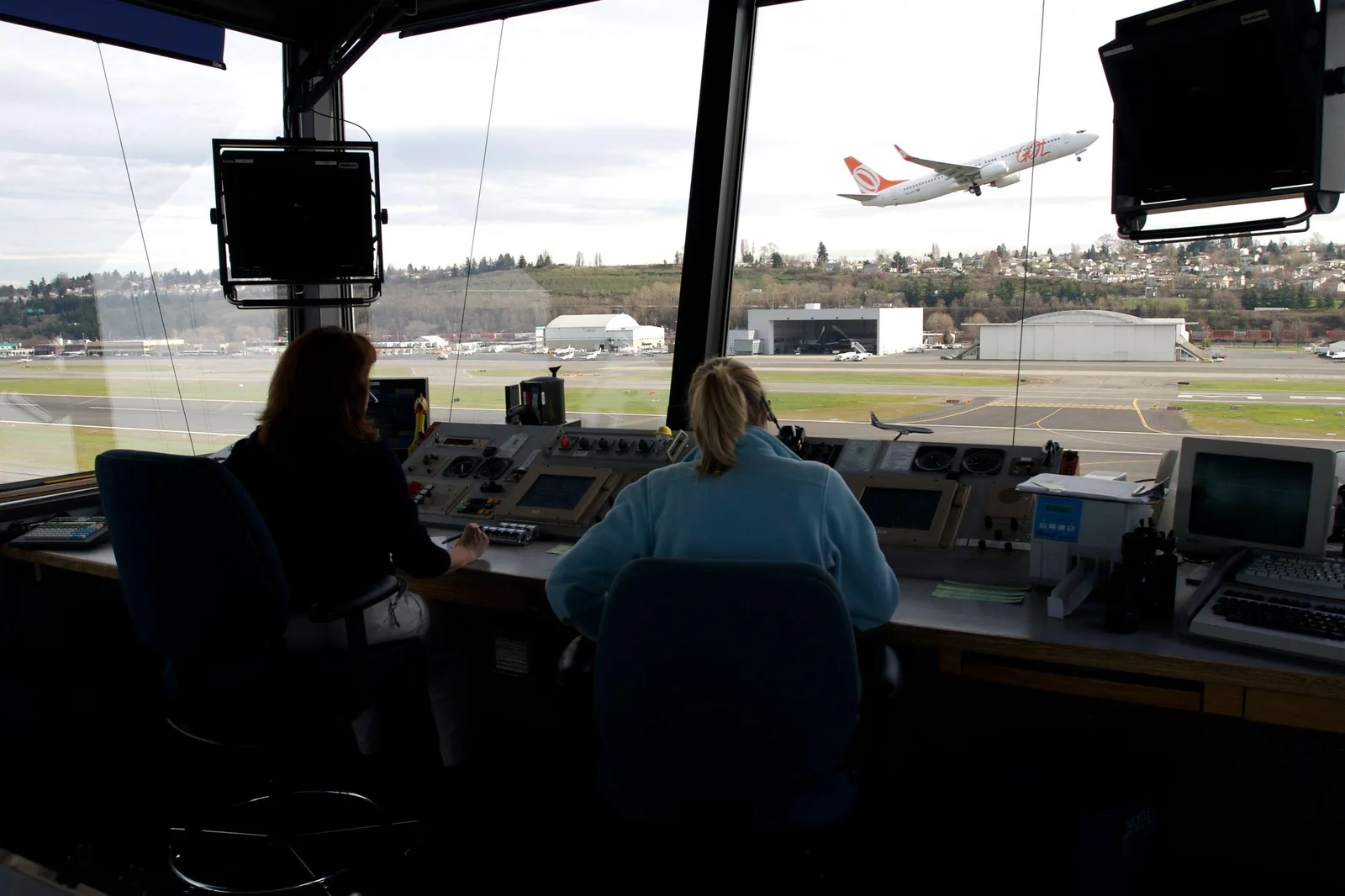
The nationwide suspension of US departures on 13 November 2026 was not a political closure of the airspace. The FAA imposed a precautionary ground stop after intermittent telecommunications problems affected air traffic control. The Department of Transportation announced that it had been lifted that evening. [1] Keeping aircraft on the ground protected operational safety while exposing a network's dependence on reliable information exchange.
Air traffic control does not rely on a single computer. Towers, control centres, radar and communications must provide a sufficiently coherent picture to manage aircraft movements. A shared disruption can therefore have consequences beyond an individual installation. When information becomes intermittent, maintaining normal traffic volumes can be riskier than temporarily stopping departures.
Explanations have developed since this article's original publication. On 15 November, the Department of Transportation said the routers involved were undergoing diagnostics at L3Harris laboratories. Sean Duffy associated the incident with maintenance and a transition from older copper connections to fibre, while stressing that the investigation still had to establish the exact cause. He said there was no indication of a cyberattack. [2] This government assessment is separate from a definitive technical finding and does not establish that an artificial-intelligence system caused the disruption.
The incident illustrates transition risk. A new component can meet its own specifications while disrupting an older system; a familiar procedure can encounter a configuration different from those tested. These are possible mechanisms, not additional established causes of the 13 November failure. They explain why modernisation must assess interactions rather than simply the quality of each replacement component.
Redundancy must survive common causes
An architecture can have several backup paths that nevertheless share a service, configuration or telecommunications dependency. Their number does not guarantee independence. Assessing resilience requires identifying scenarios that disable several functions simultaneously and procedures that preserve degraded operations. This differs from compiling an inventory of ageing equipment.
Age-related concerns are nonetheless documented. A September 2024 Government Accountability Office report noted that the FAA had judged 51 of its 138 systems unsustainable. [3] This earlier assessment does not automatically identify the components responsible for November 2026. It does establish that maintenance and replacement difficulties were recognised before the crisis.
Economic effects extend beyond the technical interruption. A grounded aircraft misses its next rotation; a crew can reach its duty limit; connections need rearranging. Restoring communications does not reposition aircraft or people. Recovery is a logistical operation in its own right, and continuing delays do not necessarily mean the original fault persists.
Budgetary responses need to reflect this complexity. Equipment funding is insufficient without migration planning, training and load testing. Conversely, postponing changes to avoid immediate risk preserves dependencies that become harder to maintain. A credible programme makes stages, transition criteria and ways to restore operational service visible.
The requirement extends beyond aviation, but comparisons have limits. Electricity, payments and telecommunications have different failure modes and obligations. Their common challenge is maintaining continuity during transformation. A country's technological strength cannot substitute for integration and maintenance.
As of 18 November, the operational lesson is more precise than a contrast between private innovation and ageing public infrastructure. Modernisation must demonstrate that it reduces dangerous dependencies without creating new ones during transition. Investigation findings, equipment tests and recovery capabilities will make that progress assessable. Success will be measured through continuity achieved, not spending alone.
Sources and assessment date
[1] US Department of Transportation, lifting the nationwide ground stop, 13 November 2026.
[2] US Department of Transportation, investigation and modernisation update, 15 November 2026.
[3] GAO, Air Traffic Control: FAA Actions Are Urgently Needed to Modernize Aging Systems, 23 September 2024. Updated assessment as of 18 November 2026; general mechanisms are not investigation findings.
Atlas Limits Research Desk
Atlas Limits’ editorial and analytical desk.