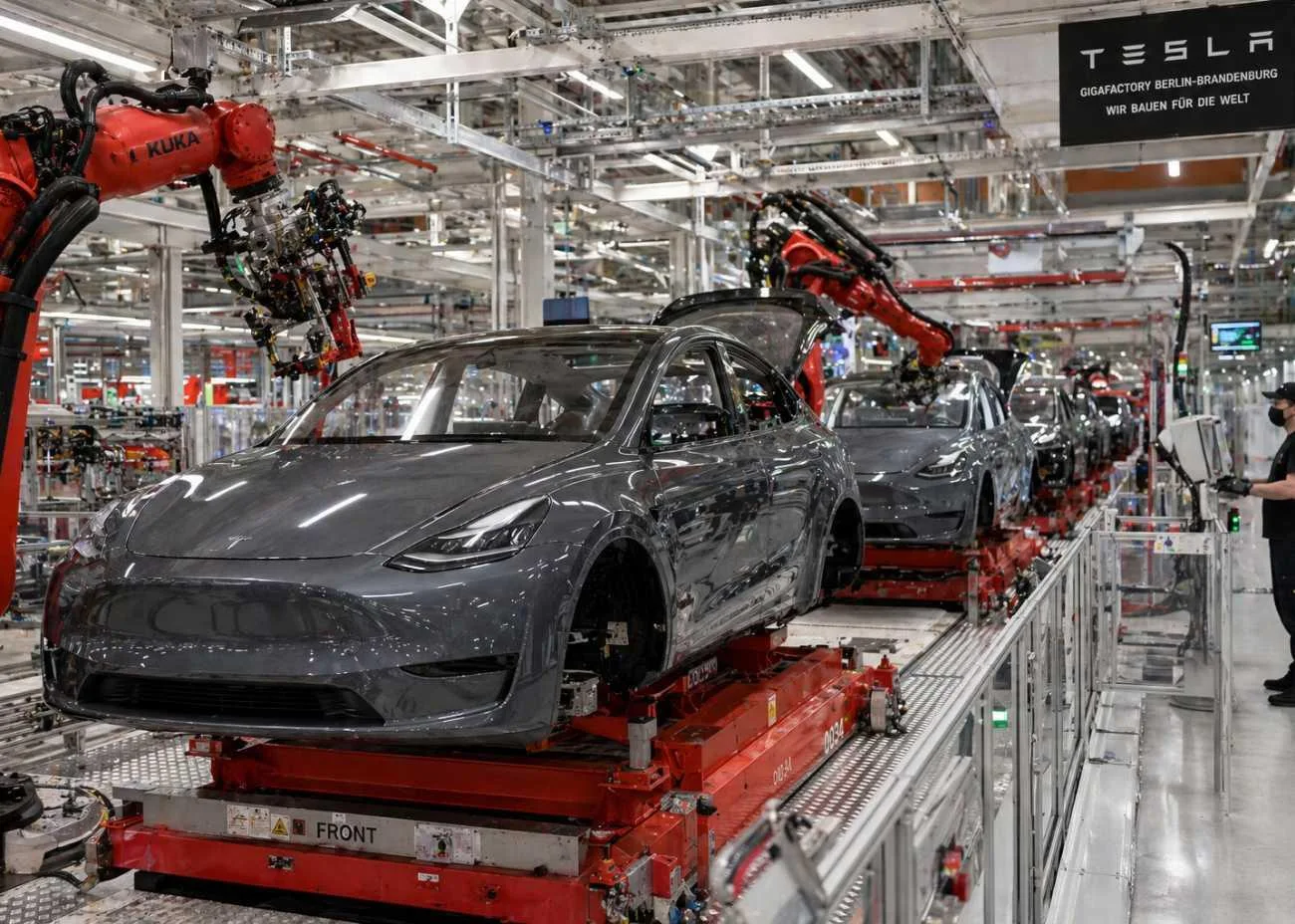
US trade policy is confronting an increasingly visible contradiction: the companies Washington seeks to protect sometimes depend on the foreign production networks it is trying to penalize. In Vietnam, interventions by Tesla and Samsung in an official US trade investigation expose the limits of an industrial revival driven primarily by tariffs.
Industrial globalization long rested on a relatively simple proposition: manufacture where costs, skills and infrastructure offered the most favorable conditions, then sell in markets where demand was strongest. American companies and their international partners organized their investments around this logic for decades. Today, governments are seeking to regain control over value chains whose organization extends far beyond their national borders.
Vietnam stands at the center of this transformation. Having emerged as one of the principal beneficiaries of industrial diversification away from China, the country now hosts activities essential to the manufacture of electronics, industrial equipment and components destined for international markets. This integration has substantially strengthened its position in global trade, but it has also exposed the country to tensions between the United States and its Asian trading partners.
The US trade investigation involving Vietnamese practices brings this contradiction into focus. While several American industries are calling for additional protective measures, Tesla and Samsung have submitted arguments against higher trade barriers. Their interventions do not necessarily reflect a general opposition to tariffs. They express a more immediate industrial reality: the supply chains on which their operations depend cannot be reorganized at the speed of political decisions.
A Trade Investigation Divided by Competing Interests
The American proceedings form part of a broader effort to scrutinize the commercial and industrial practices of US trading partners. Washington is examining issues related to production capacity, international competition and the conditions under which foreign goods enter the American market.
The submissions received during these proceedings nevertheless demonstrate that American economic interests do not constitute a unified whole.
For domestic producers facing import competition, tariffs can serve as an instrument of protection. Several industries, including steel, wood products, solar panels and certain seafood products, argue that competitive conditions justify further intervention by US authorities.
For companies whose production depends on international suppliers, the calculation is different. A tariff on imports does not exclusively affect a foreign competitor. It can also increase the cost of components, machinery and intermediate goods required by businesses operating in the United States.
Tesla has highlighted the difficulty of replacing certain specialized equipment and advanced components with alternatives available from American suppliers. The issue extends beyond price differences. Some industrial capabilities depend on expertise, supplier networks and investments accumulated over many years.
Samsung approaches the question from a different industrial position. The South Korean group has established Vietnam as one of its major global electronics manufacturing centers. Its investments, estimated at approximately $25 billion, have helped create an industrial ecosystem that supplies, among other markets, the United States.
The two companies operate in different industries and pursue different commercial interests. Their convergence in these proceedings nevertheless illustrates a defining characteristic of the contemporary economy: a measure designed to protect one domestic industry can simultaneously weaken other companies serving the same national market.
Vietnam, a Product of Global Diversification
Vietnam's industrial rise is not a geographical accident. It reflects successive investment decisions, public policies and commercial transformations that have gradually reshaped the distribution of manufacturing across Asia.
For decades, China concentrated a considerable share of global manufacturing capacity. The scale of its domestic market, its infrastructure, logistics networks and the depth of its industrial ecosystems enabled it to attract enormous investment.
Rising production costs, trade tensions with Washington and multinational companies' efforts to reduce dependence on a single country subsequently encouraged the emergence of alternative manufacturing platforms.
Vietnam benefited from this shift through its proximity to major Asian industrial centers, its openness to trade and its policies for attracting foreign investment. Companies developed manufacturing and assembly operations there while maintaining close connections with regional suppliers.
This evolution produced a paradoxical outcome. Diversification away from China, encouraged partly by Western strategic concerns, strengthened the role of another Asian economy in supply chains serving the United States.
Relocating a factory, however, does not mean that its entire value chain moves with it. Components may continue to originate in China, South Korea, Japan or other regional economies. Final assembly in Vietnam represents only one stage of a much broader industrial process.
Bilateral trade statistics are therefore insufficient to measure the actual dependence between economies. Rising Vietnamese exports to the United States may reflect the development of new domestic capabilities, but they can also result from a reorganization of production flows within Asia.
Vietnam has consequently become both a beneficiary of the fragmentation of global manufacturing and a concentration point for its emerging vulnerabilities.
When National Borders No Longer Match Industrial Geography
Part of the difficulty confronting US trade policy lies in the distinction between the legal geography of trade and the actual geography of production.
Tariffs apply to goods according to their classification, origin and the relevant trade rules. Companies, however, organize manufacturing through international networks in which individual territories perform specialized functions.
A component may be designed in the United States, manufactured elsewhere in Asia, integrated into equipment in Vietnam and eventually incorporated into a product sold on the American market. At every stage, value added, expertise and economic interests are distributed across multiple jurisdictions.
Under these conditions, taxing an imported product does not necessarily penalize only foreign manufacturing capacity. The measure may also affect an American company's margins, the prices paid by its customers or the competitiveness of its domestic operations.
This does not make tariffs inherently ineffective. They can alter investment incentives, respond to certain trade practices or provide relief to domestic producers facing competition considered unfair. Their effectiveness nevertheless depends on the availability of credible industrial alternatives.
When a foreign supplier can be replaced by domestic production or another trading partner, restructuring remains possible. When the required skills, equipment or production volumes do not yet exist elsewhere, the tariff initially becomes an additional cost.
The distinction is fundamental. Trade policy can rapidly change the price of access to a market. It cannot instantly create the productive capabilities required to replace imports.
Tesla and Samsung, Two Expressions of the Same Dependence
The participation of Tesla and Samsung in this debate is particularly revealing because their industrial models differ substantially.
Tesla operates in an automotive industry undergoing a profound technological transformation. Electric vehicle manufacturing requires batteries, electronic components, precision equipment and production systems whose suppliers are distributed across several regions.
Control over design, software or industrial integration does not necessarily mean that every physical component can be manufactured domestically under equivalent conditions.
Samsung represents a different configuration. As a South Korean company with a global manufacturing presence, it uses Vietnam as a major electronics production platform. Its operations rest on long-term investments, specialized labor and established relationships with numerous suppliers.
For Samsung, higher American trade barriers could undermine the economic conditions supporting a manufacturing organization developed over decades.
For Tesla, the risk is more closely associated with access to certain inputs and equipment required to operate or expand its industrial capabilities.
These situations are not identical, but they lead to the same question: how far can a government reorganize trade without disrupting the companies that depend on its existing structure?
The answer depends less on political declarations than on the time required to build new manufacturing capabilities.
Industrial Sovereignty Requires More Than Tariffs
American reindustrialization relies on several instruments pursuing objectives that are sometimes complementary and sometimes contradictory.
Tariffs seek to change competitive conditions. Subsidies and tax incentives are intended to encourage investment. Technology restrictions aim to protect certain strategic capabilities. Procurement and supply-chain policies seek to reduce dependencies considered excessive.
Together, these instruments form an economic security strategy in which industrial, commercial and geopolitical considerations are increasingly difficult to separate.
Industrial sovereignty, however, cannot be measured solely by the location of a factory. It depends on the availability of machinery, raw materials, engineers, specialized suppliers, energy infrastructure and logistics capabilities.
An economy can assemble more products domestically while remaining dependent on imported components. Conversely, it can retain considerable influence over an industry through design, patents, software or control of critical technologies, even when manufacturing takes place abroad.
The American debate over Vietnam therefore reveals a deeper difficulty than determining the appropriate tariff rate. It concerns the definition of economic autonomy itself.
Does autonomy mean producing everything within national borders, securing multiple sources of supply or retaining control over the most strategic stages of a value chain?
These objectives can reinforce one another, but they do not necessarily lead to the same policies.
The Cost of Industrial Fragmentation
For Vietnam, the multiplication of trade investigations and restrictions presents a significant challenge. The country has built part of its economic development on its ability to attract foreign investment and export to major consumer markets.
A deterioration in access to the American market could encourage some companies to reassess their investments, diversify production locations further or revise their sourcing strategies.
Yet Vietnam cannot be understood solely as an economy vulnerable to decisions made in Washington. Its integration into Asian industrial networks also gives it an importance that international companies cannot easily disregard.
The depth of these interdependencies helps explain why diversification policies do not automatically result in large-scale reshoring to the United States. Companies may prefer to distribute production across additional countries rather than concentrate all their capabilities in a single location.
The resulting industrial fragmentation can improve resilience against certain geopolitical risks. It can also multiply infrastructure requirements, compliance costs and redundant investments.
A more geographically dispersed value chain is therefore not necessarily a more autonomous one. It may simply redistribute dependencies.
For the United States, the risk would be to replace excessive concentration in China with a succession of dependencies on other manufacturing platforms, while increasing costs for American companies and consumers.
For Asian economies, the challenge is to preserve the benefits of industrial integration while reducing their exposure to changes in the trade policies of major powers.
A Less Open but Still Interdependent Global Economy
The American investigation involving Vietnam comes at a time when governments are seeking to redefine the relationship between trade, industry and national security.
Multinational companies are no longer merely beneficiaries of trade liberalization. They are also becoming essential, and sometimes critical, participants in policies intended to reorganize international commerce.
Their submissions should not be mistaken for a disinterested defense of free trade. Tesla and Samsung are protecting their own economic interests. American producers calling for additional measures are likewise defending concrete industrial positions.
The significance of this confrontation lies precisely in the coexistence of these divergent interests within a deeply internationalized economy.
The decisions ultimately taken by US authorities will not, on their own, determine Vietnam's future as a manufacturing platform. They will nevertheless help clarify how Washington intends to balance protection for domestic producers, the competitiveness of multinational companies and the security of industrial supply.
Beyond these proceedings, a broader transformation is taking shape. Governments are seeking to restore political control over industrial systems whose underlying organization remains international.
They possess powerful instruments capable of changing the conditions of trade. They do not necessarily possess the productive capabilities required to rapidly reconstruct what several decades of economic integration have distributed across continents.
Vietnam therefore illustrates one of the central contradictions of the emerging global economy: governments can raise trade barriers much faster than companies can relocate factories.
And the companies now requesting exceptions are not simply challenging the cost of tariffs. They are reminding policymakers that a country's industrial strength also depends on what it can obtain from the rest of the world.
Principal Sources
- Reuters, November 2, 2026 — Investigation into submissions by Tesla, Samsung and American industry groups concerning trade measures affecting Vietnam.
- Office of the United States Trade Representative (USTR) — Official trade investigation proceedings, public notices and stakeholder submissions.
- World Trade Organization (WTO) — Legal framework governing trade measures and rules of origin.
- World Bank — Data on Vietnam's external trade, investment and integration into global value chains.
- United Nations Trade and Development (UNCTAD) — Analysis of foreign direct investment and the international reorganization of manufacturing capacity.
Atlas Limits Research Desk
Atlas Limits’ editorial and analytical desk.