For more than thirty years, Western Sahara has been one of those diplomatic disputes that the United Nations has managed without succeeding in resolving. Resolutions followed one another, MINURSO mandates were renewed, and negotiations periodically resumed before returning to their familiar standstill. The conflict had its institutions, mediators, and diplomatic calendar. What it lacked was a credible prospect of settlement.
Washington is now attempting to change that pattern. Since Donald Trump returned to the White House, the United States has moved beyond simply supporting Morocco's autonomy proposal diplomatically. It is seeking to make that proposal the starting point for an operational negotiation, bring the parties directly to the table, and place the discussions within a political sequence capable of producing an agreement.
This development is not merely favorable to Rabat. It reveals a broader transformation in American diplomacy: an attempt to replace the prolonged management of disputes with concentrated negotiations, backed by the political weight of the United States and directed toward specific institutional outcomes.
Western Sahara has therefore become a testing ground for Washington's approach to international influence. Yet the first negotiations of 2026 also expose the limitations of that approach. Changing the framework of a discussion does not necessarily bring the parties closer to an agreement.
From Recognition to Negotiation
December 10, 2020, marked the starting point of the new American policy. At the end of his first presidential term, Donald Trump recognized Moroccan sovereignty over Western Sahara, breaking with decades of American diplomatic caution regarding the territory's final status.
The decision came in the context of the normalization of relations between Morocco and Israel, negotiated with American support. Washington thus linked two distinct geopolitical issues: the diplomatic realignment of the Middle East and a territorial dispute that has shaped the balance of power in the Maghreb since 1975.
American recognition did not, by itself, change the territory's status under the United Nations framework. Western Sahara remains on the UN list of Non-Self-Governing Territories, and its settlement remains subject to an international political process. The decision nevertheless transformed Washington's position: the United States no longer regarded Moroccan sovereignty merely as one possible outcome, but as the framework of its own policy.
The Biden administration maintained that recognition without launching a comparable diplomatic initiative. Trump's return in January 2025 allowed Washington to move toward a second stage. Having recognized sovereignty, the objective became to establish the political and institutional conditions for a settlement based on autonomy.
The distinction is fundamental. Bilateral recognition can be announced through a presidential decision. A lasting political agreement requires negotiations, guarantees, implementation mechanisms, and some form of acceptance by the parties concerned.
Washington is consequently confronting a reality more complex than the declaration it issued in 2020: translating recognition into a workable diplomatic settlement.
The Security Council as a Diplomatic Instrument
The United States possesses a decisive institutional lever: it has traditionally been responsible for drafting Security Council resolutions concerning Western Sahara.
This role, known in UN practice as the penholder, gives Washington considerable initiative. It prepares draft texts, conducts consultations, and influences the language around which the other Council members negotiate.
Resolution 2797, adopted on October 31, 2025, marked an important change.
The Security Council called for negotiations based on Morocco's 2007 autonomy proposal, with the objective of reaching a just, lasting, and mutually acceptable political solution that provides for the self-determination of the people of Western Sahara. It also acknowledged that genuine autonomy could constitute a feasible outcome.
The vote demonstrated both the diplomatic progress of this approach and the resistance it continued to encounter. Eleven members supported the resolution, while China, Pakistan, and Russia abstained. Algeria did not participate in the vote.
The result was significant, but its implications require careful interpretation.
The adopted resolution did not recognize Moroccan sovereignty or legally impose autonomy as the final solution. It established Morocco's proposal as a basis for negotiation while preserving the requirement for a mutually acceptable settlement consistent with self-determination.
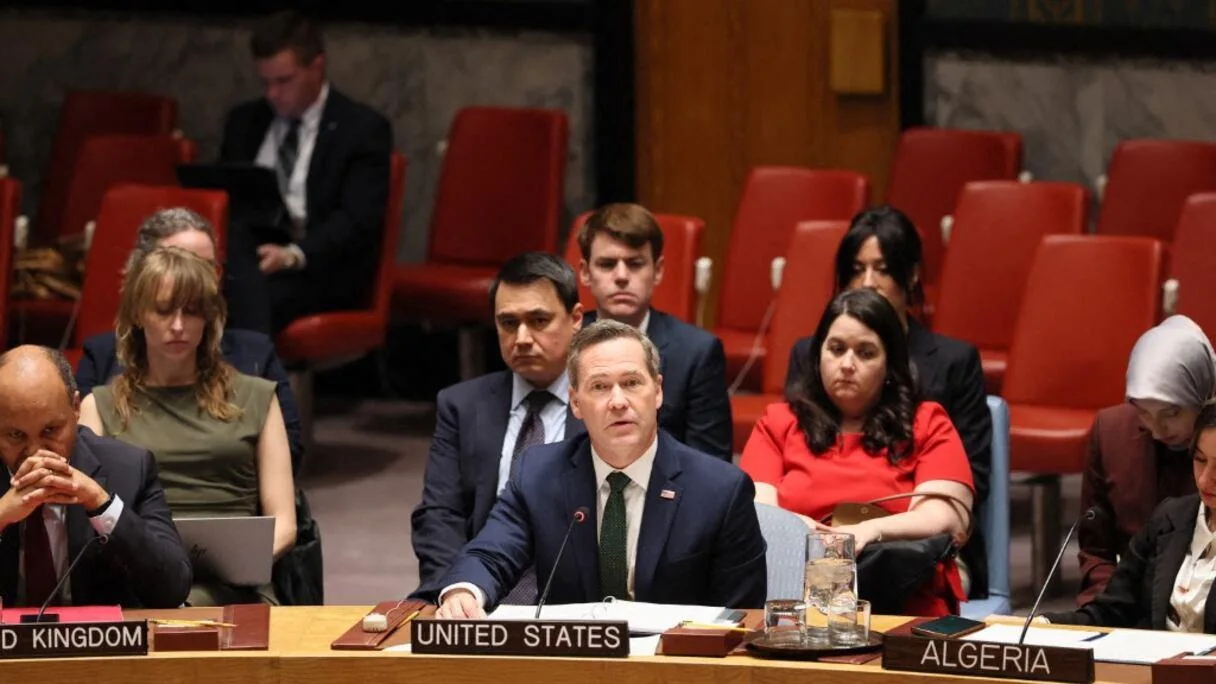
Washington defended a narrower interpretation. During the adoption of the resolution, US Ambassador Mike Waltz described the Moroccan plan as the only credible and realistic basis for settlement. That formulation reflected American policy but went further than the language collectively adopted by the Council.
The distinction reveals the method being pursued: using the international consensus that can be assembled to advance a more assertive American diplomatic position, without waiting for every UN member to adopt Washington's interpretation.
The resolution contained another important provision. It requested a strategic review of MINURSO's future, while extending the mission's mandate until October 31, 2026.
Established in 1991 to support the ceasefire and prepare a referendum that was never held, the mission could see its functions reconsidered in light of a possible political agreement. The question is therefore no longer confined to renewing a peacekeeping operation. It increasingly concerns how that operation might be adapted to a settlement architecture that has yet to be agreed upon.
Washington is attempting to reshape both the political framework of negotiations and the international instruments that might eventually support their implementation.
Diplomacy Under American Direction
The American initiative became more concrete in early 2026.
In February, delegations from Morocco, Algeria, Mauritania, and the Polisario Front met in Madrid in a ministerial-level format. The meeting involved Mike Waltz, the US Permanent Representative to the United Nations; Massad Boulos, an American adviser responsible for Arab and African affairs; and Staffan de Mistura, the UN Secretary-General's Personal Envoy.
A further round of discussions took place in Washington on February 23–24.
These meetings represented a significant diplomatic development. The four parties had not met physically in this configuration since 2019.
The format reveals several characteristics of the American approach.
Washington is not seeking to formally replace the United Nations. The Secretary-General's Personal Envoy remains involved in the process. Instead, the United States is placing its own convening power, bilateral influence, and senior diplomatic officials behind negotiations whose pace it wants to accelerate.
This arrangement brings together two different sources of legitimacy. The United Nations provides the international legal framework, institutional continuity, and mediation function. The United States contributes political weight, direct relationships with the capitals involved, and the ability to incorporate the dispute into broader diplomatic exchanges.
Algeria's inclusion is particularly important.
Algiers supports the Polisario Front and defends the right to self-determination, while Rabat considers Algeria's regional role indispensable to any durable settlement. The two countries severed diplomatic relations in August 2021, and their land border has remained closed since 1994.
By bringing all four delegations together, Washington is attempting to address Western Sahara not only as a dispute between Morocco and the Polisario Front, but also as a regional stability issue directly involving neighboring states.
This does not mean that the participants have identical legal status or responsibilities. Rather, it reflects an American intention to involve actors capable of facilitating, guaranteeing, or obstructing the implementation of a possible agreement.
That represents an important difference from earlier phases of the process: negotiations over Western Sahara can no longer be separated from relations between Rabat and Algiers.
Turning Autonomy into an Institutional Framework
The second major development concerns the substance of the negotiations themselves.
For many years, Morocco's autonomy initiative, presented in 2007, functioned primarily as a general political proposal. Rabat advocated extensive local powers within the framework of Moroccan sovereignty, while preserving the central state's authority over sovereign functions.
The discussions of 2026 have begun to address a different level of detail.
According to elements of the UN Secretary-General's report made public in early October, Morocco has developed a more detailed draft autonomy statute expanding upon its 2007 initiative. The document was reportedly shared with relevant international and regional interlocutors as early as January.
The issue is no longer simply obtaining agreement in principle on autonomy. It is determining how autonomy would actually function.
Which powers would belong to territorial institutions? How would legislative and executive responsibilities be distributed? What role would local representatives play? How would elections be organized? What guarantees would protect political and cultural rights? How would natural resources be administered and public revenues allocated?
Each question raises a practical difficulty.
Autonomy can appear extensive on paper while remaining limited in practice if financial resources, judicial authority, administrative appointments, or regulatory powers remain entirely controlled by the central government. Conversely, autonomy supported by strong institutional guarantees can establish substantial political decentralization without transferring the state's sovereign responsibilities.
The credibility of an agreement would therefore depend less on the formal proclamation of autonomy than on the precise allocation of powers, dispute-resolution mechanisms, and safeguards against unilateral reversal.
For Washington, this development offers an obvious diplomatic advantage. The more negotiations focus on verifiable institutional arrangements, the easier it becomes to negotiate partial concessions, implementation schedules, and international guarantees.
The American approach seeks to move the dispute from a confrontation between competing political principles toward negotiations over the practical terms of a settlement.
Yet this transformation does not eliminate the underlying disagreement. The Polisario Front continues to defend an interpretation of self-determination that must preserve the possibility of independence. Morocco, by contrast, considers autonomy under its sovereignty to be the framework for compromise.
No institutional arrangement can automatically resolve that contradiction. It can only create conditions in which negotiations might overcome it, provided the parties accept the outcome.
Why Washington Wants to Accelerate
American interest in Western Sahara cannot be reduced to its privileged relationship with Morocco.
The kingdom occupies an important position in the United States' strategic architecture across North Africa and the continent's Atlantic coastline. It regularly hosts the African Lion military exercise, maintains longstanding security cooperation with Washington, and participates in economic and commercial arrangements that structure bilateral relations.
Morocco is also the only African country with a bilateral free trade agreement with the United States that entered into force, in 2006, and remains operational in that form.
For Washington, the stability of its Moroccan partner belongs to a wider strategic geography linking the western Mediterranean, Atlantic Africa, and the approaches to the Sahel.
The Western Sahara dispute affects that architecture in several ways.
It contributes to the rivalry between Morocco and Algeria, two countries whose combined demographic, energy, industrial, and military weight is considerable within North Africa. It obstructs deeper Maghreb economic integration and complicates regional coordination in a Sahelian environment marked by recurring security crises.
Algeria is itself an important partner in Mediterranean energy balances and regional security questions. Washington must therefore navigate a delicate reality: explicitly supporting Moroccan sovereignty while maintaining the diplomatic channels necessary for negotiations involving Algiers.
A settlement could, from this perspective, help reduce some of the constraints affecting regional relations. Nothing guarantees, however, that an agreement over Western Sahara would be sufficient to normalize Moroccan-Algerian relations, whose tensions extend beyond this single dispute.
The economic dimension also matters.
The territory possesses fisheries resources, mining activities, port infrastructure, and potential for energy development. Its Atlantic location gives it significance within Morocco's plans to improve connectivity with sub-Saharan Africa.
The United States has expressed interest in investment opportunities associated with the territory. Nevertheless, international projects remain exposed to legal and political uncertainty surrounding its status.
In its October 2024 judgments concerning EU-Morocco agreements, the Court of Justice of the European Union reaffirmed the importance of the consent of the people of Western Sahara when certain agreements are applied to the territory. Morocco disputes the Court's legal approach.
An internationally accepted settlement could help reduce part of this uncertainty. It would not automatically eliminate obligations relating to population rights, land ownership, or resource exploitation.
American policy therefore connects several potential objectives: consolidating a strategic partnership, reducing a source of regional tension, facilitating investment, and demonstrating Washington's ability to produce a diplomatic outcome in a longstanding conflict.
It would nevertheless be excessive to present each of these objectives as an officially declared motivation for the negotiations. They represent a geopolitical interpretation of American interests, distinct from Washington's public commitments to a political settlement.
The Difference Between Washington and the United Nations
The publication of elements from Secretary-General António Guterres's report in early October helps clarify the methodological tensions surrounding the new diplomatic phase.
The United States favors an approach concentrated on political negotiations, Morocco's autonomy proposal, and the search for an agreement. The United Nations must incorporate broader requirements: international legality, self-determination, security, implementation guarantees, and the acceptability of any settlement.
This is not necessarily a confrontation between Washington and the UN Secretariat. Both participate in the same process. Their responsibilities, however, are not identical.
The American administration can openly defend an outcome consistent with its recognition of Moroccan sovereignty. The Secretary-General and his Personal Envoy must preserve a framework within which the parties can negotiate a mutually acceptable solution.
The difference becomes particularly important when considering what would happen after an agreement.
MINURSO, established in 1991, has a mandate historically associated with organizing a referendum and monitoring the ceasefire. Since hostilities resumed in November 2020, the security situation has become more complicated, while the mission has continued operating in a deteriorated political environment.
Discussions in 2026 concerning its future have raised several possible functions in the event of a settlement: ceasefire monitoring, assistance with refugee returns, support for disarmament and reintegration arrangements, and participation in mechanisms associated with the exercise of self-determination.
These possibilities are not adopted decisions. They nevertheless demonstrate that the United Nations is beginning to examine the practical implications of a potential transition.
An autonomy agreement could not be treated as a diplomatic document alone. It would require defining the authorities responsible for implementation, the security of populations, the conditions for returning refugees from the Tindouf camps, the rights of displaced people, political representation, and possible international supervision mechanisms.
Guarantees would be central.
For Rabat, a settlement would need to preserve territorial integrity and the essential sovereign responsibilities of the Moroccan state. For the Polisario Front, it would need to ensure the effective exercise of self-determination and prevent promised autonomy from remaining without sufficient guarantees. For Algiers, the legitimacy of the process and regional security would remain decisive considerations.
The United Nations must reconcile these sometimes contradictory requirements. Washington may seek to accelerate political decisions, but it cannot remove the conditions necessary for their implementation.
The Limits of American Pressure
The principal difficulty facing the American strategy emerges from the results of negotiations conducted since early 2026.
Despite renewed meetings and the greater prominence of the autonomy proposal, the fundamental disagreements have not been resolved.
This is the assessment presented by Security Council Report in its October analysis: the discussions have not yet produced a substantial convergence of positions.
The situation exposes the limitations of diplomacy organized around an accelerated timetable.
Washington possesses several instruments of influence. It maintains important bilateral relations with Morocco and Algeria, plays a central role in the Security Council, and can mobilize its diplomatic capabilities to sustain negotiations. It can also contribute to building political and economic guarantees around a possible agreement.
But these instruments do not give the United States the power to impose lasting acceptance.
Territorial negotiations involve sovereignty, political legitimacy, the representation of populations, and security. Concessions that may appear technically feasible to an outside power can represent fundamental and difficult-to-reverse decisions for the actors directly concerned.
The Polisario Front's position therefore constitutes a substantive obstacle to the American approach. Its opposition to autonomy that excludes independence is not merely a disagreement over institutional powers. It concerns the definition of the right to self-determination itself.
Algeria, meanwhile, cannot be treated simply as an actor expected to endorse a formula negotiated elsewhere. Its support for the Polisario Front is rooted in a longstanding regional policy and its declared understanding of how decolonization questions should be resolved.
International positions also remain heterogeneous. Several countries now explicitly support Moroccan sovereignty or consider its autonomy plan the most credible basis for a settlement. Others continue to emphasize a form of self-determination that includes the possibility of independence.
Resolution 2797 changed the Security Council's language. It did not eliminate these disagreements.
October 31: A Political Deadline
The next stage will unfold at the Security Council.
MINURSO's current mandate expires on October 31, 2026. Consultations beginning on October 8 and preparations for a new resolution are intended to allow Council members to assess the political situation, the prospects for negotiations, and the mission's future.
For Washington, this deadline provides another diplomatic lever.
The United States can seek to consolidate the place of Morocco's autonomy proposal in Council language, encourage the continuation of discussions, and clarify expectations directed toward the parties. It can also promote further consideration of MINURSO's future functions.
But drafting a resolution remains subject to negotiations among the Council's fifteen members, particularly the positions of the other permanent members.
China and Russia, which abstained in October 2025, retain influence over the language and diplomatic balance of the text. Countries favoring a broader interpretation of self-determination may also seek to preserve specific guarantees.
The significance of late October therefore extends beyond whether MINURSO's mandate will be renewed. It concerns the degree to which the Council is prepared to endorse the new negotiating momentum, the possible directions given to the mission, and the political conditions surrounding the continuation of the process.
A more detailed resolution could strengthen diplomatic momentum. It would not, by itself, constitute a settlement agreement.
A New Way of Exercising Power
The Western Sahara dispute ultimately reveals a broader development in American foreign policy.
Washington is not merely seeking to defend a national position. It is attempting to convert that position into a framework for international negotiations, then mobilize multilateral institutions to support the settlement it envisages.
This method combines bilateral recognition, diplomatic initiative, influence within the Security Council, and direct negotiations with regional actors.
It is neither perfectly neutral mediation nor a unilateral decision capable of resolving the conflict. It occupies the space between the two: the United States openly maintains a political preference while seeking an agreement sufficiently accepted to become operational.
Morocco now operates in a more favorable diplomatic environment than in previous decades. Its autonomy proposal occupies a central position in international discussions, and Washington is actively seeking to convert that political advantage into a settlement process.
Yet the success of this effort will not depend on American support alone. It will require defining the substance of autonomy, establishing credible guarantees, addressing security and humanitarian issues, and reaching a political formula acceptable to the parties.
After thirty-five years of MINURSO's presence, international diplomacy does not lack resolutions or procedures. It still faces the contradiction between an evolving negotiating framework and political positions that remain far apart.
That is where the real significance of the American initiative will be determined.
Washington has begun to change the terms and pace of negotiations. It must still demonstrate that this acceleration can produce something more than a new way of managing disagreement.
Main Sources
- United Nations Security Council, Resolution 2797 (2025), adopted October 31, 2025.
- United Nations Security Council, 10030th meeting, October 31, 2025, statements by the United States and other Council members.
- Security Council Report, Western Sahara — October 2026 Monthly Forecast, October 1, 2026.
- United Nations, documents and proceedings of the Special Committee on Decolonization, 2026 session.
- RFI, “Les premières conclusions de la fuite du rapport de l'ONU sur le Sahara occidental,” October 7, 2026.
- RFI, interview with Riccardo Fabiani, International Crisis Group, “Les États-Unis et l'ONU essaient de passer à la vitesse supérieure,” October 8, 2026.
- Court of Justice of the European Union, judgments of October 4, 2024, concerning EU-Morocco agreements.
- Human Rights Watch, UN: Western Sahara Peoples’ Self-Determination at Risk, March 25, 2026.
Atlas Limits Research Desk
Atlas Limits’ editorial and analytical desk.