For more than three decades, international diplomacy has managed the Western Sahara conflict without finding a political settlement. The United Nations has maintained a mission on the ground, renewed its mandates, conducted successive consultations, and searched for a formula capable of reconciling fundamentally opposing positions. Morocco defended its sovereignty and proposed territorial autonomy. The Polisario Front demanded the exercise of the right to self-determination, including the possibility of independence. Algeria supported the latter position, while Mauritania sought to preserve its stability and regional relationships. The process had diplomatic mechanisms, but it lacked an agreed framework for settlement.
The report of the United Nations Secretary-General dated October 1, 2026, registered as S/2026/781, reveals an important development. Negotiations conducted under American impetus are no longer confined to the general principles of a political solution. They have begun examining the institutions, guarantees, resources, security arrangements, and transitional mechanisms that could accompany a potential agreement.
Three rounds of negotiations brought together Morocco, the Polisario Front, Algeria, and Mauritania between January and February 2026, successively in Washington, Madrid, and Washington. Morocco presented an expanded version of its autonomy proposal. Participants examined the possibility of a transitional council and provisions concerning reconciliation, elections, and the reintegration of combatants. American and UN teams also worked on a draft framework agreement intended to organize a possible transitional period.
No final agreement has been reached. Disagreements over sovereignty and self-determination persist. Yet the nature of the discussions has changed. After decades of negotiations largely focused on the territory's status, the parties have begun examining the practical conditions under which a settlement might function.
This development clarifies Washington's strategy. The United States is no longer content merely to recognize Moroccan sovereignty or support its autonomy proposal. It is attempting to transform that position into a diplomatic process, mobilize regional actors, and construct, alongside the United Nations, the institutional instruments of a potential settlement.
Western Sahara has consequently become a testing ground for American diplomacy: an approach combining an openly stated political preference, direct negotiations, multilateral influence, and the pursuit of operational arrangements. Its effectiveness, however, remains constrained by a fundamental difficulty: designing the mechanisms of a transition does not mean that the parties have accepted the political principles on which it would rest.
From American Recognition to a Changing International Framework
The initial turning point came on December 10, 2020. At the end of his first presidential term, Donald Trump recognized Moroccan sovereignty over Western Sahara, breaking with the caution that had previously characterized American policy regarding the territory's final status.
The decision came within the framework of diplomatic normalization between Morocco and Israel. Washington thereby connected two distinct issues: the realignment of Israeli-Arab relations and a territorial dispute that has shaped the balance of power in the Maghreb since Spain's withdrawal in 1975.
American recognition profoundly changed the diplomatic relationship between Washington and Rabat. It did not, however, alter Western Sahara's status within the United Nations system. The territory remains on the UN list of Non-Self-Governing Territories, and its settlement remains linked to the principle of self-determination.
The Biden administration maintained American recognition without undertaking negotiations of comparable scope. Trump's return to the White House in January 2025 opened a second phase: translating the 2020 decision into a political process.
The American objective was no longer simply to defend a position on sovereignty. It became a matter of creating the conditions under which that position could form the framework of a negotiated agreement.
This transformation began at the Security Council.
The United States traditionally acts as the principal drafter of resolutions concerning Western Sahara, a responsibility known in UN practice as the penholder. This gives Washington considerable initiative in preparing texts, organizing consultations, and defining the compromises submitted to the Council's fifteen members.
On October 31, 2025, Resolution 2797 marked an important development. Adopted with eleven votes in favor, three abstentions — China, Pakistan, and Russia — and Algeria not participating in the vote, it called for negotiations based on Morocco's 2007 autonomy proposal.
The Council considered that genuine autonomy could represent a feasible outcome, while maintaining the objective of a just, lasting, and mutually acceptable political solution providing for the self-determination of the people of Western Sahara.
This language created a new situation. The Moroccan proposal, long defended as one possible solution among others, explicitly became the basis of the negotiating process supported by the Council.
The legal significance of this change must nevertheless be distinguished from its political implications. The resolution did not recognize Moroccan sovereignty, impose autonomy as the final outcome, or eliminate the principle of self-determination. It changed the starting point of negotiations without formally predetermining their conclusion.
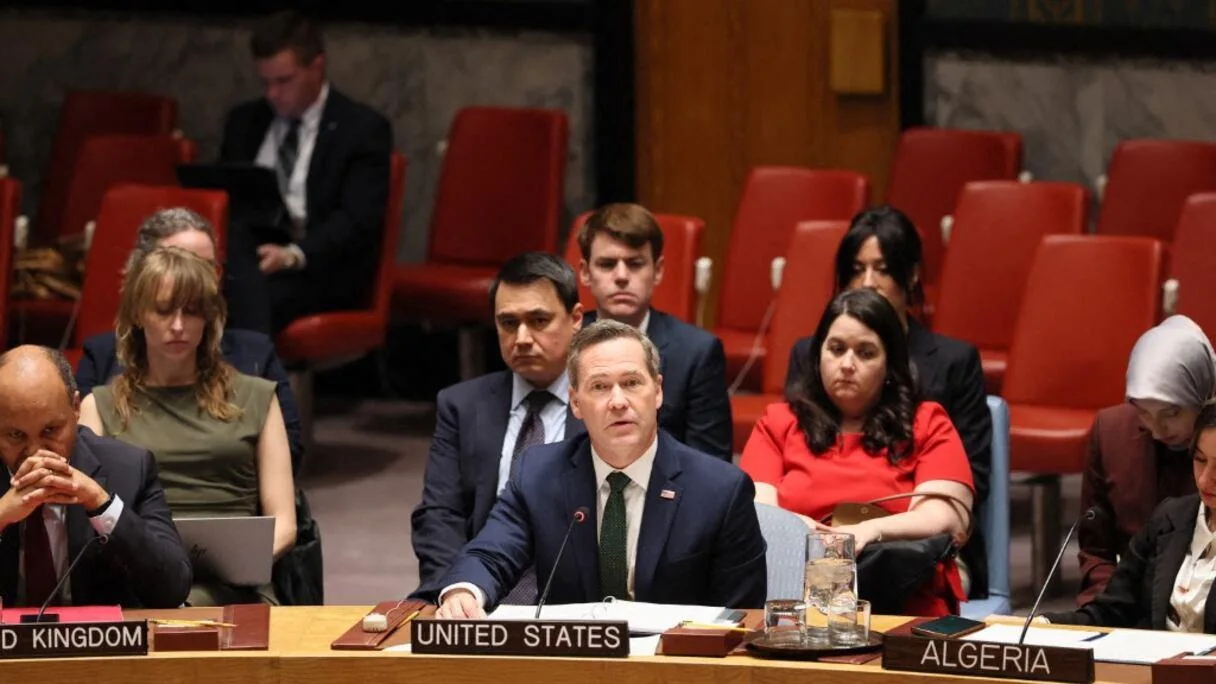
Washington defended a more assertive interpretation. Its Permanent Representative to the United Nations, Mike Waltz, presented the Moroccan plan as the credible and realistic framework for a settlement. The American position thus went beyond the strict consensus expressed in the adopted text.
The method was already apparent: advancing American policy through multilateral instruments without waiting for complete international convergence.
Three Rounds of Negotiations and Direct American Engagement
Report S/2026/781 makes it possible to reconstruct a diplomatic sequence that had remained largely confidential.
The first round of negotiations took place in Washington on January 18–19, 2026. The four participants — Morocco, the Polisario Front, Algeria, and Mauritania — engaged in discussions using the new framework established by Resolution 2797 as their reference.
A second round was organized in Madrid on February 8–9. This meeting attracted greater international attention, particularly because of the level of representation and the simultaneous presence of American and UN officials.
Mike Waltz and Massad Boulos, an American adviser responsible for Arab and African affairs, participated alongside Staffan de Mistura, the UN Secretary-General's Personal Envoy.
A third round took place in Washington on February 23–24.
The succession of these meetings revealed a change in pace. The four actors had not met physically in a comparable format since the roundtables of 2018 and 2019.
More importantly, Washington was no longer simply supporting initiatives conducted by the United Nations. The United States was placing its diplomatic officials, bilateral relationships, and convening power directly at the service of the process.
Massad Boulos's visit to Algiers, where he met President Abdelmadjid Tebboune in late January, illustrated this strategy. Washington was seeking to maintain dialogue with Algeria despite its opposition to American recognition of Moroccan sovereignty.
This approach responded to a structural constraint. Western Sahara cannot be treated exclusively as a dispute between Rabat and the Polisario Front. Relations between Morocco and Algeria, diplomatically severed since August 2021, directly affect security conditions and the prospects for implementing any settlement.
By involving Algiers in the discussions, the United States effectively acknowledged that a durable agreement would need to take regional balances into account.
Mauritania occupies a different but equally relevant position. Its geographical proximity to the territory, its relations with the various actors, and its exposure to security risks in the Sahel make its participation important for questions of movement, borders, and regional stability.
Washington is therefore constructing a format that extends beyond the two direct protagonists of the conflict. It incorporates neighboring states whose decisions could influence the implementation of an agreement.
This diplomacy rests on a particular division of responsibilities. The United Nations retains the legitimacy of the international political process and responsibility for mediation. The United States provides political momentum, negotiating capacity, and the ability to engage directly with the capitals concerned.
The combination of these two mechanisms is one of the defining characteristics of the new diplomatic phase.
Morocco's Autonomy Proposal Enters Its Institutional Phase
The report reveals another decisive development: in January 2026, Morocco prepared a detailed draft autonomy statute expanding upon the initiative it submitted to the United Nations in April 2007.
The document was reportedly communicated to the Secretary-General's Personal Envoy, the United States, and participants in the discussions.
It has not been made public and does not constitute an accepted agreement.
Its existence nevertheless indicates that Rabat is seeking to transform a general political proposal into an institutional arrangement capable of being negotiated in detail.
The 2007 plan rested on a central principle: extensive territorial powers exercised within the framework of Moroccan sovereignty, while the central state retained the principal sovereign functions, including defense, foreign relations, and the essential attributes of sovereignty.
A detailed statute must necessarily go further.
It must specify the composition of territorial institutions, the procedures for appointing or electing their officials, the extent of their legislative and executive powers, their budgetary autonomy, and the mechanisms for resolving disputes with central authorities.
The question of resources is particularly sensitive. Political autonomy whose institutions lack independent financial means risks remaining dependent on decisions taken by the central government. Conversely, a defined allocation of tax revenues, natural-resource income, and public expenditure could provide one of the material foundations of autonomy.
Institutional guarantees would be equally important.
An agreement would need to determine whether powers granted to the territory could be modified unilaterally, which courts would have jurisdiction over institutional disputes, and to what extent the statute's provisions would enjoy constitutional protection.
The report does not establish that these questions have been resolved. According to the publicly reproduced material, it confirms that a more developed proposal has entered the discussions.
The distinction is considerable.
As long as autonomy remains a general political principle, the parties can defend positions that are difficult to reconcile without addressing their institutional consequences. Once a detailed proposal exists, negotiations can focus on powers, guarantees, financing, and procedures.
Washington appears to be seeking precisely this shift: moving the conflict from a confrontation between principles toward a discussion of the practical conditions of settlement.
This method does not, however, resolve the central issue. For Morocco, autonomy must operate under Moroccan sovereignty. For the Polisario Front, self-determination must retain a meaning that allows the Sahrawi people to decide freely on their political status.
Drafting a statute can reduce certain technical uncertainties. It cannot eliminate that fundamental disagreement.
The Transitional Council: An Institutional Architecture Still Under Discussion
One of the report's most important revelations concerns the examination of a possible transitional council.
Participants reportedly discussed creating a structure responsible for managing various aspects of a transitional period and providing a forum for negotiating the terms of a political solution.
This proposal deserves particular attention.
A transition implies that an agreement would not necessarily be implemented in a single step. Some provisions could enter into force progressively, while others would require supervision mechanisms, security arrangements, or international guarantees.
Depending on its eventual composition and powers, a transitional council could perform several functions: coordinating agreed measures, monitoring implementation, addressing institutional disputes, and accompanying the establishment of new authorities.
These functions remain hypothetical. No definitive mandate, institutional composition, or binding timetable has been publicly adopted.
The report also indicates that American and UN teams worked on a draft framework agreement for a possible transitional period, followed by a revised version.
The existence of this joint work is politically significant.
It demonstrates that Washington is not merely seeking a declaration of intent. The United States is participating in the preparation of an instrument that could organize the sequence following an agreement.
A framework agreement would not necessarily constitute a comprehensive peace treaty. It could establish principles, a timetable, implementation stages, and the respective responsibilities of the actors involved.
In many settlement processes, the transitional phase is particularly delicate. It lies between the initial political commitment and the establishment of permanent institutions. Guarantees must be sufficiently strong to enable the parties to honor their commitments without creating a provisional system incapable of producing a durable political arrangement.
Western Sahara presents an additional difficulty: the proposed transition would depend on prior agreement concerning the nature and legitimacy of the settlement.
It would therefore be premature to describe the transitional council as an institution about to be established. At this stage, it remains an option under discussion, not a decision.
Its examination nevertheless reveals the level of detail that negotiations have reached.
Resources, Security, and Reconciliation: The Real Challenges of a Settlement
The report identifies several negotiating areas which, taken together, outline the principal challenges of a possible transition.
Resource allocation is among the first.
Western Sahara possesses substantial fisheries resources, mining activities involving phosphates, port infrastructure, and potential for energy development. Managing these assets raises economic, political, and legal questions.
A settlement would need to determine who administers resources, how revenues are distributed, what oversight mechanisms are established, and how the interests of the populations concerned are protected.
These issues cannot be separated from the territory's international status. In its judgments of October 4, 2024, the Court of Justice of the European Union reaffirmed legal requirements concerning the consent of the people of Western Sahara when certain international agreements are applied to the territory.
A potential political agreement could change the legal environment for investment, but it would not automatically eliminate obligations concerning population rights and resource exploitation.
Security represents a second set of challenges.
Since November 2020, the 1991 ceasefire has no longer functioned under the conditions that originally governed it. Low-intensity hostilities between Morocco and the Polisario Front have persisted, and the United Nations continues to report a deteriorated security environment.
The report mentions consideration of measures concerning disarmament, demobilization, and reintegration of combatants.
These mechanisms, generally grouped under the acronym DDR, are common in post-conflict processes. They aim to reduce or transform armed structures, reintegrate former combatants, and prevent a resumption of hostilities.
In Western Sahara, their application would raise particularly sensitive questions. Who would control security arrangements during the transition? How would combatants be reintegrated? What guarantees would be provided to those concerned? What role might an international presence play?
No definitive answers have been announced.
The third area concerns amnesty and reconciliation.
A durable settlement would need to address the human consequences of decades of conflict: population displacement, family separation, detention, alleged disappearances, restrictions on freedoms, and obstacles to return.
Refugees living in the Tindouf camps represent a major dimension of this issue. Their potential return would require security guarantees, adequate living conditions, and mechanisms for addressing individual rights.
An amnesty policy could contribute to certain forms of reconciliation, but it would also need to comply with international obligations concerning serious human rights violations.
Finally, electoral systems are among the subjects reportedly examined.
Establishing autonomous institutions would require defining representation rules, the electorate, participation requirements, and safeguards surrounding political consultations.
Determining the electorate could become particularly complex in a territory marked by displacement, migration, and demographic changes since 1975.
These questions demonstrate that a possible settlement cannot be reduced to a diplomatic formula concerning sovereignty. It would involve institutional, security, and social reorganization whose details remain largely unresolved.
The Decisive Question of Self-Determination
The shift toward technical discussions must not obscure the persistence of the fundamental political disagreement.
The Secretary-General's report emphasizes that sovereignty and self-determination remain among the most contentious questions.
This observation establishes an essential limit to interpretations of the developments in 2026.
The fact that the parties are examining transitional mechanisms does not mean that they all accept autonomy as the definitive outcome.
For Rabat, the negotiating framework must lead to autonomy exercised under Moroccan sovereignty. The Polisario Front continues to maintain that self-determination must include the possibility of independence. Algeria officially supports this interpretation of the right to self-determination.
Resolution 2797 changed the starting point of negotiations, but it did not eliminate this contradiction.
According to the reproduced report, the Secretary-General emphasizes the need for meaningful consultation of the populations concerned, allowing them freely to accept or reject a potential settlement proposal.
The wording matters.
It does not necessarily mean a return to the referendum originally envisaged in 1991, whose procedures and electorate were longstanding obstacles. It does, however, reaffirm that a settlement cannot be considered fully legitimate without a credible mechanism allowing the populations concerned to express their will.
Several questions remain open.
Who would be consulted? Under what rules? On which text? How would refugees be included? What legal significance would the result carry? What role would the United Nations play in organizing or supervising the process?
None of these questions can be considered definitively settled.
For Washington, the challenge is particularly delicate. The United States supports a solution based on Moroccan sovereignty while participating in a UN process that preserves the requirements of self-determination and mutual acceptance.
American diplomacy must therefore construct a compromise between an already established political orientation and international legitimacy requirements that cannot simply be set aside.
This relationship may prove to be the central difficulty of the next negotiating phase.
Algeria at the Center of the Regional Equation
The American strategy cannot be understood without examining Algeria's role.
For decades, Algiers has supported the Polisario Front and regarded Western Sahara as a decolonization issue. Morocco, for its part, considers Algeria's political, diplomatic, and material involvement to make its participation indispensable to a settlement.
The rivalry between the two countries extends far beyond Western Sahara. It concerns military balances, relations with external powers, regional ambitions, and competing approaches to security in North Africa.
Their land border has remained closed since 1994. Diplomatic relations have been severed since 2021.
This situation restricts economic exchanges, complicates regional integration projects, and sustains structural mistrust.
For Washington, the challenge is to maintain two important relationships simultaneously.
Morocco is a longstanding American military and diplomatic partner. It hosts the African Lion exercise, has a free trade agreement with Washington, and occupies a strategic position between the Atlantic, the Mediterranean, and sub-Saharan Africa.
Algeria, meanwhile, is a major energy and military power whose role remains important to Mediterranean and Sahelian balances.
A strategy that ignored Algiers would risk limiting the prospects for implementing a settlement. A strategy that sought its support without accounting for its political positions would also encounter resistance.
Massad Boulos's contacts with Algerian authorities demonstrate Washington's intention to maintain a direct channel.
It would nevertheless be excessive to conclude that Algeria has accepted the principle of autonomy under Moroccan sovereignty. No public commitment to that effect has been established.
Participation in negotiations does not constitute approval of their outcome.
American interests may also extend beyond Western Sahara itself. A reduction in tensions between Rabat and Algiers could theoretically create opportunities for economic, energy, and security cooperation across the Maghreb.
But it would be imprudent to assume that a settlement in Western Sahara would automatically normalize bilateral relations. The disagreements accumulated between the two countries have developed dynamics of their own.
Washington is therefore attempting to address both a territorial conflict and the regional conditions necessary for its stabilization, without any guarantee that these two objectives will converge.
Why the United States Is Investing So Heavily in the Dispute
American engagement reflects several overlapping strategic interests.
The first concerns the credibility of the policy initiated in 2020.
By recognizing Moroccan sovereignty, Washington adopted an explicit diplomatic position. The indefinite continuation of a process without settlement would limit the practical significance of that recognition. Seeking an agreement would allow the United States to attempt to transform a bilateral decision into a political arrangement supported by an international framework.
The second interest concerns Maghreb stability.
Morocco and Algeria represent two major centers of power in North Africa. Their rivalry affects regional cooperation, trade flows, infrastructure projects, and security policies.
In a context marked by crises in the Sahel, Mediterranean tensions, and competition among external powers, Washington has a strategic interest in reducing sources of regional confrontation.
The third interest is economic.
The territory lies at the intersection of several development projects: Atlantic infrastructure, port activities, resource exploitation, renewable energy production, and connections with sub-Saharan Africa.
A more stable political environment could facilitate certain investment decisions and improve the predictability of projects.
Potential interest should not, however, be confused with investment already committed. Economic opportunities remain subject to legal constraints, security conditions, profitability, and decisions by the actors concerned.
The fourth interest relates to the Trump administration's diplomatic method.
In several international disputes, Washington has favored negotiations concentrated among a limited number of actors, involving direct engagement by American officials and particular attention to producing agreements.
In Western Sahara, this approach encounters a distinctive institutional structure: a longstanding conflict, a UN legal framework, incompatible territorial positions, and an international mission present since 1991.
The American method consists of using existing instruments while seeking to change how they operate.
The Security Council provides the political foundation. Direct negotiations allow disagreements to be addressed. The draft framework agreement could structure a transition. MINURSO would remain a potential instrument of stabilization.
These elements do not yet constitute a settlement. They nevertheless outline an attempt to connect American influence with multilateral mechanisms.
Washington and the UN: Cooperation with Distinct Objectives
Cooperation between the United States and the United Nations is one of the most significant characteristics of the process.
Washington openly supports autonomy under Moroccan sovereignty. The UN Secretariat must preserve the conditions for a just, lasting, and mutually acceptable settlement consistent with the principle of self-determination.
These positions are not necessarily incompatible, but they are not identical.
The American administration can seek to accelerate negotiations by prioritizing an outcome already defined in its national policy. The United Nations must ensure that the process retains sufficient legitimacy for any agreement to be accepted and implemented.
The joint preparation of a draft framework agreement illustrates both this complementarity and its limitations.
Washington contributes initiative and diplomatic influence. The United Nations provides institutional continuity and a framework capable of ensuring that the arrangements under discussion do not become merely a bilateral transaction.
International guarantees consequently become central.
An autonomy agreement could require supervision mechanisms, commitments concerning political rights, arbitration procedures, and arrangements for verifying the implementation of agreed measures.
International actors could play a role in these mechanisms, but no definitive architecture has been established.
This cooperation reflects a permanent tension between diplomatic effectiveness and political legitimacy.
An agreement negotiated quickly may lose credibility if it lacks sufficient acceptance. Conversely, a process based exclusively on the search for complete consensus can remain paralyzed for decades.
The challenge for Washington and the United Nations is to find a method capable of producing compromises without bypassing the issues that determine their durability.
MINURSO Confronts the Possibility of Transformation
The Secretary-General's report recommends extending MINURSO's mandate until October 31, 2027.
This recommendation does not constitute a Security Council decision. It nevertheless reflects a cautious approach: preserving the mission while negotiations continue rather than prematurely changing its mandate.
Established in 1991, MINURSO was originally tasked with supporting the ceasefire and preparing a referendum on self-determination.
Thirty-five years later, the referendum has not taken place, the ceasefire has deteriorated, and the political process now operates within a different negotiating framework.
This raises a major institutional question: what should be the function of a mission designed to support a settlement mechanism that was never implemented?
Several options can be considered.
MINURSO could retain its current functions while negotiations continue. Its mandate could be reviewed if a political agreement creates new responsibilities. It could also be called upon, subject to a Security Council decision, to support certain security or transitional arrangements.
No transformation has yet been agreed upon.
UN officials have warned against prematurely modifying the mission in the absence of a political outcome. Reducing or restructuring its presence before an alternative arrangement is established could increase security uncertainty.
The Security Council must therefore balance two requirements: preserving the capabilities necessary for stability and gradually adapting international instruments to the evolution of the diplomatic process.
The October 31, 2026 deadline will represent an important moment in that assessment.
October Consultations and the Limits of the New Momentum
The Security Council consultations of October 7 and 8 took place in a contrasting diplomatic environment.
On the one hand, negotiations had resumed, Morocco's autonomy proposal had become their explicit basis, and transitional mechanisms had been examined.
On the other, no political agreement had been announced, and fundamental disagreements persisted.
According to an account citing a UN source, Staffan de Mistura reportedly emphasized two principal obstacles before the Council: the continuation of hostilities and the depth of mistrust between the parties.
These difficulties are not secondary.
A negotiating process can make progress in drafting documents without the actors being prepared to accept the concessions necessary for their adoption.
Report S/2026/781 illustrates precisely this difference between the technical development of discussions and the absence of definitive political convergence.
The draft framework agreement represents progress in preparing a settlement. It does not demonstrate that participants have reached agreement on sovereignty, self-determination, or final guarantees.
The transitional council represents an institutional possibility. It is not an authority whose establishment has already been decided.
Morocco's draft autonomy statute provides more detailed material for negotiations. It does not mean that the Polisario Front and Algeria accept its provisions.
The Secretary-General's caution regarding MINURSO's future reflects this reality.
The Security Council must also accommodate the positions of its permanent members. China and Russia, which abstained on Resolution 2797, can influence the wording and direction of the next resolution.
Washington possesses substantial initiative, but it does not control the multilateral process alone.
October 31 could therefore confirm the continuation of the existing framework, clarify certain expectations, or open a new phase of reflection concerning the mission. It cannot, at this stage, be treated as an announced date for a definitive settlement.
Morocco Faces a New Diplomatic Responsibility
The transformation of the international framework places Morocco in a particular position.
Since 2007, Rabat has defended autonomy as the political solution to the conflict. Resolution 2797 and the negotiations of 2026 have given that proposal a diplomatic centrality it did not previously possess in the same terms.
This development favors the Moroccan position insofar as it moves discussions toward a proposal designed and supported by Rabat.
But it also creates new requirements.
The more autonomy becomes the concrete framework for negotiations, the more its provisions must be precise, credible, and capable of being supported by guarantees.
Morocco can no longer rely solely on defending the principle of extensive autonomy. It must be able to define its institutions, powers, resources, and protective mechanisms.
Political rights and the representation of populations would become particularly important during any implementation phase.
The credibility of the proposal would depend, among other factors, on the ability of territorial institutions to exercise the powers assigned to them effectively, and on the existence of mechanisms for resolving disputes with the central government.
The participation of refugees and other populations concerned would also represent a major issue.
These requirements do not mean that Morocco would necessarily have to accept every demand made by its negotiating partners. They arise from the transition from a diplomatic proposal to a settlement project whose legal and institutional consequences would need to be defined.
The diplomatic advancement of the autonomy proposal is therefore accompanied by greater responsibility for its substance.
Changing the Method Does Not Yet Guarantee a Settlement
The evolution of the Western Sahara dispute since October 2025 can be summarized through three successive transformations.
The first is political. Resolution 2797 establishes Morocco's autonomy proposal as the basis of negotiations supported by the Security Council.
The second is diplomatic. The United States directly brings together the four actors concerned and gives the process momentum that had not been observed for several years.
The third is institutional. Discussions begin examining the practical mechanisms of a possible settlement: autonomy statute, transitional period, international guarantees, resources, security, reconciliation, and electoral systems.
It is this third transformation that the October 1, 2026 report makes possible to understand more clearly.
It should neither be minimized nor exaggerated.
Discussing the conditions for implementing an agreement represents a substantive development compared with a process confined to opposing general positions. But the existence of technical proposals does not establish that a political compromise has been reached.
Washington is attempting to cross a threshold that international diplomacy has previously failed to overcome: transforming a political orientation into a negotiable institutional architecture.
The difficulty is that this architecture remains dependent on decisions the parties have not made.
Morocco considers its sovereignty the necessary framework for settlement. The Polisario Front continues to defend self-determination including independence. Algeria maintains its support for that position. The United Nations insists on the need for an accepted settlement and credible guarantees.
The United States can bring the actors closer together, propose texts, mobilize the Security Council, and support preparations for a transition. It cannot replace the political consent necessary for an agreement to be implemented durably.
The real change in 2026 therefore lies less in any demonstrated proximity to a solution than in the transformation of the method used to pursue one.
For decades, Western Sahara was a conflict managed through international mechanisms. Washington is now attempting to turn it into a conflict negotiated around a concrete institutional arrangement.
The October 31 deadline will help measure the Security Council's capacity to support this momentum. It will not, by itself, establish whether the fundamental disagreements can be overcome.
American diplomacy has succeeded in shifting the center of discussion from the territory's abstract status toward the practical conditions of a potential settlement. It must still demonstrate that this evolution can produce political convergence.
That is now the central question facing Western Sahara: not merely defining a possible solution, but determining whether the actors concerned can accept the institutions, guarantees, and obligations that would make it effective.
Main Sources
- United Nations Security Council, The Situation Concerning Western Sahara, Report of the Secretary-General S/2026/781, October 1, 2026. The report's existence and registration are confirmed by the official UN record. Detailed passages used in this analysis are drawn from a provisional reproduction in an unofficial translation.
- United Nations Security Council, Resolution 2797 (2025), adopted October 31, 2025, and meeting record S/PV.10030.
- Security Council Report, Western Sahara — October 2026 Monthly Forecast, October 2026.
- Médias24, Sahara : le rapport Guterres 2026 acte le basculement, October 5, 2026, provisional reproduction of the report.
- Médias24, Sahara : ce que révèle Guterres sur un an de tractations secrètes, October 5, 2026.
- Médias24, Sahara : le Conseil de sécurité se penche sur l'avenir de la MINURSO, October 7, 2026.
- Le Monde, Sahara occidental : les États-Unis parviennent à réunir tous les acteurs du conflit, February 9, 2026.
- Court of Justice of the European Union, judgments of October 4, 2024, concerning EU-Morocco agreements.
- Hespress English, UN source: Two familiar obstacles weigh on de Mistura's Sahara push ahead of Oct. 31, October 9, 2026.
Atlas Limits Research Desk
Atlas Limits’ editorial and analytical desk.