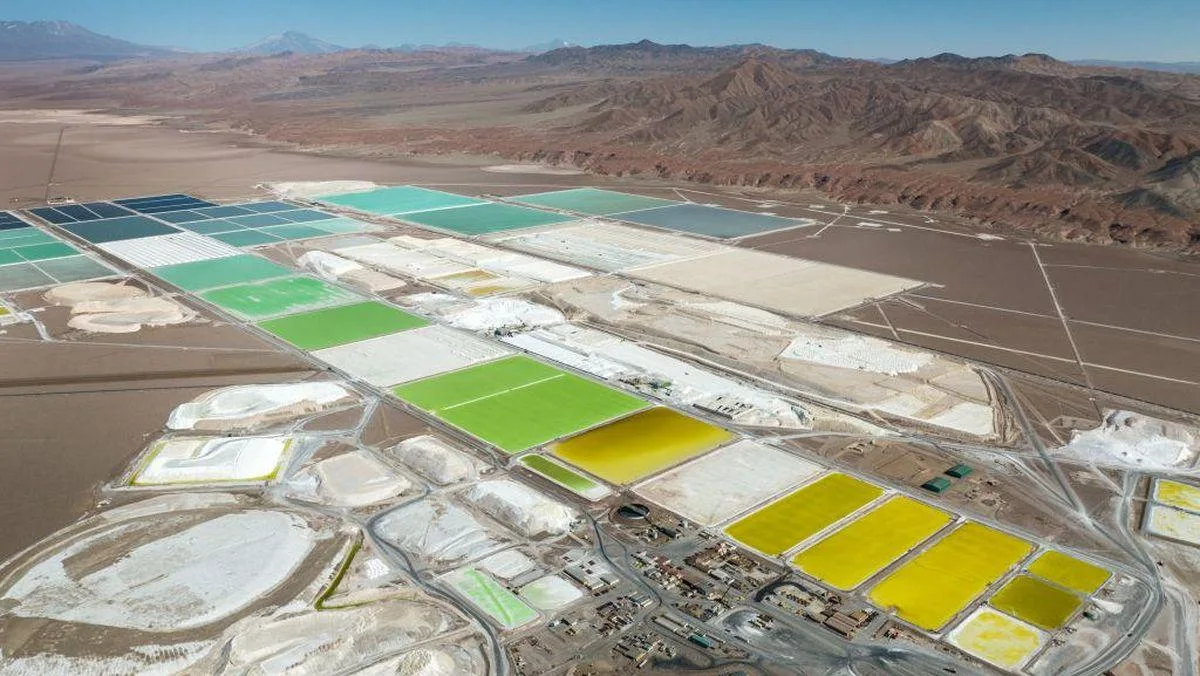
In the Atacama Desert, the energy transition takes a less intangible form than the speeches surrounding it suggest. Mines cut into the rock, evaporation ponds divide the salt flats, and solar installations spread across arid ground. The electric world begins here, in a landscape where production depends on managing what is most scarce: water. Thousands of kilometres from car factories and major consumer cities, northern Chile supplies some of the materials on which their transformation depends.
This geography gives the country an importance far beyond the size of its domestic market. According to the International Energy Agency, Chile accounts for almost a quarter of global copper production and roughly a fifth of lithium output. It stands at the intersection of two essential functions of electrification: carrying electricity and storing it. Yet this position raises a harder question than how much mineral wealth is available. Can the country supplying the materials of change transform its own economy, or could it become an increasingly indispensable supplier without becoming substantially more prosperous?
Copper gives this question its historical depth. Chile did not wait for the energy transition to build an economy around mining. Its mines have shaped exports, infrastructure and part of the public revenue base. The economy has diversified into fruit, wine, forestry products and salmon, but the metal retains an exceptional weight. In the first half of 2026, copper exports generated approximately $30.2 billion, accounting for 50.1% of Chilean goods exports. Mining as a whole represented 61.1%. Behind the variety of cargoes leaving its ports, the country’s trade balance remains heavily dependent on what lies underground.
Electrification reinforces this specialisation rather than automatically moving the economy beyond it. Expanding grids, connecting new generation capacity and powering transport and industrial equipment require conductors, cables and transformers. Copper is not tied to a single technology that might disappear with the next shift in fashion. It accompanies the expansion of the electrical system itself. In its 2025 outlook, the International Energy Agency estimated that announced mining projects could leave a gap of approximately 30% between global copper supply and requirements by 2035. This is a conditional risk, potentially reduced through investment, recycling or substitution, but large enough to place producers back at the centre of industrial strategies.
For Santiago, this prospect offers negotiating power. It guarantees neither continuously rising revenues nor an easy expansion of production. A mine cannot respond to demand like an assembly line adding another shift. Exploration, permits, financing, access infrastructure and reliable supplies must come first. As ore grades decline, more rock must be processed to obtain the same quantity of metal. Geological abundance becomes a matter of costs, engineering and time.
Lithium adds a newer promise to this equation, alongside a particular form of instability. Its importance to batteries has sometimes encouraged the idea of an almost automatic windfall. Yet a strategic material can suffer falling prices when extraction capacity grows faster than purchases. In 2024, global lithium demand increased by almost 30%, according to the IEA, without preventing substantial supply increases from putting downward pressure on battery metal prices. Long-term industrial needs and a producer’s immediate profitability follow different calendars.
Chile is therefore seeking to shape how value is captured as well as how production expands. The creation of NovaAndino Litio, announced in December 2025, embodies that ambition in the Salar de Atacama. A joint venture between state-owned Codelco and SQM, the partnership has majority state participation and provides for activities ranging from exploration to commercialisation through 2060. It brings private operational experience together with the state’s determination to retain a central role in a strategic resource.
This structure can change how revenues are shared. It does not, by itself, resolve the development challenge. Holding a stake in a profitable operation, chemically processing a mineral and mastering battery technologies are three different positions. Each requires distinct skills, equipment and markets. Proximity to a deposit does not automatically create an automotive industry, nor does it guarantee that a battery cell factory can compete with Asia’s large industrial ecosystems.
A credible strategy therefore involves selecting activities in which mining experience can become an exportable capability. Engineering, maintenance, automation, water management and certain processing technologies offer possible extensions. The challenge is to spread knowledge and business opportunities beyond extraction sites. An economy advances further when its companies learn to solve industrial problems than when they simply wait for the next rise in commodity prices.
Water shows how central these problems have become. According to Cochilco’s projections, seawater could account for 67.6% of the Chilean copper industry’s water supply in 2034, compared with 40.7% in 2024. This shift should reduce pressure on inland water resources in the north. It nevertheless requires coastal facilities, pipelines, pumping and, depending on the application, desalination. Mining is becoming increasingly dependent on an industrial system that begins at the Pacific shore.
This change transfers part of the constraint to energy. Transporting water to mining sites consumes electricity; expanding processing capacity requires more of it. Chile has a remarkable advantage here: the Atacama’s solar radiation and the winds of the south. But an exceptional energy resource is not yet a reliable supply. Electricity must be transported, the grid balanced and facilities powered when weather conditions change. In its 2025 economic survey, the OECD specifically emphasises the importance of transmission infrastructure, investment and skills in converting natural resources into growth.
Chile’s transition consequently depends on the connections between places. Sunshine, mineral deposits, ports and major consumption centres do not occupy the same locations. Across such an elongated territory, linking them requires investments whose profitability often depends on decisions made elsewhere: the opening of a mine, an electricity purchase agreement, port capacity or a commitment from a foreign customer. What looks like a natural advantage on a map becomes, in practice, a coordination problem.
The country also retains an energy dependence that its solar reputation can obscure. In 2024, it spent approximately $14 billion on fossil fuel imports, according to the IEA. Exporting the materials needed for global electrification does not mean having completed its own transition. Reducing that bill could strengthen Chile’s economic security, provided that new electricity capacity finds uses in transport, industry and everyday life.
Alongside this domestic geography sits the geography of customers. In 2025, China absorbed 36.8% of Chilean goods exports, according to Chile’s Undersecretariat for International Economic Relations. This relationship provides a major market, while also exposing the country to changes in Chinese economic activity and tensions between Beijing and its partners. Trade diversification therefore becomes a question of autonomy: broadening the customer base preserves more choices when commerce takes on a strategic dimension.
The European Union is also seeking to consolidate its supplies. Its Interim Trade Agreement with Chile, which entered into force on 1 February 2025, forms part of a relationship in which copper, lithium and hydrogen occupy an important place. For Santiago, however, the value of these partnerships will depend on what they help build within the country. A supply contract secures a market; investment accompanied by training, research and local suppliers can durably expand national capabilities. The two effects should not be confused.
The challenge is social as well. The OECD finds that Chile’s income convergence with its most advanced member economies has stalled since 2012, partly because of weaker productivity and investment. A new period of mining prosperity will therefore not necessarily restart that process. It can lift exports while leaving gaps in skills, incomes and access to opportunities intact. Success will depend on turning exceptional revenues into improvements that outlast the commodity cycle.
In mining regions, this demand takes an immediate form. Indigenous communities in the Atacama are seeking a role in environmental decisions and in the governance of projects affecting their lands. Their concerns include water and the continuity of local livelihoods. This debate cannot be reduced to a clash between development and protection: it concerns the distribution of benefits, risks and decision-making power. A resource can belong to the world’s industrial future while already being part of the lives of those who live around it.
Chile thus has a rare opportunity. Its minerals, renewable resources and export experience could help it secure a lasting place in the emerging economy. But that opportunity contains a familiar trap: confusing the rising value of what the world comes to buy with progress in what remains at home.
The outcome will depend less on a global ranking of mineral reserves than on much more concrete decisions: the quality of infrastructure, workforce training, the spread of technology, investment stability and the use of public revenues. The desert can provide copper and lithium. It cannot, on its own, provide a development model.
The world needs what lies beneath Chile to change. Chile must ensure that the change is visible on the surface too.  Main sources
International Energy Agency, Chile 2050 Energy Transition Roadmap, 2026; Global Critical Minerals Outlook 2025 and accompanying presentation of key findings, May 2025.
Cochilco, Proyección de la Demanda de Agua en la Minería del Cobre 2025–2034, 2026.
Chile’s Undersecretariat for International Economic Relations, Perspectivas del comercio exterior de Chile y sus principales socios comerciales, año 2025; first-half 2026 export report, July 2026.
Codelco, announcement of the creation of NovaAndino Litio with SQM, 27 December 2025.
OECD, OECD Economic Surveys: Chile 2025, particularly its analysis of productivity, income convergence and the green transition.
European Commission, overview of EU–Chile trade relations and the Interim Trade Agreement.
Reuters, reporting on Indigenous communities’ participation in Atacama lithium projects, 7 April 2025.
Atlas Limits Research Desk
Atlas Limits’ editorial and analytical desk.