Beijing and Muscat are deepening their strategic partnership in a region where energy, trade and diplomacy are closely intertwined. Behind the economic agreements lies a broader question: how far can China transform its commercial weight in the Gulf into lasting political influence?
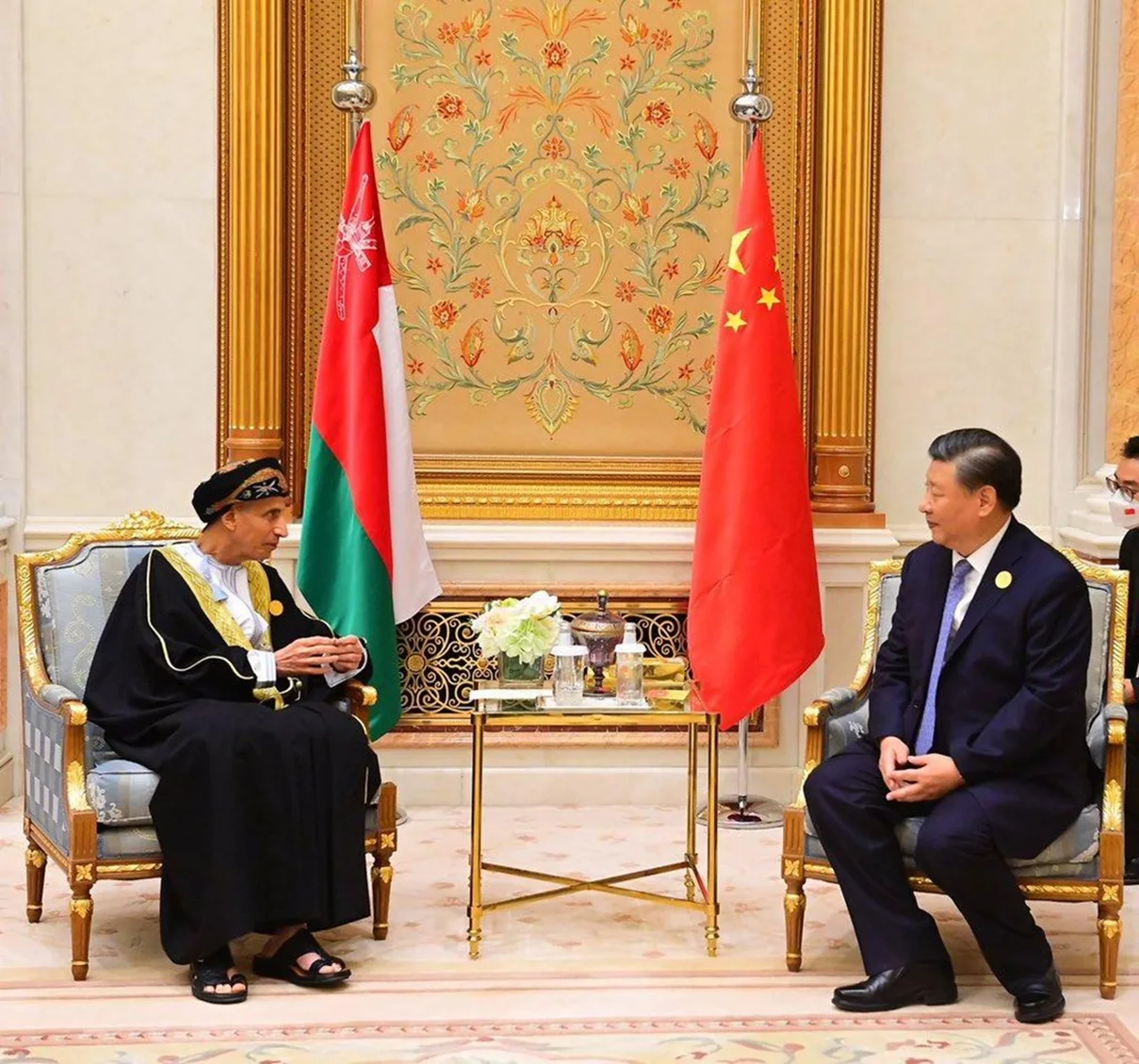
On November 2, 2026, Chinese President Xi Jinping received Sultan Haitham bin Tariq in Beijing. The visit marked a significant milestone in relations between the two countries: since the establishment of diplomatic ties in 1978, no Omani ruler had undertaken a state visit to China. Nearly half a century after their initial rapprochement, the two governments are seeking to give a new dimension to a relationship long dominated by energy trade.
The meeting took place in a regional environment where strategic rivalries, uncertainty surrounding maritime security and the diversification of Gulf economies are gradually redefining international partnerships. For Beijing, Oman represents more than a supplier of hydrocarbons. For Muscat, China is a major economic partner, but also an additional avenue for diplomatic and financial diversification.
The two leaders reaffirmed their commitment to deepening their strategic partnership. Sixteen cooperation documents were signed, covering supply chains, industrial development, technology, finance and the energy transition. Their practical significance will depend on implementation, but their breadth already reflects a determination to expand bilateral relations beyond their traditional commercial foundations.
A Commercial Relationship That Has Become Structural
China's importance to the Omani economy is not a recent development. For decades, hydrocarbon exports have helped bring the two countries closer, while China's industrial expansion has sustained substantial demand for imported energy.
In 2025, bilateral trade reached approximately 9.6 billion Omani rials, equivalent to nearly $25 billion. China accounted for around 23.8% of the sultanate's foreign trade, confirming its position as Oman's largest trading partner.
This concentration reveals a genuine but asymmetric interdependence. Oman relies on China as a crucial destination for its exports, while Beijing incorporates Omani supplies into a much broader energy strategy spanning several Gulf producers and other regions of the world.
China's economic presence now extends beyond energy purchases. Investment, logistics infrastructure and industrial projects are embedding the relationship in an increasingly diversified range of activities. During his visit, the sultan referred to more than 33 billion yuan in Chinese investments undertaken in partnership with the Oman Investment Authority over several years.
For Muscat, this relationship forms part of the economic diversification objectives established under Oman Vision 2040. The country aims to strengthen its industrial capabilities, port infrastructure, logistics activities and technology sectors in order to gradually reduce its dependence on oil revenues.
China possesses precisely the financial, industrial and technological capabilities that could support this transformation. Yet converging interests do not necessarily imply equal economic power. As the relationship diversifies, Oman must preserve its ability to balance competing international partnerships.
The Strait of Hormuz: A Geography That Matters
The strategic significance of closer China–Oman relations also stems from geography.
Located at the southeastern end of the Arabian Peninsula, Oman occupies a distinctive position near the Strait of Hormuz, one of the world's principal maritime corridors for energy trade. Omani territorial waters border part of this passage, through which substantial volumes of oil and liquefied natural gas move toward international markets, particularly in Asia.
For China, whose energy security depends heavily on maritime imports, stability in this area is a direct economic interest.
Oman possesses another important geographical advantage: several of its port facilities, including Duqm and Salalah, are located on the Arabian Sea, outside the Strait of Hormuz. This configuration gives the sultanate opportunities to develop logistics and industrial activities that do not depend exclusively on passage through the strait.
Chinese interest in Omani infrastructure therefore fits into a broader effort to secure and diversify supply chains. Ports, industrial zones, transport corridors and energy facilities are gradually forming an interconnected system in which commercial and strategic considerations are increasingly difficult to separate.
It would nevertheless be premature to interpret this rapprochement as the establishment of a Chinese military presence in Oman. The announced agreements do not demonstrate such a development. The immediate issue is instead the deepening of an economic presence that could, over time, increase Beijing's diplomatic leverage.
From Hydrocarbons to Financial and Digital Infrastructure
The diversification of the partnership is particularly evident in the nature of the documents signed in Beijing.
Discussions covered industrial supply chains, green development, emerging technologies, artificial intelligence and digital infrastructure. Cooperation involving China's BeiDou satellite navigation system illustrates Beijing's interest in expanding the international reach of its technological capabilities.
The financial dimension deserves particular attention.
The agreements include a currency swap arrangement between the two central banks, alongside initiatives concerning digital currencies. Such mechanisms can facilitate certain financial transactions and strengthen bilateral settlement capabilities, without necessarily implying an immediate abandonment of the dollar in energy trade.
The distinction is essential. A currency swap agreement is primarily an instrument of liquidity provision and cooperation between central banks. Its existence does not demonstrate a general shift in oil invoicing or an automatic transformation of commercial practices.
Nevertheless, the accumulation of such instruments can gradually broaden the financial options available to companies and institutions in both countries.
China's approach appears to favor integration through successive layers: trade, investment, infrastructure, technology and financial cooperation. Each field follows its own logic, but their combination can produce a relationship considerably deeper than one limited to hydrocarbon purchases.
For Oman, the challenge is to benefit from these additional capabilities without compromising the diversification of its international economic relationships.
Muscat: A Distinctive Diplomatic Partner
Beijing's interest in Oman extends beyond infrastructure and market access.
The sultanate has long occupied a distinctive position in regional diplomacy. Unlike several of its neighbors, it has consistently favored maintaining channels of communication with actors involved in sometimes profound rivalries.
Oman maintains relations with Iran, the United States, the Gulf monarchies and the major international powers. This approach has enabled it to act as a diplomatic facilitator during several sensitive episodes, notably in exchanges between Washington and Tehran.
This position does not reflect absolute neutrality, but rather a balancing strategy designed to preserve the sultanate's stability and decision-making autonomy.
For China, it offers an evident advantage.
Beijing already maintains substantial economic relationships with the Gulf's principal hydrocarbon producers. Its challenge is now to determine how far this commercial presence can support a more active regional diplomacy without drawing China into the very rivalries it seeks to contain.
The joint statement issued during the visit addressed regional security and stability in the Strait of Hormuz. Beijing also announced that its special envoy for the Middle East would visit Iran, Oman and Saudi Arabia during November.
The sequence of initiatives suggests a willingness to maintain simultaneous diplomatic channels with several regional powers.
It does not, however, establish the emergence of a new security architecture under Chinese leadership. China continues to face significant constraints: the depth of military relations between the United States and several Gulf states, persistent regional rivalries and the sometimes conflicting expectations of its partners.
Its economic influence is considerable, but it does not automatically translate into political arbitration capabilities.
A Chinese Diplomacy Built on Interdependence
For several years, Beijing has sought to develop a more visible diplomatic presence in the Middle East.
The rapprochement between Saudi Arabia and Iran announced in Beijing in March 2023 illustrated this ambition. China helped facilitate an agreement restoring diplomatic relations between two regional powers whose rivalry had profoundly shaped Gulf security.
That episode demonstrated that a power primarily identified with commercial relations could also provide a framework for diplomatic initiatives.
It also exposed the limitations of such an approach. Facilitating rapprochement does not guarantee the resolution of structural disagreements or lasting stability between the parties.
The partnership with Oman reflects this tension between opportunity and constraint.
China benefits from a particular advantage: it maintains important economic relationships with states whose strategic interests diverge. Its ability to engage simultaneously with several partners provides diplomatic flexibility that powers bound by more restrictive military alliances do not always possess.
But this flexibility also carries a weakness. When a regional crisis requires security guarantees, military commitments or coercive capabilities, commercial weight alone may prove insufficient.
Oman can help expand Beijing's diplomatic channels without necessarily transforming China into a guarantor of regional security.
Omani Diversification Does Not Mean a Change of Alliance
From Oman's perspective, closer relations with Beijing follow a logic extending beyond the search for investment.
Gulf economies are seeking to diversify their productive activities, sources of financing and technological partnerships. This transformation is unfolding as the energy transition, industrial restructuring and competition among major powers alter the conditions of their development.
Oman possesses energy resources, port infrastructure and a favorable geographical position, but its domestic market remains relatively limited. Diversifying its economy therefore depends heavily on attracting capital, developing export-oriented industries and integrating into international value chains.
Cooperation with China could contribute to these objectives.
The sultan also proposed examining the possibility of a preferential trade and investment agreement. At this stage, the proposal represents a potential avenue for negotiation rather than a concluded agreement.
This distinction illustrates the difference between political ambition and effective economic implementation.
Muscat continues to maintain important relationships with the United States, European countries, India and its partners within the Gulf Cooperation Council. The multiplication of partnerships reflects a diversification strategy rather than an exclusive shift toward Beijing.
For medium-sized states, the ability to maintain several structural relationships represents an instrument of sovereignty.
It broadens economic opportunities while limiting, to some extent, dependence on any single power.
Influence Built Without a Rupture
Sultan Haitham bin Tariq's visit to Beijing does not, by itself, represent a transformation of the regional order. None of the announced agreements demonstrates a break with existing diplomatic or security arrangements.
Its importance lies instead in the accumulation of cooperation mechanisms.
As commercial relations extend into infrastructure, technology, financial systems and diplomatic exchanges, the interests of the two countries become more closely interconnected. This deepening relationship could gradually increase China's influence over regional economic decisions without requiring any formal realignment of alliances.
The decisive question will be implementation: which projects will actually receive financing, which infrastructure will be developed, how extensively financial mechanisms will be used and what role Beijing will genuinely be able to play in future diplomatic initiatives.
For Oman, the challenge will be to convert this cooperation into productive capabilities and greater economic autonomy rather than new forms of dependence.
For China, it will be to transform commercial centrality into political influence without necessarily assuming the obligations of a power responsible for guaranteeing Gulf security.
The China–Oman rapprochement therefore reveals a broader evolution in international relations: influence is no longer built exclusively through military alliances or explicit diplomatic commitments. It also develops through infrastructure, payment systems, technology and supply chains.
In Beijing on November 2, no new regional order was proclaimed. Yet the two countries multiplied the instruments capable of gradually changing the conditions under which that order operates.
Perhaps this is the most enduring significance of the visit: not a change of alliance, but the patient construction of an interdependence whose diplomatic consequences have yet to be fully measured.
Atlas Limits Research Desk
Atlas Limits’ editorial and analytical desk.