Sometimes, a single aircraft component is enough to reveal the true state of relations between two great powers.
For several weeks, the US administration has been slowing the issuance of certain licenses allowing aircraft components to be exported to China. The move remains discreet enough not to resemble an embargo: parts continue to cross borders, aircraft continue to fly, and no general interruption of trade has been announced. But Washington is simultaneously working to strengthen its ability to control shipments of landing gear, hydraulic fluids and other equipment on which China’s aviation industry depends. For COMAC, the state-owned manufacturer tasked with embodying the country’s aerospace ambitions, licenses are also reportedly being calibrated to prevent the company from building excessively large inventories.
The detail is almost more revealing than the restriction itself. The United States is not necessarily trying to interrupt the supply chain.
It is trying to preserve the ability to do so.
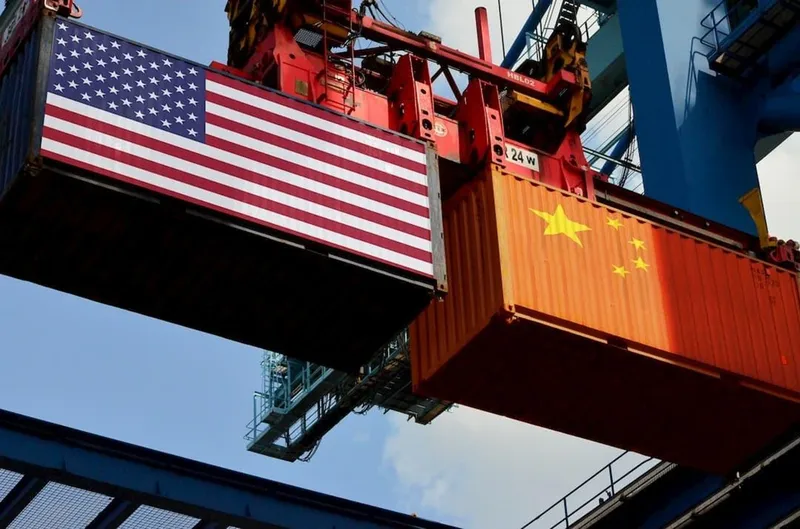
Only days earlier, Donald Trump and Xi Jinping had presented a very different image of their relationship. Their Washington summit extended the commercial truce between the two countries until January 10, 2027. Each side is also expected to identify around $30 billion worth of non-sensitive products that could receive more favorable tariff treatment. American agricultural exports, Chinese consumer goods, market access and dialogue on artificial intelligence gave substance to a détente that, after successive escalations over the past two years, is economically far from insignificant.
But aviation reveals what this détente has actually become.
It is no longer really the opposite of confrontation.
It is the management of confrontation.
The aircraft of independence
When the C919 entered commercial service in 2023, its significance extended far beyond the arrival of another passenger aircraft. China was entering one of the most difficult industrial markets in the world with the declared ambition of eventually challenging the Airbus-Boeing duopoly.
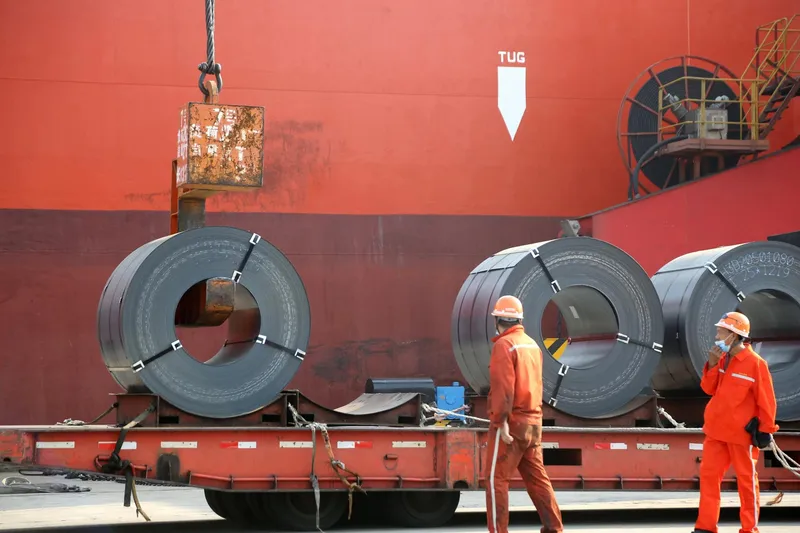
The stakes were considerable. In a country that has become one of the world’s largest air-transport markets, relying almost entirely on foreign manufacturers meant transferring billions of dollars abroad every year. More importantly, it meant accepting that an infrastructure essential to the functioning of the economy depended on technologies Beijing did not control.
COMAC was supposed to gradually change that equation.
The C919 is assembled in China, its development has mobilized a considerable domestic industrial apparatus, and its production ramp-up is intended to give the country capabilities it still lacks in commercial aviation. The program is therefore industrial, but also strategic: it belongs to the much broader effort through which Beijing is seeking to reduce its dependencies in semiconductors, energy, machine tools and advanced technologies.
But an aircraft does not become Chinese simply because its fuselage is assembled in Shanghai.
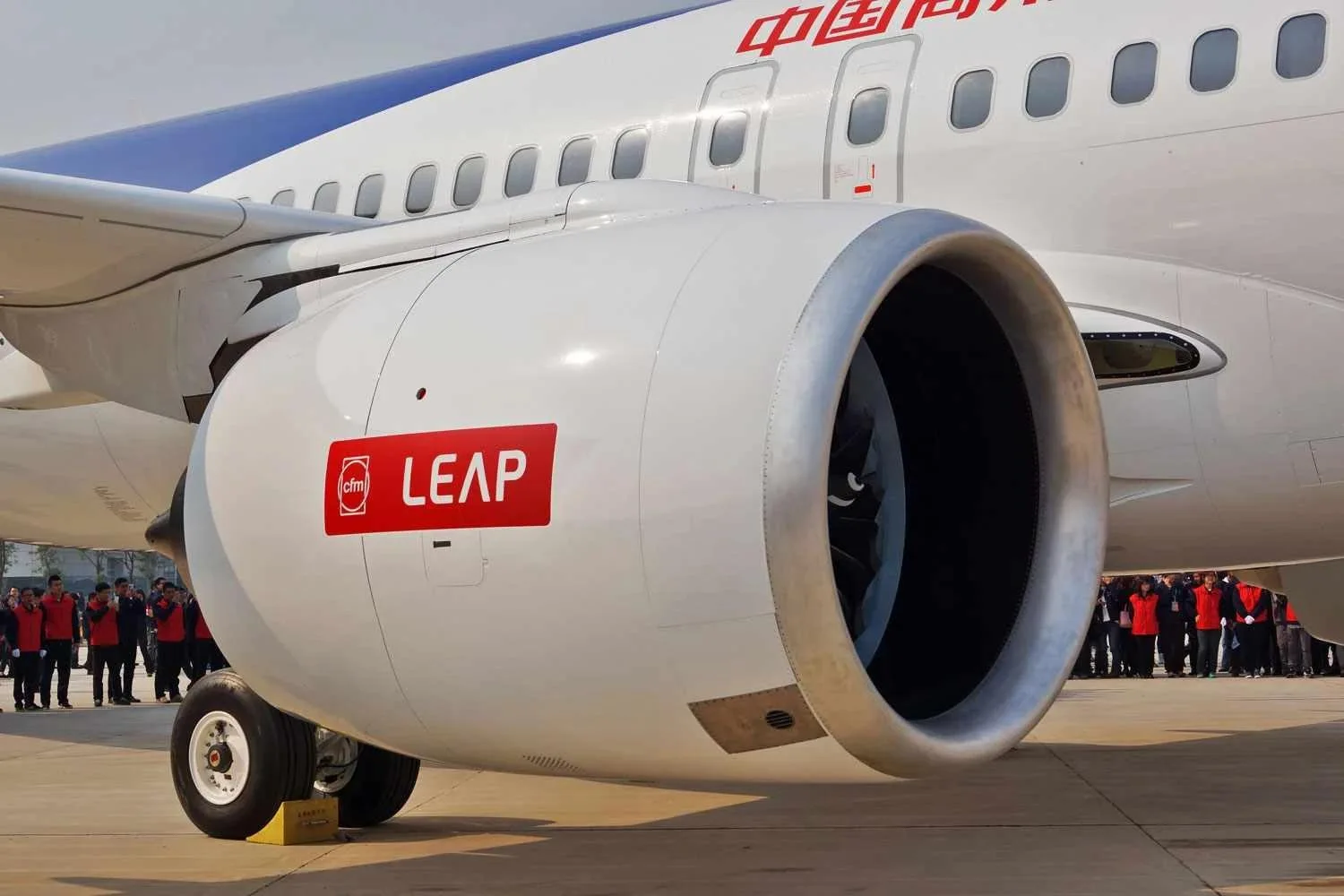
Under its wings are LEAP-1C engines produced by CFM International, the joint venture between America’s GE Aerospace and France’s Safran. Parts of its avionics, flight controls, electrical systems and other equipment also come from Western companies. Honeywell, Collins Aerospace, Parker Aerospace and other international suppliers participate in its industrial architecture.
The C919 was designed to reduce China’s dependence on Boeing and Airbus. Yet the aircraft itself remains dependent on a technological supply chain in which the United States occupies several positions that are difficult to replace.
That is precisely what Washington is turning into leverage.
The rehearsal has already taken place
The mechanism is no longer theoretical.
In the spring of 2025, at the height of a trade escalation, the United States suspended certain licenses allowing GE Aerospace to ship engines destined for COMAC. Honeywell navigation equipment was also affected. Washington lifted those restrictions several weeks later after Chinese concessions on rare earths.
The episode was brief.
It was nevertheless significant.
For several weeks, the engine of an aircraft presented as one of the symbols of Chinese industrial autonomy became a variable in a trade negotiation between Washington and Beijing.
A year later, the logic has returned in a more elaborate form. According to information published by Reuters on October 1, the US Department of Commerce is slowing some licenses and considering mechanisms that would make it easier to control additional components. In COMAC’s case, Washington is also seeking to prevent the manufacturer from neutralizing this vulnerability by accumulating enough parts to withstand a future crisis.
The question is therefore no longer simply what the United States is prohibiting today.
It is how long China could continue producing tomorrow if the United States decided to prohibit more.
Beijing understands the logic perfectly.
It is using exactly the same one.
The rare-earth mirror
China has its own landing gear.
It simply does not look like an aircraft component.
Chinese restrictions on rare earths and permanent magnets have demonstrated since 2025 how dependent some American industries remain on materials processed in China. Automotive manufacturing, electronics, semiconductors, defense and aerospace can all be affected by changes to Chinese licensing rules.
The industrial asymmetry then reverses direction.
Washington controls technologies that Beijing still struggles to substitute. Beijing controls materials — and, crucially, processing capabilities — that Washington cannot rapidly recreate. Each side therefore possesses a different set of industrial chokepoints.
The result is not the decoupling repeatedly predicted since Trump’s first term. It is something more ambiguous.
The two economies still need each other, but this interdependence is no longer regarded simply as a source of efficiency. It is becoming a permanent inventory of the other side’s vulnerabilities.
Companies must now operate inside this contradiction. An American supplier may have an interest in selling more to China while Washington has an interest in preserving the scarcity of what it sells. A Chinese manufacturer may want to secure years of spare parts while US authorities have precisely the opposite incentive: preventing it from building that insurance policy.
The global economy was organized around the fluidity of supply chains. Sino-American rivalry is beginning to assign them another function: maintaining dependencies strong enough to be activated when political negotiations require it.
Boeing in the same trap
This is where the story becomes even more interesting.
China’s dependence on American aerospace technology does not mean Washington occupies a comfortable position. The United States also needs the Chinese market.
China had agreed in the spring to purchase 200 Boeing aircraft, potentially the American manufacturer’s first major Chinese order in nearly a decade. Beijing is now seeking several years of guaranteed spare parts alongside those aircraft. Washington is reluctant to provide such assurances.
The reason is revealing: guaranteeing those parts over the long term would diminish the political value of American leverage.
Boeing therefore finds itself at the center of an almost perfect contradiction. To sell aircraft to China, the company must convince its customers that those aircraft can be maintained for decades. To preserve leverage over Beijing, Washington must ensure that this continuity is never completely guaranteed.
China, in return, can manipulate access to its own market.
It has already demonstrated this with Airbus. In early 2026, around twenty aircraft from the European manufacturer were delayed by a Chinese administrative blockage. Industry sources linked the episode to Beijing’s efforts to secure European progress on regulatory validation of the C919. The blockage was eventually cleared, and Airbus delivered 81 aircraft in May, compared with 51 a year earlier.
Even certification can therefore become part of the broader balance of pressure.
The global aviation market is no longer simply an arena in which three manufacturers compete to sell aircraft. It is becoming an architecture of overlapping dependencies between aircraft makers, engine manufacturers, equipment suppliers, certification authorities, governments and raw-material producers.
Within that architecture, nobody is completely autonomous.
A different globalization
For a long time, one of the principal arguments in favor of economic integration between China and the United States was precisely their mutual dependence.
The more the two countries traded, the more expensive confrontation would become. Global value chains were therefore supposed to produce an almost mechanical form of stabilization: American companies operating in China, Chinese capital flowing into American assets, Asian factories supplying Western consumers, Western technologies accelerating Chinese industrialization.
Part of that logic remains.
It is precisely why Washington and Beijing continue to negotiate.
But its political effect has changed.
Dependency no longer merely discourages confrontation. It provides the instruments through which confrontation can be conducted without reaching the point of rupture.
That may be the defining characteristic of the current Sino-American relationship. Washington and Beijing have discovered that a comprehensive embargo would destroy too much value, disrupt too many industrial chains and impose considerable domestic costs. They therefore have an interest in preserving a large share of bilateral trade.
But preserving trade no longer means renouncing coercion.
It means choosing where coercion can be applied.
An aircraft engine here. A permanent magnet there. An export license, design software, an electronic component, a certification process or an order for hundreds of aircraft somewhere else. Economic power is increasingly measured not only by what a country can produce, but by what others cannot easily obtain without it.
That is why the Trump-Xi truce should not be interpreted as a return to the old globalization. Both governments can reduce certain tariffs while simultaneously strengthening their ability to interrupt strategic supply chains. They can open markets while retaining licensing controls. They can buy more while guaranteeing less.
The contradiction is only apparent.
It describes the new system.
The C919 was supposed to be the aircraft demonstrating that China could gradually free itself from Western industrial dominance. Today, it demonstrates something else: how difficult that emancipation remains when technological supply chains have been built globally over several decades.
But Washington would be mistaken to see this as a one-way dependency. Rare earths, permanent magnets, access to the Chinese market and the vulnerabilities of American manufacturers themselves are reminders that Beijing possesses leverage of its own.
The United States and China are therefore not dismantling their interdependence entirely.
They are learning to administer it.
For thirty years, globalization was supposed to make confrontation too costly to be rational. Today, that cost still prevents a complete rupture — but the dependencies globalization created are providing the very weapons with which confrontation can continue below that threshold.
The truce may not be the end of the trade war.
It may be its most durable form.
Main sources
Reuters, October 1, 2026 — US slows aircraft-part exports to China as Trump seeks leverage in trade negotiations.
Reuters, September 28, 2026 — China, US pledge tariff cuts on $60 billion of goods including agriculture, toys, toasters.
Reuters, July 3, 2025 — US lets GE restart jet engine shipments to China's COMAC.
Reuters, October 10, 2025 — Trump threatens China with export controls on Boeing parts.
Reuters, June 4, 2026 — Airbus delivered 81 jets in May after China logjam eases.
Reuters, September 27, 2021 — U.S. export tightening slows advance of Chinese C919 jet.
Atlas Limits Research Desk
Atlas Limits’ editorial and analytical desk.