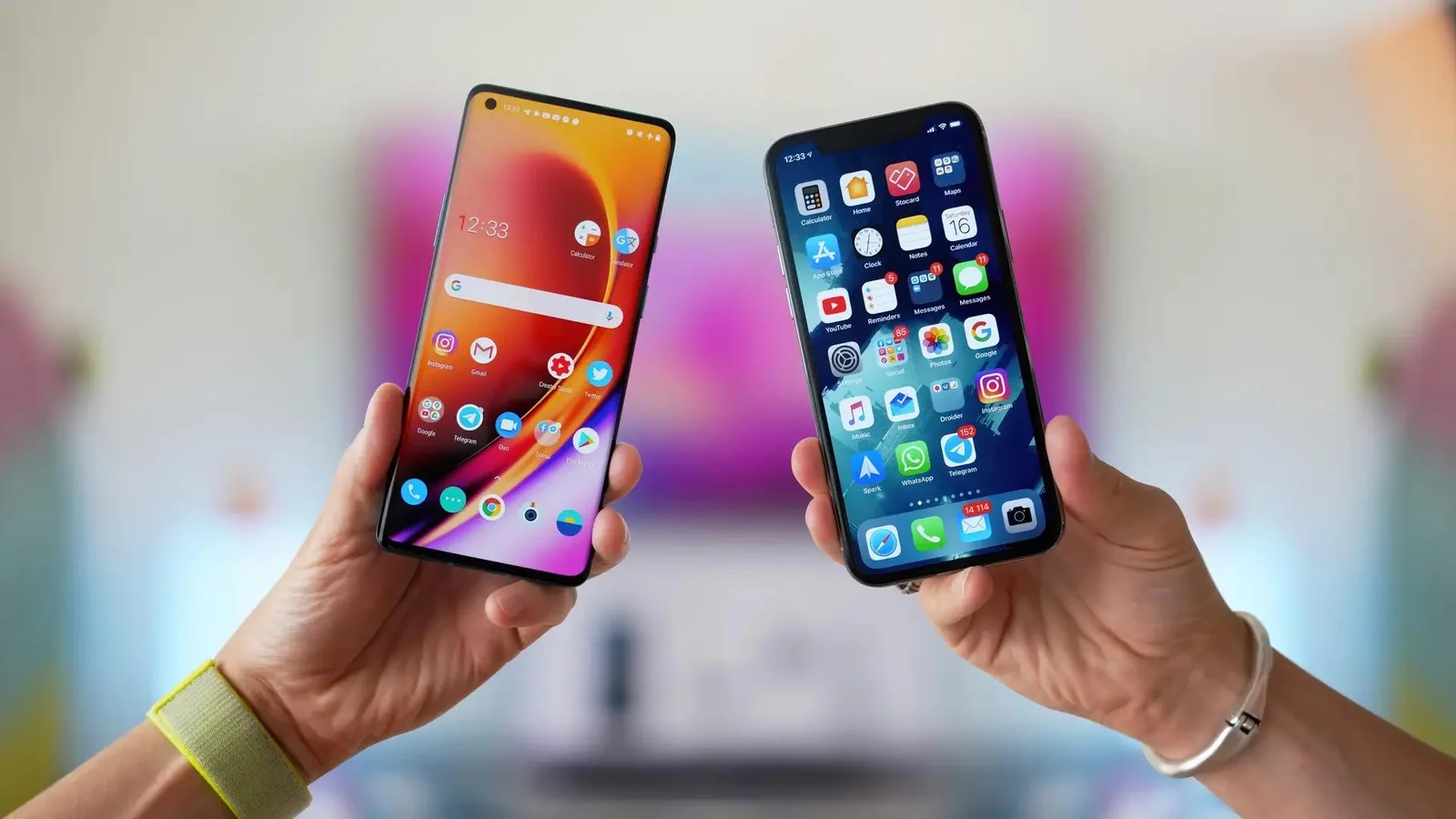
Two operating systems dominate the smartphone world, but their power extends far beyond the devices they run. Behind iOS and Android, two vast industrial, commercial and technological ecosystems have emerged, shaping access to applications, payments, data and, increasingly, artificial intelligence. Their rivalry reveals a deeper transformation: the infrastructure of everyday digital life has become an economic territory governed largely by private corporations.
The phone is no longer just a phone
In the early history of the smartphone, competition appeared relatively straightforward. Manufacturers sought to produce better devices, operating systems ensured that those devices functioned, and applications provided additional capabilities. The industry could still be understood primarily as a market for consumer electronics supported by software services.
That interpretation is no longer sufficient.
The contemporary smartphone is a permanent gateway to an extraordinary range of economic and social activities. It allows individuals to communicate, work, consume, obtain information, travel, make payments, verify their identities and access public services. It brings together personal information, authentication mechanisms, financial instruments and a growing proportion of everyday interactions.
Yet the device does not operate independently of the digital infrastructure surrounding it. Its operating system determines which applications can be installed, how they interact with hardware components, what permissions they receive and under which conditions they can reach users.
The operating system has therefore become much more than the software responsible for running a machine. It now constitutes an organizational layer of the digital economy.
Apple and Google have built their dominance around this particular position. They do not necessarily own the applications their users open, the services they consume or the businesses with which they interact. But they possess something equally consequential: the ability to establish many of the rules governing access to those activities.
This distinction explains why competition between iOS and Android cannot be reduced to a comparison of performance, features or individual preferences.
It is also a confrontation between two forms of economic power.
Two architectures, two approaches to control
Apple developed its ecosystem around the principle of vertical integration. The company designs its devices, develops its operating systems, controls the design of essential processors and organizes the principal services accompanying its products.
The iPhone, iOS, the App Store, iCloud, Apple Pay, messaging services, accessories and other Apple devices belong to a common architecture.
This structure allows Apple to coordinate hardware and software closely. It facilitates technical optimization, creates a relatively consistent user experience and enables operating-system updates without the same degree of dependence on numerous independent manufacturers.
But that consistency comes with a trade-off. Users operate within an environment whose principal rules are established by a single company.
Google adopted a different architecture.
Android is built upon an open-source software foundation, the Android Open Source Project, which manufacturers can use and modify. Samsung, Xiaomi, Oppo, Vivo, Motorola and many other companies can commercialize Android-based devices while incorporating their own interfaces, applications and complementary services.
This distribution model has allowed Android to reach an exceptionally broad range of markets, price categories and hardware configurations.
However, Android's open-source foundation does not mean that its entire ecosystem is open.
A distinction must be made between the operating system derived from AOSP and Google Mobile Services, which include proprietary applications and software interfaces. The Play Store, certain location services, notification mechanisms and various interfaces used by developers belong to an infrastructure whose availability depends on conditions established by Google.
Android can therefore remain open at the level of its underlying software while being closely associated, in its most widely distributed commercial configuration, with proprietary services.
This is where the two models begin to converge.
Apple directly controls an integrated architecture. Google exercises structural influence over a network of independent companies using its platform and services.
In one case, power rests primarily on ownership of the integrated system. In the other, it rests on control of components that have become essential to the system's commercial operation.
App stores: the new gateways to the economy
The introduction of the App Store in 2008 profoundly transformed the software industry.
Until then, software distribution relied on a variety of channels: direct sales, downloads from developers' websites, physical distribution and specialized platforms. Smartphones gradually established a model in which the application store became the principal intermediary between developers and users.
The App Store and Google Play are not merely catalogs.
They organize software discovery, distribution, updates, reputation and part of its monetization. They also operate screening and enforcement mechanisms intended to reduce malicious software, fraud and abusive practices.
For developers, this infrastructure offers considerable advantages. A company can distribute an application internationally without having to build its own global distribution, payment and maintenance network.
But that efficiency creates dependence.
Changes to ranking policies, access conditions for technical interfaces or payment requirements can transform the economics of a digital service. Account suspension or application removal can interrupt access to a substantial share of its customers.
The platform therefore becomes simultaneously a service provider, a private rule-maker and, in some cases, a competitor.
The difficulty does not necessarily arise from the coexistence of these functions. It emerges when the company organizing the marketplace also operates services that may benefit from the rules it establishes.
Apple sells its own applications and subscriptions. Google distributes search, video, storage, navigation and productivity services. Both companies therefore participate in markets to which their infrastructures provide access.
This raises a familiar competition question in a new environment: how can fair conditions be maintained when the operator of the infrastructure also competes within the activities that depend on it?
Commissions as instruments of power
Public debate has long concentrated on the commissions charged by application stores.
Historical rates reaching 30% on certain digital transactions have attracted criticism from developers and competition authorities. Those rates, however, are neither universal nor uniform. They vary according to transaction categories, applicable programs, jurisdictions and regulatory developments.
The underlying issue extends beyond the percentage itself.
In a traditional economy, a distributor earns a margin in exchange for commercial services. In the mobile economy, the intermediary may also control the technical environment in which the product is consumed.
It can determine which payment solutions are permitted, how external offers may be presented and under what conditions developers can establish direct commercial relationships with customers.
This ability makes commissions part of a broader relationship of dependence.
A company selling a digital subscription must consider distribution costs, but also possible restrictions on communicating prices, promotions and alternative payment options.
The issue becomes particularly significant when providers operate on narrow margins or depend on high transaction volumes.
Nevertheless, it would be misleading to regard every commission as unjustified. Secure distribution, infrastructure maintenance, development tools, payment processing and fraud prevention involve real costs.
The relevant economic question concerns the proportionality of compensation and the availability of effective competitive alternatives.
A market can recognize the legitimate remuneration of infrastructure without accepting unlimited control by its operator over the conditions of access.
Android: openness and its boundaries
Android is frequently presented as the open alternative to Apple's integrated environment. That distinction is meaningful, but it requires examination across several dimensions.
On Android, applications can be distributed through channels other than Google Play. Alternative stores exist, and direct software installation has historically been possible, subject to applicable security protections and restrictions.
Manufacturers have also developed their own stores and services.
Samsung operates the Galaxy Store. Amazon built its environment around Fire OS, an Android-derived platform. Huawei developed its own application and technology ecosystem, particularly after American restrictions affected its access to certain Google services.
These examples demonstrate that an open software foundation can support multiple industrial strategies.
But they also reveal the difficulty of replacing dominant infrastructures.
An application does not depend exclusively on its operating system. It may rely on mapping, payment, notification, authentication or security interfaces supplied by Google.
Technical compatibility therefore does not guarantee complete functional equivalence.
A manufacturer can use an Android foundation without Google Mobile Services, but must then rebuild, replace or adapt numerous components necessary for application functionality and user experience.
That undertaking requires substantial investment and demands that developers support an additional environment.
Open source code alone is therefore insufficient to guarantee economic independence.
This is one of the defining characteristics of contemporary platforms: a technology can be open at one architectural level and proprietary at another level that is commercially more decisive.
Apple: coherence as a competitive advantage
Apple's model follows an almost opposite logic.
By maintaining close control over devices and software, the company can design capabilities extending across several product categories.
A user can begin an activity on an iPhone, continue it on a Mac, access associated information on an iPad or use an Apple Watch as an extension of certain services.
This continuity does not arise from technical performance alone. It results from coordination between digital identities, accounts, software, hardware components and online services.
The ecosystem becomes more valuable as users add devices.
But this accumulation also increases switching costs.
Changing smartphones no longer means simply replacing one object with another. It can require modifying established habits, transferring data, recovering functionality, replacing certain accessories or sacrificing particularly seamless interactions with other devices.
This phenomenon, commonly described as economic lock-in, is not unique to Apple. It also exists across Google, Microsoft and numerous digital platforms.
It becomes especially visible, however, when several products are designed to operate as components of a unified environment.
User loyalty can consequently reflect both genuine satisfaction and increasing migration costs.
These explanations are not mutually exclusive.
The power of an ecosystem lies precisely in its capacity to create value while making departure progressively less attractive.
Data, identity and payments: the invisible infrastructure of power
The dominance of operating systems cannot be measured solely through smartphone sales or application downloads.
It also depends on control over several less visible infrastructures.
Apple and Google accounts provide digital identities connecting devices, applications and services. Backup and synchronization systems support continuity. Payment solutions enable transactions. Security interfaces govern access to sensitive information.
These functions become increasingly important as smartphones serve as authentication devices for banks, government administrations, employers and commercial platforms.
Apple and Google consequently occupy privileged positions within the digital chain of trust.
This does not mean that both companies have unrestricted access to every piece of data circulating through their systems. Privacy architectures, encryption mechanisms and data-processing practices differ between services.
Rather, they control technical layers that determine how information can be accessed, shared, protected or used.
Economic power resides as much in the ability to authorize certain activities as in the ability to restrict them.
Contactless payments, digital wallets and identification systems illustrate this evolution. When an infrastructure becomes essential to numerous transactions, its access conditions acquire significance extending far beyond the smartphone market.
The operating system gradually begins to resemble a general-purpose economic infrastructure.
Security: an industrial argument and a competition issue
Apple has traditionally defended its integrated approach by emphasizing security, privacy and the quality of the user experience.
Control over distribution allows applications to undergo review procedures and enables the enforcement of technical requirements.
Google similarly emphasizes its protective mechanisms, including Google Play Protect, application verification and systems designed to combat malicious software.
These concerns are substantial.
A smartphone may contain banking information, private communications, professional documents and identity credentials. Compromising the device can have serious consequences for its owner.
It would therefore be artificial to present openness and security as inherently incompatible.
But it would be equally inadequate to assume that every commercial restriction is necessarily justified by security requirements.
The challenge is to distinguish measures genuinely necessary for protection from mechanisms that might preserve a dominant position without delivering proportionate benefits to users.
This distinction has become central to regulatory debates.
A platform may be required to permit competing distribution channels while maintaining reasonable security standards. Conversely, public authorities cannot ignore the technical risks associated with modifying an architecture designed around centralized controls.
The conflict is therefore less about two irreconcilable principles than about defining the legitimate boundaries of private control.
Europe attempts to rewrite the rules
Through the Digital Markets Act, the European Union has sought to treat certain major digital services as access infrastructures whose economic power requires specific obligations.
Apple and Alphabet are among the companies designated as gatekeepers for several core platform services.
The regulation seeks, among other objectives, to restrict certain forms of self-preferencing, facilitate access to competing distribution channels and strengthen developers' ability to communicate with customers.
This intervention has already altered the organization of the European market.
Since 2024, Apple has introduced options for distributing applications outside its App Store within the European Union, including alternative marketplaces and, under specified conditions, direct distribution from websites.
By October 2026, further changes to European commercial terms had taken effect, including a 5% Core Technology Commission applicable to certain digital transactions involving applications distributed outside the App Store.
These developments do not mean that Apple's control has disappeared. Alternative marketplaces remain subject to technical and contractual conditions, while revised remuneration arrangements continue to raise questions about the balance between openness and dependence.
The essential difference is that access rules are no longer determined exclusively by the company's internal decisions.
Regulators now claim authority over the competitive architecture of the market.
Android is also affected by this transformation. Even where alternative solutions technically exist, authorities must examine whether those alternatives possess the conditions necessary to compete effectively with dominant services.
The formal existence of choice does not guarantee its economic effectiveness.
That is the distinction between a theoretically open system and a genuinely contestable market.
A rivalry extending beyond America and Europe
Competition between Apple and Google takes place within a global economy whose characteristics differ substantially across regions.
In higher-income markets, integration quality, brand loyalty and the value of associated services can strongly influence purchasing decisions.
Across many emerging economies, the diversity of Android manufacturers and the availability of devices at widely varying prices have supported broader smartphone adoption.
This commercial geography directly influences the economics of software development.
An application may reach more users on Android while generating a substantial proportion of its revenue on iOS, depending on geography, service category and consumer behavior.
User numbers, purchasing power, transaction frequency and customer-acquisition costs do not necessarily follow the same distribution.
China represents a distinctive case.
The absence of Google's usual services across much of the market has encouraged the development of application stores, digital services and technological infrastructures adapted to the domestic environment. Local companies consequently exercise influence that would be difficult to reproduce under the structure of Western mobile markets.
Huawei's development and the evolution of HarmonyOS also illustrate another dimension of the problem: technological sovereignty.
When a country or company depends on operating systems, software interfaces and services controlled abroad, that dependence can become strategic.
Trade restrictions, sanctions, geopolitical tensions and cybersecurity requirements can transform software choices into industrial and political questions.
An operating system may be global in its distribution while remaining nationally concentrated in the decision-making structures governing its development.
This asymmetry explains why mobile ecosystems concern not only competition authorities but also industrial policymakers, governments and national digital-sovereignty strategies.
Artificial intelligence shifts the center of gravity
The next phase of competition could fundamentally alter the role of application stores.
For almost two decades, users have primarily accessed digital services by opening individual applications.
Search, reservations, communications, commerce, navigation and productivity have gradually been organized around specialized software.
Artificial intelligence introduces another possibility: an assistant capable of understanding requests, coordinating several services and executing certain tasks without requiring users to navigate a succession of applications themselves.
Under this configuration, the operating system could become the preferred environment for orchestrating intelligent agents.
The issue would no longer be limited to controlling application distribution. It would increasingly concern determining which services an assistant can access, what data it can use and under which conditions it can act on a user's behalf.
Apple possesses the integration of devices, operating systems and hardware components necessary to develop artificial-intelligence experiences closely connected to its products.
Google benefits from Android's distribution, its digital services, search infrastructure and artificial-intelligence models.
But none of these advantages guarantees dominance over the next technological cycle.
Independent model developers, cloud providers, semiconductor manufacturers and companies specializing in software agents are also seeking positions within this emerging layer of intermediation.
The question therefore concerns the future hierarchy between applications, operating systems and intelligent assistants.
If users increasingly access services through agents, the visibility of individual applications could lose some of its economic importance relative to their ability to be selected and used by those agents.
A new form of dependence could emerge.
Distribution power, historically exercised through application stores, might partially migrate toward systems deciding which tools and providers to mobilize in response to a request.
Competition would not disappear. It would move to another layer.
Developers and the economics of structural dependence
For digital businesses, the existence of two major platforms represents both an opportunity and a constraint.
It provides access to a global customer base through relatively standardized technical environments.
But it also requires maintaining compatibility with multiple systems, complying with different distribution rules and monitoring changes to software interfaces, commercial policies and security requirements.
Large companies generally possess the resources needed to absorb these obligations.
Independent developers, startups and specialized software publishers may be considerably more exposed.
A modification to distribution conditions can affect their business models even when neither their products nor their customers have changed.
This asymmetry potentially benefits companies capable of spreading technical and compliance costs across large user bases.
It also explains the continuing interest in web applications, open standards and cross-platform architectures.
Such approaches can reduce certain dependencies, but they do not automatically eliminate them. Browsers, rendering engines, hardware interfaces and installation mechanisms remain subject to technical and commercial decisions of their own.
Digital independence is therefore not a binary condition.
It depends on how many critical components a business can replace without jeopardizing its operations.
Can proprietary ecosystems really be challenged?
The idea of a third major mobile operating system regularly returns to technological debate.
History suggests, however, that the difficulty lies not simply in developing the software.
A new entrant must simultaneously persuade manufacturers, developers, telecommunications operators, businesses and consumers to participate in its environment.
Without applications, users hesitate to adopt the system. Without users, developers have little incentive to create applications.
These network effects reinforce established platforms.
Microsoft's experience with Windows Phone, BlackBerry's proprietary systems and several Linux-based mobile initiatives demonstrated how difficult it is to establish a durable alternative against two already widely adopted ecosystems.
That does not mean their dominance is irreversible.
Technological transformations can relocate the principal points of control. Web applications, new device formats, intelligent agents and regulatory requirements may gradually alter competitive conditions.
But a credible alternative must offer more than a technically functional operating system.
It must recreate the services, tools, trust mechanisms and economic relationships that make an ecosystem practical for everyday use.
The real barrier to entry is no longer software alone. It is the entire network of interdependencies constructed around it.
From operating systems to infrastructures of power
The history of iOS and Android illustrates a fundamental transformation of digital capitalism.
Major platforms no longer merely sell products or provide services. They organize the environments within which other companies produce, distribute and commercialize their own activities.
This function gives them a distinctive form of power.
Apple draws strength from the coherence of its integrated environment, the value of its devices and the loyalty of its customers. Google benefits from Android's extensive distribution, the depth of its services and the central role of its infrastructure in digital activity.
Their business models differ, but their influence converges toward the same reality: a substantial share of global digital activity depends on technical architectures whose rules are established by an exceptionally small number of corporations.
Governments are now attempting to reintroduce principles of competition, interoperability and sovereignty into these environments. Developers seek to preserve their freedom of action. Users weigh convenience, security, choice and continuity against the constraints of established habits.
Artificial intelligence could shift this balance again by creating new intermediaries between individuals and digital services.
The smartphone may remain the central device of digital life for many years. But the decisive question will increasingly concern something other than the device itself.
It will concern who controls the interfaces, permissions, transactions and mechanisms through which individuals access the digital world.
Apple and Google have developed two different industrial responses to that question. Their success helped make the smartphone an almost universal instrument.
It has also demonstrated that, as a technology becomes indispensable, the power to define its rules eventually becomes as important as the technology itself.
Atlas Limits Research Desk
Atlas Limits’ editorial and analytical desk.