Mitsubishi's sale of an indirect stake in LNG Canada to Blackstone illustrates a profound transformation in the financing of energy infrastructure. Behind a transaction valued by the Japanese group at approximately $1.6 billion lies a model in which industrial companies retain their supply rights while opening the ownership of strategic assets to financial investors.
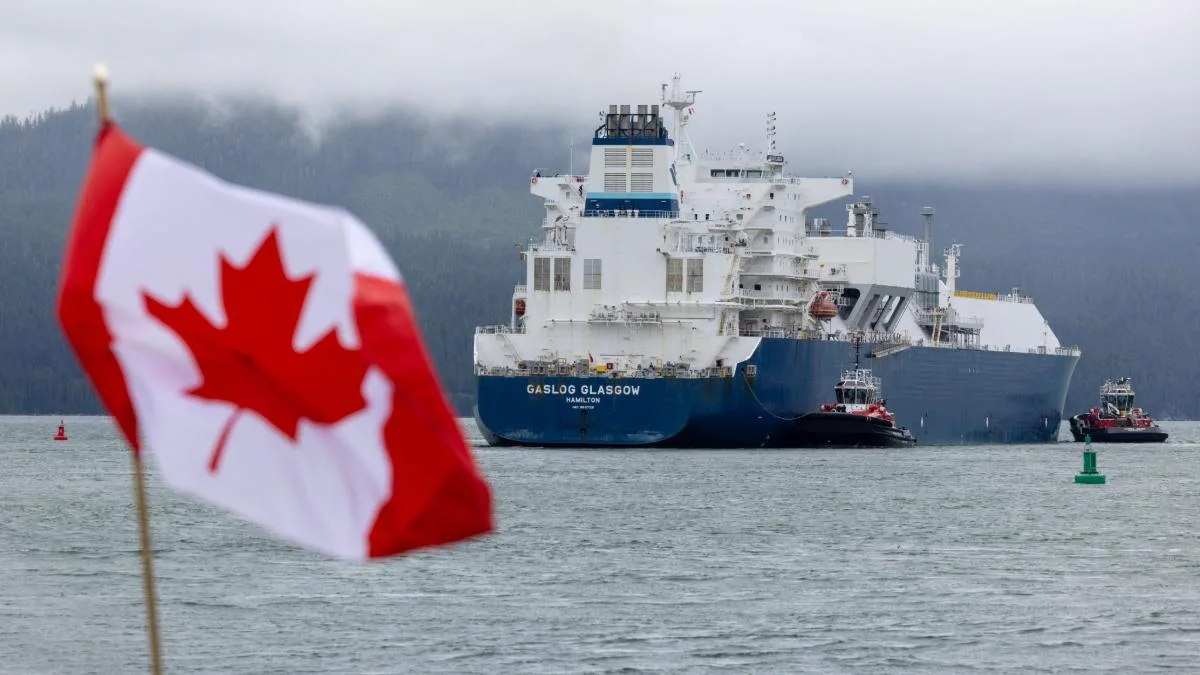
On Canada's Pacific coast, in Kitimat, the LNG Canada facilities occupy a distinctive position in the global geography of liquefied natural gas. They provide a route for North American gas to reach Asian markets without passing through the major Atlantic shipping corridors. For the project's industrial partners, this location represents both a commercial advantage and an instrument of energy diversification.
Against this backdrop, Mitsubishi Corporation has announced the sale of 49.9% of a holding company that owns its interest in LNG Canada to funds managed by Blackstone Credit & Insurance. Mitsubishi has placed the transaction's value at approximately $1.6 billion, with completion expected in November 2026.
The operation does not represent a withdrawal by the Japanese group. Rather, it reflects a reorganization of how Mitsubishi intends to finance and maintain its exposure to a long-term energy infrastructure asset.
One Financial Investment, Two Levels of Ownership
The transaction's structure requires particular attention. Through a holding company, Mitsubishi owns a 15% interest in LNG Canada. Blackstone is not directly acquiring 49.9% of the Canadian project, but 49.9% of the vehicle that holds Mitsubishi's participation.
On a strictly proportional basis, the investment would correspond to an indirect economic exposure of 7.485% to LNG Canada. This arithmetic equivalence does not, however, establish the governance rights, distribution mechanisms or potential economic preferences contained in the agreements between the parties.
The distinction matters. In major energy projects, legal ownership, financial entitlements, funding obligations and commercial commitments do not necessarily coincide.
An investor may participate in an infrastructure asset's future revenues without enjoying the same operational authority as an industrial partner. Conversely, a company may reduce its equity exposure while retaining the contracts that justify its strategic presence in the project.
This separation is precisely what gives the Mitsubishi–Blackstone transaction its broader economic significance.
An Infrastructure Project Set to Double in Scale
LNG Canada represents one of the largest industrial investments undertaken on Canada's Pacific coast. Its first phase, which entered production in June 2025, has a nominal capacity of 14 million tonnes of liquefied natural gas annually.
The project brings together several major international energy companies, including Shell, PETRONAS, PetroChina, Mitsubishi and Korea Gas Corporation. It is built around an industrial chain connecting Western Canada's natural gas resources, inland transportation infrastructure and the liquefaction facilities at Kitimat.
The final investment decision announced on September 29, 2026, concerning the second phase marks another stage in the project's development. The expansion is expected to increase total nominal capacity to 28 million tonnes annually, doubling the initial level.
This increase comes as the global LNG market experiences two simultaneous developments. Importing countries are seeking to diversify their suppliers and supply routes, while new liquefaction projects require substantial financial commitments, often years before they begin generating revenue.
The doubling of capacity therefore changes the project's financial equation. It expands its commercial potential but also requires additional capital and exposes investors to construction, scheduling and market risks.
For Mitsubishi, Blackstone's entry provides an opportunity to reorganize part of this exposure as the infrastructure enters a new phase of development.
Monetizing Capital Without Surrendering Gas Supply
The transaction's most significant feature is the preservation of Mitsubishi's commercial rights.
The Japanese group currently holds LNG offtake rights equivalent to 2.1 million tonnes annually. Following the expansion, these volumes are expected to increase to 4.2 million tonnes per year.
Mitsubishi has stated that Blackstone's investment will not alter either these volumes or its commercial relationships with customers.
In other words, the reduction in financial exposure does not entail an announced reduction in supply capacity.
This separation reflects an increasingly important industrial rationale. For a trading and investment conglomerate such as Mitsubishi, the strategic value of an energy asset does not lie exclusively in dividends or financial appreciation. It also depends on physical access to resources, control over commercial flows and the ability to serve importing markets over extended periods.
Japan, which remains heavily dependent on imported energy, has historically encouraged its major trading houses to invest throughout international supply chains. Such investments help secure volumes, establish long-term commercial relationships and diversify geographical sources.
The Blackstone transaction demonstrates that part of this strategic function can be preserved without maintaining the same proportion of capital invested in the underlying infrastructure.
Mitsubishi is therefore not abandoning the industrial rationale behind its investment. It is changing its financial structure.
A Valuation That Highlights the Importance of Existing Assets
The approximately $1.6 billion figure disclosed by Mitsubishi provides an indication of the transaction's scale, although interpreting it requires considerable caution.
A purely proportional extrapolation would value the entire holding company at approximately $3.21 billion. Applied to its 15% interest in LNG Canada, this would imply a theoretical valuation of approximately $21.38 billion for the overall project.
This is not, however, an officially established transaction valuation of LNG Canada.
The calculation assumes strictly proportional economic rights, no other significant assets or liabilities within the holding company, and no adjustments for debt, cash or contractual arrangements.
A further distinction concerns the transaction amounts disclosed by the parties. Blackstone has described a broader investment of approximately $3.1 billion, involving several Canadian institutional investors, including CPP Investments, OMERS, IMCO and PSP Investments. The difference between this figure and Mitsubishi's approximately $1.6 billion disclosure requires a reconciliation of their respective transaction perimeters before any definitive valuation can be established.
The economic value of an LNG project also depends on numerous variables, including gas prices, liquefaction costs, transportation commitments, offtake contracts, future capital requirements and the returns demanded by investors.
The transaction's importance therefore lies less in any isolated theoretical valuation than in Mitsubishi's ability to attract major financial investors into an indirect minority interest.
It suggests that energy infrastructure with an established industrial base, access to resources and long-term production prospects can attract capital whose objectives differ from those of traditional operators.
Blackstone and the Financialization of Energy Infrastructure
The participation of funds managed by Blackstone Credit & Insurance illustrates the expanding role of alternative asset managers in financing the real economy.
Energy infrastructure possesses characteristics that may appeal to certain institutional investors: long asset lives, substantial initial capital requirements, significant barriers to entry and the potential to generate financial returns over several decades.
These characteristics do not guarantee stable returns. LNG projects remain exposed to energy market fluctuations, operating costs, regulatory developments and risks associated with their commercial contracts.
They nevertheless help explain why major capital managers are expanding their presence in infrastructure alongside industrial companies and public-sector investors.
The LNG Canada transaction forms part of a broader evolution in the financing of strategic assets. Companies that have developed or supported major industrial projects can sell portions of their ownership interests to specialized investors, thereby releasing capital for other commitments.
Asset managers, meanwhile, gain exposure to infrastructure whose development requires industrial expertise, regulatory approvals and construction periods that are difficult to replicate.
This complementarity does not mean their interests are always identical. Industrial companies prioritize considerations such as supply security and operational continuity, while financial investors place particular emphasis on risk-adjusted returns, future liquidity and capital allocation discipline.
Contractual arrangements therefore become essential in organizing their coexistence.
Canada's Pacific Coast in the New Geography of Gas
LNG Canada's geographical position reinforces the significance of the transaction.
The Kitimat facility provides Canadian producers with direct maritime access to Asia-Pacific economies. It establishes an export route distinct from North American infrastructure traditionally oriented toward the United States and LNG terminals on the Gulf Coast.
For Asian buyers, this diversification can reduce dependence on certain shipping routes and broaden the range of available supply sources.
Geographical advantages do not, however, eliminate commercial constraints. The competitiveness of Canadian LNG depends on production and transportation costs, contractual conditions, international prices and competition from American, Qatari and Australian exporters.
LNG Canada's expansion also comes as several major producing regions plan to increase their liquefaction capacity. This growth in supply could alter pricing dynamics and intensify competition between projects.
Securing commercial outlets and controlling investment costs are therefore becoming as important as the technical ability to produce additional volumes.
From this perspective, the simultaneous presence of industrial companies with established commercial networks and financial investors capable of mobilizing capital is a central feature of the project's economic model.
A New Distribution of Industrial Risk
The Mitsubishi–Blackstone transaction ultimately reveals a transformation in the ownership of major energy infrastructure.
For decades, direct investment in production and liquefaction projects was one of the principal means through which energy companies and trading houses secured their positions within global supply chains.
That model is not disappearing. It is becoming more flexible.
Equity ownership, expansion financing, industrial operations and the commercialization of output can increasingly be distributed among different categories of participants, each assuming a different share of the risks.
For Mitsubishi, this structure allows the group to retain the expected commercial benefits of LNG Canada while reducing the amount of capital directly committed to its ownership interest. For Blackstone and its investment partners, it provides access to a major energy infrastructure asset without requiring direct operational ownership within the consortium.
The transaction's ultimate significance will depend on the final governance arrangements, the financing of the second phase and the project's future economic performance. It does not, by itself, establish that the global LNG financing model has undergone a comprehensive transformation.
It nevertheless offers a significant illustration of an emerging pattern.
As energy infrastructure becomes more capital-intensive and companies seek to preserve their investment capacity, full ownership of assets may become less important than control over the rights those assets provide.
On Canada's Pacific coast, Mitsubishi retains access to the gas. Blackstone enters the financial structure. And LNG Canada becomes an example of the growing separation between the capital that owns energy infrastructure and the companies that organize the world's energy flows.
Atlas Limits Research Desk
Atlas Limits’ editorial and analytical desk.