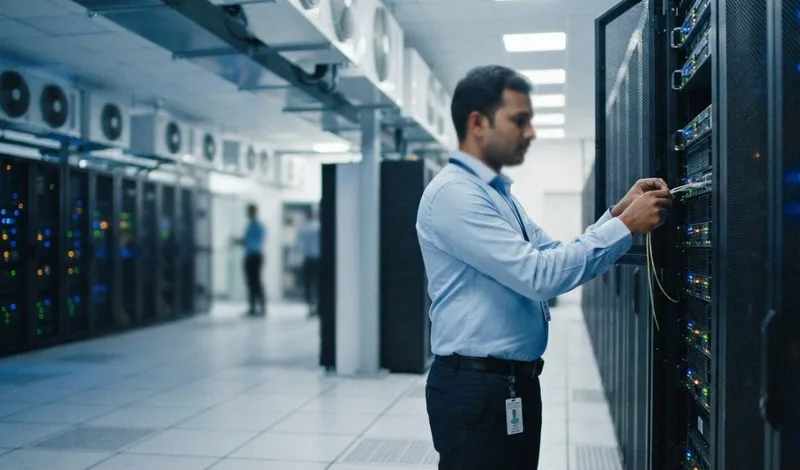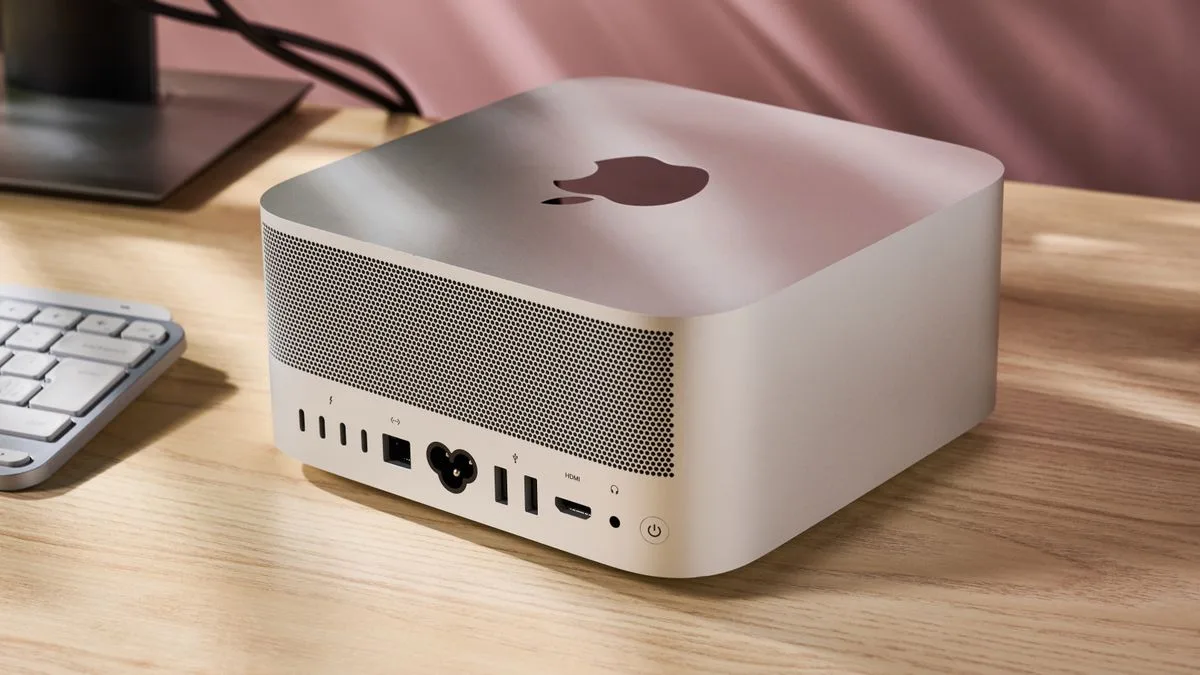
For years, the cloud gave artificial intelligence an almost self-evident geography. The most powerful models lived in data centers, behind clusters of GPUs, high-bandwidth networks and levels of investment that only a limited number of actors could sustain. The personal computer received the result: an interface, a few seconds of waiting and an answer calculated somewhere else. That division has not disappeared. But an experiment conducted this week on a Mac Studio suggests that it is becoming less clear-cut than it was even recently.
On September 10, 2026, DeepSeek released DeepSeek-V4.1-Flash, the first compact model in its new architectural family. The word “compact” requires some perspective. DeepSeek describes a Mixture-of-Experts model whose backbone contains 552 billion parameters, while only 8 billion parameters are activated during input processing and 16 billion during generation. The model natively handles text and images, and its architecture was designed in part to reduce the memory required for the KV cache, an increasingly important component in the cost of long conversations and agentic systems.
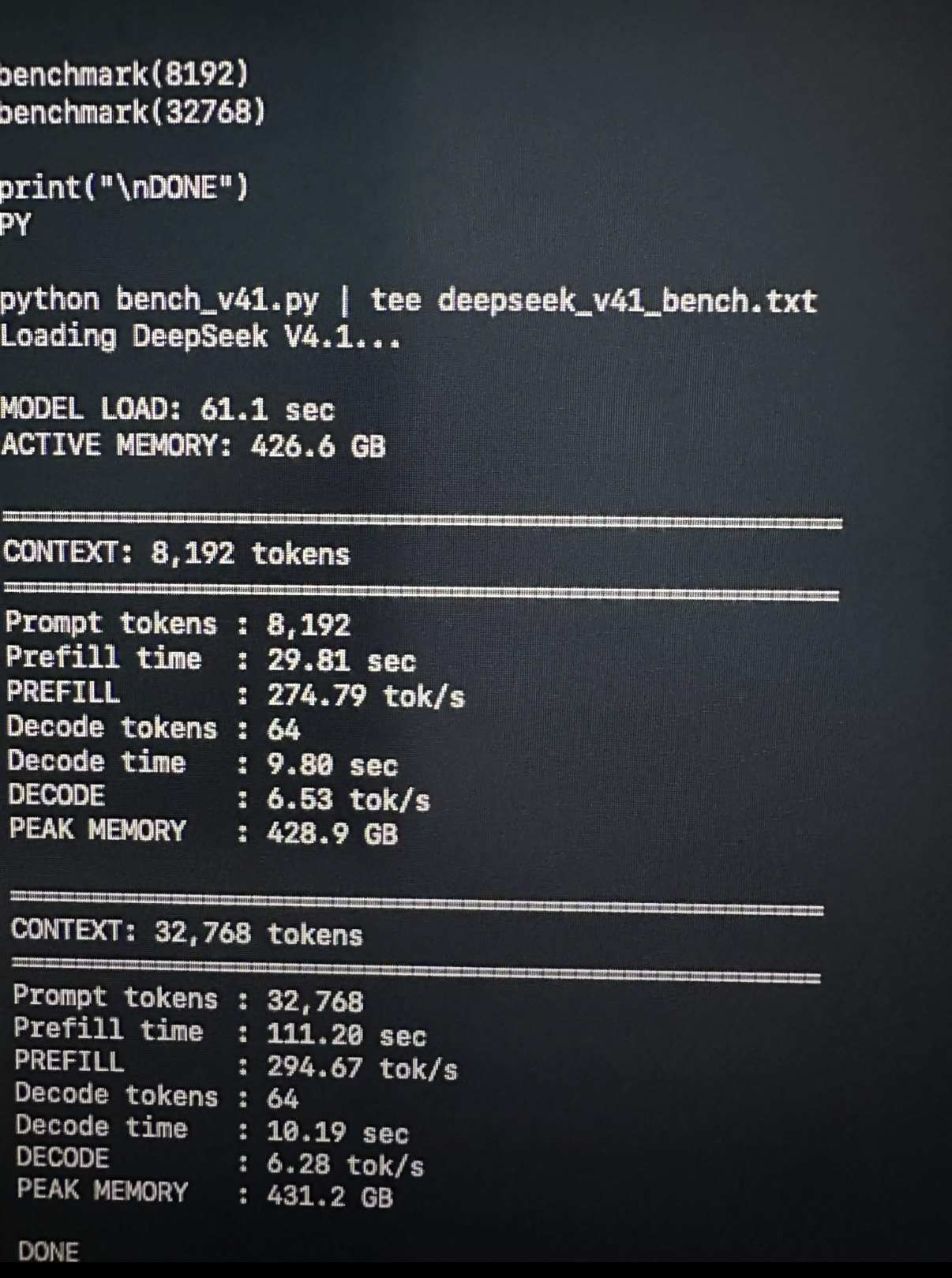
Almost as soon as the model appeared, another story began. Developers in the Apple Silicon community started adapting it to MLX, Apple’s computing framework designed to exploit its chips and unified-memory architecture. On X, Local AI Cherry demonstrated a quantized version running on a Mac Studio M3 Ultra equipped with 512 GB of unified memory. An initial implementation generated roughly six tokens per second. A day later, after changes to the runtime and dependency path, a new configuration was reported to reach around 33 tokens per second during decoding with prefilled contexts of 32,000 and 64,000 tokens.
Those numbers should be treated for what they are: extremely recent community benchmarks obtained from experimental configurations, not independently validated measures of the model’s general performance. Other MLX implementations published around the same time report different results. One experimental two-bit conversion documents speeds of up to roughly 9.5 tokens per second on a 256 GB M3 Ultra, while another implementation using speculative decoding reports approximately 19 tokens per second. Their authors themselves warn that these results neither guarantee general performance nor constitute a complete validation of model quality after quantization.
That is precisely why the figure of 33 tokens per second, impressive as it may be, is not the real story. The real story is that a model in this class can now be made to run on an individual machine.
Memory Becomes an Architecture
When Apple introduced the M3 Ultra in March 2025, it emphasized a feature that at the time appeared primarily aimed at professionals working in video, 3D rendering and artificial intelligence: support for as much as 512 GB of unified memory. Unlike conventional architectures in which the CPU and GPU operate with separate memory pools, Apple Silicon allows different computing units to access the same memory space. An M3 Ultra can therefore provide more than half a terabyte of memory directly accessible to its graphics cores.
That characteristic fundamentally changes the nature of the problem posed by very large models.
For inference, the first obstacle is not always raw computing power. The model must first fit into memory. A graphics card equipped with a few dozen gigabytes of VRAM may be extraordinarily fast while remaining incapable of holding hundreds of gigabytes of model weights on its own. Data-center infrastructure solves this problem by distributing models across multiple accelerators. Unified memory follows another logic: it makes it possible to build a single machine with an exceptionally large memory space by personal-computing standards.
DeepSeek-V4.1-Flash pushes this logic further because the architecture itself is designed to reduce the amount of computation required for each token. The model’s total mass and the number of parameters actually mobilized at any given moment are no longer equivalent. DeepSeek reports 8 billion active parameters per token during prefill and 16 billion during decoding. Its Causal Encoder-Decoder architecture is also intended to substantially reduce KV-cache requirements, in some configurations described by the company to as little as one eighth of those of the previous generation.
Hardware is therefore becoming more generous with memory at the same moment that model architectures are learning to use available resources more selectively.
Between the two sits software.
Thirty-Three Tokens Tell More Than a Silicon Story
This is probably the most revealing aspect of the experiment. The Mac did not change between the two measurements published by Local AI Cherry. Neither did the model. Yet the reported generation speed increased from roughly six to thirty-three tokens per second.
What changed was the intermediate layer: the runtime, dependencies, memory management, quantization and decoding methods.
The improvement is a reminder of a reality sometimes obscured by the race for GPUs. Computing infrastructure is never merely the sum of its transistors. When a new architecture emerges, some of its theoretical capacity initially remains inaccessible. Libraries, compilers, kernels and inference engines gradually learn how to exploit it. Performance can consequently improve dramatically while the underlying hardware remains unchanged.
Local artificial intelligence is entering precisely this phase. 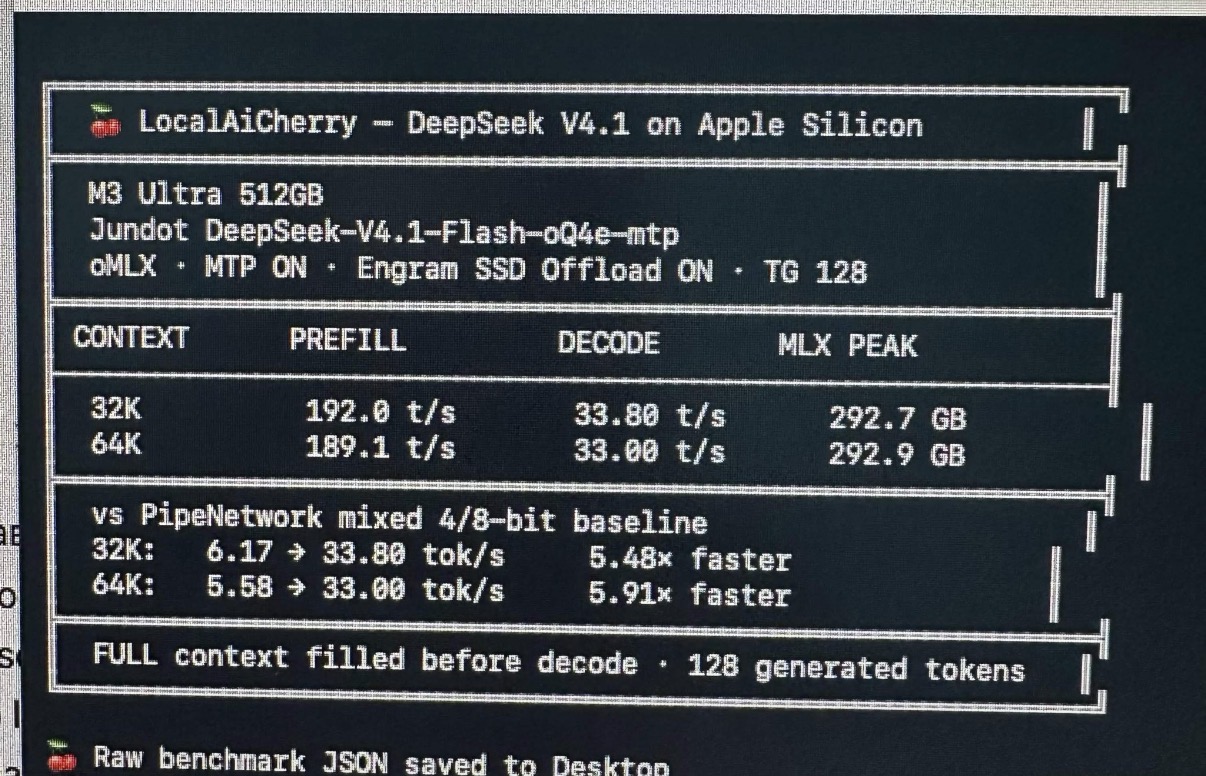
 Communities are forming around MLX, llama.cpp and other inference environments. They convert models, experiment with different quantization methods, reduce memory footprints and modify generation engines. Within hours or days of a model’s release, versions that never existed on its creator’s roadmap begin appearing on machines for which it was not necessarily designed.
DeepSeek-V4.1-Flash provides a particularly clear example. One community conversion published on Hugging Face reduces its footprint to approximately 239 GB through experimental two-bit quantization. Its author nevertheless warns that such compression may significantly degrade results and that vision, very long contexts, tool calling and production use have not yet been fully validated.
This is a technical frontier in motion, not yet a finished product.
The Return of the Personal Computer
The history of computing has long oscillated between centralization and decentralization. Mainframes concentrated computing power. The PC distributed it. The internet and then the cloud partially centralized it again. Generative artificial intelligence pushed that latter logic remarkably far: the interface may fit in a pocket, while the intelligence answering through it can reside hundreds of kilometers away.
Local AI introduces a movement in the opposite direction.
It should not be exaggerated. A Mac Studio with 512 GB of memory is not an ordinary consumer computer, and running a quantized model on a workstation does not mean that a data center has become unnecessary. Training frontier models still requires enormous infrastructure. Serving millions of users simultaneously is another problem altogether. Availability, redundancy, throughput and professional infrastructure management cannot be reduced to the number of tokens a single machine can generate per second.
But between the smartphone and the hyperscaler lies an enormous territory.
A researcher does not necessarily need to serve ten thousand users. A law firm may prefer certain documents never to leave its premises. A bank may want to experiment with data that cannot be exposed to an external provider. A government agency may consider certain AI capabilities a matter of informational sovereignty. An industrial company may want a model operating inside infrastructure isolated from the public network. For all these uses, the relevant question is not whether a workstation can replace a data center. It is whether the workstation can eliminate the need to depend on one.
The distinction is considerable.
Privacy Changes Its Nature
The cloud rests on an extraordinarily effective compromise: instead of owning infrastructure, the user purchases access to computing power. Artificial intelligence has extended that logic to the model itself. A company can use highly sophisticated capabilities without knowing precisely which infrastructure executes them.
Local inference reverses part of that relationship.
When model weights, context, documents and outputs remain on a machine controlled by the user, some privacy questions become architectural questions rather than merely contractual ones. There is no need to ask an external provider to guarantee that sensitive information will not be retained if that information is never transmitted to the provider in the first place.
This does not eliminate risk. A local machine can be compromised. Models can contain vulnerabilities. Software supply chains must be secured. Organizations still need access controls and sound data governance. But the perimeter of trust moves.
And with it moves a small part of the power.
The Economics of the Token Meets the Economics of the Machine
The cloud has an obvious economic advantage when usage is intermittent: why purchase expensive infrastructure if it will operate only a few hours each day? But that equation changes as usage becomes intensive and continuous.
An API turns computing into a variable cost. A local machine converts part of that cost into upfront capital expenditure, supplemented by electricity, storage, administration and hardware renewal. Depending on the volume of use, either architecture can become economically preferable.
The emergence of very large local models therefore introduces another variable into the economics of artificial intelligence. Companies will no longer have to choose only among competing model providers. They may increasingly arbitrate between APIs, private clouds, dedicated infrastructure and local workstations, or combine several of these layers.
Smaller models could handle routine tasks locally. Heavier models could remain on a workstation or internal server. The cloud could be called upon for demand peaks or capabilities that genuinely cannot be reproduced on site.
The future may therefore be less exclusively “cloud” or “local” than hierarchical.
A Question of Sovereignty
This evolution is gradually extending beyond personal computing.
For several years, AI sovereignty has generally been discussed through three resources: semiconductors, data centers and models. Governments seek to secure access to accelerators, attract computing capacity and develop national or regional models.
Local AI introduces a fourth dimension: the ability to distribute inference capacity.
An organization capable of downloading open weights and running them on commercially available hardware becomes less directly dependent on the model provider’s infrastructure. It can retain a capability even if an API changes price, disappears or becomes inaccessible. It can modify the model, control its execution environment and determine physically where its data resides.
The availability of model weights therefore becomes almost as important as their performance.
DeepSeek released V4.1-Flash under the MIT license, and community versions adapted for Apple Silicon began appearing almost immediately. That rapid circulation illustrates a distinctive property of the open-model ecosystem: an innovation produced by one company can be appropriated almost instantly by a global community and transferred to infrastructure that its original developer no longer controls.
For the major proprietary platforms, competition is therefore no longer solely about model quality. It is also about how intelligence is distributed.
The Data Center Is Not Disappearing
It would be tempting to watch a model containing hundreds of billions of parameters generate around thirty tokens per second on a Mac and announce the approaching end of gigantic AI infrastructure. That would confuse a retreating frontier with a disappearing one.
Data centers retain fundamental advantages. They make it possible to train increasingly large models, pool extraordinarily expensive accelerators, serve millions of requests and deploy new generations of models rapidly. Global demand for computing could continue to increase even as local devices become substantially more capable.
The history of computing also shows that greater efficiency does not necessarily reduce total computing consumption. It can produce the opposite result. As computing becomes cheaper and more accessible, new applications emerge and absorb the efficiency gains.
The PC did not destroy supercomputers. The smartphone did not destroy the cloud. Local AI will probably not destroy data centers.
It could, however, take something subtler away from them: their monopoly over high-level machine intelligence.
A Frontier Moving Toward the User
Until recently, running a model containing several hundred billion parameters locally was largely the domain of laboratory experiments or specialized configurations. Today, developers are attempting to do it on a machine sold as a workstation.
Tomorrow, the precise figures reported this week will probably seem secondary. The 33-token-per-second benchmark will be surpassed, challenged or reproduced. New quantization methods will appear. Runtimes will improve. Apple, Nvidia, AMD and memory manufacturers will increase the capabilities of their machines. Model architectures will simultaneously learn to mobilize an ever smaller fraction of their total parameters.
It is the convergence of these movements that matters.
During the first phase of generative AI, much of the competition revolved around model size and the amount of computing required to train them. A second contest is emerging around efficiency: how much intelligence can be extracted from a given number of bytes, watts and transistors?
As that efficiency improves, the geography of artificial intelligence begins to change. Part of computing moves, virtually, from the center back toward the edge. The model moves closer to the data. The user moves closer to the machine doing the thinking.
The data center does not yet literally fit on a desk. But for certain tasks, part of what required one yesterday is already beginning to.
Main Sources
DeepSeek — Introducing DeepSeek-V4.1-Flash, September 10, 2026.
DeepSeek / Hugging Face — DeepSeek-V4.1-Flash: Pushing the Limits of KV Cache Compression, model technical documentation.
Apple — Apple reveals M3 Ultra, taking Apple silicon to a new extreme, M3 Ultra architecture and unified-memory specifications.
Vontra / Hugging Face — DeepSeek-V4.1-Flash-MLX-2bit-MTP, experimental MLX conversion, methodology, reported performance and stated limitations.
Rapid-MLX / Hugging Face — DeepSeek V4.1 Flash DSpark 4d2e MLX, experimental speculative-decoding results on M3 Ultra.
Reuters — DeepSeek-V4.1-Flash launch coverage, September 10, 2026.
Atlas Limits Research Desk
Atlas Limits’ editorial and analytical desk.