Artificial intelligence is entering a new stage of industrial development. By announcing plans to integrate processors from Google, Cerebras and SambaNova into its cloud infrastructure while substantially expanding its partnership with Nvidia, Oracle is revealing a fundamental transformation of the industry. Competition is no longer simply about computing power. It increasingly concerns the architecture, financing and control of the infrastructure on which the next generation of artificial intelligence will depend.
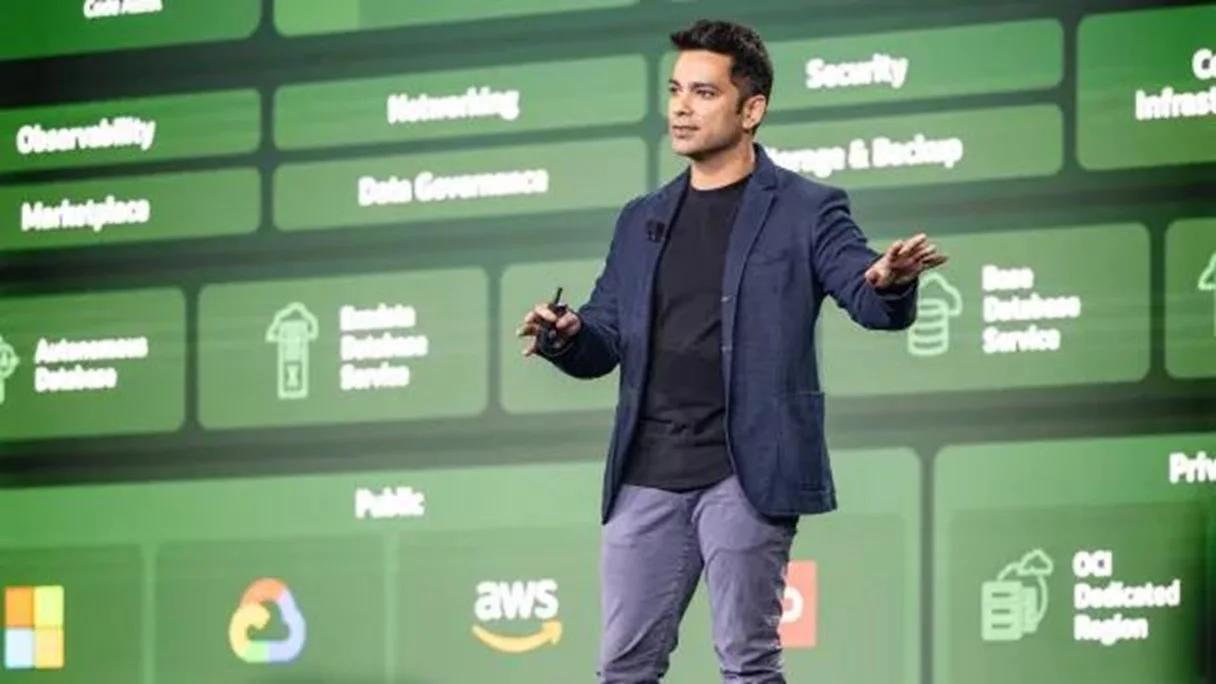
On October 27, 2026, in Las Vegas, Oracle unveiled a series of industrial agreements that could reshape the global market for artificial intelligence infrastructure.
During its AI World conference, the American technology group announced an expansion of its collaboration with Nvidia, the planned introduction of Google's Tensor Processing Units (TPUs) on Oracle Cloud Infrastructure (OCI), and partnerships with Cerebras Systems and SambaNova, two companies developing specialized computing architectures, particularly for AI inference.
The most significant development involves Google.
For the first time, Google's proprietary AI accelerators are set to become available through a major hyperscale cloud provider competing with Google Cloud. Their introduction on OCI is scheduled to begin in 2027, followed by a gradual expansion of capacity.
At the same time, Oracle and Nvidia plan to expand their joint infrastructure to a multigigawatt scale.
These announcements do not represent a break with Nvidia. Instead, they point toward the emergence of an industrial model in which several competing computing architectures coexist within the same cloud ecosystem.
Behind this diversification lies a fundamental question: who will control the computing resources on which an increasing share of the global economy will depend?
Oracle Is Transforming Its Cloud Infrastructure into a Multi-Architecture Platform
The artificial intelligence industry has developed around an exceptional concentration of computing capabilities.
Nvidia's graphics processing units, supported by its CUDA software ecosystem and advanced interconnection technologies, occupy a central position in the training of large artificial intelligence models.
This dominance extends well beyond semiconductor performance.
It also reflects an integrated ecosystem of software libraries, development tools, networking technologies and systems capable of coordinating tens of thousands of accelerators simultaneously.
For cloud operators, such concentration creates several constraints.
It exposes infrastructure investment to equipment availability, supplier pricing, technology cycles and the difficulty of adapting computing resources to rapidly evolving applications.
Oracle is seeking to address these constraints through diversification.
Rather than relying on a single hardware architecture, the company intends to offer different categories of processors optimized for specific workloads.
Training frontier AI models, adapting them to specialized applications, running inference at scale and executing autonomous agent workflows do not necessarily require identical computing configurations.
This distinction is becoming increasingly important.
A system designed to train a model containing hundreds of billions of parameters faces different technical and economic requirements from an infrastructure processing millions of real-time requests.
The ability to allocate these operations across several computing technologies could become a decisive competitive advantage.
Oracle is therefore seeking to move beyond its traditional role as a provider of computing capacity.
Its emerging ambition is to become an orchestrator of heterogeneous artificial intelligence infrastructure.
Google Opens a Strategic New Market for Its AI Processors
The agreement between Oracle and Google is arguably the most consequential development in the October 27 announcements.
For more than a decade, Google has developed its own artificial intelligence accelerators.
Its Tensor Processing Units were designed to efficiently execute the mathematical operations required for machine learning.
They offer an alternative to conventional GPUs, although their software environments, deployment requirements and performance characteristics vary depending on the workload.
Until now, their commercial distribution has remained closely associated with Google's own ecosystem.
Their planned availability on Oracle Cloud Infrastructure extends their reach to a competing cloud platform.
The two companies confirmed that Google's eighth-generation TPU architecture will become available on OCI beginning in 2027.
This generation includes two distinct architectures: TPU 8t, designed for training, and TPU 8i, optimized for inference.
For Google, the agreement creates an opportunity to expand the addressable market for its processors without necessarily requiring customers to adopt Google Cloud as their primary infrastructure provider.
For Oracle, the strategic benefits are complementary.
The company gains access to an additional family of accelerators while maintaining its direct commercial relationship with OCI customers.
This cooperation illustrates a significant evolution in the competitive relationships between major technology companies.
Two groups competing in cloud services can simultaneously cooperate in the distribution of strategically important industrial technologies.
The boundaries between competition and collaboration are increasingly determined by the specific layers of the value chain.
Google can compete with Oracle in cloud computing while using Oracle's infrastructure as an additional distribution channel for its processors.
Oracle, in turn, can strengthen its offering by integrating technology developed by one of its competitors.
The agreement does not mean that Google is abandoning its cloud business or that Oracle is becoming independent of Nvidia.
It reflects a more complex organization of industrial competition.
Nvidia Remains Central to the Expansion of AI Infrastructure
Oracle's diversification strategy might initially appear to signal a weakening of Nvidia's position.
The October 27 announcements suggest a more nuanced reality.
Oracle and Nvidia announced plans to expand infrastructure based on Nvidia Vera Rubin NVL72 systems to a multigigawatt scale.
The companies also confirmed the commercial availability of Vera Rubin NVL72 systems and Nvidia Vera CPUs on OCI.
Their collaboration encompasses infrastructure designed for advanced model training, inference and agentic artificial intelligence applications.
The reference to gigawatts deserves particular attention.
It demonstrates that the AI industry is no longer measuring its ambitions solely in terms of processor counts or storage capacity.
Electrical power is becoming an industrial unit of scale.
Large artificial intelligence facilities require simultaneous investment in servers, networking equipment, cooling systems, electrical infrastructure and reliable energy supplies.
Their expansion therefore depends as much on physical deployment conditions as on semiconductor performance.
However, the multigigawatt ambitions announced by Oracle and Nvidia should not be confused with fully installed operational capacity.
They describe a development trajectory whose realization will depend on investment, construction schedules, equipment availability and commercial demand.
Nvidia also retains substantial advantages through the integration of its hardware, software and networking technologies.
The presence of competing architectures within Oracle's product portfolio does not, by itself, undermine that position.
Nevertheless, it could gradually alter the balance of negotiating power between semiconductor suppliers and major cloud operators.
Cerebras and SambaNova: Inference Becomes a New Competitive Frontier
Oracle's planned integration of Cerebras and SambaNova technologies reveals another important transformation.
For several years, attention has focused primarily on the computing power required to train increasingly sophisticated AI models.
Training remains strategically important, but it represents only one stage in the economic life cycle of artificial intelligence.
Once trained, models must be deployed and executed.
Every generated response, analyzed document and operation performed by an AI agent consumes computing resources.
This execution phase, known as inference, is becoming increasingly significant as enterprise applications and autonomous systems proliferate.
An artificial intelligence agent may perform a sequence of operations: retrieving information, analyzing documents, calling external tools, executing code, verifying results and preparing decisions.
Each stage may require one or more model executions.
The economic constraints are consequently different from those associated with training.
Response generation speed, computing costs, energy consumption and the ability to process large numbers of simultaneous requests become increasingly important.
Cerebras and SambaNova are positioning themselves to address these requirements.
Cerebras has developed an architecture based on exceptionally large processors designed to bring computing and memory resources into close proximity.
This approach aims to reduce certain data movements and accelerate response generation.
Its partnership with Oracle is intended to make Cerebras inference capabilities available through OCI.
SambaNova, meanwhile, develops reconfigurable processors, including its SN50 generation, designed for high-performance and energy-efficient inference.
The company emphasizes the potential benefits of separating different stages of inference and assigning them to computing architectures optimized for their specific requirements.
Such specialization could transform the organization of data centers.
Rather than relying on a single processor category for every operation, infrastructure operators could combine several technologies.
However, the economic advantages of these alternatives still need to be demonstrated under comparable commercial conditions.
Performance claims depend on the models tested, hardware configurations, workloads and production constraints.
It would therefore be premature to conclude that specialized accelerators will replace GPUs on a massive scale.
Their planned integration into Oracle's infrastructure nevertheless represents an important industrial signal.
The inference market may become more open to architectural competition than the market for training the most advanced AI models.
Control of Networking Infrastructure Is Becoming as Strategic as Processor Performance
Oracle's transformation extends beyond the selection of accelerators.
It also concerns the systems connecting them.
In large artificial intelligence clusters, processors continuously exchange enormous volumes of data.
Performance therefore depends on interconnection quality, latency, bandwidth and energy efficiency.
These technologies represent an essential component of industrial value.
Nvidia supplies more than graphics processors.
It also provides networking and interconnection technologies that contribute to the overall performance of its computing systems.
Oracle is seeking to retain greater control over this infrastructure layer.
The company has confirmed the development of its Acceleron networking technologies, designed to manage communications and data flows within its data centers.
Certain systems using Nvidia processors will consequently be able to incorporate networking components developed by Oracle.
This strategy reflects a broader industrial logic.
Diversifying accelerators produces its full benefits only when an infrastructure operator retains sufficient control over the systems required to integrate them.
A cloud provider dependent on a single supplier for processors, networking and software would continue to face significant constraints.
By developing its own networking capabilities, Oracle aims to increase its operational and technological flexibility.
Control over physical infrastructure and orchestration mechanisms could become as important a competitive differentiator as access to the most powerful chips.
An Industrial Competition Requiring Enormous Capital Investment
Technological diversification does not automatically reduce financing requirements.
It may even increase investment complexity.
Each additional computing architecture requires specialized equipment, software tools, technical expertise and integration capabilities.
Infrastructure must also evolve without leaving operators with large quantities of equipment that no longer match market requirements.
Oracle therefore faces a dual challenge.
It must rapidly expand capacity to meet artificial intelligence demand while preserving the long-term profitability of its investments.
The company has maintained a capital expenditure forecast of between $90 billion and $95 billion for fiscal year 2027.
This figure illustrates the capital intensity of the industry.
However, it does not represent the financial value of the agreements announced on October 27, whose terms have not been publicly disclosed.
Nor does it relate exclusively to investments in the newly announced processor architectures.
The financial challenge extends beyond initial equipment costs.
Artificial intelligence infrastructure must generate sufficient revenue over its operating life to cover construction, energy, maintenance, financing and technological replacement.
Yet semiconductor generations are evolving rapidly.
An infrastructure investment that appears highly competitive when deployed may lose part of its economic advantage as newer architectures become available.
This dynamic increases the importance of commercial contracts, demand visibility and financing structures.
Major operators must continuously balance deployment speed, cost control and technological obsolescence risk.
The competition for artificial intelligence infrastructure is therefore becoming a financial contest as much as a technological one.
A New Distribution of Value Across the AI Industry
Oracle's announcements highlight a potential restructuring of the artificial intelligence value chain.
Until now, much of the industry's attention has focused on companies capable of designing the most powerful computing accelerators.
That capability remains fundamental.
However, the economic value of artificial intelligence also depends on the ability to assemble, finance and operate complex infrastructure.
Several industrial functions are becoming decisive.
Semiconductor designers develop computing architectures.
Manufacturers produce the chips.
Networking suppliers organize communications between systems.
Data center operators provide energy, cooling and physical infrastructure.
Cloud providers commercialize computing capacity.
Model developers and application companies ultimately transform these resources into services.
Competition may intensify at certain levels without necessarily reducing concentration elsewhere.
The introduction of new accelerators could, for example, reduce dependence on a single hardware architecture.
But it could also strengthen the position of cloud operators capable of financing and integrating several technologies.
Within this configuration, Oracle is seeking to become an indispensable industrial intermediary between semiconductor suppliers and enterprises deploying artificial intelligence.
Hardware diversification could therefore coexist with greater concentration of integration power.
This possibility represents one of the most important strategic implications of the announcement.
Energy and Physical Infrastructure Are Redefining Competitive Advantage
The expansion of artificial intelligence has progressively transformed data centers into strategic infrastructure.
Their development depends on factors extending far beyond the technology industry.
Access to abundant, competitively priced and reliable electricity is becoming essential.
Grid connection capacity, permitting procedures, land availability, cooling systems and supply chains increasingly determine deployment speed.
Announcements involving several gigawatts illustrate the scale of this transformation.
Artificial intelligence is becoming embedded in an industrial economy in which energy and territorial constraints play a central role.
This development could reshape comparative advantages between countries.
Territories capable of combining energy availability, connectivity, regulatory stability, financing and technical expertise will be well positioned to attract new computing capacity.
Conversely, regions facing electricity constraints or financing difficulties may find their digital development limited by physical infrastructure.
The geography of artificial intelligence will therefore not be determined solely by the location of research laboratories or major technology companies.
It will also depend on the territories capable of supporting its industrial expansion.
Technological Diversification Does Not Guarantee Independence
Opening Oracle's infrastructure to multiple suppliers could encourage stronger competition between computing architectures.
However, diversification should not be confused with the elimination of industrial dependencies.
Processors developed by Nvidia, Google, Cerebras and SambaNova rely on complex design, manufacturing and supply chains.
Their production remains dependent on specialized industrial capabilities, particularly in advanced semiconductors, memory technologies and packaging.
Software environments can also create substantial migration costs.
An enterprise developing applications around a particular architecture cannot necessarily transfer them to another platform without adaptation.
The coexistence of several processor families therefore does not guarantee interoperability.
It may reduce certain concentration risks while introducing new integration requirements.
The critical question becomes whether customers can move workloads between suppliers without incurring prohibitive technical or economic costs.
Only under those conditions can hardware diversification translate into effective competition.
Toward an AI Industry Built Around Multiple Computing Architectures
The announcements of October 27, 2026, do not mark the end of Nvidia's dominance.
Instead, they suggest that the expansion of artificial intelligence is creating a market large and diverse enough to accommodate several categories of processors.
Training the most advanced models may continue to favor certain high-performance architectures.
Large-scale inference could create opportunities for specialized alternatives.
Autonomous agents may increase demand for configurations combining general-purpose processors, dedicated accelerators, memory and low-latency networking.
Cloud operators will consequently seek to optimize infrastructure according to workloads, costs and expected performance.
This evolution could transform the criteria of competitiveness.
Raw processor performance will no longer necessarily determine the economic value of an infrastructure platform.
Energy consumption, total cost of ownership, commercial availability, software flexibility and integration capabilities will become increasingly important variables.
Competition could therefore shift from a component-centered model toward a system-centered model.
In such an environment, control over the overall architecture becomes a major source of economic power.
The Fundamental Question: Who Will Control the Economics of Computing?
Oracle's strategy reveals a transformation extending far beyond supplier diversification.
Artificial intelligence is entering a phase in which control over infrastructure is becoming a decisive condition for value creation.
Companies capable of designing the most advanced processors will continue to play an essential role.
But those able to combine multiple architectures, secure energy supplies, finance equipment and efficiently commercialize computing capacity may acquire equally significant influence.
This evolution is creating a new competitive landscape involving semiconductor manufacturers, cloud providers, infrastructure operators and artificial intelligence model developers.
It also raises questions of economic sovereignty.
As governments, enterprises and productive systems become increasingly dependent on artificial intelligence, access to computing resources may become an infrastructure as strategically important as telecommunications networks or energy systems.
Oracle's diversification strategy could help reduce certain technological dependencies.
It could also reinforce the power of platforms capable of organizing and controlling that diversity.
The next phase of global competition in artificial intelligence will therefore not be determined solely by the ability to manufacture the most powerful processors. It will increasingly depend on the ability to control, finance and operate the infrastructure through which those processors generate economic value.
The central question is no longer simply who will manufacture tomorrow's chips, but who will control the economics of computing on which the future of artificial intelligence will depend.
Atlas Limits Research Desk
Atlas Limits’ editorial and analytical desk.