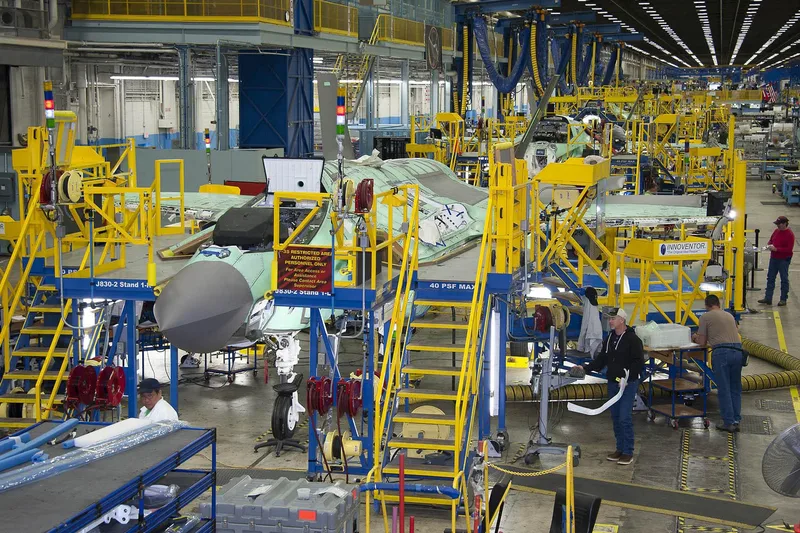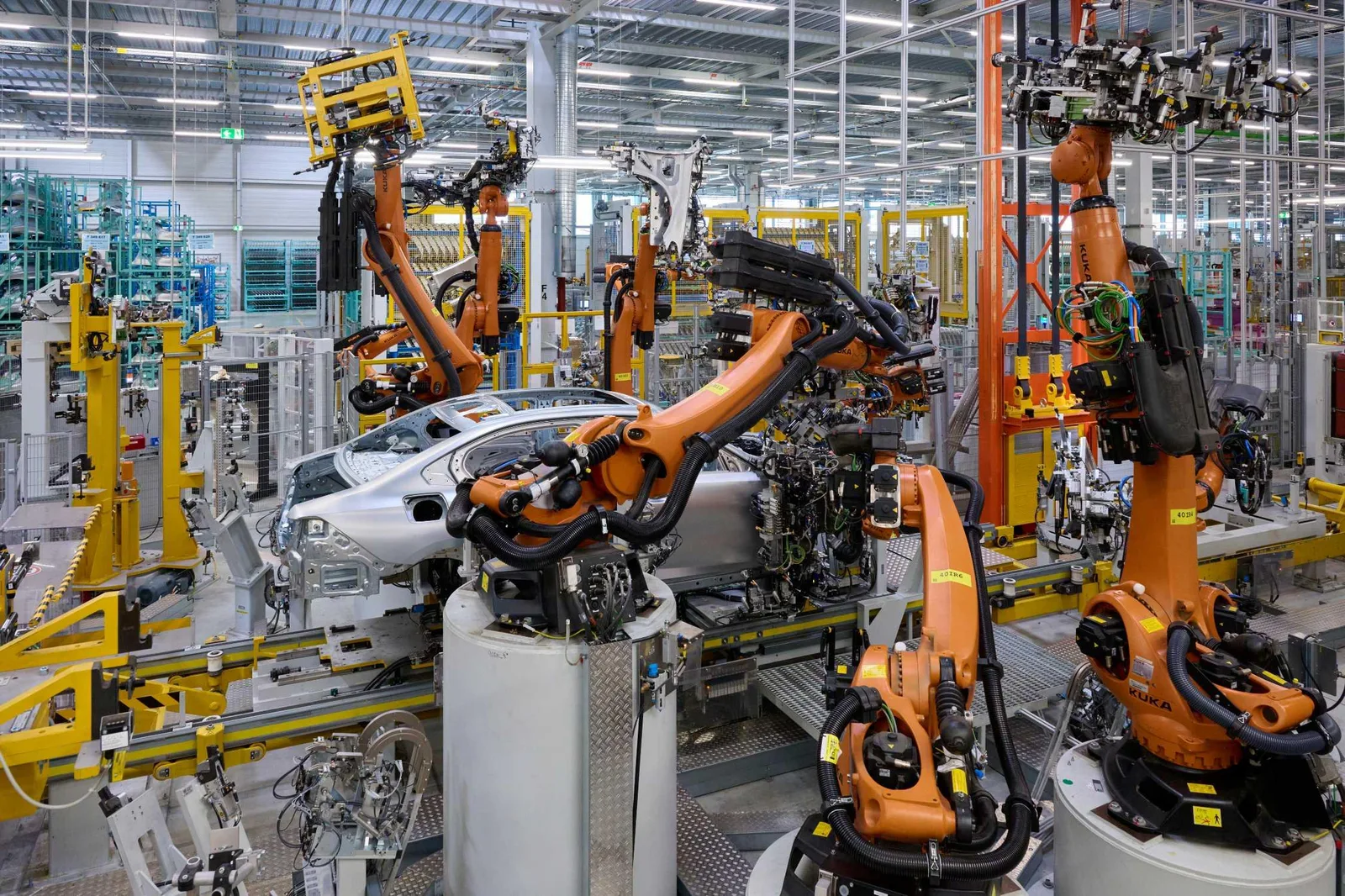
The expansion of industrial robotics is reshaping manufacturing, production costs, and the foundations of economic sovereignty. Long regarded primarily as a means of reducing labor requirements, automation is becoming a decisive factor in the redistribution of industrial power. Yet as Europe and the United States seek to rebuild their manufacturing capabilities, China is accelerating its own technological transformation. The competition is no longer simply about wages or production volumes. It increasingly concerns control over the systems that make production possible.
Inside a modern automotive factory, the scene has become familiar. Articulated robotic arms assemble vehicle bodies, machine-vision systems inspect welds, and autonomous vehicles transport components between production lines. Operations follow one another with a degree of precision that would have been difficult to imagine only a few decades ago. Workers have not disappeared, but their responsibilities have changed. They supervise equipment, respond to malfunctions, maintain machinery, and coordinate processes in which direct manual intervention plays an increasingly limited role.
This transformation may appear primarily technological. In reality, it represents one of the most profound changes in the contemporary industrial economy. For decades, factory locations were heavily influenced by the availability of abundant, relatively inexpensive labor. The industrialization of East Asia, followed by China's integration into global value chains, capitalized extensively on these differences in production costs. Western companies progressively transferred manufacturing activities to countries capable of producing at scale, at lower prices, and within competitive delivery schedules.
Robotics changes part of that equation. When machines perform operations previously carried out by workers, wages account for a smaller proportion of manufacturing costs. Proximity to customers, energy availability, supply-chain security, and technological expertise can consequently regain importance. A highly automated factory may become economically viable in a country where labor costs are comparatively high.
This possibility now underpins industrial renewal strategies across Europe and the United States. Yet it contains a fundamental paradox: the countries that benefited from previous waves of offshoring are not standing still. They are also investing heavily in robotics, sometimes more rapidly than the economies hoping to recover lost manufacturing activities.
The emerging global competition is therefore not simply about factories returning to developed economies. It may instead reinforce the positions of countries that already possess the infrastructure, suppliers, technical expertise, and financial resources required to automate their manufacturing systems.
An Industrial Revolution Already Visible in the Data
Statistics published by the International Federation of Robotics illustrate the scale of the transformation. Approximately 542,000 new industrial robots were installed worldwide in 2024, more than twice the annual volume recorded a decade earlier. The global operational stock reached approximately 4.66 million units, an increase of 9% from the previous year.
These figures describe a technology that is no longer marginal. They reflect a structural transformation in global manufacturing capacity. The automotive industry, historically the leading user of industrial robots, now shares this momentum with electronics, metalworking, machinery, chemicals, and food processing.
In 2024, the electrical and electronics industries accounted for approximately 24% of new global installations, compared with 23% for automotive manufacturing and 16% for metals and machinery. Automation is gradually expanding beyond the industries where high production volumes and repetitive operations initially made its adoption particularly profitable.
The geographical distribution nevertheless reveals considerable concentration. Asia accounted for 74% of new installations worldwide, compared with 16% for Europe and 9% for the Americas. This imbalance demonstrates that automation does not necessarily produce an industrial rebalancing in favor of Western economies.
The geography of investment in robotics continues to reflect the geography of major manufacturing powers. Countries that already produce the largest quantities of industrial goods often enjoy the most favorable conditions for installing additional machines, integrating new equipment, and recovering their investments.
The number of robots alone, however, provides an incomplete picture. Their productivity depends on software quality, spare-parts availability, production organization, maintenance capabilities, and the ability to adapt manufacturing lines to changing requirements.
An automated factory becomes genuinely competitive only when the industrial environment surrounding it operates with comparable efficiency.
China: The Leading Power in Industrial Automation
China occupies a distinctive position in this transformation. Its manufacturing ascent was long associated with abundant labor, competitive production costs, and progressive integration into international production networks. That description is now insufficient.
In 2024, Chinese factories installed approximately 295,000 industrial robots, representing 54% of worldwide installations. China's operational stock exceeded two million units, more than four times Japan's total and approximately five times that of the United States.
Even more revealing, Chinese manufacturers supplied 57% of the robots newly installed in their domestic market. A decade earlier, that proportion had been close to 28%. China is therefore no longer merely importing equipment to modernize its factories. It is developing a domestic robotics industry capable of supplying a growing share of its own requirements.
This shift fundamentally changes the outlook for global industrial competition. Chinese companies increasingly combine several mutually reinforcing advantages: enormous manufacturing capacity, dense supplier networks, substantial domestic demand, extensive logistics infrastructure, and increasingly sophisticated automation.
In electric vehicles, batteries, electronic equipment, machinery, and numerous intermediate industries, this combination helps shorten development cycles, accelerate product changes, and control a significant proportion of production costs.
Robotics does not therefore eliminate China's industrial advantage. It may strengthen it.
A European factory equipped with advanced robots can reduce its wage disadvantage compared with a traditional Chinese manufacturing facility. But if the Chinese factory is equally automated, benefits from nearby suppliers, and operates at a substantially larger scale, the competitiveness gap may persist.
This is one of the principal difficulties confronting Western reindustrialization strategies: the technology that theoretically makes the return of manufacturing possible also enables established industrial powers to defend their positions.
China also intends to extend automation into sectors where adoption remains uneven. Given the enormous size of its manufacturing workforce, its already exceptional stock of industrial robots still has considerable room to expand.
The competition is no longer between a low-wage Chinese manufacturing system and a technologically advanced West. It increasingly involves industrial systems seeking to combine automation, artificial intelligence, energy security, and manufacturing scale.
Japan and South Korea: The Architecture of Precision
China's rise should not obscure the historical importance of Japan and South Korea. Both economies built significant parts of their industrial competitiveness around automation long before robotics became a global strategic priority.
Japan occupies a particularly important position in the production of industrial robots, machine tools, servomotors, sensors, and control systems. Companies such as FANUC, Yaskawa, and Kawasaki helped establish a global industry whose equipment operates across multiple continents.
In 2024, Japan had approximately 450,500 operational industrial robots. With 446 robots per 10,000 manufacturing employees, it ranked among the world's most automated economies.
South Korea displayed an even higher concentration: 1,220 robots per 10,000 manufacturing employees, according to reference figures published by the IFR in 2026. This exceptional intensity reflects the importance of electronics, semiconductors, and automotive manufacturing in its industrial structure.
The experience of these countries demonstrates that automation is not simply a response to expensive labor. It forms part of an industrial model built around quality, production consistency, innovation, and mastery of complex manufacturing processes.
It also responds to demographic constraints. Population aging and recruitment difficulties in certain industries make automation increasingly attractive. Robots allow companies to maintain manufacturing capacity without depending exclusively on expanding their workforces.
This demographic dimension is likely to become increasingly important over the coming decades. For several aging economies, robotics may become a condition for maintaining industrial production rather than merely a tool for improving profitability.
The United States: Technological Leadership and Manufacturing Reconstruction
The United States possesses considerable advantages in software, artificial intelligence, advanced semiconductors, and financial resources. Yet technological leadership does not automatically translate into dominance in industrial robotics.
In 2024, American factories installed approximately 34,200 industrial robots, compared with 295,000 in China. The American operational stock reached approximately 393,700 units. The difference remains substantial, even after accounting for the different industrial structures of the two economies.
American industrial policy has sought for several years to address strategic manufacturing dependencies, particularly in semiconductors, batteries, energy infrastructure, and critical equipment.
Robotics could play an essential role in this reconstruction. High wages, recruitment constraints, and the need to secure supply chains make automation particularly attractive for new manufacturing investments.
However, opening a modern factory does not guarantee the reconstruction of a complete industrial ecosystem.
Producing advanced semiconductors requires specialized equipment, ultra-pure materials, component suppliers, engineers, technicians, and extremely reliable infrastructure. An automated facility can be constructed relatively quickly compared with the historical development of an industrial sector, but establishing the necessary networks and expertise often takes many years.
The United States also faces dependencies in robotics equipment itself. A significant proportion of the machinery used in American factories comes from Japanese and European manufacturers.
Its potential advantage may nevertheless lie in integrating artificial intelligence into production systems. Advances in computer vision, machine learning, and simulation are making robots more adaptable, allowing them to perform less repetitive tasks and operate in more variable environments.
American industry may therefore seek to shift competition toward software, control architectures, and autonomous systems.
But such a strategy will succeed fully only if technological advances are translated into physical manufacturing capacity.
An economy can dominate artificial intelligence without controlling all the machines that use it. That distinction could become decisive.
Europe Confronts Its Industrial Contradictions
Europe has a long tradition of mechanical engineering, automation, and precision manufacturing. Germany, Italy, Sweden, Switzerland, and several other European economies possess manufacturers of machinery, components, and industrial systems that rank among the world's most advanced.
Germany recorded a density of 449 robots per 10,000 manufacturing employees in 2024, slightly above Japan. The European Union reached 231 units, according to statistics published in April 2026.
These figures reflect a substantial industrial base. They nevertheless conceal profound differences between member states, sectors, and companies.
European industry must contend with sometimes elevated energy costs, regulatory and financial fragmentation, shortages of technical workers, and intensifying international competition.
Robotics can compensate for some of these constraints, but it cannot eliminate them all.
Automated machinery consumes energy, requires components, ties up capital, and depends on maintenance systems. Its installation becomes economically justified when improvements in productivity, quality, and equipment availability outweigh the initial investment.
For a large company producing hundreds of thousands of units, this calculation may be relatively favorable. For a small industrial company manufacturing limited and diversified production runs, automation may be more difficult to justify financially.
Yet Europe's productive structure relies heavily on small and medium-sized enterprises. The diffusion of robotics will therefore depend as much on access to financing, training, and technical integration as on equipment availability.
Europe faces another difficulty: it possesses substantial research and engineering capabilities but sometimes struggles to transform innovations into industries operating at global scale.
The risk would be to reproduce in robotics dependencies already observed in other technological sectors: designing advanced systems while allowing an increasing share of their manufacturing, components, or industrial deployment to concentrate elsewhere.
European reindustrialization therefore requires more than purchasing robots. It demands investment in machine tools, components, industrial software, energy, skills, and infrastructure.
Can France Really Bring Manufacturing Back Through Robotics?
France offers a particularly revealing example of this transformation.
Its industrial history includes major achievements in aerospace, nuclear energy, rail transport, defense, chemicals, electrical equipment, and several advanced technological industries.
Yet significant parts of its manufacturing base have contracted over the decades under the combined effects of restructuring, offshoring, international competition, and changing patterns of demand.
Robotics opens a new possibility: producing domestically certain goods that would have struggled to remain competitive using labor-intensive manufacturing methods.
This prospect is particularly credible in industries where precision, traceability, quality, and proximity to customers are important. It applies to selected mechanical industries, medical equipment, electronic components, pharmaceuticals, food processing, aerospace components, and specialized manufacturing.
Producing standardized, low-margin goods presents a different challenge. Even with extensive automation, a French factory may struggle against a competitor benefiting from larger volumes, denser supplier networks, and lower energy or property costs.
Reshoring therefore cannot simply be understood as reversing previous waves of offshoring.
Some activities may return in radically transformed forms. Where an older factory once employed several thousand workers, a modern installation could produce comparable volumes with substantially fewer employees, but with considerably greater investment in machinery and technology.
This development also changes the social significance of reindustrialization.
Recovering manufacturing capacity does not necessarily mean recovering the employment structures of the past. Maintenance, programming, quality control, engineering, and supervision roles may expand, while certain repetitive occupations continue to decline.
France must therefore answer two separate questions: how to rebuild competitive industrial capacity, and how to ensure that the broader economy benefits from the resulting productivity gains.
The first concerns investment and industrial strategy. The second involves education, wages, working arrangements, taxation, and the distribution of economic value.
The success of French industrial automation will depend on addressing both dimensions simultaneously.
Labor Costs Are Becoming Less Decisive, but They Are Not Disappearing
The economic transformation brought about by robotics can be understood through a simple distinction: labor represents only one component of total production costs.
In traditional manufacturing, a company may choose a low-wage country to reduce personnel expenses. But when operations become extensively automated, wages account for a smaller proportion of costs, while machinery, energy, financing, maintenance, and components become relatively more important.
The optimal location of a factory can consequently change.
Manufacturing closer to final consumers reduces transportation times, inventory requirements, and exposure to certain logistical disruptions. It also facilitates faster adaptation to market requirements.
Nevertheless, the profitability of a robotic factory depends heavily on capacity utilization. An expensive automated installation operating well below capacity may be less competitive than a more traditional factory benefiting from high production volumes.
Automation can also increase financing requirements. Expenses previously distributed between wages and operating costs are partially replaced by substantial initial investments that must generate adequate returns over several years.
Interest rates, credit conditions, and demand stability consequently become critical.
Robotics thus tends to shift industrial competition away from labor costs and toward investment capacity and capital productivity.
This shift may benefit some developed economies, but it may also favor large industrial groups in emerging markets capable of mobilizing substantial financial resources.
Artificial Intelligence Is Changing the Nature of Machines
Traditional industrial robotics largely relies on operations programmed in advance. Machines execute precise movements, usually within relatively controlled environments.
Artificial intelligence opens different possibilities.
Through computer vision, learning models, and perception systems, some robots can identify objects, adapt their movements, detect anomalies, and respond to less predictable situations.
This evolution could make it possible to automate activities that previously resisted mechanization, including certain handling, sorting, flexible assembly, and inspection operations.
Advances in digital simulation also allow robotic systems to be trained in virtual environments before physical deployment. Digital twins make it possible to anticipate constraints, test configurations, and optimize industrial flows.
Humanoid robots attract particular attention because their physical configuration could theoretically facilitate integration into environments designed for human workers.
But technological demonstrations should not be confused with large-scale industrial adoption.
To replace a human operation sustainably, a robot must demonstrate sufficient reliability, appropriate safety, competitive total costs, and the ability to operate over extended periods.
Manipulation, mobility, maintenance, and energy autonomy remain significant challenges for many applications.
Specialized industrial robots currently possess far greater operational maturity than most general-purpose humanoid systems.
Over the medium term, the most important transformation may therefore come less from machines that fully replicate the human body than from specialized industrial systems becoming progressively more intelligent, flexible, and easier to reconfigure.
Artificial intelligence could reduce the cost of programming and integrating robots, opening automation to companies that previously lacked the necessary resources or expertise.
If this development continues, it could considerably accelerate the adoption of robotics in small-batch manufacturing and intermediate industries.
Energy and Raw Materials: The Physical Limits of Automation
The expansion of robotics does not eliminate the physical constraints of industry. It transforms them.
Automated machines require electricity, electronic components, metals, transmission systems, motors, and control equipment. Their production depends on international supply chains that are sometimes highly concentrated.
Copper, specialized steels, certain permanent magnets, semiconductors, and power electronics occupy important positions within this industrial architecture.
Access to reliable, competitively priced electricity becomes particularly important for highly automated factories, especially those operating continuously.
Countries with abundant electricity generation, robust infrastructure, and relatively predictable supply conditions may gain an increasingly significant industrial advantage.
But energy represents only one part of the equation. Manufacturing advanced robots also requires precision machine tools, bearings, gear reducers, sensors, and control software.
Dependence on foreign suppliers may therefore shift from finished products toward critical components or manufacturing technologies.
An economy that brings a factory back home while importing most of its machinery, parts, and control systems improves its domestic manufacturing capacity without necessarily achieving complete industrial autonomy.
Productive sovereignty must consequently be assessed across several dimensions: design, components, machinery, software, energy, maintenance, and final manufacturing.
No major country fully controls all these dimensions. But their distribution will shape future industrial power relationships.
Emerging Economies Face a Changing Development Model
Global automation raises a major question for economies hoping to follow the East Asian industrialization model based on competitive labor costs.
For decades, manufacturing served as an essential instrument of economic development. It allowed countries to transfer parts of their workforce from agriculture into more productive activities, expand exports, and progressively accumulate technological expertise.
If international companies can increasingly manufacture goods in automated facilities located close to consumer markets, the advantage of inexpensive labor may decline in certain industries.
This does not mean industrial opportunities will disappear for emerging economies.
Infrastructure requirements, domestic markets, energy costs, resource availability, and geographical proximity will continue to influence investment decisions.
India, Vietnam, Mexico, Turkey, and several North African economies may therefore retain or develop advantages in selected value chains.
However, their strategies will increasingly need to incorporate technical expertise, automation, and component manufacturing.
Mexico benefits particularly from its proximity to the American market and its integration into North American industrial supply chains. Eastern European and Mediterranean economies can similarly benefit from their proximity to European markets.
Across Africa, prospects will be more differentiated. Countries possessing competitive energy, port infrastructure, efficient industrial zones, and appropriate technical training may attract automated or semi-automated production.
Conversely, economies relying exclusively on low wages risk seeing their relative advantages erode.
Robotics could therefore alter the conditions of entry into industrial development by increasing the importance of capital, skills, and infrastructure.
It would not end manufacturing globalization, but it could change its destinations and location criteria.
A New International Division of Labor
One of the most profound consequences of this transformation may be the restructuring of global value chains.
Industrial globalization over recent decades has relied on extensive geographical fragmentation. Raw materials were extracted in one country, processed in another, incorporated into components elsewhere, and eventually assembled before being shipped to consumer markets.
This organization remains largely intact. Nevertheless, it may evolve under the combined effects of automation, geopolitical tensions, trade policies, and the need for greater resilience.
Some companies may choose to locate manufacturing facilities closer to final markets, even when that decision does not strictly minimize production costs.
Supply security, shorter delivery times, and the ability to respond rapidly to disruptions can justify geographical diversification.
Robotics potentially facilitates this evolution by reducing the importance of direct labor in certain industries.
However, manufacturing closer to consumers does not necessarily mean entirely domestic production.
An American factory may use Japanese robots, European components, and Asian raw materials. A European factory may depend on sensors manufactured in Asia, American software, and machinery designed in Germany.
The emerging industrial geography could therefore combine more regional manufacturing with continued global technological dependencies.
Value chains would become less exclusively organized around wage differences and increasingly structured by technological availability, economic security, and relationships between major powers.
Producing More With Fewer Workers
Employment remains one of the most sensitive dimensions of this transformation.
Robotics generally increases productivity in the operations it automates. Its effects on total employment, however, are more complex.
Certain tasks disappear or contract. Others expand in programming, engineering, maintenance, logistics, supervision, and associated services.
Productivity gains can also reduce prices, stimulate demand, and support the expansion of certain companies. Conversely, when demand grows slowly, more automated production may require fewer workers.
The consequences vary across industries, skill levels, territories, and economic policies.
It would therefore be misleading to portray robotics either as a guarantee of massive job destruction or as an automatic source of shared prosperity.
It primarily transforms the relationship between production and labor.
An economy can increase its manufacturing output without proportionately increasing its industrial workforce. This separation is already visible in several capital-intensive sectors.
For governments, the implications are substantial. Reindustrialization policies are frequently justified by their expected effects on employment, regional development, and social cohesion.
Yet a new robotic factory can create important strategic manufacturing capacity while employing relatively few people.
Its economic contribution may nevertheless be significant: it generates value added, exports, tax revenues, supplier orders, and indirect employment.
The measurement of industrial success must therefore extend beyond the number of direct jobs created.
It should incorporate productivity, manufacturing capacity, exports, investment, innovation, and supply-chain resilience.
This transformation will also require training policies capable of supporting workers whose existing skills become less marketable.
A society that automates without investing in workforce adaptation risks widening divisions between regions, generations, and skill groups.
Robotics as an Instrument of Strategic Power
Beyond its economic consequences, automation is progressively becoming a question of strategic power.
Industrial capabilities determine the production of military equipment, energy infrastructure, transportation systems, electronic components, and many technologies essential to the functioning of modern states.
Recent geopolitical tensions have demonstrated that control over software and services alone does not always guarantee economic security.
The ability to manufacture equipment rapidly, repair infrastructure, produce critical components, and sustain substantial industrial volumes remains fundamental.
Robotics can help reinforce these capabilities, particularly when labor availability represents a constraint.
Under certain conditions, it also makes production more flexible and allows facilities to adapt more rapidly to changing requirements.
But automation introduces additional vulnerabilities.
Automated factories depend on computer networks, software, electronic components, and control systems that may be exposed to failures, trade restrictions, or cyberattacks.
Industrial resilience therefore no longer depends solely on the physical presence of factories within national borders. It also requires control over the technologies that enable those factories to operate.
Competition between major powers may increasingly concern software architectures, robotic systems, precision equipment, and industrial standards as much as manufacturing volumes themselves.
From this perspective, robots are not merely tools intended to replace certain human tasks. They are becoming integral elements of the productive capacity of states.
The Real Challenge: Rebuilding Industrial Systems
The argument that robotics could enable Western countries to recover manufacturing activities contains an important economic truth. Automation reduces certain disadvantages associated with labor costs and makes possible forms of production that would have been difficult to maintain using older technologies.
But it cannot explain industrial competitiveness on its own.
A factory never exists in isolation. It depends on suppliers, engineers, technicians, energy networks, transportation companies, financiers, and markets capable of absorbing its output.
Industrial power results from the accumulation of these elements over time.
This is precisely what makes rebuilding a manufacturing base difficult. Machines can be purchased. Skills, supplier relationships, established forms of cooperation, and innovation capabilities often require years, sometimes decades, to consolidate.
Economies that have preserved dense industrial foundations therefore possess an advantage that automation alone cannot immediately reproduce.
China benefits from this manufacturing depth. Japan and Germany possess sophisticated ecosystems of machinery and precision equipment. South Korea has developed exceptional capabilities in several advanced industries. The United States retains considerable technological and financial resources.
France and other European economies must determine how to combine their own strengths rather than attempt to reproduce foreign industrial models indiscriminately.
This requires identifying sectors where existing expertise, strategic requirements, and commercial prospects can support durable investment.
It also means avoiding artificial oppositions between automation and employment, innovation and manufacturing, sovereignty and international trade.
A coherent industrial strategy must treat these dimensions as components of the same system.
A New Industrial Map, Not a Return to the Past
Robotics could profoundly alter the geography of the global economy over the coming decades. It reduces the relative importance of certain wage differences, encourages new forms of production, and offers developed economies opportunities to rebuild manufacturing capacity.
But it guarantees neither widespread reshoring nor the restoration of manufacturing employment to its historical proportions.
China is investing heavily in automating its own industrial system. Japan and South Korea retain important technological positions. The United States is seeking to combine artificial intelligence, capital, and manufacturing reconstruction. Europe possesses a substantial industrial tradition but must overcome constraints involving investment, energy, and economic integration.
Emerging economies, meanwhile, will need to adapt their strategies to a world in which low labor costs are no longer always sufficient to secure a competitive advantage.
Industrial competition does not disappear with robotics. It moves to a different level.
For decades, the central question was where goods could be manufactured at the lowest cost. Increasingly, it is becoming where the conditions can be assembled to manufacture reliably, flexibly, competitively, and with sufficient technological autonomy.
The distinction is essential. Purchasing robots is not enough to rebuild an industry. Countries must also possess companies capable of integrating them, workers capable of operating them, suppliers capable of maintaining them, and markets capable of sustaining their activities.
The robotics revolution therefore does not promise a return to the old industrial order. It signals the emergence of a new balance in which economic power will depend less on the quantity of labor available than on the ability to organize capital, energy, technology, and skills intelligently.
The defining industrial divide of the future will not be between countries that possess robots and those that do not. It will be between economies capable of building complete productive systems around those machines and those that remain dependent on systems designed elsewhere.
Main Sources
- International Federation of Robotics (IFR) — World Robotics 2025: Industrial Robots, September 2025. Global installations, geographical distribution, and operational robot stock.
- International Federation of Robotics (IFR) — Robot Density Surges in Europe, Asia, and Americas, April 2026. International comparisons of robot density and revised statistical data.
- International Federation of Robotics (IFR) — U.S. Lags China in Factory Robot Deployment by 5 to 1 Ratio, September 2025. Comparative assessment of American and Chinese industrial robotics capabilities.
- Eurostat — EU Businesses: €10.9 Trillion in Value Added in 2024, September 2026. Structure and economic significance of European enterprises.
- International Federation of Robotics (IFR) — World Robotics 2025: Executive Summary. Sectoral distribution of robot installations and developments in industrial demand.
Atlas Limits Research Desk
Atlas Limits’ editorial and analytical desk.