XRG's acquisition of Shell's stake in Australia's North West Shelf project illustrates a gradual transformation of the global gas industry. As major Western energy companies restructure their portfolios, Gulf investors are expanding their presence in international energy infrastructure. Beyond the announced $1.45 billion transaction, the deal reveals a broader shift in strategies of ownership, financing and supply across global liquefied natural gas markets.
A Historic Stake Changes Ownership
On November 3, 2026, Shell announced an agreement to sell its 16.67% interest in Australia's North West Shelf gas project to XRG, the international energy investment company established by Abu Dhabi's ADNOC.
The transaction provides for a base consideration of $1.45 billion, with a potential additional contingent payment. Completion is expected in 2027, subject to regulatory approvals and customary closing conditions.
The deal concerns one of the oldest and most significant industrial complexes in Australia's liquefied natural gas industry. Located in Western Australia, North West Shelf played a decisive role in establishing the country as a major gas supplier to Asian markets.
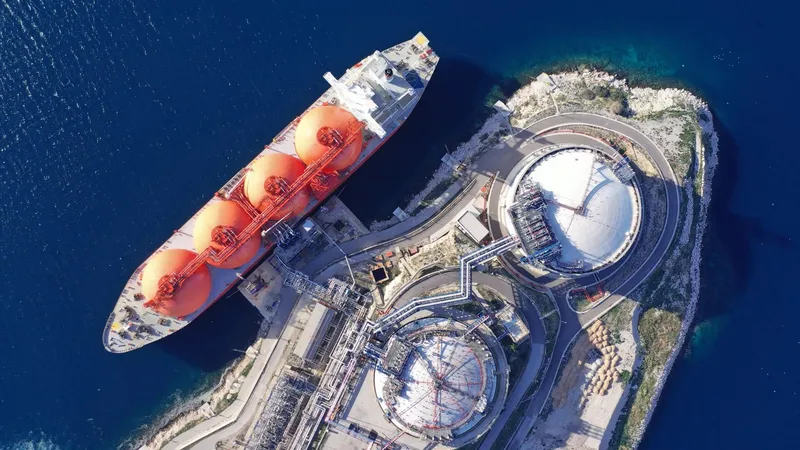
Developed from the 1980s onward, the project combines offshore production facilities, transportation networks and onshore processing and liquefaction infrastructure. Its Karratha complex has a nominal LNG production capacity of approximately 14.3 million tonnes per year.
XRG is therefore not investing in a new facility awaiting construction. It is acquiring an interest in an established industrial system, supported by operating infrastructure, decades of commercial experience and a geographical position favourable to Asian energy markets.
This distinction is essential to understanding the acquisition.
Shell: Restructuring Rather Than Retaining
For Shell, the disposal forms part of a more selective approach to managing its energy assets.
The company remains one of the world's leading participants in liquefied natural gas. Its activities extend across exploration and production, liquefaction, maritime transportation, trading and marketing. This integrated structure allows Shell to allocate resources across producing regions and consuming markets.
Yet portfolio size alone is no longer a sufficient competitive advantage.
Major international energy companies are increasingly concentrating investment on assets offering the strongest prospects for profitability, growth and cash generation. Minority interests in mature facilities may retain considerable industrial value without necessarily corresponding to the financial priorities of their shareholders.
North West Shelf illustrates this tension.
The project possesses substantial infrastructure and extensive operational experience, but its future also depends on access to additional gas resources, the utilisation of existing processing capacity and the investment required to sustain operations.
For Shell, retaining a minority stake means maintaining exposure to future expenditure and obligations associated with a mature asset, without necessarily exercising decision-making authority proportionate to the scale of its global portfolio.
The sale releases capital and reduces certain obligations while allowing the company to pursue investment elsewhere.
It does not represent a strategic withdrawal from liquefied natural gas. Shell continues to regard LNG as a central component of its energy business and is targeting annual LNG sales growth of approximately 4% to 5% through 2030.
The question is no longer simply how much production capacity a company owns, but which assets offer the most attractive combination of profitability, commercial flexibility and future capital requirements.
XRG: Building a Global Energy Portfolio
For XRG, the acquisition reflects an almost opposite strategy.
Established by ADNOC to expand its international energy investments, XRG is seeking to build a global portfolio combining resources, infrastructure and industrial activities.
Its development reflects an evolution in the United Arab Emirates' energy strategy.
Historically, Abu Dhabi's energy influence rested primarily on the exploitation of its domestic hydrocarbon resources. That foundation remains substantial, but ADNOC's international ambitions now extend well beyond the country's production base.
The objective is to establish positions in energy assets across multiple regions, diversifying revenue sources, markets and forms of industrial exposure.
Liquefied natural gas occupies a central position in this transformation.
Unlike oil, whose international trade relies on a highly globalised infrastructure system, LNG requires a particularly capital-intensive industrial chain. Extraction, processing, liquefaction, maritime transportation, regasification and distribution all involve substantial investment and frequently long-term commercial commitments.
Acquiring a stake in existing infrastructure provides access to this chain without independently bearing the risks and delays associated with developing a new complex.
North West Shelf offers precisely that opportunity.
XRG gains exposure to Australia's LNG industry, an established network of industrial facilities and a region whose exports have historically been directed towards Asia.
The investment also strengthens the group's geographical diversification, complementing its energy interests in the Middle East and other international markets.
Rather than a spectacular acquisition, it is an exercise in industrial positioning.
Australia: An Energy Platform for Asia
North West Shelf's strategic value also derives from its location.
Australia ranks among the world's major exporters of liquefied natural gas. Its proximity to Japan, China, South Korea and several Southeast Asian economies provides a logistical advantage over some supplies originating in more distant regions.
That position, however, does not guarantee superior profitability under all circumstances.
Australian producers must contend with high development costs, demanding environmental requirements, labour constraints and substantial infrastructure investment.
They also face growing international competition.
The United States has developed a particularly flexible LNG industry, supported by its domestic gas resources and expanding export capacity. Qatar continues to develop large-scale production facilities, while several African and Asian countries are seeking to commercialise their own resources.
In this environment, Australia's established LNG facilities must preserve their competitiveness.
One of their principal advantages lies in infrastructure that has already been constructed, with much of the initial capital expenditure incurred decades earlier.
But that advantage can only be fully realised if sufficient gas volumes remain available to sustain operations.
Access to gas therefore becomes as important as liquefaction capacity itself.
Historic Infrastructure in Search of New Gas Supplies
One of the fundamental challenges facing North West Shelf concerns the evolution of its industrial model.
Large LNG complexes were traditionally developed around identified gas fields, whose production supplied liquefaction facilities directly.
This model becomes more complicated as the original resources decline.
Infrastructure may retain substantial technical capacity even when the fields initially developed to supply it can no longer guarantee sufficient utilisation over the long term.
The solution involves securing additional sources of gas, sometimes produced by other operators.
Processing and liquefaction facilities can consequently evolve into platforms capable of handling volumes from multiple projects.
This development changes the economic nature of the assets.
A terminal historically integrated with a specific group of gas fields can gradually become shared industrial infrastructure, whose profitability depends on processing agreements, transported volumes and the continued utilisation of its equipment.
For investors, this transformation creates opportunities while introducing additional uncertainty.
Access to new resources depends on producers' investment decisions, environmental approvals, commercial arrangements and the ability of different partners to coordinate their projects.
In the case of North West Shelf, extending industrial operations and potentially integrating new sources of supply are therefore critical determinants of future value.
XRG is acquiring an interest in an existing system, but also exposure to its transformation.
The Acquisition Price Does Not Capture the Entire Investment
The announced $1.45 billion consideration provides an immediate measure of the transaction. It does not, however, establish its total economic cost.
In the oil and gas industry, acquiring an interest in a mature asset frequently involves commitments extending beyond the initial payment.
Facilities require maintenance, modernisation and, in some cases, adaptation to changing operating conditions.
Partners may also be required to finance new connections, environmental investments or projects designed to extend the complex's economic life.
These expenditures are accompanied by decommissioning and site restoration obligations.
The agreement between Shell and XRG includes the transfer of associated decommissioning responsibilities, an important consideration in assessing the transaction's financial implications.
Such obligations can represent significant amounts for large offshore and onshore installations.
The acquisition's economic value will therefore depend on several factors: future cash flows, actual processing volumes, the expenditure required to sustain operations and the timing of environmental liabilities.
The announced price represents the immediate cost of acquiring the stake. It is not a comprehensive estimate of the financial exposure assumed by the buyer.
This distinction is particularly important in an industry where assets can operate for several decades and where end-of-life obligations may be substantial.
A New Step Following Santos
The transaction comes at a particular moment in XRG's Australian expansion strategy.
The group previously participated in an attempted acquisition of Santos, one of Australia's leading oil and gas producers.
That proposed transaction, which would have represented a much larger change of corporate control, ultimately did not proceed.
The acquisition of Shell's North West Shelf stake demonstrates a different approach.
Rather than immediately seeking control of a major Australian energy company, XRG is investing in a defined asset within an established industrial structure.
The two strategies have fundamentally different characteristics.
Acquiring an entire company provides control over its decisions, resources and commercial direction, but also involves assuming the full range of its operational, financial and regulatory risks.
A minority investment offers more targeted exposure, generally with a smaller initial commitment, at the cost of reduced influence over collective decisions.
The North West Shelf acquisition does not, by itself, establish that XRG has abandoned its broader ambitions for corporate control.
It nevertheless demonstrates that international expansion can proceed through successive acquisitions of industrial interests without necessarily relying on major consolidation transactions.
Such an approach allows investors to build diversified portfolios progressively while distributing risks across multiple assets and jurisdictions.
Gulf Capital and the Redistribution of Energy Assets
The Shell–XRG transaction forms part of a broader movement in the international allocation of energy capital.
Gulf energy companies and investors are no longer concentrating exclusively on financing domestic production capacity.
They are increasingly seeking ownership positions in the infrastructure, resources and businesses that structure global energy trade.
Several factors underpin this development.
Historical hydrocarbon revenues have enabled the accumulation of substantial financial resources. National diversification strategies simultaneously encourage international investment in industrial sectors considered essential to future economic development.
Meanwhile, transformations within the energy industry are creating acquisition opportunities.
Major international companies regularly reassess their portfolios. Some prioritise assets offering stronger immediate returns, while others reduce exposure to ageing facilities or seek to finance new projects without increasing leverage excessively.
Investors operating with longer holding periods may evaluate the same assets differently.
Mature infrastructure offering limited growth prospects for a large publicly listed company may remain attractive to an investor seeking diversified revenues and a broader geographical presence.
It would nevertheless be excessive to interpret every Western divestment as an industrial retreat, or every Gulf acquisition as a strategic conquest.
These decisions are primarily driven by economic considerations, and their outcomes will depend on operating conditions and market developments.
Yet their cumulative effect may gradually alter the international distribution of ownership across energy infrastructure.
Influence in the sector no longer rests exclusively on possessing reserves. It also depends on the ability to finance, operate and commercialise the infrastructure connecting producers with consumers.
Energy Security Becomes a Question of Ownership
The North West Shelf acquisition also raises a broader question about energy security.
For decades, energy security was understood primarily in terms of physical resource availability: ensuring that sufficient oil or gas existed to meet demand.
That consideration remains fundamental, but it no longer captures the full complexity of contemporary energy interdependence.
Security of supply also depends on liquefaction capacity, port terminals, specialised vessels, commercial contracts and the financing required to sustain the entire system.
Ownership of these assets influences investment decisions, the allocation of risks and, under certain circumstances, commercial strategies.
It does not, however, automatically confer control over physical flows.
In projects jointly owned by multiple partners, decision-making rights are governed by established agreements. Commercialised volumes may also be subject to long-term contracts and pre-existing commitments.
XRG's entry into North West Shelf therefore does not mean that Abu Dhabi will be able to determine independently where Australian gas is delivered.
It nevertheless strengthens the presence of a Gulf energy investor in infrastructure that plays an important role in regional gas trade.
As international investments multiply, supply chains become increasingly integrated financially, even when resources and facilities remain geographically dispersed.
This interdependence can facilitate capital mobilisation and support continued investment. It can also complicate the relationship between energy sovereignty, commercial interests and security of supply.
A Limited Transaction, a Deeper Transformation
On a global scale, the sale of a 16.67% interest in North West Shelf does not immediately alter the balance of the liquefied natural gas market.
It does not create new production capacity, guarantee additional volumes or independently change the outlook for Asian demand.
Its significance lies elsewhere.
Shell is converting a historic investment into financial resources available for other priorities. XRG is deploying its investment capacity to establish a position in an existing international energy infrastructure asset.
Between these two decisions, a broader evolution in energy capitalism is becoming visible.
International energy companies no longer necessarily seek to retain every position accumulated during earlier periods of expansion. Investors originating from major producing economies are increasingly becoming owners of assets located far beyond their national territories.
Australia provides a particularly revealing setting for this transformation, combining substantial resources, expensive infrastructure, proximity to Asian markets and growing requirements for industrial adaptation.
The success of XRG's investment will depend on concrete factors: the complex's future gas supply, its competitiveness against other exporters, the expenditure required to maintain operations and the ability of its partners to extend its economic life.
The transfer of ownership resolves none of these questions by itself.
It does, however, change the identity of the investors responsible for addressing them.
In the global gas industry, the redistribution of capital may ultimately become as consequential as the discovery of new reserves. The infrastructure supplying tomorrow's energy markets will not necessarily remain in the hands of the companies that built it yesterday.
Main Sources
- Shell, November 3, 2026 — Official announcement of the agreement to sell its North West Shelf interest to XRG.
- XRG, November 3, 2026 — Corporate announcement concerning the acquisition and the group's international investment strategy.
- Reuters, November 3, 2026 — Reporting on the transaction's financial terms, expected completion and XRG's Australian ambitions.
- Woodside Energy — Corporate documentation concerning the North West Shelf project, its infrastructure and LNG production capacity.
- International Energy Agency (IEA) — Gas Market Report and assessments of global liquefied natural gas market developments.
- Australian Government — Department of Industry, Science and Resources — Data and outlooks concerning Australian LNG exports.
Atlas Limits Research Desk
Atlas Limits’ editorial and analytical desk.