Southern Africa occupies a distinctive position in the economic geography of the African continent. It concentrates a substantial share of Africa's industrial capabilities, some of its most developed financial infrastructure, several of its principal logistics corridors and an exceptional proportion of the mineral resources essential to the global economy. Its territories connect the Atlantic and Indian Oceans, its companies participate in international production chains, and its mineral deposits supply industries as diverse as automotive manufacturing, metallurgy, electronics, chemicals and energy technologies. Yet this accumulation of advantages has not translated into a proportionate economic and social transformation. The region remains marked by some of the world's highest levels of inequality, persistent energy constraints, unevenly distributed industrialization and significant dependence on external markets.
This contradiction constitutes the central paradox of contemporary Southern Africa. Unlike several other African regions, it does not need to build the foundations of an industrial economy entirely from scratch. It already possesses manufacturing companies, technical expertise, financial markets, transport networks and extensive experience in extracting and processing natural resources. But these capabilities remain concentrated in certain territories and are insufficient to bring all regional economies into a convergent development trajectory.
Southern Africa therefore possesses genuine but incomplete economic power. Its future will depend less on discovering new resources than on its ability to organize those it already possesses, reduce the constraints affecting its businesses and transform extractive revenues into lasting productive capabilities.
The definition of the region itself requires an initial distinction.
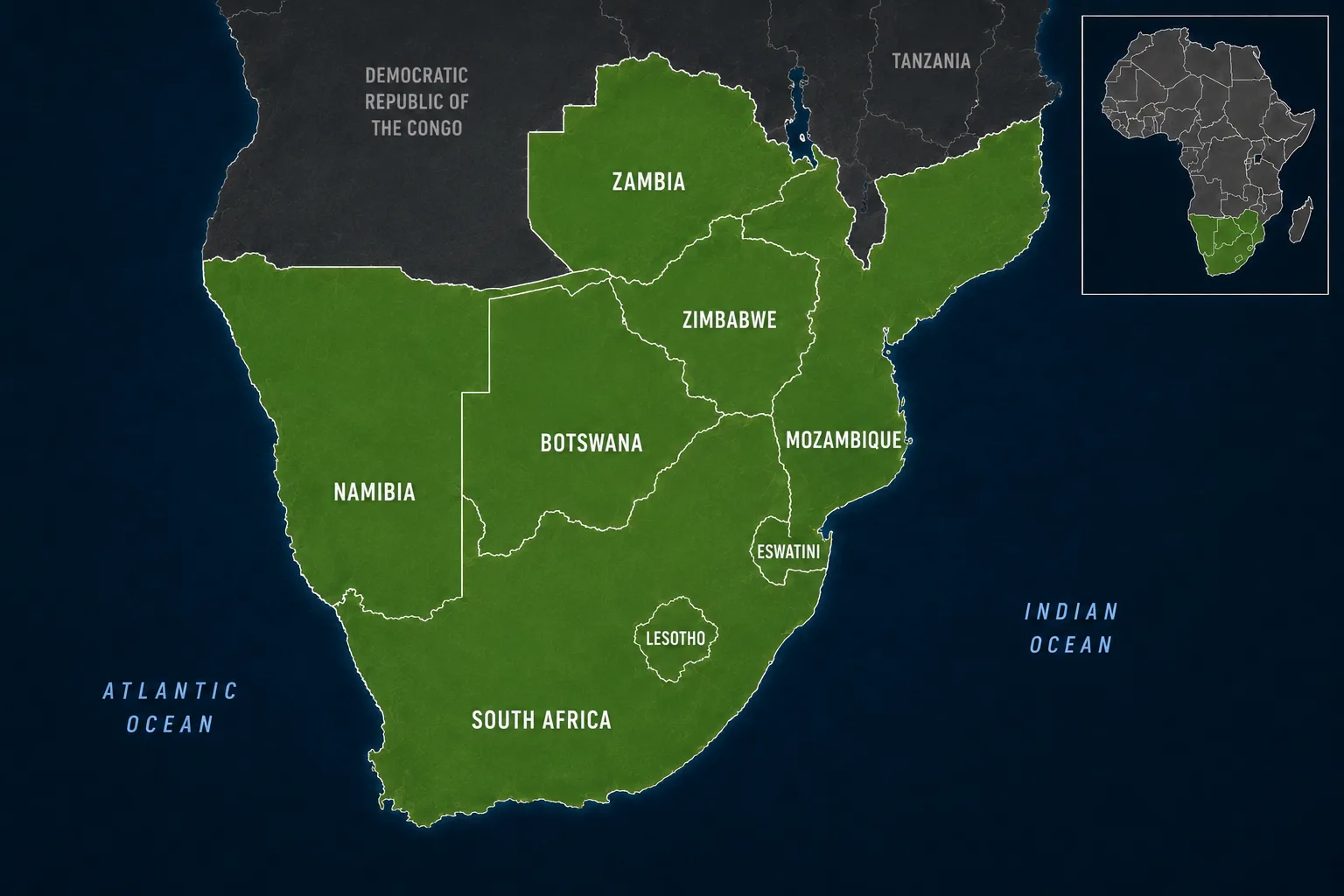
Southern Africa can be understood as a geographical area encompassing South Africa, Botswana, Namibia, Zimbabwe, Zambia, Mozambique, Angola, Malawi, Lesotho and Eswatini, among others. This broad definition does not correspond exactly to the United Nations' narrower statistical classification, nor to the membership of the Southern African Development Community, which extends into Central Africa, Eastern Africa and the Indian Ocean.
This distinction is essential when assessing the region's demographic and economic dimensions. Population totals, gross domestic product and market shares vary significantly depending on the boundaries used.
Beyond these classifications, however, Southern Africa forms an economic space organized around several fundamental interdependencies.
South Africa constitutes its principal industrial and financial center. Inland mining economies supply regional and international value chains. Atlantic and Indian Ocean ports provide access to global markets. Electricity networks and transport infrastructure connect territories whose resources and needs are complementary.
This organization rests on a particular geography.
At the southern end of the continent, maritime routes connecting the Atlantic and Indian Oceans retain considerable strategic importance. The Cape of Good Hope constitutes a major alternative to routes passing through the Red Sea and the Suez Canal.
When security tensions disrupt navigation in the Red Sea, part of the commercial traffic between Asia and Europe can be diverted around southern Africa.
These diversions increase distances and transport times, but they also reinforce the importance of maritime infrastructure along the continent's southern coastline.
Southern Africa's geographical position does not, however, guarantee that it will automatically capture the value generated by these flows.
The passage of ships produces substantial economic benefits only if ports possess the capacity to provide transshipment, maintenance, bunkering and logistics services.
The competitiveness of port infrastructure therefore becomes a component of regional power.
This question is particularly relevant to South Africa.
The country possesses the region's most diversified industrial base and one of the most developed on the continent. Its economy combines manufacturing, extractive industries, financial services, telecommunications, commerce, transport and specialized technologies.
The automotive industry constitutes one of its principal manufacturing sectors.
Several international manufacturers, including BMW, Mercedes-Benz, Toyota, Ford, Volkswagen and Isuzu, operate industrial facilities in the country.
These factories produce for both the domestic market and export markets. They are integrated into international supply chains combining imported components, local suppliers, assembly, logistics and distribution.
Their presence demonstrates that Southern Africa is not limited to exporting raw materials.
It possesses the capacity to host complex industrial activities requiring technical expertise, infrastructure and substantial investment.
But this capacity remains vulnerable to the conditions under which the economy operates.
Electricity interruptions, railway difficulties, port congestion and logistics costs can reduce business competitiveness.
A factory may possess modern equipment and a skilled workforce while losing markets because its supplies or exports become too expensive.
Industrial performance therefore depends on the entire infrastructure surrounding production.
This interdependence explains why South Africa's economic difficulties have regional consequences.
South African companies operate in commerce, distribution, banking, insurance, telecommunications and several industrial sectors across neighboring countries.
The country's financial and logistics networks facilitate trade, but they also create a concentration of economic functions.
When South African infrastructure operates efficiently, it can support activity in surrounding economies.
When it encounters difficulties, the costs spread beyond national borders.
This centrality represents both a strength and a vulnerability.
It allows the region to benefit from a relatively developed industrial center, but it also limits the emergence of a more balanced economic structure.
Diversifying production centers and logistics corridors therefore constitutes an essential challenge.
This question becomes particularly important in the mining sector.
Southern Africa possesses one of the world's largest concentrations of strategic mineral resources.
South Africa occupies a major position in platinum-group metals, manganese, chromium and several other industrial minerals.
Botswana is among the important diamond producers, while Namibia possesses significant uranium and diamond resources.
Zambia constitutes one of Africa's major copper-producing centers.
Zimbabwe possesses resources including lithium, gold, chromium and platinum-group metals.
Angola has hydrocarbons and diamonds, while Mozambique possesses important natural gas, coal, graphite and heavy-mineral resources.
This diversity gives the region an importance extending far beyond traditional commodity markets.
Southern African minerals contribute to the operation of strategic industries worldwide.
Copper is used in electricity networks, motors, industrial equipment and transport infrastructure.
Lithium, graphite, nickel and manganese are used in different battery technologies, depending on their chemical composition.
Platinum-group metals are used in industrial catalysis, certain electronic equipment, pollution-control devices and several hydrogen-related technologies.
Chromium is essential to the production of certain steels, while manganese is used in metallurgy and several electrochemical applications.
Uranium remains a strategic resource for countries that use nuclear energy.
Southern Africa therefore stands at the intersection of several global industrial transformations.
Transport electrification, electricity-grid development, investment in renewable energy, infrastructure modernization and supply-chain diversification are increasing the importance of several of its resources.
But this strategic position does not guarantee a proportionate increase in the value retained by local economies.
Possessing a mineral deposit does not automatically confer control over processing activities.
Mining value chains comprise several stages: exploration, extraction, concentration, refining, intermediate-material production, component manufacturing and finished-product marketing.
Margins, risks and capital requirements differ considerably between these activities.
A country can possess exceptional mineral resources while depending on refining capacity, technologies and markets located abroad.
This asymmetry constitutes one of Southern Africa's principal economic challenges.
The global energy transition could increase extractive revenues without necessarily generating equivalent industrialization.
Higher copper or lithium exports can improve foreign-exchange earnings and fiscal revenues.
But they do not guarantee the development of battery, electrical-equipment or industrial-component manufacturing.
These activities require additional investment, technical expertise, reliable energy infrastructure and competitive market access.
Local processing is therefore not simply an administrative decision.
It must rest on industrial conditions that make production economically sustainable.
Imposing processing requirements without appropriate infrastructure can discourage investment or produce uncompetitive facilities.
Conversely, an industrial policy combining energy, training, infrastructure and technological partnerships can enable lasting progress through value chains.
The central question then becomes the capacity to organize this transformation.
South Africa already possesses metallurgical, chemical and industrial activities that could provide a foundation for new production chains.
Zambia could strengthen connections between copper extraction, metallurgical processing and equipment manufacturing.
Zimbabwe is seeking to increase the processing of certain mineral resources.
Namibia has prospects linked to uranium, strategic minerals and energy technologies.
But these trajectories cannot be identical.
Each country must account for the nature of its resources, the size of its market, its infrastructure and its financial capabilities.
A regional industrial policy could allow certain activities to be distributed among several economies.
It could also encourage the emergence of suppliers, technical services and specialized expertise.
But it requires coordination that regional institutions do not yet fully guarantee.
This difficulty is evident in the organization of trade.
The Southern African Development Community constitutes one of the continent's principal frameworks for economic and political cooperation.
It seeks to facilitate trade, develop infrastructure, support industrialization and strengthen cooperation among its members.
The region also possesses a long history of customs integration.
The Southern African Customs Union brings together South Africa, Botswana, Namibia, Lesotho and Eswatini.
It is one of the oldest customs unions still operating.
It facilitates certain exchanges and organizes a common customs-revenue mechanism.
But institutional integration does not eliminate economic differences between countries.
South Africa possesses a productive base considerably larger than that of several partners.
Smaller economies often depend on imports of manufactured goods and South African commercial networks.
This asymmetry can facilitate the circulation of goods, but it can also limit the development of certain national industries.
A customs union can reduce trade barriers without automatically producing industrial convergence.
The question then becomes which policies can enable less diversified economies to develop their own productive capabilities.
Regional infrastructure plays a central role in this transformation.
Southern Africa is structured by several corridors connecting mining areas, industrial centers and ports.
The Maputo Corridor links South African economic areas to the Mozambican port of Maputo.
The Walvis Bay corridors provide Atlantic access to several inland economies.
The Beira and Nacala corridors connect Mozambican ports to territories farther west.
The North–South Corridor constitutes a major logistics system for trade between South Africa and several Central and Southern African economies.
The Lobito Corridor occupies a particular place within this structure.
It aims to strengthen connections between Angola's port of Lobito and inland mining regions, notably in the Democratic Republic of the Congo and Zambia.
Its development has attracted considerable international interest because of the importance of copper and cobalt in industrial supply chains.
But the geopolitical importance of a corridor does not guarantee its contribution to local development.
Railway infrastructure can improve conditions for mineral exports without necessarily encouraging the creation of industrial activities in the territories it crosses.
The difference depends on the organization of secondary connections, logistics platforms, industrial zones and associated services.
A corridor designed exclusively for exports can reinforce extractive dependence.
A corridor integrated into an industrial strategy can instead contribute to diversifying regional economies.
This distinction constitutes one of the principal challenges of developing Lobito.
International financing can accelerate the construction or modernization of infrastructure.
But its contribution to economic sovereignty depends on contractual conditions, transport costs and local businesses' ability to use the facilities.
Southern Africa must therefore choose between several models of logistics development.
It can multiply specialized corridors intended for mineral exports.
It can also seek to build more diversified networks connecting mines, industrial centers, agricultural markets and cities.
The second option requires greater coordination and complementary investment.
But it could generate broader economic benefits.
Logistics performance, however, remains closely connected to energy.
Southern Africa possesses an industrial history deeply associated with the availability of energy resources.
Coal long constituted one of the foundations of South African industrialization.
It enabled the development of substantial electricity-generation capacity and supported mining, metallurgical and manufacturing activities.
But this dependence has become a source of vulnerability.
The aging of part of the electricity-generation fleet, maintenance difficulties, governance problems and insufficient investment contributed to recurring electricity shortages.
These constraints weighed on industrial production, services and investment decisions.
They also led some businesses to develop their own electricity-generation capacity.
South Africa's energy crisis illustrates a major contradiction.
An economy can possess a developed industrial base while gradually losing competitiveness as its essential infrastructure deteriorates.
Electricity availability is a fundamental condition of productive activity.
It influences the operation of mines, factories, digital networks, transport and services.
But the energy question extends beyond South Africa.
Zambia depends heavily on hydropower, exposing its electricity system to hydrological variations.
Periods of drought can reduce available generation and affect mining and industrial activities.
Mozambique possesses substantial hydroelectric and gas resources, but their development depends on infrastructure, financing and security conditions.
Angola also possesses hydroelectric capacity and projects.
Namibia and Botswana have considerable solar potential.
These complementarities could support deeper regional energy integration.
The Southern African Power Pool already constitutes an important framework for electricity exchanges.
It allows participating electricity systems to coordinate certain operations and develop cross-border transactions.
But its effectiveness depends on available generation capacity and the quality of transmission networks.
An interconnection does not create additional electricity when connected countries experience shortages simultaneously.
It can nevertheless improve resource allocation when generation and consumption patterns are complementary.
Energy cooperation could therefore reduce certain costs and strengthen supply security.
But it requires substantial investment in networks and reliable coordination mechanisms.
This transformation is taking place amid the global energy transition.
South Africa must progressively reduce its electricity system's dependence on coal while preserving the competitiveness of its industries.
Namibia is seeking to develop green hydrogen projects.
The solar and wind resources of several countries offer opportunities for low-carbon electricity generation.
But the energy transition is not merely an environmental question.
It represents an industrial and financial transformation.
Replacing power plants, developing networks, installing storage facilities and adapting industries require considerable capital.
Financing costs directly influence project competitiveness.
Countries facing unfavorable borrowing conditions may incur high costs despite abundant renewable resources.
This situation creates a new asymmetry.
The economies with the greatest solar or wind potential are not necessarily those able to mobilize financing at the lowest cost.
The energy transition could therefore reproduce certain development inequalities if financial mechanisms fail to narrow these gaps.
This question is particularly important for green hydrogen projects.
Producing hydrogen from renewable electricity requires substantial generation capacity, electrolyzers, water, transport infrastructure and commercial outlets.
Export-oriented projects must also account for conversion, storage and transport costs.
Their profitability depends on international demand, prices and contractual conditions.
Namibia and South Africa could develop new industrial activities around these technologies.
But their economic contribution will depend on the ability to create local value chains.
Exporting hydrogen or its derivatives can generate revenues.
Developing associated industrial activities could produce greater effects on employment, skills and businesses.
This distinction mirrors the one observed in mining.
The challenge is not merely to produce a resource sought by international markets.
It is to control an increasing share of the activities that give it economic value.
This issue also concerns agriculture.
Despite its industrial and mining profile, Southern Africa possesses important agricultural sectors.
South Africa is a major exporter of several agricultural products, including citrus fruits, other fruits, grapes and wine.
Zambia, Zimbabwe, Malawi, Mozambique and Angola also possess significant agricultural capabilities.
Production systems, however, differ considerably.
Some farms possess advanced technologies, irrigation networks and direct access to international markets.
Others rely on small-scale structures with more limited investment capacity.
This duality influences productivity and income distribution.
It also contributes to territorial inequalities.
Regional agriculture is heavily exposed to climate constraints.
Droughts, floods and rainfall variability affect yields, incomes and food security.
Drought episodes can also reduce water availability for electricity generation, cities and industry.
Water-resource management therefore becomes a major economic and geopolitical question.
Several river basins cross national borders.
The Zambezi, Okavango, Limpopo and Orange–Senqu systems connect territories with different water requirements.
Agriculture, mines, hydroelectric plants and urban populations depend on shared resources.
Decisions made upstream can have significant downstream consequences.
Cross-border cooperation therefore becomes essential to reconcile competing uses.
But this cooperation must also account for climate variability and increasing demand.
Urban growth and industrial activity will intensify water requirements.
Water-resource management will consequently have to incorporate trade-offs between economic development, food security and ecosystem preservation.
This question connects to one of Southern Africa's principal social contradictions.
The region possesses relatively developed companies, important infrastructure and considerable natural resources.
Yet it concentrates some of the world's highest levels of inequality.
South Africa, Namibia, Botswana and Eswatini display particularly large income disparities.
These inequalities result from a combination of historical and economic factors.
Colonial systems and apartheid profoundly influenced land distribution, access to education, population settlement patterns and labor-market organization.
The consequences of these structures remain visible in differences in wealth, qualifications and access to economic opportunities.
But contemporary inequalities cannot be explained by history alone.
They also depend on economies' ability to create productive employment and expand access to public services.
South Africa experiences particularly high structural unemployment.
This reflects difficulty absorbing a substantial share of the labor force into formal activities.
Modern industrial companies can generate considerable added value without creating enough employment to reduce unemployment rapidly.
Mining activities are also capital-intensive and do not necessarily constitute large-scale employment engines.
This characteristic creates a gap between wealth production and its social distribution.
A country can export strategic minerals, host international companies and possess a sophisticated financial system while leaving a substantial proportion of its population outside the productive economy.
This contradiction weakens social cohesion.
It can fuel political tensions, distrust of institutions and demands for redistribution.
But redistributive policies alone cannot resolve the problem if productive job creation remains insufficient.
A lasting reduction in inequality requires improvements in skills, investment and productivity.
It also presupposes better access to housing, transport, education and public services.
Industrial policies must therefore be assessed not only through exports or production, but also according to their ability to broaden economic participation.
This question is particularly important in mining territories.
Extractive activities can generate substantial tax revenues and investment.
But their local benefits depend on employment creation, purchases from national suppliers, infrastructure construction and redistribution mechanisms.
Communities located near mineral deposits may bear environmental and social costs without benefiting proportionately from the value produced.
The quality of contracts, regulations and institutions then becomes decisive.
Governments must balance investment attractiveness, public revenues, environmental protection and territorial development.
Excessively rigid requirements can discourage certain projects.
Conditions overly favorable to investors can reduce public benefits.
The challenge is to establish sufficiently stable rules to enable investment while ensuring an economically and socially sustainable distribution of its results.
This capacity depends on institutional quality.
Southern Africa presents considerable political diversity.
South Africa possesses democratic institutions, an active press, independent courts and an organized civil society.
But it continues to face governance difficulties, corruption problems and constraints affecting state effectiveness.
Botswana has long benefited from a reputation for institutional stability and relatively prudent resource management.
Namibia also possesses a relatively stable institutional framework.
Other countries have more complex trajectories.
Zimbabwe remains marked by prolonged economic, monetary and institutional difficulties.
Mozambique must confront the consequences of the insurgency in Cabo Delgado province, which directly affects certain energy-investment prospects.
Eswatini retains a monarchical system with a strong concentration of power.
Lesotho has experienced several episodes of political instability.
Angola is pursuing economic and institutional transformation after several decades of highly centralized political power and dependence on hydrocarbons.
These differences influence investment conditions.
But they do not mechanically determine economic performance.
Stable institutions can encourage predictability and confidence.
They do not automatically guarantee industrial diversification.
Conversely, some economies can attract substantial investment despite institutional weaknesses when their resources possess high strategic value.
The central question is the ability to transform these investments into lasting development.
This requires competent administrations, transparent rules and oversight mechanisms.
It also presupposes rigorous public-finance management.
Resource-dependent economies are particularly exposed to revenue fluctuations.
An increase in oil, copper or diamond prices can rapidly improve external accounts and public finances.
But falling prices can trigger substantial adjustments.
Botswana has developed particular experience in managing diamond revenues.
Angola remains exposed to fluctuations in the oil market.
Zambia must reconcile the development of its mining activities with financial and fiscal constraints.
These situations illustrate the importance of revenue diversification and economic-cycle management.
Economic transformation requires investments whose benefits materialize over several decades.
It cannot depend exclusively on international price movements.
This constraint becomes particularly important in the current context of geopolitical competition.
Southern Africa attracts growing interest from several economic powers.
China occupies a major position in trade, infrastructure, mining and several industrial activities.
Its companies participate in resource extraction, infrastructure development and equipment supply.
The European Union seeks to secure supplies of critical raw materials while developing energy and industrial partnerships.
The United States supports several initiatives related to strategic supply chains and logistics infrastructure, notably around the Lobito Corridor.
India is developing its commercial, industrial, pharmaceutical and energy relationships.
Japan, South Korea and several Gulf states also have interests in the region's resources, infrastructure and markets.
This competition can strengthen governments' negotiating positions.
It potentially offers them more options to finance infrastructure, develop industries and access technologies.
But it does not guarantee increased economic autonomy.
Diversifying partners can reduce certain dependencies.
It can also produce new forms of dependence when financing, equipment or export markets remain concentrated.
Economic sovereignty therefore cannot be measured solely by the number of international partners.
It depends on the ability to negotiate contracts, oversee their implementation and develop national expertise.
This question is particularly important for critical minerals.
Major powers seek to secure their supplies amid industrial and technological rivalries.
They may offer financing, trade agreements and processing investments.
But their strategies primarily respond to their own economic and security needs.
Southern African states must therefore determine how to use this competition to strengthen their productive capabilities.
They can seek greater local processing, training and participation by national businesses.
They can also develop regional agreements to improve their bargaining power.
But this strategy requires coordination among producing countries.
When several states possess comparable resources, they may compete to attract the same investments.
This competition can lead to less favorable fiscal or contractual conditions.
Regional cooperation could allow certain value chains to be organized more effectively and prevent excessive dispersion of investment.
But it requires reconciling different national interests.
South Africa possesses an industrial base that several partners do not yet have.
Zambia seeks to develop more activities linked to copper.
Zimbabwe wishes to increase the added value of its minerals.
Namibia is developing specific energy and industrial ambitions.
Angola seeks to diversify an economy long dominated by oil.
Mozambique must develop its resources while confronting security and infrastructure constraints.
These trajectories can become complementary.
They can also compete.
The region's ability to organize productive specializations and industrial exchanges will therefore constitute an essential determinant of its future.
This transformation could be supported by the African Continental Free Trade Area.
Expanding the markets accessible to businesses could encourage regional production and reduce certain commercial dependencies.
But opening markets is not sufficient to create industrial capabilities.
Businesses must possess electricity, financing, skills and competitive logistics infrastructure.
Administrations must reduce delays and regulatory uncertainty.
States must also preserve the stability of commercial rules.
Regional integration can produce its benefits only if production conditions allow businesses to take advantage of larger markets.
This requirement returns to Southern Africa's central question.
The region already possesses part of the material foundations necessary for industrial transformation.
It has mineral resources, companies, expertise, ports, financial networks and regional institutions.
But these elements do not yet function as a sufficiently integrated productive system.
Mineral resources remain frequently oriented toward exports.
Industrial capabilities remain concentrated.
Energy infrastructure faces significant constraints.
Logistics corridors are sometimes insufficiently connected to local economies.
Inequality limits the social distribution of growth.
Institutional differences complicate certain forms of cooperation.
This combination explains why Southern Africa's economic power remains unfinished.
The region does not lack advantages.
It struggles to transform their accumulation into sufficiently diversified and inclusive development.
Long-term prospects nevertheless remain significant.
Global demand for copper, manganese, graphite and several other strategic minerals could support new investment.
The development of renewable energy and electricity interconnections could reduce certain industrial constraints.
Modernizing ports and railway networks could improve export competitiveness.
Local processing policies could encourage the emergence of new activities.
Urban growth could expand domestic markets and support services.
But each of these prospects depends on specific conditions.
Higher mineral demand does not guarantee the creation of local industries.
A new power plant does not guarantee lower costs if networks remain inadequate.
A railway corridor does not automatically produce economic integration.
Foreign investment does not guarantee technology transfer.
GDP growth does not guarantee a reduction in inequality.
Structural transformation depends on the combination of these elements.
It requires a coherent strategy linking energy, industry, infrastructure, financing, training and institutions.
It also presupposes the ability to manage climate constraints.
Southern Africa will have to adapt its agricultural systems, water infrastructure and energy networks to increasingly uncertain environmental conditions.
It will also have to reconcile decarbonization requirements with the needs of industrial development.
This transition could constitute a major economic opportunity.
But it could also intensify certain vulnerabilities if investment and financing costs become too high.
Financial sustainability will therefore be central.
States will have to balance social expenditure, infrastructure, energy transition and fiscal stability.
They will also have to determine how to mobilize more private capital without compromising their long-term interests.
The quality of projects, contracts and institutions will play a decisive role.
But the most important question remains the distribution of value.
Southern Africa possesses resources indispensable to global industries.
It hosts manufacturing companies, financial institutions and relatively developed infrastructure.
It has industrial experience that constitutes an important advantage compared with several other African regions.
Yet a substantial share of its population remains excluded from the benefits of this wealth.
The challenge is therefore to transform concentrated productive power into more broadly shared economic development.
This transformation cannot rely solely on increasing exports.
It will require the development of local businesses, improvements in skills, the creation of productive employment and better public infrastructure.
It will also presuppose regional integration capable of distributing economic activities across several territories.
South Africa will probably retain a central role.
But the consolidation of lasting regional power will depend on the emergence of other industrial, energy and logistics centers.
Zambia, Botswana, Namibia, Angola, Mozambique and Zimbabwe possess resources and geographical positions capable of supporting this diversification.
Their contribution will depend on their ability to convert these advantages into productive activities.
Southern Africa's future will therefore be determined less by the quantity of resources extracted than by the organization of the activities surrounding them.
The true measure of its power will not simply be the volume of copper, platinum, diamonds or gas exported.
It will be the share of added value retained by local economies, the quality of employment created, the diversification of businesses and the capacity of institutions to finance infrastructure and public services sustainably.
This distinction is fundamental.
A region can be indispensable to global supply chains without controlling their most profitable segments.
It can possess strategic resources without achieving sufficient industrial autonomy.
It can host substantial investment while maintaining profound social inequalities.
Southern Africa faces precisely this contradiction.
Its material power is considerable, but its economic and social transformation remains incomplete.
Southern Africa already possesses many of the instruments of economic power: mineral resources, industry, finance, energy and logistics infrastructure. Its challenge is not to become indispensable to the world, because several of its resources already are. It is to transform this strategic importance into more diversified productive capabilities, more effective institutions and more broadly distributed prosperity. The region will not become a fully developed economic power through the value of its mineral wealth alone. It will do so to the extent that it can control an increasing share of the processing, decisions and revenues made possible by its resources.
Atlas Limits Research Desk
Atlas Limits’ editorial and analytical desk.