A minority stake of 13.1% has proved sufficient to derail a $600 million acquisition. By blocking Singapore-based Grab's proposed takeover of Foodpanda's Taiwanese operations, the competition authority in Taipei has challenged a conventional assumption in corporate transactions: that preserving two legally separate competitors necessarily preserves effective competition. The decision illustrates how financial relationships, minority shareholdings and historical corporate alliances can become decisive obstacles to international consolidation.
On October 21, 2026, a $600 million transaction came to a halt before Taiwan's competition authority. The prospective buyer was Singaporean, the seller German, and the business at the centre of the deal operated in an island economy of approximately 23 million inhabitants.
At first glance, the transaction followed a familiar corporate logic. A European group intended to dispose of an asset to strengthen its financial position, while an Asian technology company sought to expand beyond its established geographical markets.
Yet Taiwan's Fair Trade Commission (FTC) refused to approve Grab Holdings' acquisition of Foodpanda Taiwan from Delivery Hero.
The obstacle was not Grab's existing dominance in Taiwan. The Singaporean company had no established operations in the territory. Its entry would seemingly have preserved the market's competitive structure, with Foodpanda continuing to compete against Uber Eats under different ownership.
But that interpretation overlooked a critical detail.
Uber Technologies, the owner of Uber Eats, holds approximately 13.1% of Grab's equity.
Although this participation does not constitute majority ownership, it fundamentally altered the regulator's assessment. Behind two legally independent companies, the Taiwanese authorities identified financial interests capable of weakening the incentives to compete.
The implications extend well beyond food delivery. The case raises a question increasingly relevant to international mergers and acquisitions: how much influence can a minority financial interest exert over the competitive behaviour of a company?
An Acquisition Serving Two Corporate Strategies
When Grab and Delivery Hero announced their agreement on March 23, 2026, their industrial and financial objectives appeared complementary.
For Grab, the acquisition represented an important stage in its international expansion.
Operating across eight Southeast Asian markets, the Singapore-based group had spent years developing a digital ecosystem combining mobility services, deliveries, payments and financial technology.
Taiwan would have become its ninth market and, more importantly, its first expansion beyond Southeast Asia.
The transaction offered immediate access to an established commercial infrastructure: consumers, restaurant partners, delivery workers, logistics systems and an existing geographical footprint.
Rather than building a competing network from the ground up, Grab could acquire an operational business with an established market position.
The financial figures helped explain the attraction.
In 2025, Foodpanda's Taiwanese operations generated approximately $1.8 billion in gross merchandise value, or GMV.
This indicator measures the total value of transactions conducted through the platform rather than the revenue recognised by the company.
Against a purchase price of $600 million, the transaction represented approximately 0.33 times annual GMV.
This is not a conventional valuation multiple comparable to revenue or EBITDA multiples. Nevertheless, it illustrates the scale of the commercial activity Grab intended to acquire.
The company also anticipated that the Taiwanese business could contribute at least $60 million in additional adjusted EBITDA by 2028.
For Delivery Hero, the rationale was different.
The German group was reviewing its international portfolio and seeking opportunities to strengthen its balance sheet.
The proceeds from the transaction were intended to support debt repayment and general corporate purposes.
The acquisition therefore brought together two distinct strategic objectives: geographical expansion for the buyer and financial restructuring for the seller.
The economic logic appeared coherent.
But its execution depended on a condition that neither company could ultimately control: regulatory approval in Taiwan.
The Paradox of a Two-Platform Market
Taiwan's food delivery industry has a distinctive competitive structure.
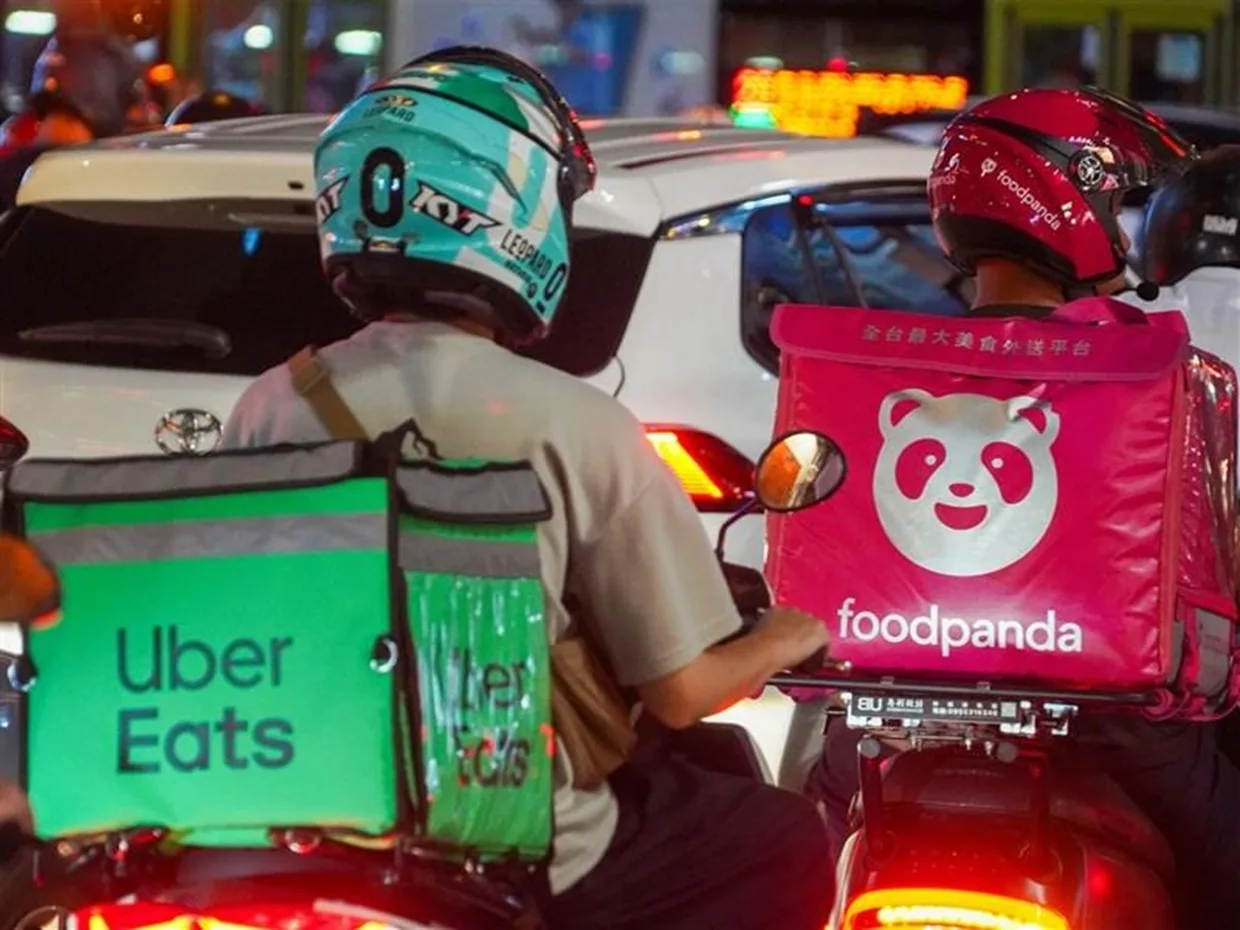
The market is largely organised around two major platforms: Foodpanda and Uber Eats.
Economists describe such a configuration as a duopoly.
In this environment, competition depends not only on the number of companies operating in the market but also on their willingness and ability to compete aggressively.
Platforms compete through commissions charged to restaurants, delivery fees paid by consumers, promotional discounts, working conditions offered to couriers and the quality of their services.
These competitive parameters directly affect the businesses and individuals dependent on their digital infrastructure.
Grab's proposed acquisition would not have mechanically reduced the number of platforms operating in Taiwan.
Unlike a merger between Foodpanda and Uber Eats, the transaction would have maintained two separate commercial networks.
This is precisely what makes the regulator's decision significant.
The FTC did not consider the continued existence of two brands sufficient to guarantee effective competition.
Instead, it examined the financial and historical relationships connecting the companies that would ultimately own those platforms.
Uber, the owner of one of Taiwan's two principal food delivery services, also holds a significant minority stake in Grab, which was seeking to acquire the other.
That ownership relationship is accompanied by historical governance links and commercial interactions between the two groups in other markets.
The Taiwanese regulator concluded that these connections could alter the economic incentives governing their competitive behaviour.
The question was no longer simply how many platforms would remain operational.
It was whether their owners would retain sufficient incentives to compete independently.
When a Shareholder Becomes a Competition Concern
The FTC's reasoning rests on a fundamental distinction between legal control and economic influence.
A company may hold only a minority stake in another business while retaining a financial interest in its profitability.
In Grab's case, Uber does not hold a controlling majority.
Its approximately 13.1% participation does not, by itself, give the American company the authority to direct Grab's operational decisions.
But the absence of legal control does not eliminate overlapping financial interests.
If Grab generated higher profits in Taiwan, Uber could indirectly benefit through the value of its investment.
Conversely, particularly aggressive competition by Uber Eats against Grab could undermine the profitability of a company in which Uber owns a substantial stake.
This creates a potential tension between two objectives: maximising the performance of one's own platform and preserving the value of an investment in a competitor.
Economic theory has long examined such situations through the concepts of cross-ownership and common ownership.
Shared financial interests do not necessarily imply coordination between companies.
They may, however, influence incentives to engage in price competition, offer promotional discounts or invest aggressively to gain market share.
The distinction is particularly important in platform industries.
Food delivery companies operate with significant logistical expenses, constrained margins and consumers who are often highly sensitive to prices and promotions.
In such circumstances, even relatively modest changes in competitive incentives can have meaningful consequences.
For the Taiwanese authorities, the commitments proposed by Grab to address Uber's potential influence and restrict sensitive information exchanges were insufficient to eliminate the identified risks.
The decision does not establish that Grab and Uber had engaged in unlawful coordination.
Instead, it reflects a forward-looking assessment of the competitive effects that could arise from the acquisition.
That distinction is essential.
Merger control exists precisely to prevent transactions from creating market structures capable of weakening competition, even before any anticompetitive conduct has occurred.
The Uber Precedent: Two Buyers, One Regulatory Obstacle
The history of Foodpanda in Taiwan gives the latest decision additional significance.
In May 2024, Uber announced plans to acquire Foodpanda's Taiwanese operations for $950 million.
That transaction followed a conventional horizontal consolidation strategy: an established market participant sought to absorb its principal competitor.
In December 2024, Taiwan's Fair Trade Commission rejected the acquisition because of concerns that it would substantially restrict competition.
The transaction was eventually abandoned in March 2025.
Two years later, Grab appeared to offer a different solution.
The proposed acquisition price was $350 million lower, representing a decline of approximately 37% compared with Uber's earlier offer.
More importantly, the prospective buyer did not already operate in Taiwan's food delivery market.
In principle, the transaction could therefore preserve the competitive structure that the earlier Uber acquisition threatened to eliminate.
Yet Uber's shareholding in Grab placed the American company at the centre of the regulatory assessment once again.
The two transactions were not legally equivalent.
In the first case, Uber sought direct ownership of its principal competitor.
In the second, Grab intended to acquire Foodpanda while retaining Uber as a significant minority shareholder.
Nevertheless, the regulatory outcomes reveal continuity in Taiwan's approach.
The authorities are seeking to preserve effective rivalry between the principal platforms, regardless of the legal arrangements through which ownership is organised.
For Delivery Hero, the consequences are particularly important.
A business may possess substantial economic value while becoming difficult to sell when the most commercially attractive buyers have direct or indirect relationships with existing competitors.
The universe of potential acquirers consequently narrows.
And that restriction can affect the price an asset can realistically command.
Delivery Hero and the Financial Cost of a Blocked Disposal
For Delivery Hero, the prohibition represents more than an operational setback.
The proposed sale formed part of a broader reassessment of the group's international portfolio.
The anticipated $600 million in proceeds was intended to support debt reduction and strengthen financial flexibility.
The Taiwanese decision therefore prevents the group, at least for now, from receiving funds associated with its financial restructuring strategy.
This does not mean that Foodpanda Taiwan has lost its underlying economic value.
The business retains its customers, restaurant partnerships, delivery network and operational prospects.
But the situation highlights an important distinction between the theoretical value of an asset and the value that can actually be realised through a transaction.
The first depends on operating performance, growth prospects, profitability and expected future cash flows.
The second also depends on the availability of credible buyers, their strategic motivations and their ability to secure the necessary regulatory approvals.
In highly concentrated markets, those conditions can become unusually restrictive.
An economically attractive asset may therefore possess limited transactional liquidity.
For a company seeking to reduce indebtedness, this constraint matters.
A delayed or prohibited disposal can alter the timetable for debt repayment, prolong exposure to markets that management intended to exit and increase the need for alternative financing arrangements.
Delivery Hero has indicated that the transaction agreements contain contractual protections, including a termination-related payment mechanism subject to specified conditions.
The existence of such provisions does not mean that compensation automatically becomes payable.
Their application depends on the contractual terms and the circumstances surrounding the transaction's failure.
The company may also pursue available legal remedies.
The financial uncertainty consequently extends across several dimensions: the future ownership of Foodpanda Taiwan, the possibility of identifying another buyer and the consequences for Delivery Hero's broader capital allocation strategy.
The case illustrates a recurring weakness in corporate restructuring plans.
A disposal may appear financially attractive on paper while remaining dependent on regulatory conditions that cannot be guaranteed.
Grab and the Limits of Acquisition-Led Expansion
For Grab, the rejection disrupts an international expansion strategy intended to establish a new source of growth.
The company had presented Taiwan as a natural extension of its technological and logistical capabilities.
The island's urban density, digital consumer habits and mature delivery market broadly corresponded to the characteristics of economies in which Grab had developed its business model.
The acquisition also offered opportunities to deploy existing technologies and operational expertise across an established commercial network.
Yet the case exposes a contradiction frequently encountered in the growth strategies of major digital platforms.
Companies pursue acquisitions because they offer immediate access to customers, transaction volumes and infrastructure.
But the most attractive targets are often those that already occupy strong competitive positions.
The more important those positions become, the more closely regulators examine the consequences of a change in ownership.
The composition of the buyer's shareholder base adds another layer of complexity.
An investment relationship that previously supported a company's development may subsequently constrain its ability to expand.
The links between Uber and Grab originated in the restructuring of their Southeast Asian operations in 2018.
At that time, Grab acquired Uber's regional businesses, while Uber received an equity stake in the Singaporean company.
The arrangement helped reshape Southeast Asia's mobility market.
Eight years later, the ownership relationship created by that transaction has become relevant to the assessment of an acquisition in a different geographical market.
The Taiwanese decision therefore illustrates the enduring strategic consequences of historical corporate transactions.
An acquisition or investment can influence a company's future freedom of action long after its immediate financial objectives have been achieved.
A Changing Risk Landscape for Mergers and Acquisitions
The Grab–Foodpanda case reflects a broader evolution in the assessment of corporate concentration.
Traditionally, investors and transaction advisers have focused on combined market shares, economies of scale, barriers to entry and the potential creation of dominant market positions.
These considerations remain essential.
But contemporary corporate structures require a more extensive examination of financial relationships, governance rights, information flows and the incentives connecting companies operating in the same industry.
The challenge is particularly pronounced in the digital economy.
Large platforms increasingly operate across multiple sectors, invest in other technology companies, establish strategic partnerships and share institutional investors.
These relationships do not inherently violate competition law.
They can nevertheless complicate assessments of genuine economic independence.
For prospective acquirers, this development increases the importance of regulatory due diligence before a transaction is announced.
The analysis can no longer be confined to the businesses directly controlled by the buyer and the target.
It must also consider significant minority shareholdings, historical commercial agreements, governance relationships and potential channels through which competitive behaviour could be influenced.
For sellers, the risk is equally financial.
An announced transaction may fail months after signing, consuming management resources, delaying restructuring programmes and disrupting the intended allocation of sale proceeds.
The negotiated purchase price is therefore only one component of the economic equation.
The probability of regulatory approval, the expected completion timetable and the contractual protections against transaction failure become essential elements of deal value.
This does not mean that every minority shareholding in a competitor should lead to the prohibition of an acquisition.
The assessment depends on market structure, ownership concentration, the relationships between the companies and the likely economic effects of the transaction.
Nevertheless, the Taiwanese decision confirms that the boundary between passive financial investment and competitive influence deserves increasing attention.
Regulatory Sovereignty in a Global Corporate Economy
Another dimension distinguishes this transaction.
The proposed acquisition involved two international groups: Grab, headquartered in Singapore, and Delivery Hero, based in Germany.
Yet a Taiwanese authority ultimately determined whether the transaction could proceed.
This illustrates the territorial reach of competition law.
An acquisition may be negotiated between foreign companies, financed internationally and structured through cross-border contractual arrangements.
But when it affects competition within a national market, it can fall under the jurisdiction of that market's regulatory authorities.
Regulatory power consequently becomes a decisive constraint on global consolidation strategies.
The implications extend beyond food delivery.
Similar considerations arise in telecommunications, digital infrastructure, semiconductors, energy, financial services and other strategically important industries.
In these sectors, companies may pursue industrial rationalisation or financial restructuring objectives that conflict with national priorities concerning competition and market access.
It would nevertheless be misleading to interpret Taiwan's decision automatically as an expression of economic protectionism.
The regulator's stated concerns relate to the potential restriction of competition arising from the relationship between Grab and Uber.
Protecting competition and protecting domestic companies are distinct objectives, governed by different economic and legal considerations.
In this case, the authorities' central concern is the preservation of effective rivalry between the two principal food delivery platforms.
The strategic consequence remains significant.
International companies may possess the financial resources and operational capabilities necessary to expand, yet their ambitions remain subject to regulatory decisions in each market they seek to enter.
Global capital does not eliminate national jurisdiction.
In some circumstances, it makes that jurisdiction more consequential.
When an Acquisition Fails Without an Apparent Merger of Competitors
The Grab–Foodpanda case offers an instructive illustration of the changing constraints governing international acquisitions.
It demonstrates that a transaction can possess a coherent financial rationale, offer credible industrial advantages and apparently preserve the number of competitors in a market without satisfying merger control requirements.
It also highlights the difference between the legal ownership of a company and the broader financial interests capable of influencing its economic behaviour.
For Grab, Uber's minority participation represents a legacy of regional expansion that now complicates a new international acquisition.
For Delivery Hero, the prohibition transforms a planned disposal intended to strengthen its balance sheet into an additional source of financial uncertainty.
For Taiwan, the decision reflects a determination to preserve competition in a market where two platforms account for most food delivery activity.
Beyond these individual interests, a more fundamental transformation is becoming visible.
Mergers and acquisitions can no longer be understood exclusively as transfers of ownership between buyers and sellers.
They take place within networks of shareholders, investments, partnerships and financial interests whose consequences can extend far beyond the formal boundaries of a transaction.
The globalisation of capital has multiplied these interdependencies.
Competition authorities are increasingly examining how they may affect market behaviour.
In this environment, owning part of a company can sometimes become almost as consequential as controlling it.
And a 13.1% minority stake can be enough to prevent a $600 million acquisition.
Main Sources
Taiwan Fair Trade Commission (FTC) — Official decision of October 21, 2026, prohibiting Grab's acquisition of Foodpanda Taiwan. Assessment of ownership relationships, Uber's minority participation and potential effects on competition.
Delivery Hero SE — Regulatory announcement, October 21, 2026, confirming the refusal of approval and outlining contractual protections and possible legal remedies.
Delivery Hero SE — Corporate announcement, March 23, 2026, concerning the proposed $600 million disposal of Foodpanda Taiwan and its role in the group's portfolio restructuring strategy.
Grab Holdings Limited — Corporate announcement, March 23, 2026, detailing the acquisition's strategic rationale, operational characteristics and expected financial contribution.
U.S. Securities and Exchange Commission (SEC) — Grab Holdings, Form 6-K, March 2026, concerning the proposed acquisition.
Central News Agency (Taiwan) — October 21, 2026, reporting on the Fair Trade Commission's decision and its assessment of the relationships between Grab and Uber.
Reuters — Reporting dated March 23 and October 21, 2026, covering the transaction's financial terms, strategic objectives and regulatory rejection.
Atlas Limits Research Desk
Atlas Limits’ editorial and analytical desk.