With a Roadster promising almost aerospace-level capabilities, Elon Musk is pushing Tesla toward a new technological frontier. Yet behind the spectacle lies a deeper industrial transformation: the company that once sought to democratize electric mobility is increasingly positioning itself around artificial intelligence, robotics, and extraordinary machines. This shift comes as China consolidates its position at the center of the global electric vehicle industry.
For years, Tesla embodied a relatively straightforward promise: to make electric cars desirable, powerful, and progressively affordable to a broader population. Elon Musk did not simply want to build different vehicles. He intended to transform a century-old industry, redefine automotive manufacturing, and accelerate the transition away from internal combustion engines. Nearly two decades after the original Roadster entered production, that ambition appears to have changed. Automobiles remain central to Tesla's identity, but they no longer necessarily occupy the same position in its founder's industrial vision.
The return of the Roadster, accompanied by technologies that appear closer to aerospace engineering than conventional automotive design, crystallizes this transformation. The Wall Street Journal has interpreted the vehicle's unveiling as evidence that Musk has moved away from designing cars for ordinary drivers. The assessment is deliberately provocative, but it raises a fundamental industrial question: is Tesla still seeking to transform the global automobile market, or is it increasingly using automobiles as technological platforms for ambitions extending far beyond personal transportation?
The distinction matters. A car capable of extraordinary acceleration, or even unconventional forms of propulsion, may represent a remarkable engineering achievement. It does not necessarily constitute progress in affordability, everyday mobility, or the energy transition. Spectacular innovation and mass-market industrial progress are not always the same thing.
From the People's Car to the Exceptional Machine
Tesla's original development strategy followed a relatively coherent industrial logic. The first Roadster, introduced in 2008, was intended to demonstrate that an electric vehicle could compete with high-performance sports cars. The revenue and technological experience generated by that initial product would then support the development of more affordable models. The Model S, followed by the Model 3 and Model Y, gradually transformed that strategy into a large-scale manufacturing operation.
This progression formed the foundation of the plan Musk outlined in 2006: begin with an expensive vehicle, reinvest the proceeds in a less expensive model, and continue toward broader accessibility. Tesla was not supposed to remain a luxury automobile manufacturer. Its ambition was to change the economic structure of electric mobility.
The results were substantial. The Model 3 and Model Y helped move electric vehicles beyond a niche market. In 2023, Tesla delivered approximately 1.81 million vehicles worldwide. The Model Y became one of the world's best-selling passenger vehicles across all powertrain categories, according to several industry rankings. Tesla had demonstrated that a manufacturer specializing in electric vehicles could achieve production volumes comparable to those of established automotive groups.
Yet that success created a new challenge. Once electric vehicles became mainstream industrial products, Tesla could no longer rely exclusively on its technological lead and brand recognition. It had to compete on pricing, manufacturing costs, product diversity, distribution networks, and the speed at which new models could be introduced.
This is precisely where Chinese manufacturers began to reshape the global competitive landscape.
China Takes the Lead in Industrialization
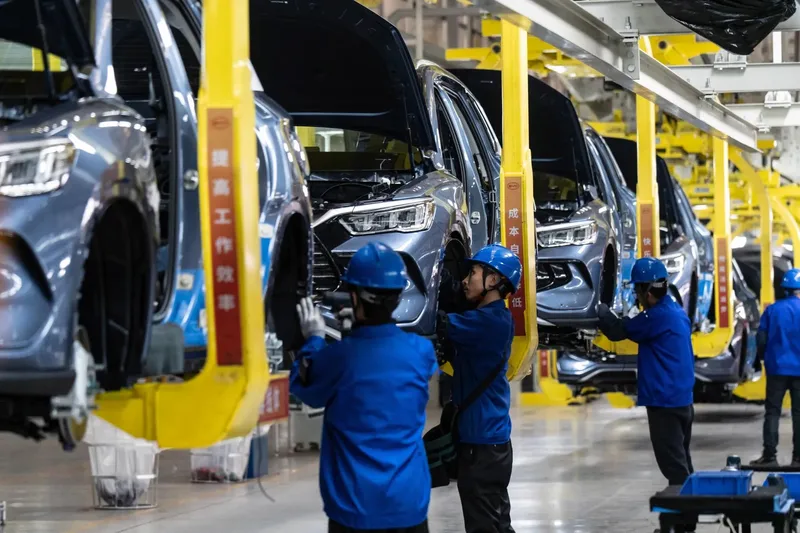
The rise of BYD and other Chinese manufacturers represents one of the most consequential transformations in the electric vehicle market since Tesla's emergence. China has not merely developed competing automotive brands. It has established an industrial ecosystem encompassing batteries, mineral processing, power electronics, embedded software, components, and vehicle assembly.
This vertical integration has fundamentally changed the terms of competition. Producing a technologically advanced electric vehicle is no longer sufficient. Manufacturers must be able to build it at scale, control production costs, secure supply chains, and continuously renew their product ranges.
According to the International Energy Agency, global electric car sales exceeded 17 million units in 2024, accounting for more than 20% of new passenger car sales. China represented more than 11 million of those sales, giving it a dominant position in the global market. These figures include both battery-electric vehicles and plug-in hybrids, categories that must be distinguished when comparing individual manufacturers.
BYD illustrates this evolution. In 2024, the Chinese group sold approximately 4.27 million new energy vehicles, including battery-electric and plug-in hybrid models. Tesla, whose automotive business is concentrated on fully electric vehicles, delivered approximately 1.79 million cars during the same year. The figures are therefore not directly comparable, but they reveal two increasingly different industrial strategies.
While Tesla seeks to preserve its identity as a technological pioneer, BYD is expanding across models, price segments, and geographic markets. Competition is no longer determined solely by battery performance or driving range. It increasingly depends on the ability to organize a comprehensive, cost-efficient, and accessible automotive manufacturing system.
This transformation presents Tesla with a dilemma. To maintain its position in mass-market automobiles, the company must invest in cost reductions, platform renewal, and a broader product portfolio. To pursue Musk's technological ambitions, it must simultaneously allocate substantial resources to artificial intelligence, autonomous driving, robotics, and computing infrastructure.
These trajectories are not necessarily incompatible. But they operate according to different economic timelines and industrial requirements.
The Roadster as a Technological Manifesto
The new Roadster occupies a distinctive position in this transformation. First presented in November 2017, it was initially expected to enter production in 2020. Tesla announced acceleration from zero to 60 miles per hour in 1.9 seconds, a top speed exceeding 250 miles per hour, and a projected driving range of 620 miles, or nearly 1,000 kilometers.
Those specifications, particularly ambitious at the time, were designed to demonstrate the potential superiority of electric propulsion over conventional internal combustion technology.
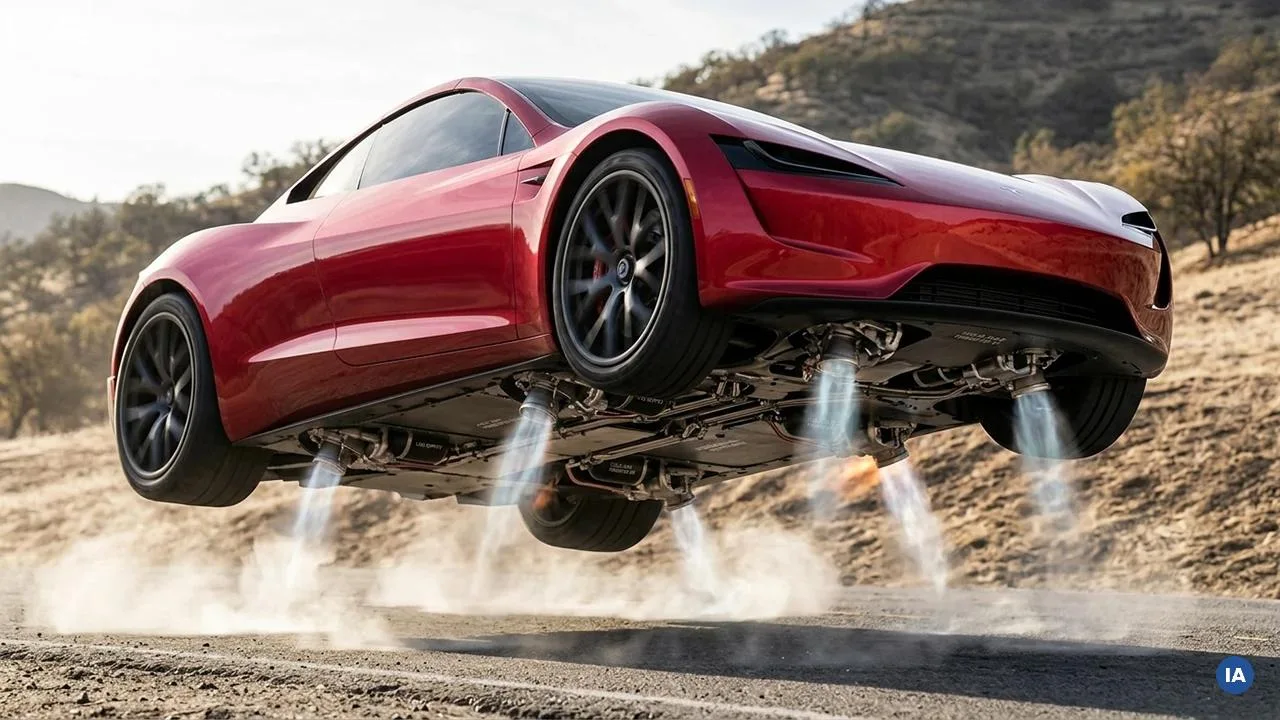
Musk's subsequent statements pushed the project into more spectacular territory. The possibility of incorporating cold-gas thrusters inspired by SpaceX technologies, potentially improving acceleration and producing limited airborne movement, transformed the Roadster into a hybrid concept positioned between a high-performance automobile and an aerospace demonstrator.
The October 2026 unveiling reinforced this direction. The demonstration presented the Roadster not merely as an exceptionally fast electric car but as a vehicle intended to challenge conventional assumptions about what an automobile can do.
Nevertheless, an important distinction remains between controlled demonstrations, technical claims, and commercially validated capabilities. Limited airborne movement does not establish that a vehicle can operate as a practical flying car. Sustained flight, stability, safety, certification, and operation on public roads raise considerably more complex engineering and regulatory questions.
The Roadster's industrial significance therefore extends beyond whether it can briefly leave the ground. It lies in what Tesla has chosen to demonstrate.
The vehicle is no longer simply presented as a technological precursor to innovations that will eventually become affordable. It also functions as a declaration of technological power, reinforcing the idea that Tesla remains capable of designing machines outside the conventional automotive imagination.
This strategy may strengthen the symbolic value of the brand. It may also widen the gap between Tesla's technological identity and the practical needs of the global automobile market.
The Automobile Becomes Part of a Larger Project
The strategic shift becomes clearer when examining the other businesses Musk increasingly emphasizes. Autonomous driving, robotaxis, the Optimus humanoid robot, and artificial intelligence infrastructure have become central elements of Tesla's long-term narrative.
Under this vision, a car is no longer merely a durable consumer product. It becomes a mobile computing platform equipped with sensors, processors, and software capable of interacting with its environment. Its economic value could increasingly depend on its digital capabilities rather than its mechanical characteristics alone.
The underlying argument is ambitious. A conventional automobile manufacturer sells vehicles, provides maintenance, and develops related services. A company capable of mastering autonomous driving could theoretically operate transportation fleets, license software, monetize mobility services, and transfer technological capabilities into robotics.
But this transition depends on several assumptions that remain uncertain.
Autonomous driving systems must reach sufficiently high levels of reliability to operate in complex environments. Regulators must establish frameworks compatible with their deployment. Hardware and infrastructure costs must support profitable operations. Consumers must also become comfortable relying on systems whose performance continues to face technological limitations.
Humanoid robotics presents comparable difficulties. Public demonstrations can establish certain capabilities, but they do not independently prove that profitable, large-scale industrial production is achievable.
Tesla is therefore attempting to shift its economic center of gravity toward potentially enormous markets whose commercial maturity remains less established than that of conventional automobiles.
This repositioning may prove to be an exceptionally successful act of strategic anticipation. It may also represent a substantial industrial risk.
The Paradox of Democratization
The contradiction becomes particularly visible when measured against Tesla's original promise.
The company played a major role in making electric vehicles credible. It demonstrated that electric cars could combine strong performance, practical driving range, and integrated software. It also pushed established manufacturers to accelerate their own investments.
Yet the effective democratization of electric mobility now depends on factors extending far beyond technological performance: purchase prices, battery availability, charging infrastructure, financing conditions, maintenance costs, taxation, and household purchasing power.
In these areas, the most consequential innovation is not necessarily the one producing the fastest vehicle. It may instead be the one that reduces manufacturing costs by several thousand dollars, extends battery life, or makes it possible to produce hundreds of thousands of additional vehicles.
China has concentrated a significant share of its industrial efforts on precisely these objectives.
Tesla, meanwhile, retains considerable advantages: a globally recognized brand, extensive experience in electric vehicle manufacturing, an established charging network, and substantial expertise in embedded software. It would therefore be excessive to conclude that the company has abandoned mainstream automobiles.
Its stated priorities nevertheless suggest a changing conception of economic value. Affordable electric mobility was once the central industrial objective. It now coexists with a broader ambition to develop autonomous systems capable of transforming transportation, labor, and the organization of economic activity.
The distinction is fundamental. In the original model, technology was developed to democratize a product. In the emerging model, the product also serves as a platform for developing and commercializing technology.
A New Frontier for Automotive Capitalism
Tesla's transformation reflects a broader evolution in technological capitalism. The most highly valued companies are not necessarily those producing the greatest physical volumes. They are often those investors believe can control platforms, software ecosystems, infrastructure, or future markets.
This logic helps explain Tesla's distinctive financial position. Its market valuation has frequently exceeded what automotive sales alone might justify when compared with traditional manufacturers. Investors are not simply pricing the vehicles the company sells. They are also incorporating expectations concerning autonomous driving, artificial intelligence, energy systems, and robotics.
The spectacular Roadster contributes to this economy of expectations. It reinforces the image of a company operating at the intersection of several technological revolutions.
But financial markets and industrial markets operate on different timelines.
A technological promise can sustain investor enthusiasm for an extended period. It cannot eliminate the need to manufacture products, generate sales, control costs, and maintain profitability. As competition intensifies in electric vehicles, Tesla must demonstrate that it can preserve its automotive competitiveness while financing its ambitions in emerging sectors.
The question therefore extends beyond the future of one manufacturer. It concerns whether a company can simultaneously sustain two economic identities: that of a mass-market automotive producer and that of a technology enterprise whose valuation depends substantially on future possibilities.
Industrial history shows that such transitions can produce dominant corporations. It also shows that they can disperse resources, complicate strategic priorities, and weaken the businesses that originally made a company successful.
The Future Is Not Measured by Speed Alone
The Roadster ultimately embodies a paradox. The vehicle that once helped establish the path toward affordable electric mobility has returned as the symbol of exceptional technology. What originally represented the first stage of a democratization process may now express a strategy built around extreme technological differentiation.
Meanwhile, the transformation of the global automobile market continues through Chinese factories, battery supply chains, manufacturing platforms, and international distribution networks. It advances less through spectacular demonstrations than through the accumulation of industrial improvements, productivity gains, and declining production costs.
Tesla can still play a central role in this transformation. Its experience, infrastructure, and technological capabilities give it considerable resources. But the company increasingly appears determined to compete on another frontier, where automobiles are only one component of a broader system combining artificial intelligence, autonomy, and robotics.
That ambition could open an entirely new industrial cycle. It could also leave other manufacturers to fulfill the promise that helped establish Tesla in the first place: making electric mobility genuinely accessible to a much larger share of the world's population.
The real turning point, then, may not be that a Tesla could one day leave the ground. It is that, just as electric mobility becomes a global mass-market industry, its most emblematic pioneer appears increasingly focused on a horizon beyond the road.
Main Sources
- Tesla — The Secret Tesla Motors Master Plan (just between you and me), Elon Musk, August 2, 2006; original next-generation Roadster presentation, November 2017; annual reports for 2023 and 2024.
- International Energy Agency (IEA) — Global EV Outlook 2025, global electric vehicle sales, market development, and China's position in the automotive industry.
- BYD — Official communications and annual sales figures for new energy vehicles in 2024.
- The Wall Street Journal — Analysis of the Roadster unveiling and Tesla's technological repositioning, shared on X in October 2026. The full article was not independently reviewed for this analysis.
- Tesla — Public presentations and corporate communications concerning autonomous driving, robotaxis, and the Optimus humanoid robotics program.
Atlas Limits Research Desk
Atlas Limits’ editorial and analytical desk.