With the launch of TorchNeuron, Amazon Web Services is seeking to dismantle one of the main barriers to the adoption of its Trainium processors: developers’ dependence on Nvidia’s software ecosystem. Behind this technical initiative lies a major industrial confrontation in which control over software could become just as decisive as semiconductor performance.
Atlas Limits | Technology · Industry · Artificial Intelligence | October 20, 2026
Introduction — Nvidia’s Dominance Is Not Built on Chips Alone
For several years, the global competition surrounding artificial intelligence has been portrayed primarily as a race for computing power.
Technology companies have placed enormous orders for graphics processing units, data centers have absorbed unprecedented levels of investment, and governments have increasingly incorporated advanced semiconductors into their industrial sovereignty strategies.
At the center of this transformation stands one American company: Nvidia.
Yet its dominance cannot be explained exclusively by the performance of its graphics accelerators. It rests on a much deeper industrial architecture combining processors, software libraries, programming tools, interconnection systems, and computing infrastructure.
This integration represents one of Nvidia’s most significant competitive advantages.
A company developing artificial intelligence models within this environment is not simply selecting a hardware supplier. It is gradually adopting an entire collection of tools, practices, and optimizations that make migration toward competing architectures increasingly complex.
This is precisely the dependency Amazon is now attempting to weaken.
With TorchNeuron, Amazon Web Services (AWS) is pursuing an ambition that extends beyond selling its Trainium processors: making those processors more accessible to developers accustomed to working with PyTorch and, indirectly, with computing environments dominated by Nvidia.
The stakes are considerable.
If companies can transfer artificial intelligence applications from one hardware architecture to another without undertaking expensive software rewrites, part of Nvidia’s economic power could be challenged.
The battle for artificial intelligence would then enter a new phase: the erosion of software lock-in.
I. Nvidia: A Dominant Position Built Over Decades
Understanding the significance of Amazon’s initiative requires examining the foundations of Nvidia’s industrial strength.
Graphics processing units were originally developed to accelerate image rendering and the calculations required by visual applications.
Their parallel processing capabilities subsequently made them particularly suitable for other forms of intensive computation, including machine learning.
Nvidia recognized relatively early that manufacturing powerful processors would not be sufficient to establish a durable competitive position.
In 2006, the company introduced CUDA, a platform allowing developers to harness the computing capabilities of its GPUs for applications extending beyond graphics.
That decision fundamentally altered Nvidia’s industrial trajectory.
CUDA gradually became a programming environment around which scientific libraries, optimization tools, software frameworks, and professional expertise developed.
When deep learning began expanding rapidly, Nvidia already possessed a particularly mature software infrastructure.
Researchers and engineers could therefore rely on existing tools rather than rebuild their computing environments from the ground up.
This initial advantage strengthened over time.
Each new generation of processors benefited from a software environment that was already widely adopted. Each new application, in turn, reinforced the attractiveness of that environment.
The result was a classic mechanism of industrial economics: indirect network effects.
The more developers use an architecture, the more numerous and sophisticated its supporting tools become. The more those tools improve, the more attractive the architecture becomes.
Nvidia’s dominance is therefore not simply a question of technical performance.
It also represents a form of cumulative technological dependence.
II. CUDA: Nvidia’s Real Industrial Fortress
Processor performance can be measured through several indicators: computing capacity, memory bandwidth, power consumption, and energy efficiency.
These characteristics make it possible to compare hardware architectures.
But they are insufficient to determine the actual cost of operating artificial intelligence infrastructure.
A company training or deploying a model must also consider its engineers’ expertise, software library compatibility, the stability of development environments, and maintenance costs.
A competing processor may offer a lower purchase price or superior energy efficiency without necessarily being economically preferable if adopting it requires months of engineering work.
This is where CUDA functions as a barrier to entry.
Developers do not necessarily work directly with CUDA. They frequently use higher-level frameworks such as PyTorch, which rely on libraries and execution mechanisms optimized for Nvidia GPUs.
The dependency may therefore be indirect, but it remains substantial.
It becomes particularly apparent when applications rely on custom operations, specialized libraries, optimized computing kernels, or communication mechanisms between accelerators.
Migrating to a competing architecture may require modifying sections of code, replacing software components, and validating model performance again.
These switching costs represent a major economic advantage for the incumbent supplier.
They allow Nvidia to defend its position even when competitors introduce technically competitive accelerators.
Amazon’s objective is to reduce this friction.
It is not necessarily attempting to replace CUDA across every function. Instead, it is seeking to reduce the number of situations in which dependence on Nvidia’s software environment prevents the adoption of another architecture.
This distinction is fundamental.
A company may retain its familiar development environment while running certain workloads on different processors.
If that possibility becomes sufficiently simple, reliable, and economically attractive, the relationship between software and hardware could begin to change.
III. TorchNeuron: Amazon Targets the Cost of Migration
The announcement of TorchNeuron fits directly into this strategy.
AWS is seeking to simplify the use of its Trainium accelerators for developers working with PyTorch, one of the leading machine-learning frameworks.
The objective is to minimize the modifications required to execute certain applications on Amazon’s hardware infrastructure.
The significance of this initiative lies less in the appearance of another software tool than in the industrial problem it seeks to solve.
Until now, alternatives to Nvidia GPUs have frequently encountered the same difficulty: adopting them required integration efforts that could offset part of their economic advantages.
By improving compatibility with existing development practices, Amazon is attempting to change the terms of the purchasing decision.
The question would no longer be merely whether a company can technically migrate to Trainium, but whether doing so makes economic sense.
This development could intensify competition across several dimensions: cost per request, processing throughput, energy consumption, computing capacity availability, and performance on specific models.
AWS has highlighted the experience of Deepgram, a company specializing in voice technologies, which reported improvements reaching 70% in the amount of audio processed per dollar following migration to Trainium in certain configurations.
This result illustrates the potential economic benefits of Amazon’s approach, but it requires careful interpretation.
It concerns a particular application and configuration. It does not establish that Trainium is systematically faster or cheaper than Nvidia GPUs across all workloads.
Similarly, simplifying the execution of a PyTorch program does not mean that every specialized operation automatically becomes compatible.
Performance depends on numerous factors, including model architecture, batch size, numerical precision, available memory, interprocessor communication, and compiler maturity.
The real success of TorchNeuron will therefore need to be assessed through a sufficiently diverse range of production deployments.
Nevertheless, the strategic direction is clear.
Amazon is attempting to remove some of the software obstacles protecting Nvidia’s position.
And this offensive comes at a time when computing costs are becoming a central issue in the economics of artificial intelligence.
IV. Trainium: Amazon’s Ambition to Control Its Own Infrastructure
Amazon’s strategy forms part of a broader transformation that began years ago in the digital infrastructure industry.
For decades, major cloud providers primarily purchased their processors from specialized suppliers.
Intel and AMD dominated central processing units, while Nvidia progressively established itself in graphics acceleration.
This organization reflected a relatively clear division of responsibilities: semiconductor manufacturers designed components, while cloud operators built the infrastructure required to deploy them.
The explosion in artificial intelligence computing requirements has gradually disrupted that balance.
Investment in accelerators has become sufficiently large to justify the development of proprietary alternatives.
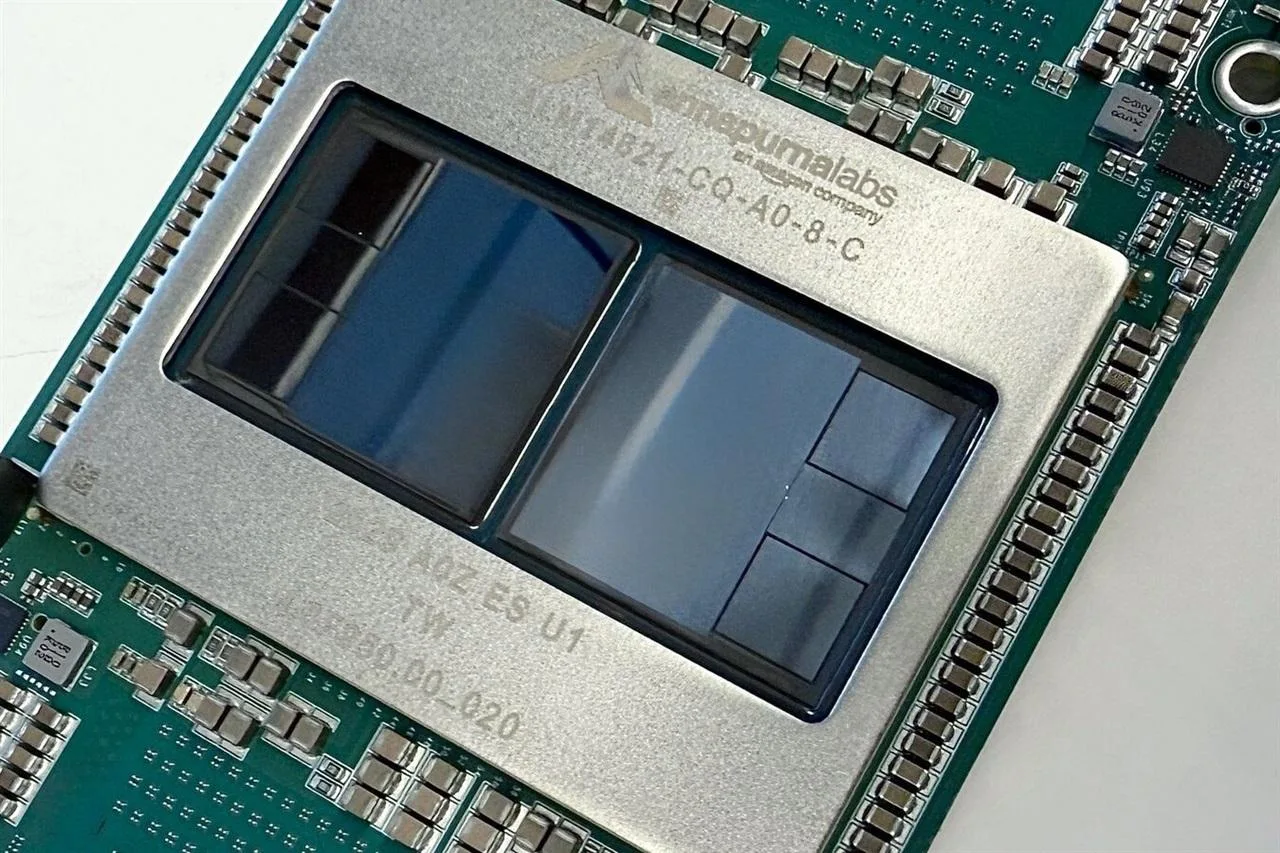
Amazon had already begun moving in this direction with its acquisition of Annapurna Labs in 2015.
That acquisition helped establish an internal semiconductor design capability, now supporting several processor families.
Graviton chips address general-purpose computing requirements, while Inferentia and Trainium were developed for artificial intelligence applications.
With Trainium, Amazon is seeking to control an increasing proportion of the technological value chain connecting silicon to cloud services.
The company can design accelerators suited to its requirements, integrate them into its data centers, optimize their operation, and sell computing capacity directly to customers.
This vertical integration offers several potential advantages.
It can reduce exposure to external suppliers’ pricing, improve coordination between hardware and software, and enable economic optimization across entire infrastructure systems.
But it also introduces a major challenge.
A proprietary processor does not automatically become an attractive industrial platform.
It must be capable of running the applications developers actually want to deploy.
TorchNeuron therefore appears to be an essential complement to Amazon’s hardware strategy.
The software is intended to transform Trainium from a specialized solution within AWS into an architecture more accessible to the broader PyTorch developer community.
Its release under the Apache 2.0 open-source license, announced in October 2026, reinforces that ambition. TorchNeuron supports Trainium2 and Trainium3 and builds on PyTorch’s hardware extension mechanisms.
However, software openness must be distinguished from infrastructure openness.
TorchNeuron’s code may be accessible and modifiable, while Trainium processors remain integrated into AWS’s hardware and commercial environment.
Open software can therefore facilitate the adoption of a proprietary platform.
This apparent paradox lies at the heart of Amazon’s strategy.
V. The New Economics of AI: Inference Costs Become Decisive
The economics of artificial intelligence are no longer limited to training increasingly powerful models.
A second industrial phase is expanding: operating those models at scale.
Training refers to the process of developing a model through data and intensive computation.
Inference refers to its operational use, when it generates text, analyzes images, processes audio, or responds to requests.
These two activities have different economic structures.
Training generally requires substantial computing resources over relatively concentrated periods.
Inference, by contrast, can generate continuous computing demand proportional to the number of users and the complexity of their requests.
For a service used millions of times each day, even a relatively modest reduction in unit costs can produce considerable savings.
Consider a purely illustrative example.
A company processes 100 million artificial intelligence requests daily at an average computing cost of $0.01 per request.
Its theoretical annual expenditure reaches $365 million.
A 25% reduction in unit costs would therefore represent potential annual savings of $91.25 million, assuming constant volumes and excluding migration costs.
This example is not an estimate of Trainium’s performance. It simply demonstrates how sensitive large-scale AI services are to changes in computing costs.
This economic logic explains why competition between accelerators could intensify as artificial intelligence becomes a recurring industrial activity.
For service operators, absolute performance is not always the dominant criterion.
The cost per unit of useful computation may become more important than theoretical peak processing power.
This development potentially favors specialized architectures optimized for particular categories of models or calculations.
But it does not guarantee their success.
An accelerator that is economical for one application may prove less competitive for another.
Flexibility, library availability, and deployment simplicity therefore retain considerable value.
That is why Amazon’s software offensive is as important as its investment in processors.
It seeks to make meaningful economic comparisons possible.
VI. Deepgram: A Promising Demonstration, but Not Yet Universal Proof
Deepgram’s experience illustrates both the potential and the limitations of this strategy.
The company develops voice-processing technologies, including transcription and audio analysis.
These applications can generate enormous computing volumes, making operating costs particularly sensitive to accelerator efficiency.
According to a technical study published by AWS on October 19, 2026, migrating the Nova-3 model to Trainium2 produced improvements ranging from 11% to 70% in audio throughput per dollar for certain batch-processing configurations compared with previously used setups.
In a statement published by PyTorch, Deepgram’s chief technology officer referred to an improvement of approximately 60% in the evaluated benchmarks.
These figures reflect different comparison parameters.
However, it would be misleading to present these gains as the automatic result of a simple configuration change.
The technical study describes several months of work involving model adaptation, computing-kernel optimization, performance analysis, and the development of a suitable execution environment.
In other words, TorchNeuron may simplify the initial migration process, but achieving the best performance can still require substantial engineering.
This distinction reveals Amazon’s real challenge.
Functional compatibility is a necessary condition.
Sustainable economic competitiveness will depend on the ability to reproduce such results across numerous, complex, and continuously evolving models.
For large enterprises, infrastructure decisions rarely depend on an isolated benchmark.
They incorporate system reliability, development costs, equipment availability, contractual commitments, and the risks associated with technological dependence.
TorchNeuron potentially reduces one of these constraints.
It does not eliminate all of them.
VII. Google, AMD, and Other Competitors: Nvidia Faces a Collective Challenge
Amazon is not the only company seeking to reduce the industry’s dependence on Nvidia accelerators.
Google has been developing its Tensor Processing Units, or TPUs, for several years.
These specialized processors were designed for mathematical operations used in machine learning.
Google consequently possesses both internal hardware design capabilities and a cloud platform through which those processors can be commercialized.
AMD, meanwhile, is seeking to establish an alternative in the accelerator market through its Instinct product family and ROCm software environment.
Competition therefore concerns hardware and the software tools required to operate it.
Other companies are also exploring specialized architectures adapted to particular workloads.
But their competitive strategies are not identical.
AMD is primarily seeking to offer a hardware alternative to Nvidia GPUs, supported by a software stack designed for accelerated computing.
Google is developing an architecture integrated into its own infrastructure.
Amazon combines chip design, cloud distribution, and improved compatibility with frameworks already used by developers.
This diversity matters.
It demonstrates that the challenge to Nvidia is not a single confrontation between two manufacturers.
It is the result of multiple competing architectures backed by companies possessing considerable financial, technical, and commercial resources.
The market could therefore become increasingly fragmented.
Certain processors might be preferred for training enormous models, others for large-scale inference, and still others for specialized applications.
The dominance of a single supplier would become less inevitable if software tools made it easier to distribute workloads across several architectures.
But this development depends on one condition: interoperability must become sufficiently mature to reduce fragmentation costs.
Otherwise, the industry could simply replace one dominant dependency with several incompatible environments.
VIII. Amazon’s Paradox: Freeing Developers from Nvidia to Attract Them to AWS
Amazon’s offensive raises a fundamental question.
Does reducing dependence on Nvidia necessarily increase companies’ technological independence?
Not entirely.
Amazon is attempting to make applications easier to transfer to Trainium.
But these processors are offered within its cloud infrastructure.
A company migrating to Trainium may reduce its dependence on Nvidia hardware while increasing its commercial dependence on AWS.
This situation illustrates a broader transformation of the digital industry.
Cloud providers no longer merely rent computing capacity.
They design hardware components, develop software environments, organize networks, operate data centers, and commercialize the resulting services.
The boundary between semiconductor manufacturer, infrastructure operator, and platform provider is becoming increasingly difficult to distinguish.
Amazon can therefore compete with Nvidia in part of its business while continuing to offer cloud instances powered by Nvidia processors.
There is nothing contradictory about this coexistence.
AWS customers have heterogeneous requirements, and Amazon benefits from offering multiple architectures to preserve the overall attractiveness of its platform.
Its objective is therefore not necessarily to eliminate Nvidia.
A more rational strategy may be to reduce AWS’s structural dependence on a single supplier, strengthen its negotiating position, and capture a larger share of the value generated by artificial intelligence infrastructure.
TorchNeuron’s open-source approach must be understood within this framework.
It potentially increases freedom of choice between computing architectures without guaranteeing equivalent freedom between cloud platforms.
The distinction between software portability and infrastructure independence therefore becomes essential.
IX. Nvidia Retains Advantages TorchNeuron Cannot Immediately Eliminate
It would be premature to interpret this announcement as the beginning of Nvidia’s inevitable decline.
The company retains several structural advantages.
The first is the maturity of its software ecosystem.
CUDA benefits from many years of development, optimization, and adoption.
Specialized libraries, profiling tools, and communication mechanisms between GPUs form an integrated environment that is difficult to reproduce quickly.
The second advantage concerns systems integration.
Modern infrastructure performance does not depend exclusively on individual processors.
It also depends on interconnections, memory, networking, and software capable of coordinating thousands of accelerators.
Nvidia has progressively expanded into these different components.
The third advantage is operational confidence.
Large enterprises operating critical models frequently favor architectures whose performance and reliability have already been demonstrated at scale.
Even when an alternative offers a theoretical economic advantage, adoption may be delayed by validation requirements.
Finally, Nvidia maintains a particularly strong position among developers and companies working on the most advanced models.
Software innovations frequently appear first in environments supported by the most widely deployed hardware resources.
This dynamic continues to reinforce the attractiveness of its ecosystem.
TorchNeuron therefore does not eliminate Nvidia’s dominance.
It seeks to weaken one of its foundations.
The distinction is important: challenging a barrier to entry does not automatically mean capturing the market share that barrier protects.
X. An Industrial Battle Extending Beyond Semiconductors
The confrontation between Amazon and Nvidia also has a macroeconomic dimension.
Artificial intelligence has become a major driver of investment in digital infrastructure.
Data center construction mobilizes enormous amounts of capital, electrical equipment, cooling systems, communication networks, and global supply chains.
Accelerator availability is one of the factors driving this expansion.
But processor costs represent only one component of the equation.
Access to electricity, grid capacity, construction timelines, and environmental constraints also influence project profitability.
In this context, improving the economic efficiency of computing can generate consequences extending well beyond the semiconductor industry.
If an architecture makes it possible to perform more useful computation with a given quantity of resources, it can improve the profitability of existing infrastructure.
It can also change investment decisions between constructing new data centers and optimizing installed capacity.
However, efficiency must be distinguished from an absolute reduction in consumption.
Lower computing costs can encourage more intensive use of artificial intelligence.
Increasing demand may then absorb some or even all of the efficiency gains.
This phenomenon, similar to the rebound effect observed in other industries, represents an important variable in the energy economics of AI.
Competition between accelerators could therefore simultaneously reduce the unit cost of computation and accelerate the overall expansion of infrastructure.
The industrial question is not limited to identifying who will sell the processors.
It also concerns how improvements in computing productivity will spread throughout the real economy.
XI. Three Possible Trajectories for the Accelerator Market
Over the medium term, several developments are conceivable.
Scenario One — Nvidia Retains Structural Dominance
Alternatives continue to improve, but software advantages, systems performance, and established development practices continue to favor Nvidia.
Trainium secures a position in selected workloads without fundamentally transforming the structure of the market.
Amazon improves its economics across certain infrastructure categories, but Nvidia retains its central role in advanced computing.
Scenario Two — A Multipolar Market Emerges
Software portability improves.
Companies increasingly use multiple architectures according to their requirements.
Nvidia maintains a central position in certain segments, while Amazon, Google, and AMD gain ground elsewhere.
Infrastructure decisions become more dependent on economic comparisons between platforms.
Competition gradually shifts toward operating costs and the quality of software environments.
Scenario Three — Cloud Giants Capture an Increasing Share of Value
Proprietary architectures become sufficiently competitive for a significant proportion of applications.
Major cloud operators internalize more hardware design and strengthen their control over the economics of computation.
Under this scenario, competition does not disappear.
Instead, it reorganizes around integrated platforms capable of controlling processors, software, and computing-capacity distribution simultaneously.
These scenarios are not mutually exclusive.
Nvidia could retain a dominant position in the most advanced systems while proprietary cloud processors expand rapidly in inference.
The market could therefore experience increasing segmentation rather than the abrupt replacement of its dominant supplier.
Such an evolution would be consistent with the history of other technology industries, in which general-purpose architectures have gradually coexisted with specialized solutions.
The determining variable will remain total cost of ownership.
A processor will only be competitive if its hardware advantages can be exploited through a sufficiently stable, accessible, and efficient software environment.
XII. The Indicators That Will Determine Amazon’s Success
The announcement of TorchNeuron marks an important step, but it does not yet establish that the market is undergoing a structural transformation.
Several indicators will need to be monitored over the coming quarters.
The first is the actual adoption of TorchNeuron by developers and enterprises.
The number of experiments matters less than the number of applications deployed and operated sustainably in production.
The second is the breadth of compatibility.
The key question will be whether recent models, specialized libraries, and emerging optimization methods can run on Trainium without disproportionate adaptation efforts.
The third is economic competitiveness measured across comparable workloads.
Benchmarks must account not only for instance pricing but also for actual throughput, performance, migration costs, and engineering resources.
The fourth is Amazon’s ability to maintain its software at the pace of PyTorch development.
The artificial intelligence ecosystem evolves rapidly. Compatibility that is satisfactory today may become insufficient if new models and tools are not supported quickly.
Finally, Nvidia’s response will be decisive.
The company can react through additional software optimizations, hardware improvements, more attractive commercial offerings, or deeper integration with cloud providers.
Competitive dynamics will therefore depend as much on Amazon’s progress as on the incumbent supplier’s ability to adapt.
Conclusion — The AI Battle Enters the Age of Portability
The announcement of TorchNeuron does not represent an immediate disruption of Nvidia’s industrial dominance.
It nevertheless reveals an important strategic development.
For several years, accelerator performance has been one of the principal factors differentiating the artificial intelligence market.
That performance remains essential, but it is no longer sufficient to explain competitive dynamics.
Software, migration costs, infrastructure availability, and cloud-service integration are becoming central elements of competition.
Amazon understands this shift.
By facilitating the execution of PyTorch applications on Trainium, AWS is seeking to weaken the historical relationship between model development and the use of Nvidia processors.
The success of this strategy is not guaranteed.
It will depend on software maturity, real-world performance, developer adoption, and Amazon’s ability to offer an economically credible alternative.
But the underlying industrial movement is already visible.
Major cloud operators no longer want to depend exclusively on semiconductor manufacturers to determine the cost and capabilities of their infrastructure.
They want to design their own architectures, control more of their value chains, and provide developers with sufficiently familiar environments to encourage adoption.
The result could be a gradual transformation of the accelerator market, moving from dominance structured largely around a single ecosystem toward competition between several integrated platforms.
This evolution does not necessarily mean the end of Nvidia’s power.
It could, however, change the conditions under which that power is exercised.
The real significance of TorchNeuron is not whether Amazon can manufacture competing processors. It is whether Nvidia can continue to benefit from such a decisive software advantage once artificial intelligence applications become easier to transfer between hardware architectures.
In the AI industry, the next major battle will not be fought solely over chip performance.
It will be fought over the freedom — real or apparent — to choose the processors that run the software.
Sources and References
- PyTorch, Introducing TorchNeuron: Native PyTorch Backend for AWS Trainium, October 19, 2026. https://pytorch.org/blog/introducing-torchneuron-native-pytorch-backend-for-aws-trainium/
- Amazon Web Services, How Deepgram Optimized Voice AI at Scale with AWS Trainium, October 19, 2026. https://aws.amazon.com/blogs/machine-learning/how-deepgram-optimized-voice-ai-at-scale-with-aws-trainium/
- Hugging Face, TorchNeuron: Running HF Models on AWS Trainium, October 2026. https://huggingface.co/blog/hf-torchneuron
- Reuters, Amazon Challenges Nvidia with PyTorch-Compatible AI Chips, October 19, 2026.
- AWS Neuron, TorchNeuron Technical Documentation and Release Notes. https://awsdocs-neuron.readthedocs-hosted.com/en/latest/release-notes/components/torchneuron.html
Atlas Limits — Technology, Economic and Industrial Analysis.
Atlas Limits Research Desk
Atlas Limits’ editorial and analytical desk.