In Orvieto, the Palazzo del Capitano del Popolo has witnessed enough history to remain largely unmoved by the shifting currents of Italian politics. Yet on September 20, 2026, the scene unfolding inside it reached somewhat beyond Rome. Roberto Vannacci, founder of Futuro Nazionale, was looking towards Alternative für Deutschland. Its programme, he argued, was fairly similar to his own; the two movements had much in common and sat in the same group in the European Parliament. German MEP Marc Jongen had also come to Orvieto. Around them, Gianni Alemanno spoke of European sovereigntism and sought to bring together political families that, in their respective countries, promise precisely to return to the nation some of the power transferred to the European level.
The contradiction is almost too perfect. To defend the primacy of the nation, it is now necessary to cross borders. To reduce the power of Brussels, it is necessary to organise in Brussels. To restore the capacity of states to decide for themselves, German, Italian, French, Dutch or Spanish allies must be found who can exert influence together within common institutions.
Orvieto does not necessarily foreshadow a lasting alliance. The parties commonly grouped under labels such as sovereigntist, nationalist or populist right diverge substantially over Russia, Ukraine, NATO, economic policy, the role of the state and, at times, their own neighbours. On the very same day, a controversy over South Tyrol offered a reminder of how simple sovereignty can appear in the abstract and how complicated it becomes when it encounters territory. Asked about possible German territorial claims, Jongen rejected them and consigned such questions to the past. The nation can travel as an idea; its borders cannot.
What makes Orvieto interesting, then, is not the hypothetical birth of a new political international. It is the paradox that compels these movements to seek one.
Europe has integrated its economies, rules, infrastructure and parts of its decision-making to such an extent that even those who want to renationalise some of that power are forced to think at continental scale. Having Europeanised markets and rules, the Union has ended up Europeanising even some of its opposition.
This tells us something deeper than an electoral shift to the right. It reveals that Europe is once again debating questions it had gradually ceased to regard as questions at all. For a generation, integration, open trade, the fading of internal borders, the globalisation of production and the American alliance became less a political programme than an environment. Their pace, excesses and implementation could be contested without necessarily challenging their general direction.
That is no longer entirely true.
And when an era has to begin justifying again what it once regarded as self-evident, something of that era is usually already beginning to disappear.
The order that ceased to look like a doctrine
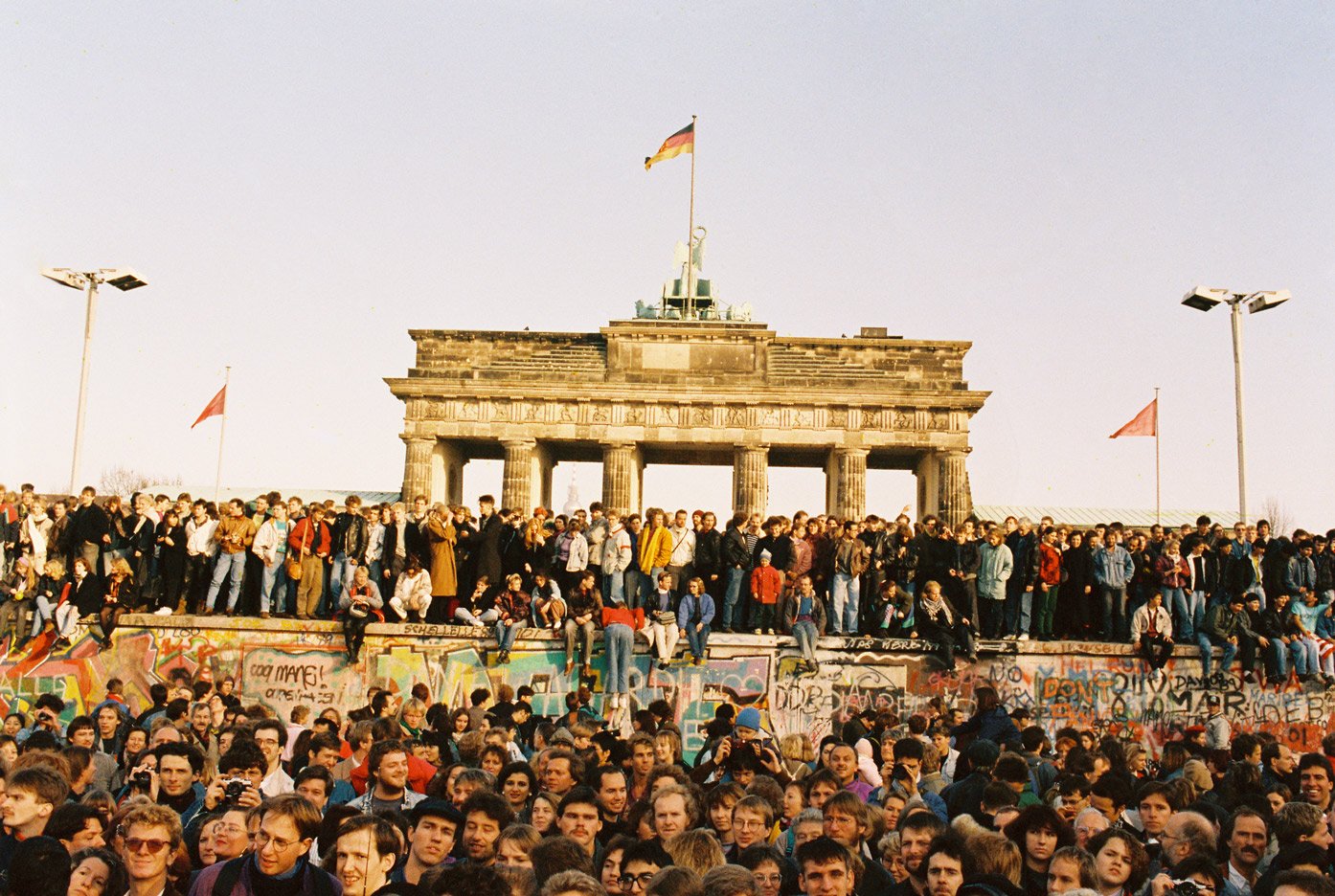
On November 9, 1989, when Berliners began crossing a wall that only hours earlier had still seemed immutable, they could not know what kind of world would emerge from that night. History, while it is happening, is rarely as orderly as it appears when reconstructed afterwards. Yet with the disappearance of the communist regimes of Central and Eastern Europe and then the collapse of the Soviet Union, a direction gradually asserted itself.
Market economies expanded. Representative democracy became the continent's dominant political reference. The Atlantic Alliance enlarged. Western Europe deepened its integration while the former communist states sought admission to its institutions. Maastricht entered into force, the Single Market took shape, Schengen transformed movement across borders, the euro appeared, and the 2004 enlargement erased part of the political geography inherited from the Cold War.
The movement was neither linear nor peaceful. The wars in Yugoslavia alone rule out any idyllic reading of the period. Yet one conviction nevertheless took hold: Europe now had a direction.
That conviction extended beyond the continent. The creation of the World Trade Organization, China's accession to it, the communications revolution, falling transport costs and the international fragmentation of production created a world in which economic efficiency increasingly encouraged manufacturing to move away from the place of consumption. A European company could design at home, source components elsewhere, assemble on another continent and sell everywhere. Industrial geography ceased to be merely a constraint; it became a variable to optimise.
This transformation generated enormous gains. It helped hundreds of millions of people enter the global economy, expanded markets for European companies and gave consumers access to an abundance of goods at prices previously unimaginable. But it also produced a more discreet illusion: that economic efficiency and strategic rationality would necessarily converge.
The more interdependent economies became, the more expensive rupture would be. And the more expensive rupture became, the less incentive states would have to provoke it.
The logic was not absurd. To a considerable extent, it remains true. But it assumed that the cost of interdependence would always be understood as a reason to preserve a relationship. It was less prepared for the possibility that one day this very cost might become the instrument through which one side could constrain the other.
European integration, meanwhile, was changing domestic politics itself. Left and right naturally continued to disagree over taxation, public spending, redistribution, labour, immigration and social questions. Yet much of this competition unfolded within a framework that appeared increasingly removed from fundamental dispute. The economy would remain primarily market-based. Europe would remain integrated. Trade would remain open. Internal borders would continue to fade. The United States would remain the continent's principal military guarantor.
Political conflict increasingly concerned how to inhabit this order rather than whether another one should be built.
This is how consensus becomes invisible. It does not necessarily triumph because everyone accepts it. It triumphs when it ceases to appear as one doctrine among others and becomes the scenery within which doctrines compete.
That scenery has not disappeared.
But it has become visible again.
The financial crisis of 2008 first exposed one of its essential weaknesses. The financial integration that had allowed capital to move with remarkable efficiency also allowed risk to travel at comparable speed. A few years later, the euro-area crisis confronted Europeans with a question the common currency had partly postponed: how far can monetary sovereignty be shared without fiscal and political responsibility being shared to a similar degree?
Then the migration crisis of 2015 revealed another contradiction. Schengen had made internal borders less visible; it had not abolished the need for an external one. On the contrary, the freer movement becomes inside a common area, the more the management of its outer boundary concerns everyone within it.
Brexit, the following year, broke another intellectual convention. Integration could slow, encounter resistance or produce exemptions; now it could also reverse. A state could leave.
None of these crises destroyed the European order. But each removed another layer of its self-evidence.
Then came 2020.
When aircraft remained grounded, factories closed and certain supplies became difficult to obtain, the value chain abruptly changed meaning. What had appeared to be a triumph of optimisation also became a map of dependencies. A medicine, Europe discovered, was not merely the product of a company and a price. Behind it stood molecules, components, suppliers, factories, ports and routes. The same discovery soon extended to semiconductors, batteries, critical minerals and energy equipment.
Globalisation had not stopped working.
It had stopped being politically innocent.
Two years later, Russia's full-scale invasion of Ukraine pushed that discovery much further. For decades, Russian gas had been understood through a commercial logic that also seemed to serve stability: Europe bought competitive energy, Moscow received revenue, and interdependence gave both sides a material interest in preserving the relationship. When war returned, the same pipelines told another story. What connected two economies could also expose one of them.
Europe did not discover that interdependence had been a mistake. It discovered something more uncomfortable: a dependency can be efficient in normal times and dangerous when the political relationship deteriorates.
That distinction changes almost everything.
A semiconductor plant is no longer merely a factory. Energy infrastructure is no longer merely an asset. A submarine cable, satellite, data centre, mine or port acquires a second existence. It still belongs to the economy, but now it also belongs to security.
Europe's vocabulary begins to change accordingly. Resilience joins efficiency. Economic security joins competition. De-risking qualifies interdependence. Strategic autonomy enters institutional language. Industrial policy, long viewed with suspicion in a Europe committed to market neutrality, acquires new legitimacy.
This change in language may matter more than the individual instruments themselves. When an institution changes its vocabulary, it often reveals that its understanding of the world has begun to change as well.
The state is therefore returning to the economy through a different door from the one it used in the twentieth century. This is not necessarily about nationalising or planning production as a whole. It is about determining that some capabilities are too important to be left entirely to the spontaneous geography of the market.
A factory may now be worth more than the sum of its financial flows because its disappearance would create a dependency. A technology may justify public support because losing control over it would restrict future choices. Industry therefore becomes again what it often was before several decades of openness obscured this dimension: a component of power.
War has accelerated this movement dramatically. NATO's European Allies and Canada collectively spent around 1.4% of their GDP on defence in 2014; by 2025, the figure had reached 2.3%, following an increase in spending of close to 20% in a single year. Yet the numbers say less than what they imply. Rearmament is not simply a matter of moving a line in a budget. It requires factories, engineers, raw materials, inventories, software, satellites, logistics and time.
Europe is rediscovering a distinction that decades of peace had allowed it to keep at a distance: there is a difference between having the legal right to decide and possessing the material means to carry out that decision.
This is where sovereignty begins to change meaning.
It no longer describes only the legal location of authority.
It begins to describe capability.
When history starts asking questions again
It is precisely at this point that the 1930s inevitably return to the European conversation. Too often, they return too quickly.
Comparing two historical periods does not mean that they will lead to the same destination. 2026 is not 1936, and the analogy becomes useless the moment it is used to assign contemporary actors roles in a drama whose ending we already know. Today's Europe possesses institutions, alliances, social protections, central banks, levels of wealth and, above all, historical memory that profoundly distinguish it from the interwar period. Nazism, fascism, Stalinism and world war are no longer abstract possibilities whose consequences remain unknown.
The relevance of the 1930s lies elsewhere.
After the crash of 1929, economic contraction did more than destroy jobs and businesses. It undermined confidence in institutions and gradually changed the nature of political questions. World trade contracted dramatically while tariffs, quotas, exchange controls and preferential trading arrangements contributed to the fragmentation of the international economy. States increasingly sought to secure the economic spaces on which they depended. Economics and power became harder to think about separately.
More importantly, Europeans were no longer arguing only about how to govern the same system. They were confronted with incompatible conceptions of what the system itself should be. Parliamentary democracy, socialism, communism, fascism, National Socialism and different forms of authoritarianism did not offer variations on a common architecture. They answered fundamental questions about legitimacy, the state, the individual, the nation, property and international order in radically different ways.
It is this mechanism, not the political identities of the period, that illuminates the present.
A society enters a different phase when disagreement ceases to concern public policy alone and begins to reach the principles organising that policy. Contemporary Europe is once again debating where power should reside, what a nation must control, how much integration it should accept, which borders it intends to protect and which dependencies it considers tolerable.
That does not make our era a repetition of the interwar years.
It simply means that politics is reaching the foundations again.
European history offers another, almost opposite mirror that helps explain why the transformation extends beyond economics and institutions.
In May 1968, Parisian students occupied the Sorbonne, barricades appeared in the streets and strikes paralysed much of France. The political crisis was spectacular. Yet only weeks later, legislative elections delivered a large majority to the Gaullists. If history were reduced to the immediate control of institutions, May 1968 could almost be regarded as a failure.
That would miss the essential point.
The cultural transformations to which 1968 gave expression neither began that year nor belonged to it exclusively. The expansion of higher education, urbanisation, changes in family structures, the evolving position of women, the decline of certain traditional authorities and the individualisation of Western societies followed much longer trajectories. But 1968 gave particular force to a question that reached beyond the conquest of political power: by what right does an authority deserve to be obeyed?
That question subsequently entered schools, companies, families, the media and the law. Hierarchies that had once seemed natural increasingly had to justify themselves. The transformation was slow, uneven and contradictory, but it eventually altered what society regarded as normal.
Half a century later, that normality has itself become contested terrain.
Some contemporary European conflicts now revolve around transmission, identity, family, religion, immigration, authority and the place of the nation. Certain conservative movements even describe their project in the language of restoration: continuity, they argue, must be recovered after decades of social transformation weakened it.
Again, describing this as May 1968 in reverse would be too simple. Societies do not travel backwards through time, and movements that contest some of the cultural transformations of the past half-century are themselves profoundly contemporary. They use digital networks, construct alternative media, challenge institutions, denounce elites and sometimes define themselves through the transgression of dominant norms. Those who oppose parts of the legacy of 1968 have also inherited the proposition that no authority deserves respect simply because it is established.
They have changed the object of rebellion.
Not necessarily its grammar.
This may be where Europe's current situation becomes distinctive. It combines questions that several historical periods posed separately. As during the great economic and geopolitical crises of the twentieth century, economics is once again meeting power. As during the cultural transformations of the 1960s, norms and authority are explicitly political again. And unlike the moment after 1989, no general direction appears dominant enough to become invisible.
This combination helps explain the return of doctrines.
Not because old ideologies are returning intact, but because every major political family is being forced to redefine what it thought it already knew.
Liberals must now explain how far openness remains desirable when it creates strategic dependencies. Social democrats are rediscovering an industrial state that some of them had come to regard primarily as regulator and redistributor. Green politics is discovering that decarbonising an economy is not only about closing or reducing, but also about building networks, power generation, factories, mines, storage capacity and industrial supply chains. Conservatives are returning continuity, transmission and borders to the centre of their thinking. Sovereigntists must explain how national sovereignty can become effective in a world where certain capabilities require continental scale. The radical left, meanwhile, continues to ask another version of the same question by focusing on who controls capital, infrastructure and economic decisions.
Most revealingly, these doctrines are beginning to borrow instruments from one another. The right is rediscovering industrial policy. Liberals speak of economic security. European institutions speak of sovereignty. Environmentalists must speak of production. Social democrats defend greater military capacity. Some sovereigntists advocate strong social protection.
This does not mean ideological differences are disappearing.
It means that the ground on which they compete is changing.
And that ground keeps leading back to the same question: scale.
Sovereignty meets power
A European state can decide that it wants to develop an artificial-intelligence industry. It still needs the capital, energy, data centres, semiconductors, engineers and market capable of sustaining that ambition. It can decide to strengthen its defence; it still needs to manufacture or purchase the necessary systems, maintain inventories and secure their components. It can decide to protect its border; movements across neighbouring borders can still make that decision partly theoretical. It can seek to reduce an energy dependency; an alternative infrastructure must still exist.
Legal sovereignty answers one question: who has the right to decide?
Material sovereignty adds another: who possesses the means to make that decision real?
Europe lives precisely in the gap between these two definitions.
Its nations remain the principal arenas of democratic legitimacy. Citizens elect their governments there, most taxes are raised there, welfare systems are organised there and collective memories are maintained there. Yet a growing share of the capabilities required to exercise that sovereignty exceeds the scale of individual European states.
No treaty can abolish this contradiction.
A defence industry fragmented across numerous national standards loses part of the scale enjoyed by larger continental systems. Fragmented capital markets restrict the ability to finance certain technology companies. National energy policies depend on neighbouring networks. A common external border necessarily creates responsibilities that extend beyond the state geographically located on the front line.
European integration itself was born, in part, from this insight: some forms of sovereignty can be strengthened materially by being exercised jointly.
But the opposite argument remains just as powerful. The further a decision moves from the arena in which citizens can sanction those who make it, the greater the risk that collective capacity gains in power what it loses in democratic clarity.
This is why the opposition between "more Europe" and "less Europe" is becoming insufficient.
The deeper conflict increasingly concerns the boundary between levels of power.
What should remain national because legitimacy requires it? What must be exercised together because power demands it? And how can a system distributed across several layers of sovereignty avoid allowing each level to claim successes while assigning failures to another?
Europe's problem is therefore not only one of power.
It is one of the legibility of power.
That difficulty explains why several Europes can now be imagined without any one of them appearing capable of imposing itself.
One would deepen integration, no longer primarily in the name of peace or freedom of movement, but in the name of critical mass. In a world structured by the United States, China and increasingly other continental powers, the European argument would change in nature: the purpose would no longer be only to remove barriers among Europeans, but to give them collectively capabilities that in some fields they no longer possess separately. Defence, energy, capital markets, critical technologies and industry could all push in this direction.
Such a Europe would be less preoccupied with regulatory harmonisation and more concerned with building capacity. Yet the more capable of action it became, the more urgently it would have to answer a simple question: to whom is that power politically accountable?
Another Europe could begin precisely from this weakness and place nations back at the centre. The Union would continue to organise a market, certain trade policies and chosen forms of cooperation, but it would cease to treat integration as a historical direction that must necessarily advance. States would remain the fundamental political units and would cooperate differently depending on the field.
This architecture would respond more directly to the problem of legitimacy.
It would immediately encounter the problem of size.
The nation may be the place where political decisions appear most democratic. It is not always the scale at which those decisions possess the means to become effective.
Between these two models lies a less dramatic possibility, and perhaps one closer to the way Europe has always developed: a hybrid system, deeply integrated in some areas, almost entirely national in others, and organised through variable coalitions elsewhere.
Such a system already exists in part. The currency can be European while taxation remains national. Trade is common while welfare protection remains overwhelmingly national. Defence combines national armed forces, European structures and the Atlantic Alliance. Energy combines sovereign choices with continental networks. The border belongs simultaneously to the state and to a common area.
Europe may therefore never definitively resolve the contradiction between nation and continent.
It may simply learn to organise it.
That would be less elegant than either a grand federal project or an orderly return to a Europe of nations. But institutional history often prefers imperfect arrangements to intellectually pure architectures.
The risk would lie elsewhere. When power is distributed across too many levels, responsibility can become difficult to locate. Brussels can accuse national capitals of failing to implement common decisions; governments can tell their electorates that Brussels has imposed measures they themselves sometimes helped negotiate. The system continues to function, but citizens struggle to identify whom they should reward or punish.
Political power cannot remain merely capable.
It must also be accountable.
Power requires decisions.
Democracy requires knowing who makes them.
It is probably around this tension, more than around the simplistic opposition between federalism and sovereigntism, that part of Europe's political recomposition will unfold.
What Orvieto reveals
We can now return to the Palazzo del Capitano del Popolo.
What initially appeared to be a tactical contradiction takes on another meaning. If Vannacci looks towards the AfD, if national movements seek partners in the European Parliament, it is not simply because ideas circulate more easily through a common digital space. It is because the power they want to transform is itself exercised at several levels.
Renationalising some decisions therefore requires a transnational coalition.
The paradox is not unique to sovereigntists. Environmentalists had to build continental policies to act on a global problem. Supporters of the Single Market created supranational institutions so that companies could cross national borders more freely. Governments seeking greater industrial autonomy are now discovering that some of the capabilities they want to recover may only be economically viable at European scale.
Each approaches the same problem from a different direction.
The nation remains an extraordinarily powerful political space, but it now operates in an environment where material power often requires a larger scale.
This may be what most profoundly distinguishes the current period from the three historical moments it sometimes resembles.
The Europe of the 1930s was politically fragmented and far less economically integrated. The Europe of 1968 was undergoing profound cultural transformation but remained, in the West, protected by a relatively stable strategic order. The Europe of 1989 was entering a period in which economic integration and political convergence seemed to be moving in the same direction.
The Europe of 2026 presents a different configuration.
It is materially integrated and politically plural.
Its economies, networks, currencies, companies, rules and infrastructure have reached a level of interdependence unknown to previous generations. Yet political legitimacy remains largely national, while doctrines once again diverge over the direction of the whole.
This is why fragmentation would not necessarily mean disintegration. Europe could become more politically conflictual while remaining materially difficult to separate. National decisions would continue to affect neighbours immediately precisely because decades of integration have made their economies interdependent.
The old world, then, is not simply disappearing to make room for another.
It continues to function while its principles are being reopened.
Schengen exists while borders return to the centre of politics.
The Single Market exists while governments pursue more strategic industrial policies.
Globalisation continues while companies and states seek to reduce certain dependencies.
NATO remains at the heart of European security while Europe debates strategic autonomy.
Nations remain sovereign while discovering that some capabilities exceed their scale.
The Union remains integrated while movements build political support on promises to return power to states.
This overlap makes the period difficult to name. We have a precise vocabulary for the order that is receding — globalisation, the peace dividend, the unipolar moment, post-Cold War Europe — but no term yet fully describes what might succeed it.
Strategic autonomy is not enough.
Nor is Europe as a power.
Nor a Europe of nations.
Multipolarity describes the international system without telling us how Europe will organise itself within it.
De-risking describes a method, not an order.
This absence of a name may not be an intellectual problem requiring an immediate solution. It may be precisely the sign that the transition remains open.
Those who live through a recomposition usually see its contradictions before they know its synthesis.
Europe must remain open enough to prosper but autonomous enough not to be paralysed by an external rupture. It wants to preserve its nations while building continental capabilities. It seeks to decarbonise its economy while discovering that the energy transition has its own geography of dependencies. It wants to reduce technological vulnerability without being able to reproduce every link in global supply chains. It wants to assume more responsibility for its defence while remaining deeply connected to the United States. It wants to preserve free movement while strengthening control of its external border.
No doctrine yet possesses a synthesis of these contradictions.
And that is precisely what makes the moment important.
For part of the post-Cold War era, the European question could still be framed largely as one of speed: how far, and how quickly, would integration proceed?
The formulation already contained its answer.
It assumed a direction.
The contemporary question is more open.
What do Europeans still want to integrate because their capacity depends on it? What do they want to preserve or return to nations because political legitimacy depends on it? And how can the boundary between the two be organised without sacrificing one to the other?
Europe is therefore not simply confronted with a choice between integration and sovereignty.
It must redefine what sovereignty means in a world where almost no European power individually possesses the scale required to achieve all of its objectives.
That is why Orvieto ultimately deserves more than an electoral reading.
On that day, movements promising to return power to nations sought ways to cooperate beyond them. They are not alone in encountering this contradiction. In different forms, it now runs through almost every major European political family.
Liberals must reconcile openness with security. Environmentalists, transition with industry. Social democrats, protection with competitiveness. Conservatives, continuity with adaptation. Sovereigntists, the nation with the scale of power. European institutions, finally, must reconcile a growing capacity to act with a legitimacy that cannot simply be decreed.
No one has yet won this argument.
Perhaps that is the real event.
Not the victory of a new doctrine, but the gradual disappearance of an era in which one general architecture could dominate sufficiently to appear natural.
Great historical transitions do not necessarily begin when a new order appears.
They begin when the old one suddenly has to explain why it exists.
Why should this border be open or closed? Why can this production be left abroad? Why should this competence be European rather than national? Why does this alliance remain indispensable? Why is this dependency acceptable? Why should this rule apply to everyone?
As long as the answers appear self-evident, an order survives partly because it no longer needs to explain itself.
When those answers become objects of political conflict again, something has already changed.
The Europe of 2026 is not the Europe of 1936. It is not replaying May 1968 in reverse, nor is it erasing 1989. It is entering a configuration of its own: a deeply integrated economy, culturally contested societies, politically persistent nations and an international environment in which material power is regaining a place that several decades of peace had allowed Europeans to underestimate.
In Orvieto, this new age obviously had no name.
It still does not.
But it already has its question.
At what scale do Europeans still want to be capable of deciding their own future?
The answer remains open.
That is precisely what has changed.
The age of certainties is over.
Main sources
ANSA — coverage of the Italian Independence Forum in Orvieto and statements by Roberto Vannacci and Marc Jongen, September 19–20, 2026.
European Parliament — political groups and institutional structure of the 2024–2029 parliamentary term.
NATO — data on defence expenditure by European Allies and Canada and the capability commitments adopted by the Allies.
European Commission — work on economic security, competitiveness, strategic dependencies, industrial policy and European strategic autonomy.
World Trade Organization — historical data on world trade and documentation on the development of the multilateral trading system.
European Union — historical documentation on the Maastricht Treaty, the Single Market, Schengen, the euro and successive enlargements.
Institutional historical and statistical sources on the Great Depression, interwar Europe, the social transformations of the 1960s and the end of the Cold War.
Atlas Limits Research Desk
Atlas Limits’ editorial and analytical desk.