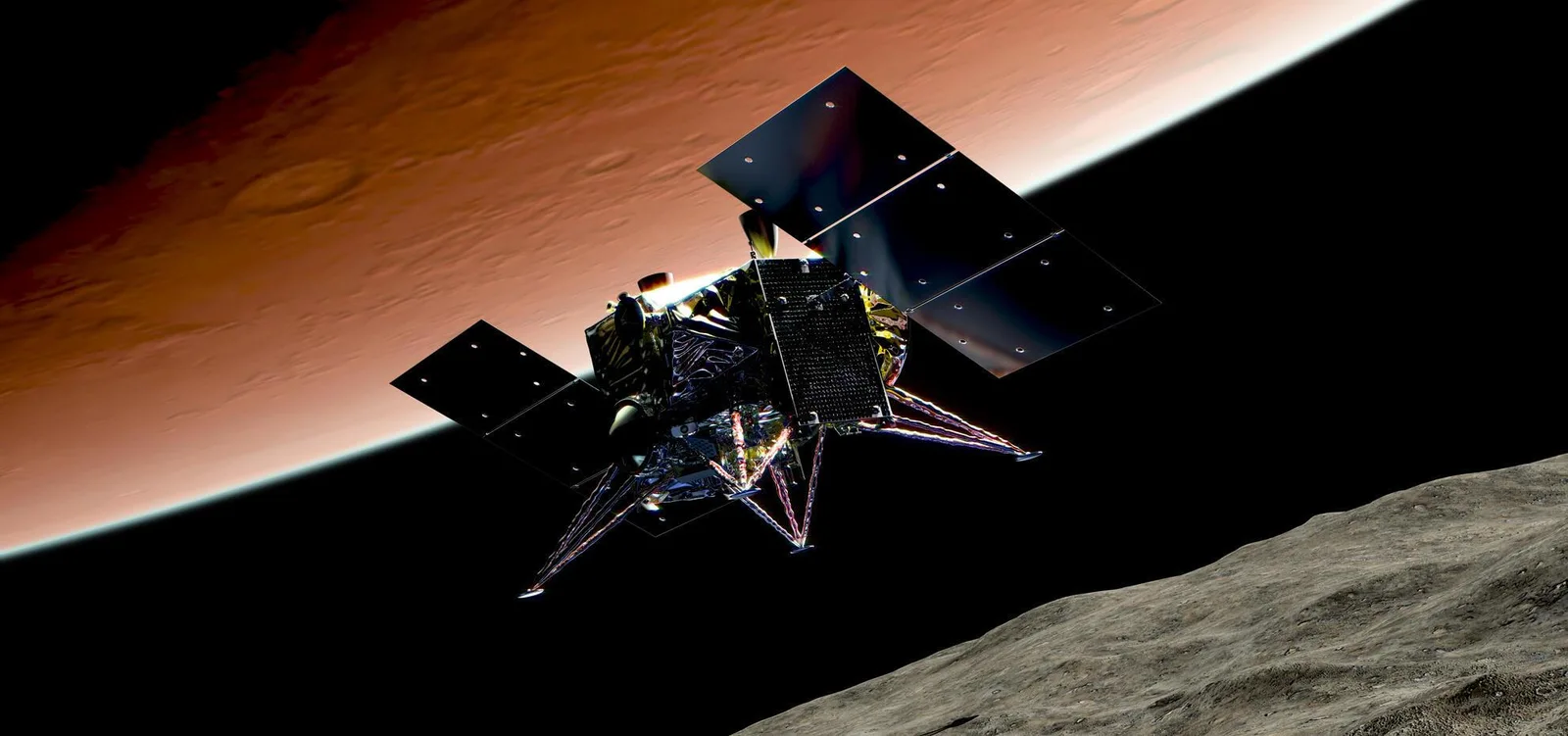
On the night of October 19–20, 2026, an H3 rocket rose above the Tanegashima Space Center in southern Japan. On board, a spacecraft weighing nearly five tonnes carried an unusual ambition: to travel hundreds of millions of kilometres, reach one of Mars’s moons, collect a few grams of extraterrestrial material and bring them back to Earth. The launch proceeded according to plan. At 4:41 a.m. Japan Standard Time, the rocket left its launch pad. Just over 71 minutes later, the Martian Moons eXploration spacecraft, known as MMX, was released onto its initial trajectory.
The event might appear modest at a time when reusable rockets, satellite constellations and ambitions to colonise Mars increasingly dominate the public imagination of space exploration. Yet Japan has embarked on an undertaking whose scientific significance extends far beyond the quantity of material it hopes to recover. If successful, the mission will bring back to Earth, for the first time, samples collected directly from Phobos, the larger of Mars’s two moons, allowing terrestrial laboratories to examine a previously inaccessible part of the Martian system’s history.
Behind this operation lies a broader national strategy. In a space competition dominated by American resources and Chinese ambitions, Tokyo is seeking not so much to replicate its competitors’ programmes as to master some of the most demanding operations in interplanetary exploration. Reaching a celestial body, landing on its surface, collecting material and returning to Earth constitutes a complete technological chain. A country capable of performing these operations possesses expertise whose scientific, industrial and strategic value extends well beyond any individual mission.
Ten Grams to Understand Billions of Years
Phobos is an unusual celestial body. Measuring approximately 27 kilometres along its longest dimension, this irregularly shaped moon orbits only about 6,000 kilometres above the Martian surface. It completes one revolution around Mars in less than eight hours, faster than the planet rotates on its own axis. Its dark surface, covered in dust and marked by numerous craters, preserves traces of a history that astronomers have yet to reconstruct.
Two principal hypotheses attempt to explain its origin. According to the first, Phobos and its neighbouring moon Deimos are primitive bodies captured by Martian gravity, possibly originating from asteroid populations. According to the second, they formed from debris thrown into space following a major collision between Mars and another celestial body.
The distinction is far from incidental. Under the first scenario, Phobos could preserve part of the composition of materials circulating through the young Solar System. Under the second, it would be the product of a planetary catastrophe, potentially revealing important information about the structure and evolution of Mars itself. Remote observations have not conclusively resolved the question. The orbital characteristics of both moons, their low densities and their spectral properties continue to fuel scientific debate.
This is precisely the uncertainty that MMX is designed to help resolve.
The Japan Aerospace Exploration Agency, JAXA, intends to recover at least ten grams of regolith, the mixture of dust, rock fragments and altered material covering the surface of Phobos. The quantity is negligible by terrestrial standards but potentially substantial for planetary science. In a laboratory, individual grains can undergo isotopic, mineralogical and chemical analyses of a precision that instruments carried aboard spacecraft cannot match.
Researchers will be able to examine the isotopic ratios of selected elements, search for signatures of ancient thermal processes and compare the recovered material with meteorites and previously analysed extraterrestrial samples. The central objective will be to establish whether Phobos more closely resembles primitive asteroids or materials associated with Mars.
A further possibility makes the mission particularly intriguing. The surface of Phobos may contain fragments of Martian rock ejected from the planet by ancient impacts. If such materials are identified among the returned samples, they could provide additional information about the geological evolution of Mars. Their presence and scientific usefulness, however, remain to be demonstrated.
MMX is therefore not setting out to discover direct evidence of the emergence of life. Its purpose is to clarify the physical and chemical conditions that accompanied planetary formation, the circulation of water and the transport of organic compounds. Understanding these mechanisms may help scientists identify the environments in which life could have emerged, without establishing that life ever existed on Phobos or Mars.
Japan and the Science of Bringing Samples Home
Japan's ambitions did not begin with MMX. They belong to a technological tradition built around an exceptionally demanding speciality: returning extraterrestrial samples to Earth.
In 2010, the Hayabusa mission returned particles from the asteroid Itokawa after a journey marked by numerous technical difficulties. Ten years later, Hayabusa2 achieved an even more ambitious operation, delivering approximately 5.4 grams of material from the asteroid Ryugu. Analyses of these samples revealed complex chemistry, including organic molecules and minerals recording ancient interactions with water.
These discoveries helped reshape scientific understanding of primitive Solar System materials. More importantly, they demonstrated the value of an approach based on physically recovering extraterrestrial matter rather than relying exclusively on remote observation.
The difference is fundamental. A spacecraft instrument must operate within strict limits of mass, electrical power, computing capacity and operational lifetime. A sample returned to Earth, by contrast, can be studied for decades using techniques that did not exist when it was collected. Some of the most important discoveries may therefore emerge long after the mission itself has officially ended.
This approach explains why Japan has progressively developed internationally recognised expertise in autonomous navigation, proximity operations, material collection and sample protection against contamination.
MMX nevertheless represents a change in scale. Ryugu was an asteroid orbiting the Sun. Phobos belongs to a gravitational environment dominated by Mars, where orbital operations and surface manoeuvres require a substantially different architecture. The spacecraft must not only reach the Martian system but also operate near a moon with extremely weak gravity, identify suitable sampling sites, perform controlled contact with the surface and preserve the collected material throughout the return journey.
The success of Hayabusa2 provides a valuable technological inheritance. It does not guarantee the success of MMX.
A Five-Year Mission at the Edge of Mars
The mission's timetable illustrates the complexity of the undertaking. Following its October 2026 launch, MMX is expected to reach the vicinity of Mars in August 2027. It will then enter a trajectory allowing prolonged observation of Phobos, mapping its surface and examining its physical properties.
The spacecraft uses a modular architecture comprising propulsion, exploration and return elements. This design is intended to preserve the functions required at each stage of the journey while progressively discarding equipment that is no longer needed.
Near Phobos, the spacecraft will operate along a quasi-satellite orbit adapted to the gravitational conditions of the Mars–Phobos system. Scientific teams will study the moon's relief, surface composition, distribution of boulders and the characteristics of potential sampling locations.
Two surface contacts are planned to collect the required material. The extremely weak gravity of Phobos presents a particular challenge. A vehicle approaching too quickly could rebound or compromise the stability of its instruments. Operations must therefore be conducted with exceptional precision in an environment where communication delays with Earth make instantaneous human intervention impossible.
A small Franco-German rover named Idefix will contribute to surface exploration. Developed through cooperation between the French space agency CNES and the German Aerospace Center, DLR, it is intended to provide close-range observations and help characterise the mechanical properties of the ground.
After its scientific operations around Phobos, the mission is also expected to observe Deimos, Mars's second moon. Departure from the Martian system is scheduled for 2030, followed by a return to Earth in 2031. A capsule containing the samples will then enter Earth's atmosphere and is expected to be recovered in Australia.
Complete success can only be established at that final stage. Between launch and return, each phase carries distinct risks: interplanetary navigation, arrival in the Martian system, instrument performance, surface operations, sample preservation and atmospheric re-entry.
Distance turns even a minor malfunction into a potentially serious problem. Unlike a satellite in Earth orbit, an interplanetary spacecraft cannot be repaired through conventional intervention. Its systems must incorporate their own diagnostic, corrective and survival capabilities.
A Space Power Choosing Its Battles
Japan does not possess the same space resources as the United States, nor does it pursue exactly the same objectives as China. Its programme relies on a combination of scientific exploration, industrial capabilities, international cooperation and specialised technologies.
The MMX budget, estimated at approximately $578 million according to information reported around the launch, illustrates this approach. The amount is substantial, but remains below the cost of the largest planetary exploration programmes. It nevertheless supports a multiyear mission involving a complex spacecraft, scientific instruments and an architecture capable of returning material to Earth.
The strategic value of the operation cannot be measured solely by its cost. It lies in the accumulation of industrial expertise that would be difficult to reproduce quickly.
Missions of this kind mobilise capabilities in propulsion, navigation, radiation-resistant electronics, space telecommunications, advanced materials, robotics, embedded software and high-precision manufacturing. They sustain engineering and research ecosystems whose applications may extend to other civilian, scientific and institutional programmes.
The H3 rocket forms part of the same logic. Developed to succeed the H-IIA launcher, it is intended to strengthen Japan's ability to reach space through a modernised national system. Its inaugural flight in March 2023 ended in failure. Subsequent launches helped restore confidence in the programme, although its expansion has continued to face challenges.
The MMX launch represents another milestone: it demonstrates that the H3 can be used to initiate an interplanetary mission. That achievement alone does not establish the launcher's long-term commercial competitiveness, but it confirms the expansion of its operational capabilities.
For Tokyo, such autonomy carries particular importance. A country entirely dependent on foreign capabilities to deploy satellites or launch scientific probes accepts a degree of technological and political vulnerability. Maintaining a domestic launch industry is therefore a matter extending well beyond scientific research.
Japan's space policy also operates within an industrial environment facing structural pressures: demographic ageing, international technological competition, fiscal constraints and the need to preserve advanced engineering capabilities. Space programmes cannot resolve these challenges on their own. They can, however, sustain research and industrial ecosystems whose benefits extend beyond the space sector.
Cooperation as an Instrument of Power
MMX is a Japanese mission, but it is not an exclusively Japanese undertaking. NASA, the European Space Agency, CNES and DLR are participating through scientific instruments, equipment and technical contributions.
This cooperation reveals an essential characteristic of contemporary space exploration: major missions increasingly depend on international networks of specialised expertise.
For European and American partners, participation in MMX offers access to unprecedented observations, opportunities to test equipment and involvement in the scientific exploitation of the results. For Japan, these contributions enhance the mission's scientific and technical capabilities while consolidating its position at the centre of an international network.
There is a form of influence here that depends neither on possessing the largest rocket nor on independently financing the most expensive programmes. A country that masters a rare technological capability can become indispensable to major international projects.
This logic does not eliminate rivalry. The United States remains a dominant power in planetary exploration, with extensive experience in Martian missions, scientific spacecraft and surface operations. China, meanwhile, is pursuing a rapid expansion of its capabilities, illustrated by its lunar missions, Martian programme and ambitions for returning extraterrestrial samples.
Yet space competition cannot be reduced to a confrontation between two powers. It leaves room for countries capable of occupying specialised technological positions.
Japan is seeking to consolidate precisely such a position. Demonstrating the ability to conduct a sample-return mission from the vicinity of Mars would strengthen its role in developing the methods, instruments and scientific standards of future exploration.
The influence acquired might be less spectacular than humanity's first footsteps on another planet, but potentially more durable in particular scientific and technological fields.
Mars and the New Frontier of Scientific Competition
The Martian system now occupies a central place in space exploration strategies. Orbital missions and surface rovers have fundamentally transformed our understanding of Mars, revealing the ancient existence of rivers, lakes and environments that may once have possessed some of the conditions necessary for life.
The question is no longer simply whether liquid water existed on Mars, but for how long, in which environments and with what chemical and geological consequences.
Returning samples represents a decisive step in this research. NASA and its partners have developed a strategy to bring back materials collected directly from the Martian surface, while China is pursuing its own Tianwen-3 project. These programmes remain subject to schedules, budgetary decisions and technical risks that make their eventual completion dates uncertain.
MMX follows a different path. Rather than collecting rocks directly from Mars, it targets a moon orbiting nearby. The operation is not equivalent to returning samples from the Martian surface: the provenance, geological history and scientific objectives are different. Nevertheless, it may provide complementary information about the formation and evolution of the Martian system.
The mission also has a preparatory dimension. Phobos has sometimes been considered a possible staging point for future human operations around Mars, partly because its environment could support certain activities without imposing the same constraints as descending to the planet's surface.
Such scenarios remain speculative. No permanent human infrastructure is currently being established on Phobos, and the technical, logistical and financial obstacles remain formidable. However, precise knowledge of the moon's composition, mechanical properties and environment could help assess longer-term exploration possibilities.
Fundamental science and space strategy therefore intersect without becoming identical. The samples sought by MMX are primarily intended to answer scientific questions. The technologies developed to obtain them could subsequently support broader objectives.
The Paradox of Ten Grams
The history of space exploration contains an apparent contradiction. Some of its most complex missions are designed to return extraordinarily small quantities of material.
The hundreds of kilograms of lunar rocks collected by the Apollo missions transformed our understanding of the Moon. Decades later, a few grams retrieved from asteroids opened new perspectives on the chemistry of the primitive Solar System.
MMX extends this tradition by moving exploration into an environment that remains poorly understood.
The importance of these samples lies less in their mass than in their provenance. Meteorites already provide scientists with an exceptional source of extraterrestrial information, but their histories are often incomplete. Their parent bodies may be uncertain, their trajectories unknown and their composition altered during their journey or subsequent exposure to Earth's environment.
A sample collected from an identified location, accompanied by geological observations and preserved under controlled conditions, provides a much richer scientific context.
Such precision may help answer questions that have remained unresolved for decades. It may also generate entirely new ones. Major scientific discoveries do not always eliminate uncertainty; they often shift the boundaries of what remains to be understood.
For Japan, the challenge is therefore twofold. It must return materials capable of illuminating the history of the Solar System while demonstrating that a space power can build lasting international influence through focused technological excellence.
Five years from now, if the MMX capsule returns to Earth carrying its ten grams of dust and rock, the achievement will represent more than a Japanese success. It will constitute a new physical archive of planetary history, available for generations of researchers to examine.
And perhaps it will offer a particularly clear illustration of what scientific power is becoming: not merely the ability to reach distant worlds, but the ability to bring back something that no one, until then, has been able to study.
Main Sources
JAXA — Japan Aerospace Exploration Agency
- Official announcement of October 20, 2026, confirming the launch of MMX aboard the tenth H3 rocket flight and the successful separation of the spacecraft.
- Martian Moons eXploration (MMX), official mission overview, scientific objectives, spacecraft architecture and projected timeline.
- https://www.jaxa.jp/press/2026/10/20261020-1_j.html
- https://www.mmx.jaxa.jp/en/
ESA — European Space Agency
- MMX lifts off to Mars's moon Phobos, October 20, 2026.
- Information on international contributions, scientific objectives and planned operations around Phobos.
- https://www.esa.int/Science_Exploration/Space_Science
Associated Press
- Reporting on the launch, international cooperation, spacecraft characteristics and the mission's reported budget, October 2026.
- https://apnews.com/article/fb51fbbf90374631e8ae658f9ca46154
Reuters
- Reporting on the launch, sample-return timetable and the scientific and industrial implications of the H3 programme, October 2026.
- https://www.reuters.com/science/japan-launches-mission-return-samples-mars-moon-2026-10-19/
Methodological note: Scientific characteristics and planned mission stages are based primarily on institutional publications from JAXA and ESA. Budget figures are drawn from contemporary reporting on the launch. The 2027–2031 milestones are projected objectives rather than accomplished results. The industrial and geopolitical implications discussed in this article constitute Atlas Limits' editorial analysis.
Atlas Limits Research Desk
Atlas Limits’ editorial and analytical desk.