For several years, the semiconductor battle has focused on the most visible components of artificial intelligence: advanced processors, GPUs, the equipment required to manufacture them, and the enormous data centers that house them. Another part of this architecture is now entering the realm of industrial geopolitics: memory.
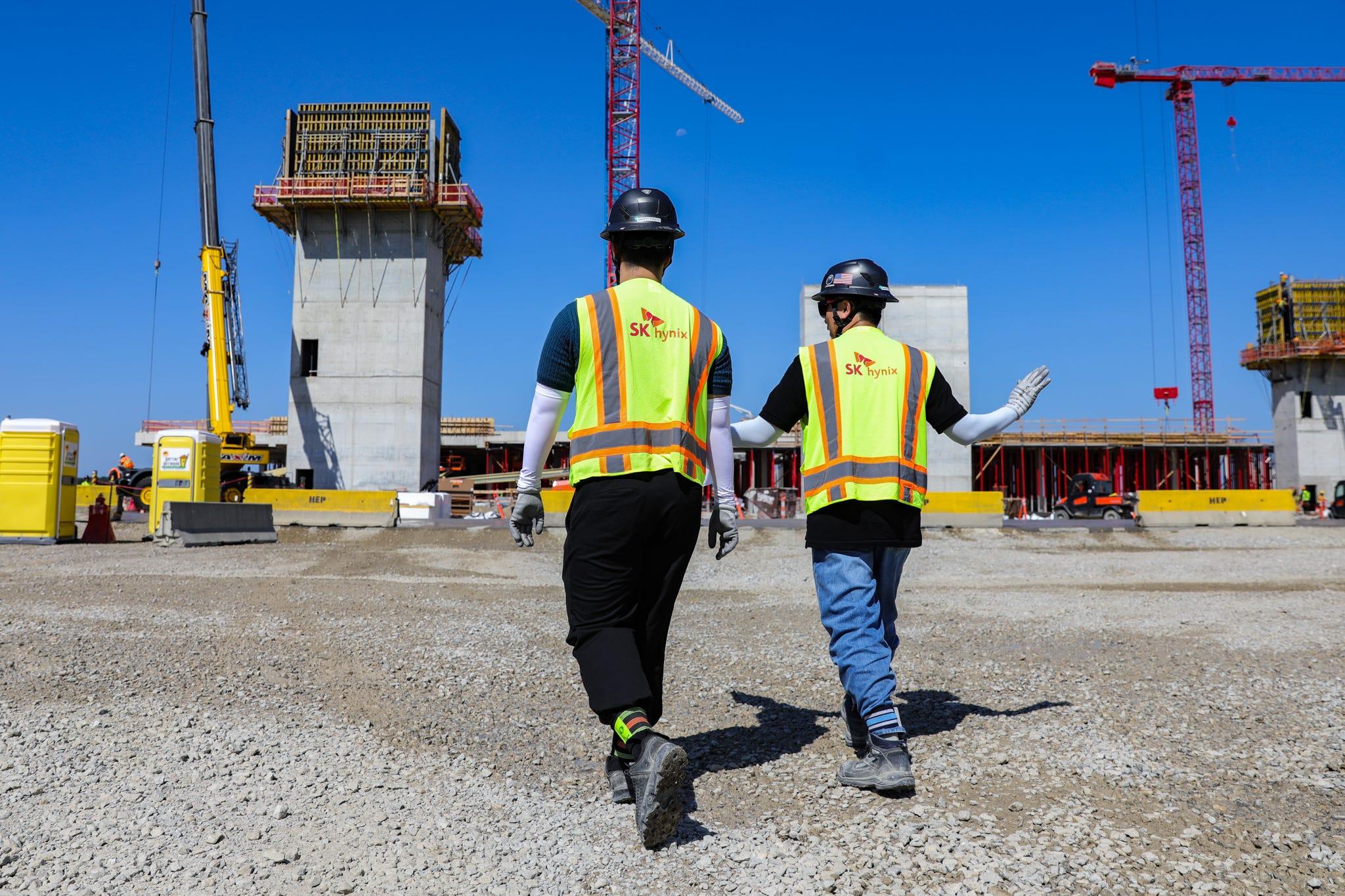
Within a matter of weeks, several projects involving South Korea’s SK hynix have begun to sketch out an industrial infrastructure in the United States that would have seemed unlikely only a few years ago. In Indiana, the company is already building a facility dedicated to high-bandwidth memory, or HBM, which is essential to AI accelerators. In Ohio, it is discussing various options with Intel that could allow memory chips to be manufactured on US soil. And in New York State, its US subsidiary Solidigm is now considering the possibility of establishing a NAND flash memory plant.
None of these developments, taken individually, is enough to suggest that the global memory industry is moving to the United States. The discussions concerning Ohio and New York, in particular, have not resulted in final investment decisions. Their convergence nevertheless reveals a deeper shift: Washington is gradually seeking to extend semiconductor reshoring to the components surrounding AI processors.
Memory is becoming strategic.
After GPUs, HBM
Artificial intelligence has profoundly changed the economics of memory.
An extremely powerful accelerator is of limited use if it spends too much of its time waiting for the data required for its calculations. AI systems must therefore move enormous volumes of information between computing units and memory. The speed of that transfer has become one of the defining physical constraints of modern AI infrastructure.
This is precisely the role of HBM. Stacked vertically and positioned close to accelerators, these memory systems provide far greater bandwidth than conventional architectures. They have therefore become critical companions to the GPUs used to train and operate large artificial intelligence models.
This transformation has given SK hynix particular importance. The South Korean group has established itself as one of the central players in HBM and is directly exposed to the surge in investment in AI infrastructure.
Washington identified that importance early.
In December 2024, the US Department of Commerce finalized up to $458 million in public funding under the CHIPS and Science Act to support an approximately $3.87 billion SK hynix investment in West Lafayette, Indiana. The objective was explicitly to fill a missing link in the American semiconductor supply chain for artificial intelligence.
The project has since moved into a concrete phase. On August 27, 2026, SK hynix broke ground on its West Lafayette facility, near Purdue University. It is expected to host advanced packaging capabilities and research into future generations of HBM. The company is now targeting US-based supply from 2029.
What was initially presented as an industrial investment is therefore becoming part of the emerging geography of American AI.
From Indiana to Ohio
A second stage may now be taking shape.
According to information reported by Reuters on September 16, SK hynix and Intel are discussing arrangements that could allow the South Korean company to manufacture memory chips in the United States for the first time.
Several configurations are reportedly under consideration. One would involve using part of the large manufacturing complex Intel is developing in Ohio. Another could involve a structure bringing together Intel, SK hynix and potentially major American cloud or AI companies.
The discussions remain exploratory, and there is no guarantee that they will result in an agreement. Their existence is nevertheless significant.
The United States has committed tens of billions of dollars to restoring advanced semiconductor manufacturing capacity. Intel, TSMC, Samsung and other companies have announced or undertaken major investments on American soil. But possessing factories capable of manufacturing processors is not enough to reconstruct an entire supply chain.
Every accelerator depends on memory, substrates, advanced packaging, manufacturing equipment, materials, power networks and data centers.
American industrial policy is therefore beginning to move deeper into the different layers of this architecture.
NAND Enters the Equation
The movement could extend further.
On September 18, Reuters reported that Solidigm, SK hynix’s US subsidiary specializing in storage, was considering building a NAND memory factory in the United States. Upstate New York is among the locations reportedly being examined.
Again, no final decision has been made.
But the project carries particular geopolitical significance because an important part of the industrial capacity on which Solidigm relies is currently located in Dalian, China. A US facility would therefore do more than shorten the distance between production and major American customers. It could also reduce part of the supply chain’s exposure to trade tensions, technological restrictions and any further fragmentation of economic relations between Washington and Beijing.
NAND does not perform exactly the same function as HBM. It is non-volatile storage memory, widely used in SSDs and in the infrastructure required to store massive quantities of data. But the expansion of artificial intelligence is also increasing demand for this less visible layer of digital infrastructure.
Models are becoming larger. Datasets are accumulating. Data centers must store, move and retrieve growing quantities of information.
AI infrastructure can therefore no longer be understood simply through processors.
It is becoming a system.
China Is Moving in the Opposite Direction
The American transformation takes on another dimension when viewed from Beijing.
At the same time that SK hynix is considering moving some memory capacity closer to the United States, Chinese manufacturer ChangXin Memory Technologies, or CXMT, is preparing to enter the NAND memory market.
Historically focused on DRAM, the company is developing research and production capabilities in Beijing as it seeks to enter a market dominated by companies including Samsung, SK hynix, Micron and China’s YMTC.
The two trajectories mirror each other.
Washington is attempting to reduce the external dependencies of its technological ecosystem while attracting Asian companies that control critical components of the AI supply chain. Beijing, meanwhile, is seeking to broaden its own industrial system in order to reduce dependence on foreign technologies and gradually overcome constraints created by US export restrictions.
The competition is therefore no longer simply about producing the best chip.
It is about being able to reproduce an entire industrial environment around it.
South Korea’s Dilemma
This emerging geography places South Korea in a particularly delicate position.
Samsung and SK hynix are two pillars of the global memory industry. That concentration gives Seoul considerable industrial power, but it also creates vulnerability: its leading companies are caught between the American market, manufacturing capacity located in China, and South Korea’s own determination to preserve strategic technologies and investment at home.
The pressure is becoming increasingly visible as Washington and Seoul continue negotiating the implementation of a large South Korean investment package in the United States linked to their broader trade arrangements.
South Korean President Lee Jae Myung has himself emphasized the importance of commercial viability in such discussions. For Seoul, moving industrial capacity is not simply a diplomatic decision: every factory built elsewhere can also represent capital, employment, expertise and industrial ecosystems that will not be developed in South Korea.
The US-South Korean technology alliance therefore contains an inherent tension.
Washington wants to secure Korean capabilities.
Seoul wants to avoid losing them.
Territorializing Artificial Intelligence
The first phase of US semiconductor policy addressed a vulnerability that had become impossible to ignore: a disproportionate share of the world’s most advanced chips was manufactured in East Asia.
The response was to bring fabs back.
But a processor factory alone cannot create a sovereign artificial intelligence infrastructure. Accelerators must be paired with extremely fast memory, integrated through sophisticated packaging technologies, connected to massive storage systems and ultimately installed in data centers supplied with abundant electricity.
As this reality becomes clearer, American industrial policy is changing scale.
Logic fabs represented one frontier. Advanced packaging represents another. HBM, and now potentially NAND, are opening a new one.
This shift does not mean that the United States will become self-sufficient. Semiconductor supply chains are too complex, capital-intensive and internationalized to be replicated entirely within a single territory. Japan remains essential for certain materials and equipment. Taiwan retains an exceptional position in advanced manufacturing. South Korea dominates several segments of the memory industry. The Netherlands occupies an irreplaceable position in lithography.
The transformation underway is different.
Washington does not necessarily seek to eliminate every interdependence. It seeks to change their geography, so that a greater share of the links considered most critical are located either inside the United States or within politically secure industrial networks.
Memory is now entering that logic.
After seeking to bring processor manufacturing home, attract investment in advanced packaging and secure the GPUs required for artificial intelligence, the United States is confronting another reality: computing power also depends on components that receive far less attention.
Artificial intelligence once appeared to be an industry of software.
It is increasingly becoming a politics of territory.
Main Sources
Reuters, September 16, 2026 — discussions between SK hynix and Intel concerning potential memory-chip manufacturing in the United States.
Reuters, September 18, 2026 — Solidigm’s consideration of a US NAND memory plant; industrial context and exposure to manufacturing capacity located in China.
Reuters, September 18, 2026 — CXMT’s expansion into NAND memory and the evolution of China’s domestic memory industry.
SK hynix, August 28, 2026 — groundbreaking of the West Lafayette facility and the company’s US strategy for HBM.
US Department of Commerce, December 19, 2024 — award of up to $458 million to support SK hynix’s Indiana project and the objectives of the CHIPS and Science Act.
Atlas Limits Research Desk
Atlas Limits’ editorial and analytical desk.