From Ukraine to Sudan, from Gaza to the Sahel, from Myanmar to Western Sahara, conflicts are no longer isolated crises. Together, they are gradually forming an international system in which war is once again becoming a permanent condition.
17 September 2026
There is no single world war. There is something more diffuse: a world in which wars have become numerous enough, prolonged enough and interconnected enough to change the way the international system operates.
Ukraine remains the scene of the largest interstate war in Europe since 1945. Sudan is engulfed in a civil war that has fragmented the country. Gaza remains at the heart of an Israeli-Palestinian conflict that has reshaped the Middle East. Myanmar is still divided between the military and a constellation of rebel forces. In eastern Democratic Republic of Congo, fighting continues despite repeated diplomatic efforts. The Sahel has become a vast zone of insurgency. Somalia is still fighting Al-Shabaab. Yemen remains tied to the broader confrontation around the Red Sea and the Gulf. And from Western Sahara to the India-Pakistan frontier, several conflicts once considered contained remain unresolved.
Classifications vary between institutions precisely because it is becoming increasingly difficult to define what a war now is. Some databases track armed conflicts between states, others civil wars, insurgencies, communal violence or confrontations involving non-state armed groups.
The phenomenon is therefore not only quantitative. It is geographic, political and institutional.
EUROPE: TERRITORIAL WAR RETURNS
In Ukraine, the war triggered by Russia’s full-scale invasion in February 2022 has still not produced a durable political settlement. The front remains immense, strategic depth has once again become central, and both sides have progressively extended strikes to energy, logistics and industrial infrastructure far behind the lines.
Its significance goes far beyond Ukraine.
The war has brought concepts once thought to belong to another era back to the centre of European politics: mass ammunition production, air defence, industrial mobilisation, conscription, protection of critical infrastructure and border security.
Other fault lines remain around this principal conflict. Armenia and Azerbaijan are trying to transform decades of military confrontation into a political relationship. Further north, relations between Russia and NATO member states have themselves become a permanent source of strategic risk.
THE MIDDLE EAST: SEVERAL WARS INSIDE ONE
The Middle East illustrates even more clearly the disappearance of traditional boundaries between conflicts.
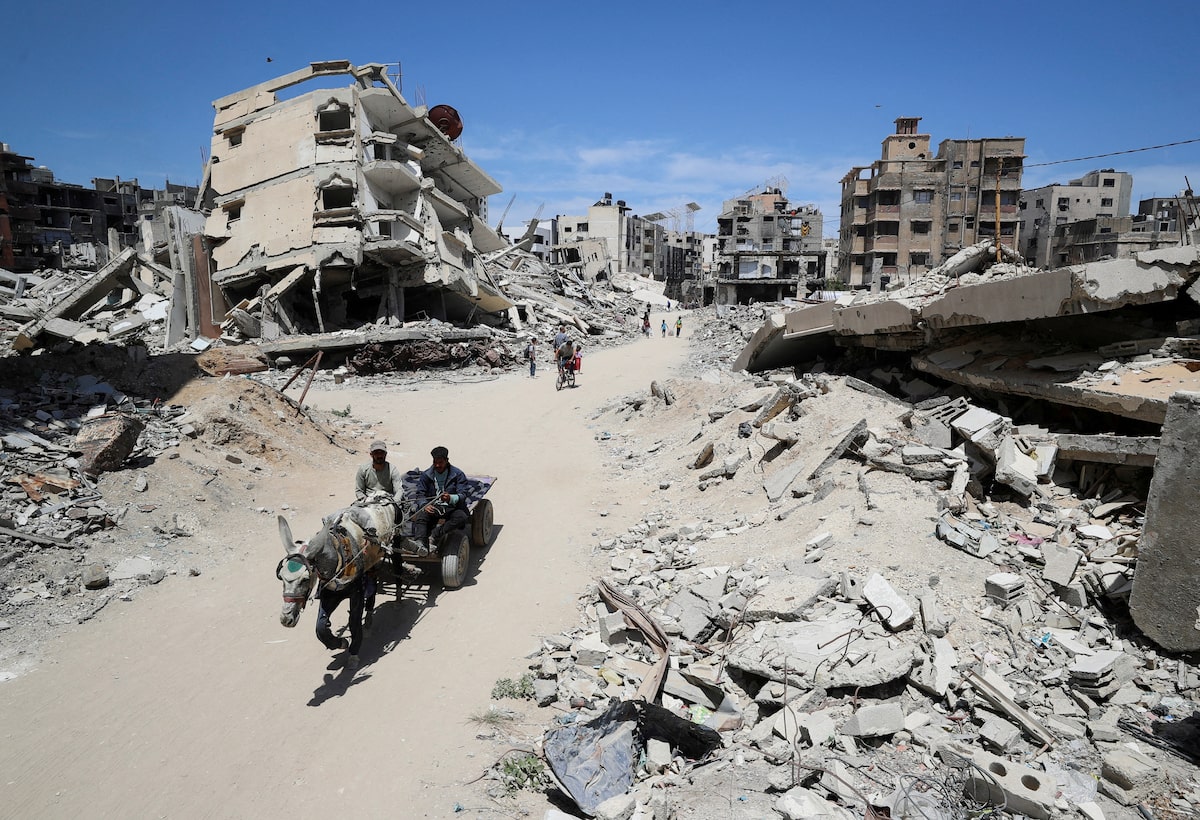
The Israeli-Palestinian conflict remains the political and human core of the region’s instability. After the Hamas attack of 7 October 2023 and the Israeli offensive that followed, Gaza experienced massive destruction, large-scale displacement and a prolonged humanitarian crisis. Successive rounds of negotiation and ceasefires have altered the intensity of fighting without resolving the political causes of the conflict.
Around Gaza, a broader regional military system has gradually taken shape, linking Israel, Hezbollah, Iran, the Houthis in Yemen, several Iraqi armed groups and the United States.
Lebanon remains exposed even when the intensity of fighting falls. Yemen, whose civil war had partly stabilised after the 2022 truce, regained strategic importance because of Houthi attacks in the Red Sea and the wider regional confrontation.
Syria presents another paradox. Even when a regime changes, a front line disappears or a civil war changes form, peace does not necessarily return. Institutions remain fragile, armed groups survive and foreign influence persists.
In the Middle East, it is therefore becoming increasingly difficult to view each conflict separately. An attack launched from Yemen can affect global shipping. An operation in Lebanon can alter Iran’s strategic calculations. A decision taken in Gaza can have consequences in Iraq or the Red Sea.
SUDAN: THE FRAGMENTATION OF A STATE
Few conflicts illustrate the new geography of war as brutally as Sudan.
Since April 2023, the Sudanese Armed Forces and the Rapid Support Forces have fought for control of the country. The conflict has destroyed infrastructure, caused mass displacement and fragmented political authority.
But Sudan is no longer simply a civil war.
Foreign support, supply routes, Gulf interests, proximity to the Red Sea and interactions with Chad, Egypt, Libya, Ethiopia and South Sudan give the conflict a regional dimension.
As the war continues, it is also creating its own economies, logistics networks and power structures.
THE SAHEL: WAR WITHOUT A FRONT
From Mali to Burkina Faso and Niger, the problem is different.
There is no single continuous front line. National armies are fighting groups linked in particular to Al-Qaeda and Islamic State across enormous territories where administrative control is often intermittent.
Political change in several Sahelian states has also transformed external alliances. Western military partnerships have receded while Russia has expanded its security role.
But changing partners has not eliminated the insurgencies.
The Sahel therefore shows that a conflict can persist independently of the diplomatic architecture surrounding it. Governments change, foreign armies leave or arrive, alliances shift, yet local violence retains its own momentum.
Further east, Somalia remains locked in a long war against Al-Shabaab. South Sudan remains fragile despite agreements intended to stabilise the country.
CONGO: DIPLOMACY AND WAR AT THE SAME TIME
In eastern Democratic Republic of Congo, the conflict involving Congolese forces, the M23 and numerous other armed groups remains one of Africa’s principal centres of violence.
The particularity of the Congolese conflict lies in the permanent coexistence of warfare and diplomacy.
Agreements, negotiations, ceasefires and military operations can now unfold simultaneously for months or years.
This is one of the defining characteristics of contemporary conflict: diplomacy no longer necessarily means the end of war. Sometimes it simply becomes another dimension of it.
WESTERN SAHARA: THE ALMOST INVISIBLE WAR
Western Sahara belongs to another category.
For nearly three decades, the 1991 ceasefire between Morocco and the Polisario Front had turned the conflict into a territorial dispute that was largely contained militarily.
That architecture broke down in November 2020.
Since then, hostilities have remained low-intensity compared with the major wars of the present era. There is no permanent large-scale battle and no mobilisation comparable to what can be seen in Ukraine, Sudan or Gaza.
But the conflict is no longer completely frozen.
MINURSO remains deployed on the ground. The United Nations continues to seek a political solution to the dispute and to monitor incidents around the military arrangement separating Moroccan positions from those of the Polisario Front.
Above all, the conflict has a deep regional dimension.
Morocco controls and administers most of the territory and supports an autonomy plan under Moroccan sovereignty. The Polisario Front seeks independence and benefits from political and material support from Algeria. The United Nations continues to seek a durable and mutually acceptable political solution within the process it oversees.
The dispute directly shapes the strategic balance of the Maghreb.
Diplomatic relations between Morocco and Algeria remain severed. The land border remains closed. Both states have strengthened their military capabilities and developed distinct international partnerships.
Diplomatic shifts around recognition of, or support for, Morocco’s autonomy proposal have also increased the geopolitical significance of the issue.
Western Sahara is therefore not one of the world’s deadliest conflicts.
But that is precisely why it illustrates an important transformation: some conflicts can remain militarily limited for decades while continuing to shape alliances, defence spending and the diplomacy of entire regions.
ASIA: THE WARS WE SEE AND THE WARS THAT WAIT
Myanmar remains one of Asia’s main active conflicts.
Since the 2021 coup, the military has fought both forces linked to the National Unity Government and numerous ethnic armed organisations. The country is deeply fragmented and large areas remain beyond the direct control of the central authorities.
Further west, relations between Afghanistan and Pakistan remain tense over armed groups operating on both sides of the border.
In South Asia, the rivalry between India and Pakistan remains one of the world’s most dangerous interstate conflicts because both possess nuclear weapons and crises around Kashmir recur periodically.
Other confrontations are not yet open wars but carry much greater systemic potential.
Taiwan, the South China Sea and the Korean Peninsula concentrate enormous military capabilities.
A confrontation in any of these areas would immediately involve several major powers and disrupt supply chains essential to the global economy.
The distinction between war and peace is therefore itself becoming increasingly blurred.
THE AMERICAS: WHEN VIOLENCE REPLACES WAR
The Americas experience fewer conventional wars.
That does not mean they are outside this broader phenomenon.
Haiti has gradually entered a form of territorial fragmentation in which armed groups control substantial parts of the urban environment and directly challenge state authority.
In Mexico, violence involving criminal organisations reaches levels and takes organisational forms in some regions that can resemble armed conflict, even though the legal and political classification is different.
This is one of the major mutations of the era.
The monopoly of violence is no longer challenged only by revolutionary or separatist movements.
It can also be challenged by militias, criminal networks, jihadist organisations, paramilitary groups or illegal economic structures with their own territories, military capabilities and logistical chains.
THE HUMAN COST
Behind this military map lies another measure of war.
More than one hundred million people remain forcibly displaced worldwide because of conflict, persecution and violence.
Tens of millions live in states where war is no longer a temporary crisis but a structural condition.
At the same time, the international system’s ability to absorb these crises is weakening.
Humanitarian agencies must respond simultaneously in Sudan, Gaza, Ukraine, Congo, the Sahel, Myanmar, Syria, Afghanistan and elsewhere.
Available funding is not increasing at the same pace as needs.
This may be where the most important change lies.
The world is not only running short of peace.
It is beginning to run short of institutions capable of managing the absence of peace over the long term.
THE EROSION OF THE FIRE EXTINGUISHERS
For several decades, much of the international order rested on the idea that wars could gradually be contained.
Sanctions, peacekeeping operations, mediation, humanitarian aid, reconstruction, financial institutions and international guarantees formed a kind of system of containment.
That system still exists.
But it is now operating across too many fronts at once.
And, more importantly, the major powers that once formed its principal pillars are themselves increasingly engaged in strategic confrontation.
The United States is reordering its priorities.
Russia is directly involved in a major war.
China is developing a parallel diplomatic and economic architecture without systematically seeking to reproduce the functions once performed by Western powers.
Gulf states, Turkey and other middle powers are becoming more active in mediation, financing, infrastructure and, at times, the conflicts themselves.
The result is not the collapse of the international order.
It is its fragmentation.
WAR AS A NORMAL CONDITION
Ukraine.
Gaza.
Sudan.
Myanmar.
Congo.
Sahel.
Somalia.
Yemen.
Syria.
Western Sahara.
These conflicts do not have the same origins, the same actors or the same levels of violence.
Placing them on the same map does not make them equivalent.
But their coexistence reveals something.
The post-Cold War era encouraged the belief that territorial conflicts could be frozen, civil wars negotiated, borders stabilised and rivalries between major powers contained through economic interdependence.
None of those mechanisms has disappeared entirely.
None now functions with the same certainty.
Some wars still end.
Some ceasefires hold.
Some mediation succeeds.
But elsewhere, conflicts last long enough to become institutions in their own right.
They create their own economies, supply networks, armed groups, informal borders, rents and international alliances.
The danger may therefore not be the sudden emergence of a third world war.
It is quieter than that.
It is the prospect of a world gradually becoming accustomed to living with dozens of wars at the same time.
MAIN SOURCES
- United Nations — peacekeeping operations and reports on ongoing conflicts.
- MINURSO — United Nations Mission for the Referendum in Western Sahara.
- UNHCR — Global Trends and forced displacement data.
- Uppsala Conflict Data Program — data on armed conflict and organised violence.
- Council on Foreign Relations — Global Conflict Tracker.
- International Crisis Group — regional conflict analysis and mediation processes.
Atlas Limits Research Desk
Atlas Limits’ editorial and analytical desk.