For decades, the Gulf’s oil vulnerability seemed reducible to a single point on the map: the Strait of Hormuz. Its narrow waters, the concentration of exports passing through them and their immediate proximity to Iran had made the strait one of the main systemic risks to the global economy. Saudi Arabia had built part of its energy strategy precisely to escape this geography. Across the desert, its East-West Pipeline carries crude from the fields of the Eastern Province to Yanbu on the Red Sea, bypassing Hormuz altogether. 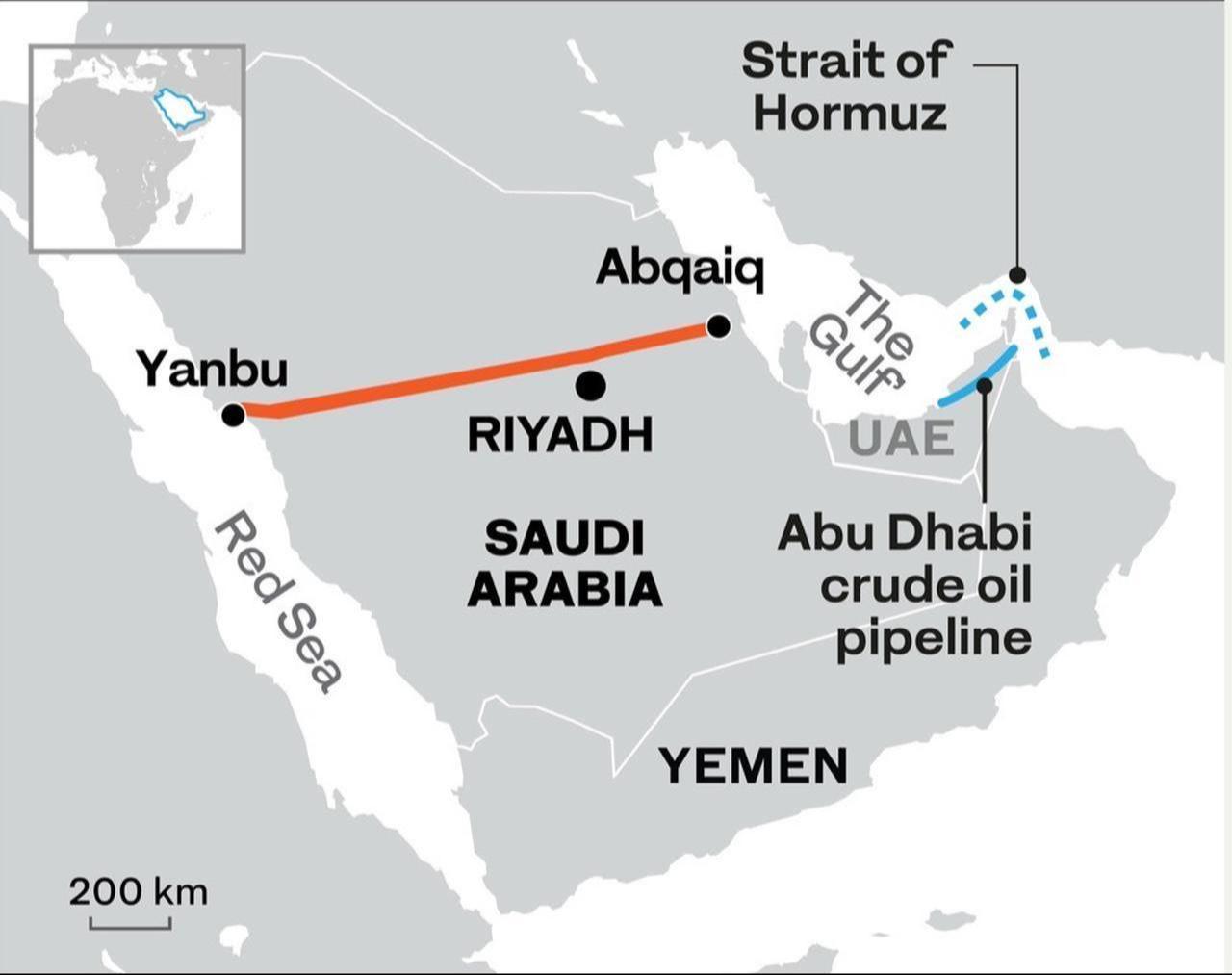 On September 24, 2026, that geographical insurance changed in nature. Emmanuel Macron announced that France would send troops, radars and defense systems to Saudi Arabia to help protect Yanbu. The French president described the mission as strictly defensive: according to Paris, the objective is not to draw France into the regional conflict, but to protect the site. The agreement with Riyadh was finalized as the Red Sea port becomes one of the most sensitive points in the Saudi energy system.
The timing gives the decision particular significance. On the same day, the Saudi-led coalition said it had intercepted six ballistic missiles fired by Yemen’s Houthis toward Taif and the Yanbu area. The Houthis subsequently claimed missile and drone attacks against Saudi Aramco facilities in Yanbu as well as what they described as a sensitive target in Riyadh. Saudi authorities did not confirm the claimed impacts on either site.
The sequence is almost a strategic demonstration. Yanbu was supposed to allow Saudi Arabia to circumvent a threat in the east. The threat is now moving west.
Saudi Arabia’s Insurance Policy
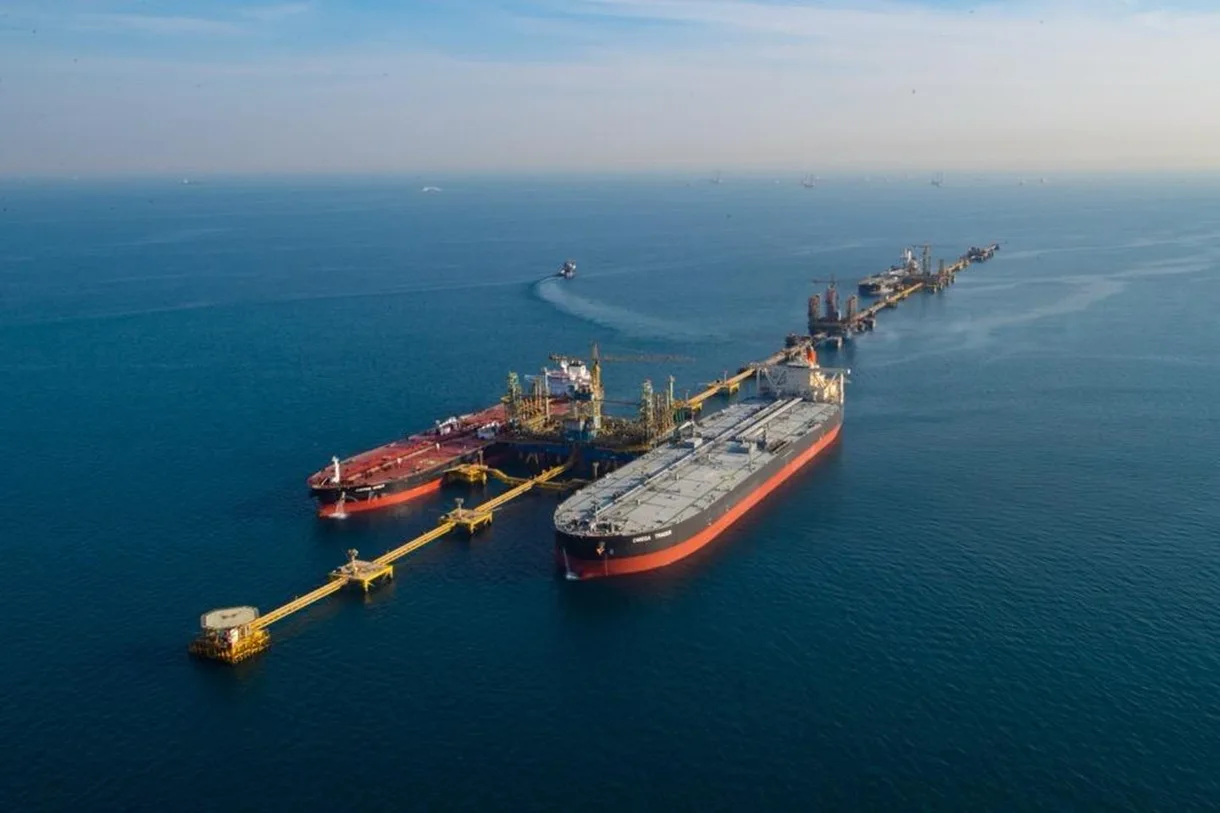
Yanbu’s importance does not derive solely from its port and industrial facilities. The city is the western terminus of the East-West Pipeline, also known as Petroline, one of the most important pieces of infrastructure in the geography of global oil.
The pipeline crosses Saudi Arabia from east to west, connecting producing areas near the Gulf with facilities on the Red Sea. Its nominal capacity is around seven million barrels per day. Under current conditions, close to four million barrels a day can be redirected toward Yanbu. At the scale of the global market, this is more than a logistical alternative: it is one of the main physical capacities available to sustain part of Gulf oil exports when traffic through Hormuz becomes difficult.
The September crisis has exposed both its usefulness and its vulnerability.
A drone attack damaged three pumping stations along the pipeline, forcing its shutdown and disrupting loadings from Yanbu. Saudi Aramco had to reduce some deliveries to Europe while the kingdom simultaneously increased exports from the Gulf. The paradox was striking: precisely when Saudi Arabia most needed the route designed to bypass Hormuz, it was forced to increase its reliance once again on the route it was trying to avoid.
The East-West Pipeline resumed operations on September 22, but at reduced capacity. According to information gathered by Reuters, restoring full capacity could take six to eight weeks. The immediate market reaction demonstrated the corridor’s importance: news of the restart helped push Brent crude down by more than two dollars that day.
Two days later, missiles were once again heading toward the Yanbu region.
When the Bypass Becomes a Target
This is where the strategic logic changes.
Most major energy infrastructures are designed around a simple principle: never depend on a single route. Alternative pipelines, multiple terminals, storage capacity, secondary ports and diversified shipping lanes are supposed to keep the system functioning when one component is disrupted.
But that logic assumes that alternative routes are exposed to different risks.
Hormuz and Yanbu embodied precisely that principle. A crisis in the Gulf could be circumvented overland toward the Red Sea. Redundancy did not eliminate risk, but it geographically separated its points of concentration.
The multiplication of regional fronts is now undermining that separation.
To the east, the Strait of Hormuz remains exposed to the consequences of the conflict involving Iran. To the west, the Houthis possess capabilities that allow them to threaten targets deep inside Saudi territory and infrastructure along the Red Sea. Between the two lies the pipeline itself, whose pumping stations constitute fixed points that are difficult to conceal and impossible to relocate.
The backup corridor is therefore becoming a system that must be defended along its entire length.
It is no longer enough for a tanker to be able to load at Yanbu. Oil must leave the eastern fields, cross the kingdom, pass through each pumping station, reach storage and refining facilities, be loaded at the terminal and then sail through a Red Sea that is itself exposed to regional tensions.
Energy redundancy becomes a chain. And a chain remains vulnerable to its weakest link.
France Enters the Geography of Saudi Oil
It is against this backdrop that the French deployment assumes its full significance.
Paris and Riyadh have maintained military cooperation for decades. But directly protecting Yanbu means something different from selling equipment, training forces or maintaining a naval presence in regional waters. French military personnel will now be associated with the defense of territory hosting infrastructure essential to Saudi Arabia’s ability to export oil.
The distinction drawn by Emmanuel Macron remains important. France says it is not entering the conflict and presents its intervention as a protective mission. That position can be legally and politically coherent while still creating a more complicated operational reality.
A radar deployed to protect Yanbu must detect a threat. A defense system must be able to track it. And if the rules of engagement allow it, an interceptor must be able to destroy it.
The boundary between protecting infrastructure and participating in a confrontation therefore becomes extremely narrow when that infrastructure is itself designated as a target by one of the belligerents.
Much will depend on parameters that remain undisclosed: the number of personnel deployed, the systems involved, their precise location, the command structure, coordination with Saudi and allied defenses, rules of engagement and the duration of the mission.
But the political decision already establishes a precedent: a European power now considers the security of a Saudi oil terminal on the Red Sea important enough to commit military assets directly to its defense.
From Freedom of Navigation to Infrastructure Protection
For decades, Western responses to threats against Middle Eastern energy flows have largely revolved around maritime security. Escorting vessels, monitoring straits, deploying warships and keeping major trade routes open allowed the problem to be addressed where commodities entered international waters.
Yanbu moves that logic inland.
If oil must be protected before it even reaches the sea, securing energy flows no longer begins in the strait. It begins at pumping stations, terminals, refineries and the infrastructure that makes bypassing the strait possible.
This shift could extend beyond the French case. The more essential alternative energy routes become, the more their defense acquires a collective dimension for consuming states. The security of a Saudi pipeline can then indirectly become a matter of European economic security; the security of a Red Sea terminal, a variable in the global price of oil; the security of a pumping station in the middle of the desert, an element of macroeconomic stability thousands of kilometers away.
The market reaction to the events of September already illustrates this connection. When the East-West Pipeline was disrupted, the prospect of losing capacity equivalent to several percentage points of global oil supply immediately affected expectations. When its restart was announced, prices fell. Following the new Houthi attacks on September 24, Brent instead rose 3.4% to $106.60 a barrel.
Military geography and price geography are moving closer together.
Two Straits and a Desert
Saudi Arabia built Yanbu as an answer to a geographical vulnerability. It is now discovering that an alternative route is not necessarily a safe one.
That may be the central lesson of the current sequence.
Energy security no longer depends only on diversifying routes, but on the ability to defend all of them simultaneously. That requirement becomes considerably more expensive when the threat is no longer concentrated around a single strait but distributed across thousands of kilometers.
To the east lies Hormuz. To the west, the Red Sea and Bab el-Mandeb. Between them are pipelines, pumping stations, refineries, storage facilities and terminals whose strategic value increases as maritime routes become less secure.
France is therefore not merely coming to protect Yanbu. It is entering an energy-security system that is gradually expanding from the sea to infrastructure on land.
It would be premature to interpret this as the certain beginning of a permanent multinational military architecture. The precise format of the French deployment remains too unclear, and there is no evidence at this stage that other powers will follow Paris. But the logic driving the decision is already visible: when primary routes become vulnerable, backup routes become strategic; when they become strategic, they become targets; and when they become targets, their mere existence is no longer enough.
They must also be defended.
Yanbu was designed to bypass the geography of crisis. The crisis has now reached Yanbu.
Main Sources
Reuters — “France to send military to protect Saudi Arabia on Red Sea oil route, Macron says”, September 24, 2026.
Reuters — “Saudi Arabia says it intercepted Houthi missiles; group claims strikes on Riyadh, Aramco”, September 24, 2026.
Reuters — “Houthis say they attacked Riyadh and Aramco facilities in Yanbu”, September 24, 2026.
Reuters — “Saudi Arabia restarts East-West oil pipeline”, September 22, 2026.
Reuters — “Saudi pipeline outage threatens loss of 4% of global oil supply”, September 13, 2026.
Reuters — “Saudi cancels some oil cargoes after pipeline hit, top buyer chasing alternatives”, September 15, 2026.
Reuters — “Oil prices settle up about 3% as Houthi attack on Saudi Arabia lifts supply fears”, September 24, 2026.
Atlas Limits Research Desk
Atlas Limits’ editorial and analytical desk.